
A wireless vibration monitoring point typically costs $200–$800 for the industrial sensor alone, making a practical per-machine budget about $300–$1,200 after shared infrastructure and installation are allocated [S5].
The figure depends on whether a machine receives one triaxial point or several measurements, whether data is hosted or retained on-site, and how much mounting, networking and engineering labor the plant must absorb.
Per-Machine Cost Range and Core Assumptions
The $200–$800 sensor figure applies to modern industrial wireless accelerometers, while wired measurement points can cost $1,000–$5,000 before the full monitoring platform is included [S5]. Wireless vibration sensors cost $200–$800 per point, while wired installation costs $1,000–$5,000 per measurement point [S5].
This range is a planning estimate, not a supplier quote. It assumes one wireless sensor point per machine and shared network infrastructure. Motors, pumps, fans, gearboxes, compressors and conveyors may need additional points where one location cannot represent the complete machine, or where separate drive and non-drive ends are required [S1].
What Drives the Price
The largest hardware cost is the sensor and its mounting arrangement, with industrial wireless accelerometers listed at $200–$800 per point [S5].
Connectivity creates a second cost layer. A gateway may serve several machines rather than one, but it must have adequate radio range, usable throughput and a secure route into the plant network.
Software and data services form the third layer. Higher-capacity examples listed include PCB's Echo Wireless for $6,690, enDAQ's W-Series Sensors for more than $3,400, and Erbessd 3X Wireless for $3,700 [S4].
Wireless and Wired Cost Comparison
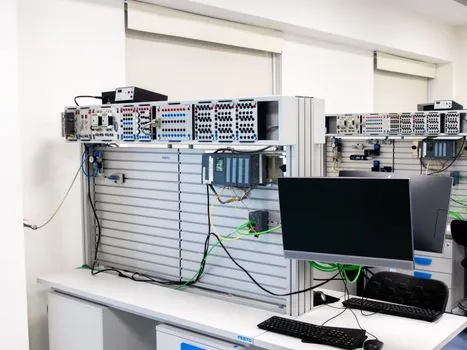
Wireless usually wins on deployment economics because it removes much of the conduit, junction-box and permanent-cabling work. Installation of wired monitoring can run up to 3 times the cost of wireless, which helps explain why plants often reserve wired systems for their most critical assets [S2].
Wireless sensors can meet the requirements of about 40% to 50% of typical industrial monitoring points, but they do not yet match the full performance envelope of permanently mounted wired IEPE systems [S3]. That limitation supports a hybrid architecture instead of an all-or-nothing purchase.
Choosing the Right Depth Per Machine
One triaxial sensor can capture vibration in three axes, while the AMS Wireless Vibration Monitor also records temperature, speed and PeakVue measurements through an AI-enabled WirelessHART network [S1].
A critical machine may require more than one point, additional modalities or higher-frequency diagnostics. Emerson's AMS Wireless Vibration Monitor captures triax vibration, temperature, speed, and PeakVue measurements [S1]. A condition monitoring system should be bought for its diagnostic depth and integration, not merely for the lowest sensor price.
Handheld collection remains useful for periodic surveys and low-criticality assets because it avoids a permanent point on every machine. Wireless sensors can cover that gap where continuous trending justifies the added hardware.
Installation, Maintenance and Operating Cost

Sensor purchase price is only one part of the cost model. The AMS Wireless Vibration Monitor supports an OpEx-friendly deployment model that lowers upfront costs and allows plants to pay only for the insights they consume [S1].
Battery life affects maintenance cost.
The AMS Wireless Vibration Monitor can extend condition-monitoring coverage to hazardous-area and balance-of-plant machines [S1].
Ownership Models and Cost Risk
There are three practical ownership structures. A self-hosted wireless program places sensor, gateway, router, software and cybersecurity costs on the plant. A cloud-managed program shifts more infrastructure and cybersecurity effort to the provider, while retaining recurring service charges [S1]. A rental program can be justified for temporary or low-volume coverage, since Echo Wireless systems are available for rental and eliminate recurring walk-around checks [S6].
The platform price can exceed the sensor price by a wide margin. Published examples run from $950 plus $60 per year, $3,700, $6,690 and above $3,400, while gateway-based service tiers can reach $100 per month [S4]. Per-machine cost must therefore allocate platform fees by the number of assets served, not attribute the entire subscription to one machine.
Before approval, request a bill of materials that separates sensor, mounting, gateway, router, enclosure, software, cloud service, cellular plan, installation, configuration and maintenance. This avoids a misleading comparison between a $200 sensor and a system whose shared software and network costs are omitted.
Recommended Budget and Approval Check

Use $300–$1,200 per machine as the initial planning range for one wireless sensor point, shared gateways and standard software deployment [S5]. Add $1,000–$5,000 per point for critical wired coverage where continuous high-frequency data and direct integration justify it, and add separate line items for hazardous-area certification, washdown protection, high-speed dynamic range and temporary rental [S5].
The key approval signal is coverage per monitored asset, not the lowest sensor bid. Verify that each machine has a representative measurement point, required fault frequencies are within the sensor's capability, gateway coverage has been tested, and the vibration sensor data reaches the maintenance workflow with useful alarms rather than unprocessed waveforms [S5].
Track two numbers during rollout: installed cost per protected machine and data utilization per gateway. A program that reaches balance-of-plant assets, removes routine walk-arounds and produces actionable alarms has a defensible business case; a program with low point coverage or unused waveform data does not.