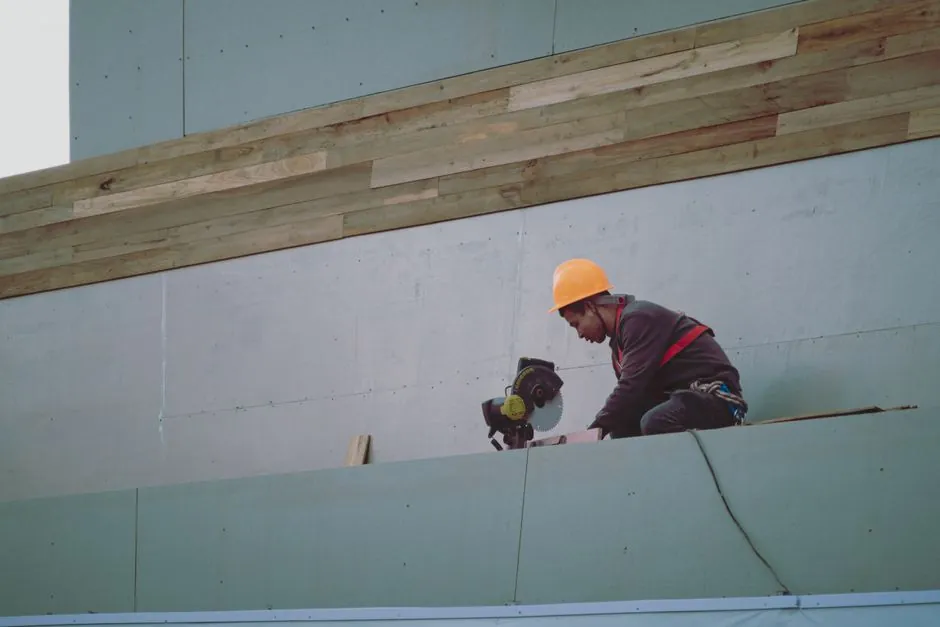
An XPS tile backer board is a three-layer composite panel: an extruded polystyrene foam core, a fiberglass mesh interlayer on both faces, and a polymer-modified cementitious mortar coating that gives the panel a tile-ready skin [S1][S2][S3].
Typical stock thicknesses span 6 to 50 mm, panel sizes run 600 x 1200 mm or 600 x 2400 mm, and the foam core is a closed-cell structure that absorbs under 1% water by volume, which is the property that lets the panel replace a separate waterproofing membrane in many shower assemblies [S1][S3].
Where it fits, and where it does not
XPS-coated backer board is specified for shower walls, wet rooms, kitchen splashbacks, sauna partitions, and as a tile underlayment over underfloor heating loops, because the closed-cell foam adds R-value to the wall or floor assembly while staying dimensionally stable below 70 °C [S1][S2][S3]. It is not a structural sheathing: it cannot replace plywood or OSB subfloor on joist spans, and it should not be used as an exterior cladding behind open-joint rainscreens where the polymer mortar skin sees prolonged UV and wet/freeze cycling [S1].
Compression strength of the foam core is the dimensioning limit, not the surface coating: 1 inch (25 mm) of commodity XPS rates around 20 psi, which is more than enough for a slab-supported tile floor but marginal for a 12 x 12 inch porcelain tile on a joist-only subfloor unless the framing is stiff [S5]. The polymer mortar skin itself adds negligible compressive load capacity; it is there to give the thin-set a toothy, water-stable substrate [S1][S2].
Coating composition and what it actually does
The "polymer mortar" or "cementitious" coating is a 1 to 3 mm layer of Portland cement blended with polymer latex (typically redispersible EVA or acrylic powder) and a fine sand aggregate, sprayed or trowelled onto the fiberglass-reinforced XPS face and cured before shipment [S1][S2][S3]. The polymer phase rewrites the failure mode: pure cement skin on XPS would delaminate because the foam absorbs very little water and gives the cement nothing to grip, so the latex and the embedded mesh do the mechanical anchoring [S2].
Fire behaviour is a known trade-off. Extruded polystyrene foam is an organic, combustible plastic, so a flame spread rating of Class A on a coated backer board has to come from the coating, the fiberglass mesh, and any fire-retardant additive in the foam formulation, not from the core itself [S1]. Local code on foam-plastic insulation (for example NFPA 285 in multi-family assemblies or the IRC 316 thermal barrier rule) still applies; a thermal barrier such as drywall may be required behind the board in occupied walls even when the coating is rated [S1][S3].
Installation sequence that holds up on site
Studs at 16 in or 24 in on center with blocking at panel edges, panels butted with a 1/8 in gap for thermal expansion, and corrosion-resistant screws set every 6 to 8 in along edges and 12 in in the field of the panel, with heads driven flush, not countersunk [S3]. Walls go straight to studs; floors go over a bed of polymer-modified thin-set with the screws or washers as secondary fixings, not as the only attachment [S3].
All seams, corners, screw heads, and pipe penetrations get sealed with alkali-resistant fiberglass mesh tape bedded into the same polymer-modified thin-set used for tiling; silicone alone is not enough on the screw heads because it does not transfer load [S3]. The 1/8 in panel gap is not a typo: it lets the foam expand during a hot shower and during the first underfloor heating ramp without buckling the joint, and it is wider than the gap a cement board installer is used to leaving [S3].
Ambient conditions matter more than with cement board. Install above 10 °C (50 °F) so the polymer latex in the thin-set can film-form, and bring the panels themselves to room temperature before fixing so the foam does not shrink after the joints are taped [S3].
Comparison against cement board and foam-only boards
On four procurement-relevant criteria, the differences are concrete. A 12 mm coated XPS panel at 600 x 1200 mm weighs roughly 2.5 to 3.5 kg versus 9 to 11 kg for a 12 mm cement board of the same size, which is the headline number for a solo installer on a renovation job [S2][S6]. Water absorption for the closed-cell XPS core is under 1% by volume, against several percent for cement board, so XPS does not need a separate waterproofing membrane on the panel face, only at the joints and penetrations [S1][S2][S3][S4].
Cutting is a utility knife score-and-snap on the coated XPS panel, against a diamond or carbide blade and dust collection on cement board, which on an interior renovation is the difference between a clean site and a respirator job [S2][S3]. Thermal contribution is where the coated XPS panel earns its premium: a 20 mm board adds roughly R-0.9 to the wall or floor, against essentially R-0 for cement board, so underfloor heating warm-up time drops and the tile surface feels warmer in a bathroom [S1][S5].
The honest trade-offs: coated XPS backer costs more per square metre than cement board, is harder to find in rural building supply, and still needs a thermal barrier on occupied walls per local foam-plastic code, which is where a 1/4 in cement board layer on top of the foam is sometimes specified as a fire-rated compromise [S1][S3]. Foam-only boards without the polymer mortar skin are cheaper but they bond poorly to standard thin-set, which is exactly the problem the cement mortar coating is designed to solve [S2][S3].
Failure modes and what the spec must check

Most XPS-tile failures are not in the middle of the panel. They originate at the joint, at an unsealed screw, behind a pipe escutcheon, or at a cold joint where the thin-set skinned over before the tile was bedded [S2][S3]. The polymer mortar coating will telegraph through the tile if a high-gloss large-format tile is bedded in a soft, unmodified thin-set; this is why manufacturer guidance and tile adhesive selection both call for a polymer-modified thin-set (C2 per EN 12004, or an S1/S2 in the UK classification used by Pro Tiler Tools) on this substrate [S3][S4].
Compressive creep of the foam at sustained point load (a heavy claw-foot tub on small feet, for example) is the second failure path. The 20 to 40 psi compressive strength of the foam looks generous until it is multiplied by 50 years of static load, so a bathtub should sit on a plywood or sleepers plate that bypasses the foam rather than on the foam itself [S5]. For a primer-free tile installation the board must arrive with a fully cured, dust-free polymer mortar skin; field priming is generally not needed and is sometimes counter-productive because the primer can sit on the polymer film and starve the thin-set [S4].
The moisture profile of the substrate also governs which waterproof coating is used at the joints, since tape-and-thin-set waterproofing and liquid-applied waterproofing membranes behave differently over a polymer mortar face than over a cement board face, and only some manufacturers warrant their dry-mortar thin-set directly on the coating without a primer.
Related product categories and where to look next
For the floor build-up over the underfloor heating loop, the wet-room assembly usually pairs a coated XPS backer with a ceramic tile finish, and the XPS board choice governs both the R-value and the point-load behaviour of the whole floor. [S3]
For quality control on a delivered batch, a coating thickness gauge on the polymer mortar skin is a quick check that the factory applied a uniform 1 to 3 mm coat, which is the single biggest predictor of thin-set adhesion. For an industrial wall behind tiles in a commercial kitchen, an industrial coating over the cured board adds chemical resistance that the polymer mortar skin alone does not provide.
Track two signals going forward: the published thermal conductivity (lambda value, typically 0.030 to 0.035 W/m·K for commodity XPS) and the closed-cell water absorption figure on the manufacturer's data sheet, both of which are the two numbers that quietly govern whether a coated backer board will pass a 25-year wet-room warranty. For a broader building-materials view, the procurement pattern visible across 2024 to 2026 is the same one seen in the extrusion line demand pipeline for 2026: coated foam panels are eating share from cement board wherever the buyer weighs labour and water risk above unit price.