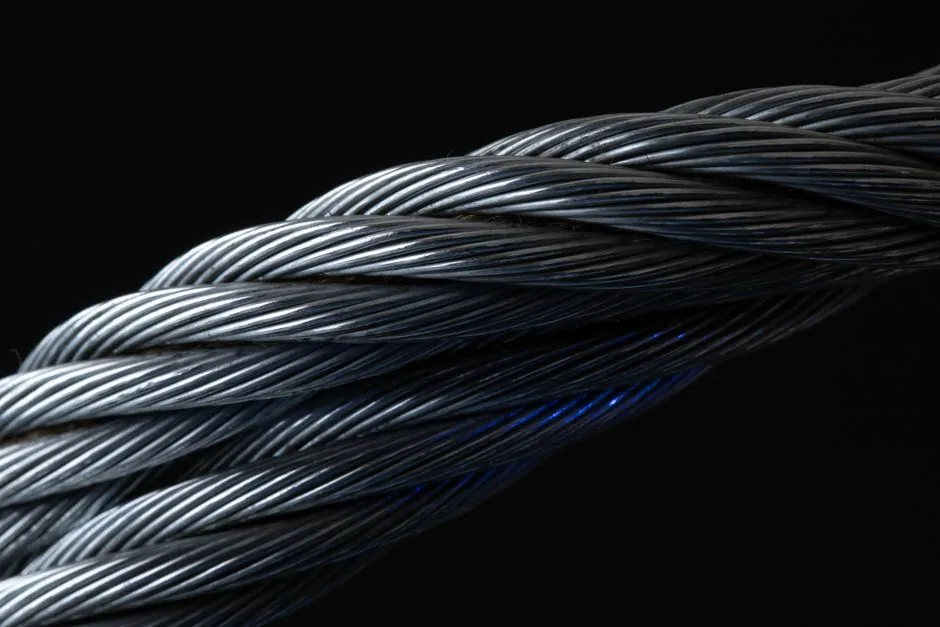
Compacted 7-wire strand pushes the metallic fill factor from the normal 0.70 to 0.82 range up by deforming the outer wires into the interstices, gaining roughly 6 to 10 percent more metallic area at the same nominal diameter [S5]. That extra steel, locked in by rolling or drawing after stranding, is the entire reason the product exists.
Standard 7-wire prestressed concrete strand, covered by ASTM A416, uses one center wire helically wrapped by six outer wires with no post-strand deformation [S2]. Compacted strand is the same construction plus a plastic deformation step that reshapes the cross-section, and that single step changes the engineering case for using it.
What Compaction Actually Does to the Cross-Section
A conventional round strand leaves triangular gaps between the six outer wires and the center wire; those gaps are air, not steel, and they waste diameter budget [S5]. During compaction the originally round outer wires are squeezed into flattened, interlocking shapes, the interstices collapse, and the strand diameter shrinks for the same amount of steel, or equivalently, the steel area grows for the same nominal diameter [S5][S6].
For prestressed concrete applications, this geometric change is not cosmetic: compacted PC strand carries slightly higher breaking load per nominal millimeter and bonds more aggressively to the surrounding concrete, which shortens the development length the designer has to detail at each anchorage [S3]. The trade-off the supplier calls out plainly is unit cost, since compacting is an extra pass through rolling or drawing tooling after stranding [S3].
Where Compacted Strand Earns Its Premium
Three job conditions make the higher cost disappear. The first is short anchorage zones: when the concrete section cannot physically provide the full development length required for a standard ASTM A416 strand, a higher-bond compacted product lets the designer hit the same force transfer in a shorter embedment [S3]. The second is diameter-constrained ducts: where the post-tensioning duct or sheath is fixed in size, a compacted strand packs more tensile capacity into the same bore [S5].
The third is wear and crushing resistance in wire-rope service. Compacted strand rope, used in heavy-lift cranes, mine hoists, and large-diameter crane ropes, shows better resistance to drum crushing and external abrasion because the larger metallic cross-section leaves less void for debris ingress and the deformed wires lock together rather than moving independently [S1][S6]. Where the cable path is straight or nearly so, strand is already the right pick over wire rope, and within strand, compaction stacks further benefit on top [S1].
Where Compaction Is the Wrong Choice
Compact a strand and you trade away bending fatigue life. The same plastic deformation that locks the wires together also work-hardens them and introduces residual stresses at the contact lines, so the rope fails sooner under cyclic bending over sheaves and drums than a standard round strand of equivalent diameter and tensile grade [S6]. For crane reeving, elevator suspension, and any application where the strand passes over small-diameter sheaves cycle after cycle, this is a hard limit, not a soft preference.
Standard 7-wire strand also remains the right answer for the bulk of pretensioned and post-tensioned concrete work, where ASTM A416 minimum breaking strength, 3.5 percent minimum elongation, and low-relaxation properties are well-understood by designers, testing labs, and inspection agencies [S2]. Pulling a compacted product into a job that was designed and detailed around standard strand properties introduces a non-standard material without a matching gain, since the higher bond and tighter development length only pay off in the specific conditions listed above. For background on how steel strand grades are typically selected, the basics of cold drawing and stress relief still apply identically to both products.
Spec and Manufacturing Reality
The wire going into either product is cold-drawn high-carbon steel wire rod, typically 0.7 to 0.85 percent carbon, drawn from about 5.5 mm rod through 12 to 15 die passes down to roughly 5.0 mm for standard 7-wire PC strand, then stress-relieved at 350 to 400 degrees Celsius to lock in low relaxation behavior [S3]. Compaction is a downstream operation that happens either in-line with the strander or in a separate rolling/drawing station, and the same wire chemistry and tensile grade is used either way [S5].
On the wire-rope side, the prestressing-strand reference is direct: a prestressing strand made by this route is dimensionally tighter, and the wire rod selection upstream decides whether the compacted product can actually deliver the higher breaking load or whether the supplier is just selling the same steel in a reshaped envelope. Suppliers such as Bekaert offer 7-wire compacted strand specifically as an option alongside the standard product, with the compacting pass being the only real process delta [S7].
Decision Comparison: Standard vs Compacted 7-Wire Strand
Standard 7-wire strand, ASTM A416 stress-relieved or low-relaxation, gives fill factor 0.70 to 0.82, baseline bond, baseline fatigue, and the lowest unit cost, fitting pretensioned beams, post-tensioned slabs, and general precast where anchorage length and duct size are not constrained [S2][S3][S5].
Compacted 7-wire strand raises fill factor above 0.82, increases breaking load per nominal millimeter, improves bond and shortens development length, and improves crushing and wear resistance in straight or gently curved rope service, but costs more per meter and drops bending fatigue life over sheaves [S3][S5][S6]. For cyclical bending on small sheaves, standard strand wins; for short anchorages, fixed-duct post-tensioning, and heavy-lift straight-line rope, compacted strand wins.
If the cable path is going to bend repeatedly over sheaves, drop the compaction step and stick with a flexible wire rope construction instead, since a multi-strand rope absorbs more deformation and resists sheave damage better than any single-strand product [S1]. The compaction decision only makes sense once the cable is essentially staying in a straight line, in a duct, or embedded in concrete.
Track two signals before specifying: confirm the compacted product's minimum breaking strength and relaxation class on the mill cert against ASTM A416 tables, since the compaction step is downstream of the wire and does not relax the steel, and ask the supplier for fatigue-cycle data on the exact nominal diameter and construction rather than relying on generic rope-life curves [S2][S6]. A steel strand product datasheet that lists both the compacted and standard options side by side is the cleanest way to compare on a like-for-like basis.
See also our earlier report, PP vs PET Strapping: Meters per Kilogram Yield Compared.