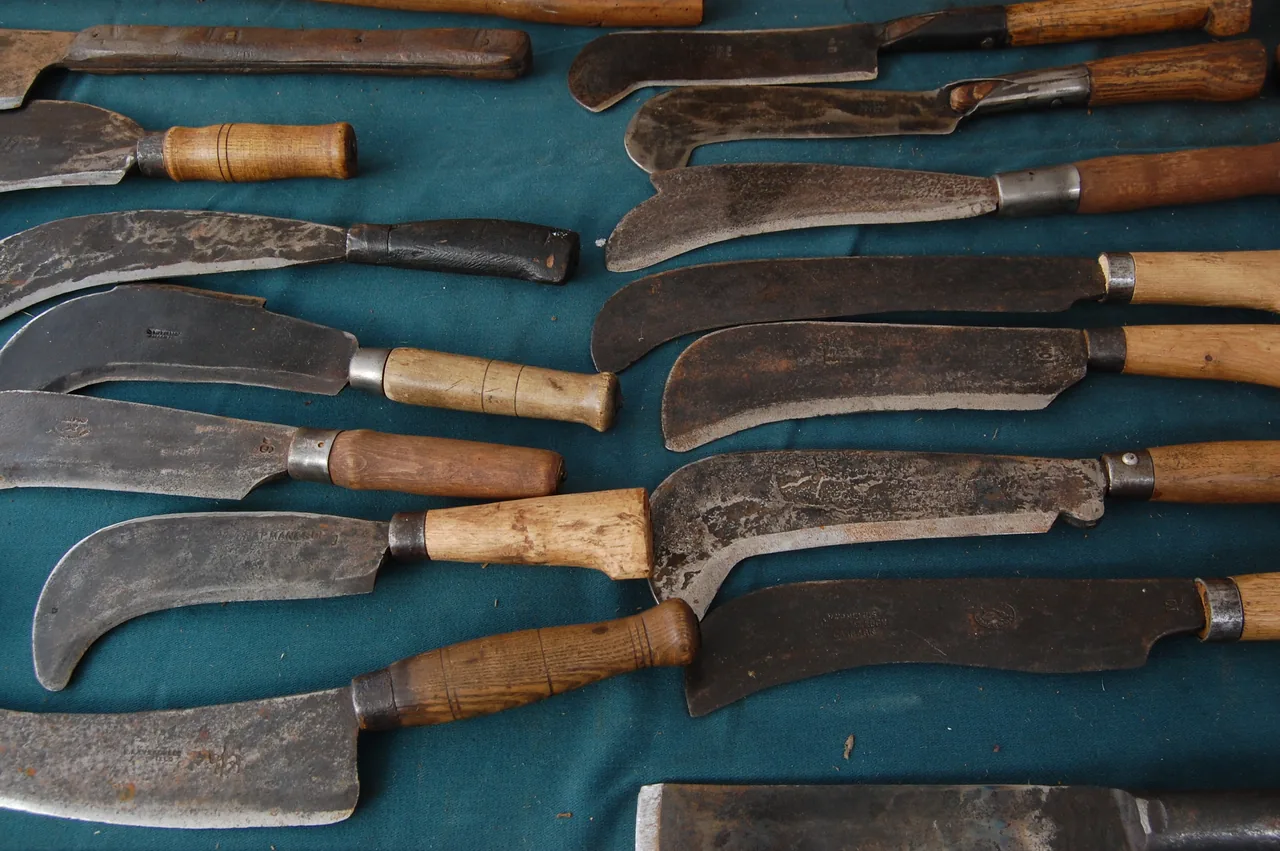
A billhook is a cutting hand tool with a short, heavy blade that curves along its sharpened edge and sits in line with a handle of wood or composite. It is swung by hand: a chopping stroke for stems that stand up to the blade and a pulling stroke for vines and growth that bend away from it. It severs brush, saplings, hedge shoots and woody weeds at or near ground level. European forms have a straight back, a hooked edge and a handle short enough for one hand, while the North American brush hook, or ditch bank blade, carries a longer and heavier blade on an axe style handle for two hands. Its use lies between that of a knife and that of an axe.
The purchase looks simple and is not. Two billhooks of the same length can differ in carbon content, hardness, blade thickness, the way the tang is fixed and the species of the handle wood, and each difference changes what the tool will cut, how long its edge lasts and how often the handle is replaced. A crew cutting green hedge shoots all day needs a different tool from a contractor clearing woody briars and saplings from a ditch bank, and both need a different one from a grower pruning vines. Blade pattern, steel, weight, handle length, the sheath and the supply of replacement handles are the points an order has to settle. The written standards for the tool are few and short, so the buyer's specification carries most of the weight in a bulk purchase.
A billhook purchase turns on five things. The blade pattern comes first, because a one-handed hedging hook and a two-handed bank blade are different tools for different growth. The steel and its heat treatment come next: they set whether the edge rolls, chips or holds. Mass and its distribution follow, since they set how much each stroke cuts and how tired the arm becomes. Then the handle and the way the blade is fixed to it, where a failure is dangerous because the blade comes loose mid-swing. Last come the fittings and the follow-up: sheaths, sharpening kit and replacement handles. Cutting dates decide when the tools are needed.
Chapter 1 / 06
What a Billhook Is and How It Works
A billhook is a hand tool for cutting woody material: shrubs, small trees and branches, hedge shoots and vines. Its blade is short and heavy, straight near the handle and curved with increasing sweep toward the nose, and the sharpened edge runs along the inside of the curve. It sits between the knife and the axe. A knife needs a thin stem, and an axe needs room for a full swing. The billhook works in the crowded space of a hedge bottom, where stems grow at every angle and the cut has to be close to the stump. It is used for hedging, for snedding side shoots off a branch, for pruning vines and for clearing brush from the base of a tree before felling.
The curve does two jobs at once. First, it shortens the length of edge that meets the wood at any instant, so the force of the stroke is concentrated on a small arc instead of being spread along a straight edge. Second, the hook wraps around a stem instead of pushing it away: on the pull stroke the stem is caught between the edge and the inside of the curve, and it stays there while the blade is drawn back. A straight blade tends to glance off a round, springy stem that is not held taut; the hook catches it. The hooked front also keeps the edge off the ground, which is why the billhook was the tool of choice for clearing brush close to the soil.
A billhook has four working parts: the blade, the edge, the tang or socket, and the handle. The blade carries the mass; its back is thick, and the nose, the forward end of the curve, can be thickened to place more mass where the cut lands. The edge runs along the inside of the curve and is generally sharpened on that side only. The tang is the shank that continues the blade through the handle; a socket is a tube on the handle that encloses the base of the blade. The handle is a short shaped grip, round or with a knob projecting on one side near the lower end, so that it does not slip out of the hand.
When the edge meets a green stem, three things happen in sequence. The bevel wedges fibers apart along a short arc; the curve converts part of the swing into a slice, because the contact point travels along the edge as the blade turns through the stroke; and the hook bends the stem over the edge so that it is cut in tension rather than pressed flat. Slicing lowers the force needed per unit of depth, which is why a pulling stroke takes a thin, flexible shoot that a straight chop would only bend. The blade does not need a razor edge for this: a small, smooth bevel that does not stall in the wood and a spine stiff enough that the blade does not spring are enough.
Every stroke is a small impact problem. The useful work is the force at the edge multiplied by the depth of the bite, and that force comes from the mass of the blade and the speed of the hand. A one-handed billhook typically weighs in the range of roughly 0.35 to 0.9 kg (0.8 to 2 lb). A blade with the mass concentrated toward the nose cuts deeper for a given swing, and a two-handed bank blade with a long handle can take growth that a one-handed hook would only score. Balance matters as much as total mass: a nose-heavy tool tires the wrist, and a handle-heavy one has to be swung harder. The practical limit of any pattern is stem diameter.
The duty that wears a billhook is not one cut but thousands of them. A hedger working along a laid hedge makes short, frequent strokes with the blade passing close to the ground, through soil and grit; a coppicer cutting stools makes fewer and heavier strokes at ankle height, where the blade meets the stool among leaf litter and stones. Soil contact, not wood, is what dulls an edge fastest, because mineral particles are harder than the tempered steel of the blade. The hooked front limits that contact but cannot remove it. The pattern of work therefore sets the compromise between hardness and ease of sharpening: a blade that is re-sharpened in the field several times a day should be soft enough to restore with a file.
Chapter 2 / 06
Billhook Types and Structural Variants
The basic European form is a single-edge billhook with a blade typically 20 to 25 cm (7.9 to 9.8 in) long, straight near the handle and sweeping into a strong curve toward the nose. It is fixed by a rat-tail tang to an ash handle 12 to 15 cm (4.7 to 5.9 in) long, a wood chosen for its strength and its tolerance of repeated impact; the handle is round or caulked, with a knob projecting on one side near the lower end so that it does not slip out of the hand. Blades fall into regional patterns that differ in curvature, in the mass carried at the nose and in the bevel: some are single-beveled and made in right- and left-handed versions, some are dished, concave on one side and convex on the other, and some carry a thickened nose.
Double-edge billhooks, also called broom hooks, add a straight secondary edge along the back of the blade. The curved front edge does the general cutting and the back edge is kept extremely sharp for delicate trimming, for topping off stakes, or used as an axe for occasional heavy clearing. The proportions of a bill-hook once specified in India can be read from the 1982 first revision of IS 3094, withdrawn in September 2024 when the second revision took its place: the single-edge type has an overall length of 275 mm (10.8 in) and a blade 135 mm (5.3 in) deep, the double-edge type 300 mm (11.8 in) and 160 mm (6.3 in), and the second edge of the double-edge type is 130 mm (5.1 in) long and 20 mm (0.8 in) wide. Both types take a handle 150 to 175 mm (5.9 to 6.9 in) long including the ferrule.
Regional patterns grew around local work. A Midlands-style hedging hook is a one-handed tool with a 15 cm (6 in) handle and a 25 cm (10 in) blade. The Yorkshire hook is two-handed, with a 36 cm (14 in) handle and a 25 cm (10 in) blade, sometimes with a handle up to 91 cm (36 in) long; its drawback is its weight. The Llandeilo and Carmarthenshire hooks have a 23 cm (9 in) handle, a 25 cm (10 in) blade and no back edge, but a small notch at the top called a hedge grip, which lets the hedger push pleachers and brash into place without using the hands. Because that handle is so long, the Yorkshire hook is fixed by a socket instead of a tang.
Longer handles turn the billhook into a two-handed tool. A slasher is a long-handled billhook. The North American brush hook takes the idea further, with a longer and heavier blade on an axe style handle, in two constructions. The bank blade or ditch bank blade is double-edged, 0.109 in (2.8 mm) thick, blanked from high carbon hot-rolled strip steel and bolted to its handle; it comes in 12, 14 and 16 in (30, 36 and 41 cm) blade lengths, and the 16 in (41 cm) size is intended for growth up to 2 in (51 mm) in diameter, the shorter sizes for lighter growth. The bush hook is drop forged, with a head about 0.25 in (6.4 mm) thick on an axe style handle, for tough vines, weeds, undergrowth and small saplings.
The billhook is best bounded against four neighbors. An axe sets a straight, wedge-shaped blade in line with its handle and chops end-on; it fells and splits, but it cannot cut close around a hedge bottom. An adze turns its blade at right angles to the handle and hollows. A machete is a long, broad, nearly straight blade swung like a sword; the billhook is its short, hooked counterpart for crowded growth. A sickle has a thin crescent blade that is drawn through grain or grass with one hand and is never struck. Among hand tools the billhook is the curved-blade chopper, used where a knife is too light and an axe too blunt an instrument. Powered brush cutters and chain saws do the same work by engine and lie outside this treatment.
Chapter 3 / 06
Key Specification Parameters and Standards
A billhook datasheet is short, and most of what it lists is geometry and steel. Blade length for a European billhook is typically 20 to 25 cm (7.9 to 9.8 in). Edge curvature makes the tool: the single-edge drawing of the 1982 first revision of IS 3094 marks two radii of 85 mm (3.3 in), one at the back near the nose and one on the sharpened edge, and the double-edge drawing marks 95 mm (3.7 in) on the sharpened edge and 150 mm (5.9 in) at the back, dimensions that text gives for guidance only. Spine thickness is the stiffness figure: at least 3.0 mm (0.12 in) for the Indian bill-hook and 0.109 in (2.8 mm) for a bank blade.
The blade is made from carbon steel, alloy steel or tool die steel. The carbon steel of the Indian specification carries 0.7 to 0.9 percent carbon, in typical grades C75, C80 and C85; billhooks in general are made from steel of a moderate carbon content. A forged or blanked blade is oil quenched for uniform hardness and straightness, then drawn or tempered for edge holding and toughness. The 1982 first revision of IS 3094 sets the result at 400 to 475 HB or HBW (roughly 42 to 49 HRC), and proves toughness with a practical test: not less than 12 drops of the edge from 60 to 75 cm (23.6 to 29.5 in) onto a hardwood block, after which the edge must show no sign of deformation.
Handles are of ash in Europe, hickory on North American bank blades, and timber or PVC on the Indian bill-hook, where the handle is 150 to 175 mm (5.9 to 6.9 in) long including the ferrule, smooth and with a suitable grip. The ferrule there is mild steel sheet or tube or brass, at least 1.5 mm thick; a tang that runs the full length of the handle is fixed by a bolt or screw with a washer, and a part-length tang is held by a rivet or pin of 3 to 6 mm. Blades must be free from cracks, seams, pits and burrs, exposed metal must be coated with oil or grease against rust. IS 3094, the Indian standard for bill-hooks, covers material, dimensions and other requirements. The figures above are those of its 1982 first revision, withdrawn in September 2024 after the second revision was established, so an order cites the current revision and does not copy these figures.
Parameter
Typical range or requirement
What it decides
Blade length, European billhook
typically 20 to 25 cm (7.9 to 9.8 in)
Arc of edge in each stroke
Blade length, bank blade
12, 14 or 16 in (30, 36 or 41 cm)
Largest growth cleared
Overall length, Indian bill-hook
275 mm single edge, 300 mm double edge (10.8 and 11.8 in)
Balance and reach
Spine thickness
3.0 mm minimum (0.12 in); 0.109 in (2.8 mm) bank blade
Stiffness and mass
Blade steel
Carbon steel 0.7 to 0.9 percent C; alloy steel or tool die steel
Edge retention against sharpening
Blade hardness
400 to 475 HB (roughly 42 to 49 HRC)
Rolling or chipping of the edge
Edge impact test
12 drops minimum from 60 to 75 cm (23.6 to 29.5 in)
Toughness of the hardened edge
Handle length
12 to 15 cm (4.7 to 5.9 in) European; 150 to 175 mm (5.9 to 6.9 in) Indian; 40 in (1.0 m) bank blade
Reach and handling
Blade fixing
Tang through the handle or socket; rivet 3 to 6 mm
Whether the head stays firm
Ferrule
Mild steel sheet or tube, or brass; 1.5 mm minimum thick
Holds the handle on the tang
Rated capacity, bank blade
Growth up to 2 in (51 mm) in diameter, 16 in size
Stem size cleared
Rust protection
Exposed metal oiled or greased; wooden handle polished or lacquered
Shelf life before first use
Chapter 4 / 06
Selection and Duty Checks
Selecting a billhook is matching a blade pattern to the growth in front of it and then fixing the steel, the handle and the fittings in the order. Each check can be run on paper before a sample arrives, and each one narrows the order.
Start with the growth. Hedging, where the cutter works close to the stems and lays and pleaches them after cutting, calls for a one-handed billhook with a 20 to 25 cm (7.9 to 9.8 in) blade on a short caulked handle; a back edge or a hedge grip notch saves the free hand. Coppicing and cutting stakes want more mass at the nose, because the cuts are made low on the stool among last year's stubs and the blade must not bounce. Clearing dense brush, briars and saplings on ditch banks and field edges wants a two-handed bank blade. Vine pruning uses lighter hooks, down to the miniature billhooks once used to harvest grapes. Thatchers, coppicers, hurdle makers and charcoal burners are among the regular users.
The first duty check is stem diameter against blade capacity. A blade severs a stem cleanly when the arc of edge that meets the wood is longer than the stem is thick; beyond that the blade bites and then tears. A stated capacity is published for the heavy types: the 16 in (41 cm) bank blade is intended for growth up to 2 in (51 mm) in diameter, and the 12 in and 14 in (30 cm and 36 cm) sizes for lighter work. For one-handed hooks no figure is published, and the working rule is a stem the edge can wrap at least halfway around. Where most stems run larger, they belong to a saw, and the billhook is kept for the brush around them.
The second check is reach and clearance, which handle length sets. A one-handed hook of 275 to 300 mm (10.8 to 11.8 in) overall works within arm's length and lets the cutter place each cut by eye. A bank blade on a 40 in (1.0 m) hickory handle reaches across a ditch and keeps the feet back from brambles and from the edge itself. Length is bought at the price of control: the head of a long tool travels farther and faster than the eye can follow when it is swung hard, so the longer the handle, the more the stroke has to be a measured one from the shoulders. The handle should be long enough that every swing ends in air and never against the leg.
The third check is steel and hardness against the duty. Green, soft growth cut all day in contact with soil favors the lower half of the hardness band, because the edge will be renewed often and a softer edge files quickly. Thick, dry or frozen stems, and vines carrying grit, favor the top of the band. Stainless steel buys nothing here: the tool needs neither hygiene nor appearance. A carbon steel of 0.7 to 0.9 percent carbon reaches the 400 to 475 HB band that the 1982 first revision of the Indian bill-hook specification set, and that withdrawn text also admits alloy steel and tool steel. On delivery, a Brinell hardness tester on a ground spot confirms the band and a caliper micrometer confirms the minimum spine thickness.
The fourth check is fleet size and follow-up. A crew needs one working tool per cutter, a share of spares for breakage, a sheath for every tool that is carried and a stock of replacement handles. Handle supply is the line most often left out of an order: a tang-mounted head fits only the handle made for it, and a bolted bank blade needs a handle drilled to its hole pattern, so a supplier who will not quote replacement handles with the tools leaves the fleet tied to one pattern. Where handles stay wet, a handle of glass fiber reinforced polymer, the usual FRP composite for long tool handles, does not swell or shrink with moisture the way hickory does. Sharpening kit, oil and protective equipment complete the list.
Duty
Selection
Reason
Laying and trimming hedges close to the stems
One-handed billhook, 20 to 25 cm (7.9 to 9.8 in) blade
Cuts placed by eye within arm's length
Coppice stools cut for stakes and binders
Heavy hook with a thickened nose
Mass at the nose for low cuts
Dense brush, briars and saplings
16 in (41 cm) bank blade, 40 in (1.0 m) handle
Stated capacity up to 2 in (51 mm) growth
Lighter clearing of weeds and undergrowth
12 or 14 in (30 or 36 cm) bank blade
Less mass per stroke, less fatigue
Tough vines and springy growth that bends away
Any hooked blade, used on the pull stroke
The curve holds the stem on the edge
Purchase on a written specification
Bill-hook to IS 3094 in its current revision: hardness, edge impact test, finish and marking
The lot can be inspected against numbers
Daily use by a paid crew
Forged or thick-bladed tools, spare handles and sheaths ordered with them
Handles and edges are the consumables
Hedge work in England from 1 March to 31 August
Hedge-laying or coppicing from 1 March to 30 April only
Hedgerow rules forbid covered cutting in that period
Chapter 5 / 06
Use, Maintenance and Typical Failure Modes
A billhook is a hardened steel edge fixed to a wooden or composite handle, and nearly everything that goes wrong with it begins as either a dull edge or a loose handle. Sharpening and inspection are one job done at two intervals.
Technique is the first safety device. The cutter stands with the feet apart and outside the swing path, holds the tool behind the knob or the ferrule, and swings so that the edge meets the stem at an angle and finishes its travel in clear air, never toward the leg. A thick stem is cut from both sides. A dull edge is the commonest cause of a slip: the cutter adds force when the blade fails to bite, and the tool carries on past the stem on its original line. Everyone else stays outside the full arc of the swing. The tool is carried at the side, edge down in a sheath of leather or heavy nylon, and never handed over with the edge toward the receiver.
Personal equipment is the second device. Safety glasses or goggles and safety gloves are the minimum for hand tool work, and a face shield with a polycarbonate window is added where thorny or springy growth whips back toward the cutter. Safety shoes with a protective toe, worn with long trousers, guard against a blow that carries past the stem, and heavier protective clothing of the kind made for chain saw operators is worn where the blade is swung hard at ground level. A dust mask goes on when the brash is dry, dusty or moldy, and a first aid kit stays at the work site. Employers are answerable for the safe condition of the tools their workers use and may not issue an unsafe hand tool.
Sharpening restores the edge in the field and re-shapes it in the workshop. The bevel is commonly ground at roughly 25 to 35 degrees included angle, steep enough not to roll in green wood and thin enough to bite. In the field a mill file held at that angle is pushed along the edge from the heel of the curve to the nose, a few strokes on the beveled side, and the burr comes off with a fine stone. In the workshop nicks are ground out on a bench grinder or with an angle grinder in light passes, so that the steel does not overheat; a blue edge has been softened and must be ground back or re-hardened in a heat treatment furnace. The bevel is then restored on a silicon carbide or oil stone and honed.
Between uses the tool is cleaned, dried and coated. Sap wipes off with water; resin from conifers yields to an industrial solvent and not to water. Exposed steel is coated with oil or grease, the same industrial lubricant as the rest of the tool kit takes, and a wooden handle is polished or lacquered and kept dry. The factory finish on a blade, a lacquer or paint applied as an industrial coating against slow rusting, is no substitute for oil once it is cut through at the edge. Tools hang sheathed and off the floor in a dry shed and are packed so that edges cannot meet in transit. Before every use the cutter examines the tool for damage and takes a damaged one out of service.
Condition or failure
Likely cause
Action
Edge rolls or dents in use
Steel below the hardness band
Stone out the roll; test hardness on a ground spot
Edge chips
Steel above the band; buried stones
Grind back to sound steel; check the bevel angle
Edge goes blunt quickly
Soil and grit on the growth; soft steel
File in the field; order a harder blade next
Blue color at the edge
Overheating on a grinder
Grind back, or re-harden and re-temper the blade
Head loose on the handle
Handle dried and shrunk; rivet or bolt worked loose
Tighten or re-rivet; re-fit or replace the handle
Handle split at the ferrule or bolt holes
Tang or bolts wedging dried wood; overstrike
Replace the handle; do not bind or tape it
Handle splintered or cracked
Stones, wire and weathering
Take out of service; replace the handle
Rust pitting at the edge or ferrule
Stored wet; oil film gone
Remove rust with fine abrasive and oil; store dry
Resin and sap on the blade
Conifers and sappy spring growth
Wipe with a solvent, dry, and oil
Chapter 6 / 06
Industry Applications and Procurement Checks
The main trade for the billhook is hedge management. It is the primary tool of the hedgelayer, who cuts the shoots of a hedge part way through, lays them at an angle and builds them into a stock-proof barrier, working with quick, angled cuts that no other tool makes as well. The same tool trims hedge tops and sides by hand where a tractor-mounted flail cannot reach, on banks, under wires and around gateways, and a newly laid hedge is trimmed by hand in its first months. Estate and park crews, farmers and contractors keep billhooks for these jobs beside powered equipment, because a hand cut is selective: it takes the shoot the cutter chooses and leaves the rest. The choice of pattern still follows the region.
The second trade is small-scale woodland work. A coppice stool is cut on a rotation, and the billhook fells the rods, strips their side shoots and dresses the stools, because a clean, angled cut sheds water and sends up new shoots. The rods become stakes and binders for hedges, spars for thatching, the material of hurdles, and the feedstock of the charcoal burner. Before chain saws it cleared the brush from around the base of every tree to be felled by axe or crosscut saw. The spars that peg down a coat of thatch are split with the lightest hook of all, the spar hook. Armies issue the same tool as a pioneer's knife for cutting the brushwood of fascines and gabions.
The third group of users works in agriculture and estate management: vineyard and orchard pruning, where the billhook is widely used in France and Italy; lopping branches and clearing in plantations and estates; roadside and drainage maintenance, where a bank blade clears briars and undergrowth from a ditch. Timing is a specification of its own in England. Hedgerow cutting rules in force since 23 May 2024 forbid cutting or trimming a covered hedgerow from 1 March to 31 August. They apply to hedges more than 20 m (66 ft) long with gaps of 20 m (66 ft) or less, on or next to agricultural land, and they permit hedge-laying or coppicing from 1 March to 30 April and hand trimming of a newly laid hedge within 6 months of laying. A tool order therefore follows the cutting dates.
A billhook order should state, line by line: the blade pattern and the work it is bought for, whether a one-handed hedging hook, a double-edge hook, a slasher or a two-handed bank blade; the blade length and, for a bank blade, the growth diameter it is rated for; the steel family and carbon content; the hardness band in HB or HRC and the test that proves it, with the edge impact test written in; the minimum spine thickness; the handle species, length and section, and the fixing, whether a tang with a riveted ferrule, a bolted full-length tang or a socket; the finish, an oil or grease film on exposed metal and a polished or lacquered wooden handle; the marking of maker, batch, type and size; a sheath for each tool; the quantity of tools and of replacement handles; the packing for transit and storage; and the acceptance rule for a lot. Ask for one sample tool to be tested before the balance is made, ask which edition of any cited standard the maker works to, and ask for the hardness and the edge impact test to be reported for the delivered lot.
FAQ
What is a billhook and what is it used for?
A billhook is a hand tool whose short, heavy blade curves along its sharpened edge and sits on a short handle. It cuts woody growth such as shrubs, small trees, branches, hedge shoots and vines, with a chopping stroke for upright stems and a pulling stroke for growth that bends away. Its work is hedging and hedge laying, cutting the rods of coppice stools, snedding side shoots off branches, pruning vines and clearing brush close to the ground. The hooked front keeps the edge off the soil, which is why it suits clearing at ground level.
What is the difference between a billhook and a brush hook?
A billhook in the European sense is a one-handed tool: a blade typically 20 to 25 cm (7.9 to 9.8 in) long on an ash handle 12 to 15 cm (4.7 to 5.9 in), fixed by a tang. A brush hook is the two-handed North American form, with a longer, heavier blade on an axe style handle. The ditch bank blade is double-edged, 0.109 in (2.8 mm) thick and bolted to its handle; the bush hook is drop forged. The largest size is intended for growth up to 2 in (51 mm) in diameter.
What steel and hardness should a billhook have?
Carbon steel, alloy steel and tool steel are all used, and stainless steel is not. The Indian bill-hook specification IS 3094, in its withdrawn 1982 first revision, allowed a carbon steel of 0.7 to 0.9 percent carbon and required a blade heat treated to 400 to 475 HB (roughly 42 to 49 HRC); the second revision is the one an order cites. Below the band the edge rolls; above it the edge chips. Toughness is proved by striking the edge at least 12 times from 60 to 75 cm (23.6 to 29.5 in) into a hardwood block.
How do you sharpen a billhook?
In the field, with a mill file or a pocket stone held at the existing bevel angle, commonly about 25 to 35 degrees included. Follow the curve from the heel of the edge to the nose so that the bevel stays even, and remove the burr with a fine stone. In the workshop, grind out nicks with light passes so that the steel does not overheat, restore the bevel on a silicon carbide or oil stone, and hone. A blue color at the edge means the temper has been drawn and the steel must be ground back.
How do I choose the right billhook?
Match the pattern to the growth. For laying and trimming hedges, take a one-handed billhook with a 20 to 25 cm (7.9 to 9.8 in) blade and a short caulked handle. For coppice stools and stakes, take a heavier pattern with mass at the nose. For dense brush, briars and saplings, take a two-handed bank blade: the 16 in (41 cm) size is rated for growth up to 2 in (51 mm) in diameter, and the 12 in and 14 in (30 cm and 36 cm) sizes are for lighter work. Then fix hardness, handle length and replacement-handle supply.
What drives the cost and lead time of a billhook order?
Cost follows the steel and the making. A blade drop forged in a die takes more work than one blanked from strip and heat treated, and a steel with a tested hardness band and a passed edge impact test takes more than an untested one. Handle species and length matter. Fittings add lines: a brass against a steel ferrule, a bolted against a riveted tang, and a leather against a nylon sheath. Lead time follows forging or blanking capacity, heat treatment batches and handle supply, so order tools, replacement handles and sheaths together.
What safety gear and standards apply to billhooks?
OSHA guidance makes the employer responsible for the safe condition of hand tools and forbids issuing an unsafe one; it calls for safety goggles and gloves, sharp tools and wooden handles that are not loose, splintered or cracked. For a swung blade add a face shield where growth whips back, safety shoes and long trousers, and keep everyone outside the swing arc. A written product standard for the tool is IS 3094, the Indian bill-hook specification, covering material, dimensions, hardness, an edge impact test, rust protection and marking; its second revision replaced the first revision of 1982, so an order names that revision. In England, hedgerow rules forbid cutting a covered hedgerow from 1 March to 31 August.