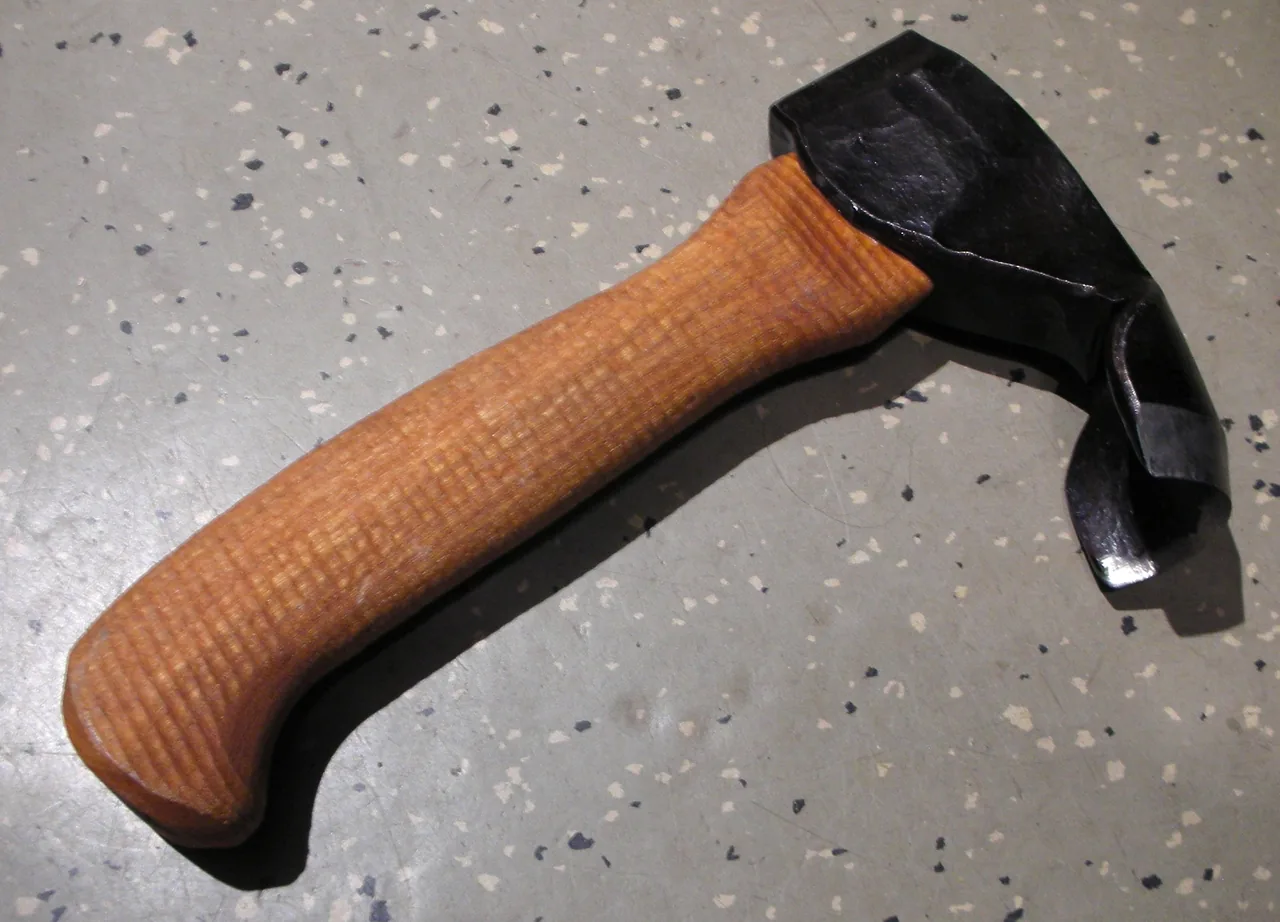
An adze (also spelled adz) is a cutting hand tool whose blade is set at right angles to the handle. It is swung so that the edge slices into wood to shape, hollow or dress timber along or across the grain. The head has three working zones: a tapered eye that takes the handle, a poll behind the eye that balances the bit, and a bit whose bevel and curvature decide what the tool can do. With a sharp edge, a sound handle and a tight head it is a productive tool; with a dull edge or a cracked shaft the same swing becomes a laceration or a flying head. It is one of the older members of the hand tools family, and it is still bought for boatyards, timber framing, log building, trail crews, coopers, and chair and bowl makers.
The adze sits between the axe and the chisel. Where an axe chops along the swing, an adze works like a chisel driven by a swing, paring a surface to a line or scooping a hollow. This page follows the purchase from the steel to the work site: the forms still sold, the geometry of the bit, the heat treatment behind the hardness, the handle and its grain, the sharpening and hanging that keep the tool safe, and the wording a buyer uses to state what is wanted. Dimensions and procedures come from the United States Forest Service trail hand tool handbook, the forging practice published by a Swedish edge tool maker, a steel producer's data for SAE 1080, and the hand tool clauses of the OSHA logging rule.
Four things decide an adze purchase. First the form, because a carpenter's, shipwright's, lipped, gutter or bowl adze is a different tool for a different cut. Second the head, by weight, edge width and steel, with a hardness that holds an edge without chipping. Third the handle: hickory or an alternative, the right length, the grain running true, the head wedged tight. Fourth the supplier's evidence that sharpening, inspection and replacement are part of the offer. A buyer who states those four in writing gets a tool that is safe at the first swing and inexpensive to keep.
Chapter 1 / 06
What an Adze Is and How It Works
The head is a forging with three zones. The eye is the tapered hole through which the handle passes; its taper lets the head tighten when the tool is swung and lets a crew remove it for carrying and sharpening. The poll is the mass behind the eye, a face that balances the bit and gives the head its swing. The bit is the blade in front of the eye: a cheek that curves down from the head and ends in an edge ground with its bevel on the underside. The Forest Service handbook gives the carpenter's adze a blade 8 to 10 inches (200 to 250 mm) long, an edge 4 to 7 inches (100 to 180 mm) wide and a weight of 3 to 5 pounds (1.4 to 2.3 kg).
The cut is a slice, not a split. The edge enters the wood at a shallow angle, the blade curves down to it in an arc that roughly matches the curve of the handle, and the bevel rides on the surface left by the previous stroke while the curvature lifts the chip. A straight edge leaves a flat face; an edge rounded toward its ends scoops a trough, a gutter, a notch or the inside of a bowl. Because the blade meets the wood at a grazing angle, the tool is sensitive to sharpness: a keen edge bites at once and the swing stays short, while a dull edge skids along the grain and forces the user to swing harder and less accurately. Sharpness is a safety property of an adze, not a convenience.
The stroke is a pendulum, not an overhead blow. For hewing, the user stands astride or on top of the log, grips the handle with both hands and swings in short arcs along the log, using the thigh as a stop for the arm and as the control on the depth of the cut. The head travels between the feet, so the position of the body decides where the edge can land. On a short-handled adze for bowl or seat work the user works over the blank and chips between the feet, moving backward as the surface develops. The arc is kept short because the mass of the head, not the length of the swing, does the cutting, and a short arc can be stopped before it reaches a leg or a hand.
Grain direction sets the order of work. Along the grain an adze takes a long shaving from a straight-grained face and finishes close to a plane's surface. Across the grain it is used for the final dressing of a beam side, where short overlapping strokes sever the fibers instead of lifting them into splinters, and for fitting planks. A lipped edge, with its ends turned up, was made for cross-grain work because the turned shoulders carry the cut to a clean end at each side. The wood itself changes the load: hardwood and frozen timber demand a fairly thick bit with a rounded bevel face, softwood forgives a thinner edge, and every knot is a shock to the bit that a stone in the soil is to a hoe.
The bit works because two zones of steel sit in one head. The edge zone is hardened and tempered to hold a keen bevel; the eye and poll stay comparatively soft and tough so that they absorb the shock of the handle and resist cracking. One Scandinavian forger, which makes adzes and axes in the same hand-forging shop, heats its steel to approximately 1200 degrees Celsius (2190 degrees Fahrenheit) for forging, heats the edge to 820 degrees Celsius (1508 degrees Fahrenheit), cools it rapidly in water, and then holds the head in a tempering oven, a low temperature heat treatment furnace, at 195 degrees Celsius (383 degrees Fahrenheit) for 60 minutes. It states that the hardness of the steel depends chiefly on its carbon content and also on the tempering temperature.
Head weight and handle length set how the energy arrives. A heavy head on a short handle moves slowly and delivers a deep, controlled bite for close work; a lighter head on a long handle moves fast and covers a beam face with less fatigue. The poll is part of this balance, because its mass pulls the center of gravity back toward the hands and keeps the bit from dragging the swing forward. The poll is not a hammer face. It is not hardened like one, and the Forest Service warns that pounding with the flat end of an axe bit loosens the head, chips the face and warps the eye, which then causes problems with rehandling and balance. A crew that needs to drive wedges carries a sledge.
Chapter 2 / 06
Adze Types and Structural Variants
Long-handled adzes are swung with both hands and are known as foot adzes because the edge lands near foot or shin level. The carpenter's adze is the heavy one: steep curves in the bit, a very heavy, blunt poll, and a head meant for trimming and shaping hewn timbers and flattened logs. Its weight makes it unsuitable for sustained work overhead. On a building site it dresses the face of a beam after an axe or a circular saw has scored and removed the bulk of the waste; the trail handbook tells crews to hew the scored sections with an adze or a broadax, and to reach for the broadax only when no adze is available.
The shipwright's adze is lighter and more versatile. It was designed to be used in a variety of positions, including overhead and in front at waist and chest level, where a heavier head would soon exhaust the arms. The lipped shipwright's adze is a variant with a bit wider than normal whose outer edges turn sharply upward; seen from the bit toward the eye, the edge looks like a very wide and often very flat U. It was made mainly for shaping cross grain, as in joining planks. The turned ends let the bit run wide without its corners biting the plank face at each side of the stroke.
Short-handled adzes are the bowl maker's and chair maker's tools. They carry a handle that one or two hands control close to the body and a head with more curve, which gives clearance for short cuts in a hollow. A Swedish maker sorts them by edge shape: a straight adze with a transverse edge that works much like a chisel for squaring logs and planks, smoothing surfaces and forming boat ribs, and a gutter adze with an edge rounded at its ends for hollowing troughs, old-style gutters and notches in log construction. Its small straight adzes come in widths of 56 mm (2.2 in) and 80 mm (3.1 in) and its small gutter adzes in radii of 25 mm (1 in) and 40 mm (1.6 in). The larger sizes are for the user who stands over the log and chops between the legs.
The head form is shared with digging tools. An adze hoe has the same tapered eye, poll and curved bit and is used to break sod and to level trail tread; its edge is ground to an inside bevel of 45 degrees, far blunter than a woodworking adze, because it meets soil, roots and stones. A mattock has a two-sided steel head on a long wooden handle, one side an axe blade or a pick and the other an adze; a cutter mattock carries a 2-inch (50 mm) cutter blade opposite the grubbing blade. A Pulaski pairs an axe head with a smaller adze and is the firefighter's combination tool. None of these will dress timber: their bits are made to survive the ground, and a woodworking adze should never be used as a hoe.
The boundaries are easiest to state by what the edge does. An axe has its blade in line with the handle and is built to chop across the grain. A chisel and a plane take the same shaving but are pushed or struck from a stable surface, where an adze cuts from a swing. The adze head is not machined from steel plate either: it is hot-forged from bar so that the grain of the steel follows the bit and wraps the eye. A rotary hammer or a demolition hammer drives and breaks masonry and has no role in shaping timber. A demolition adze, with a deliberately dull edge, is a prying tool and not a cutter.
Construction differs chiefly in how head and handle are joined. The common form is a separate wooden handle fitted into a tapered eye and locked with a wedge; in industrial production the eye is reamed and the poll faced on machine tools after forging. D-handled adzes carry a closed loop handle close to the bit, so the hand wraps the D and the bit is not built around a shaft as a head; this form gives no mechanical leverage. On some small tools the steel handle is forged in one piece with the head, and fiberglass shafts are sold as an alternative to wood. Mechanized tools have taken over the bulk of the work: the sawmill and the powered plane replaced the adze in industrial carpentry, and in a bowl shop an angle grinder with a carving disc often roughs the hollow before the adze and the sander finish it.
Chapter 3 / 06
Adze Key Specification Parameters and Standards
The specification of an adze is short, and every line of it changes how the tool cuts. Head weight and edge width set the depth and the width of the bite; the curvature of the bit, from flat to deeply rounded, sets whether the tool leaves a plane or a hollow; and the edge angle, ground on the underside, sets how long the edge lasts against the wood it meets. The handle adds material, length and grain direction, and the fixing of the head adds the wedge. The values stated with a source in the table are taken from the documents listed on this page; those marked typical describe common practice and are to be confirmed by the supplier in writing before an order is placed.
Steel is specified by grade and by hardness. The bar is melted in an electric arc furnace or an induction furnace. Alloy steel is used by some forges and tool and die steel reaches a higher hardness but needs closer control in the forge, so carbon steel of the SAE 1080 type remains the common choice. That grade carries approximately 0.75 to 0.88 percent carbon and 0.60 to 0.90 percent manganese, and its producer states that it can reach 55 to 60 HRC when fully hardened and tempered, the figure depending on section thickness and tempering temperature. An adze bit is tempered below that maximum, typically 45 to 55 HRC, so that the edge holds under a file yet gives instead of chipping on a knot. A hardness tester on the finished head is the only proof of the temper.
No dedicated standard fixes an adze's dimensions: sizes are the maker's, and the numbered sizes of foot adzes are a trade convention rather than a published document. What does apply is the law on hand tools at work. The OSHA logging rule, 29 CFR 1910.266, requires every hand tool to be kept in serviceable condition, to be inspected before first use in each workshift, and to be used only for the purpose for which it was designed. Its inspection list names handles that are sound, tight-fitting, properly shaped and free of splinters and sharp edges, heads of impact tools free of mushrooming, and edges that are sharp and properly shaped. Rockwell hardness is reported on the C scale by an ASTM test method for Rockwell hardness of metallic materials, and hot-wrought carbon steel bar is ordered to ASTM general requirements.
Parameter
Value to state
What it decides
Head weight, carpenter's or foot adze
3 to 5 pounds (1.4 to 2.3 kg)
Depth of the bite and fatigue in long hewing
Head weight, hand adze
Typically 1 to 2 pounds (0.45 to 0.9 kg)
Control for bowl, seat and other close work
Blade length, carpenter's adze
8 to 10 inches (200 to 250 mm)
Reach of the bit below the handle
Edge width, carpenter's adze
4 to 7 inches (100 to 180 mm)
Width of each stroke and the flatness of the hewn face
Edge width, small straight adze
56 or 80 mm (2.2 or 3.1 in)
Suitability for close shaping and boat ribs
Edge radius, small gutter adze
25 or 40 mm (1 or 1.6 in)
Radius of the hollow scooped in one stroke
Edge bevel, woodworking adze
30 degrees, on the underside
Life of the edge against the wood being cut
Inside bevel, adze hoe
45 degrees
Survival in soil, roots and stones
Hardness of the bit
Typically 45 to 55 HRC
Edge holding against chipping
Hardness of SAE 1080, fully hardened and tempered
55 to 60 HRC
Upper limit set by the steel and the temper
Carbon content of SAE 1080
0.75 to 0.88 percent
Hardenability and attainable hardness
Handle material
Hickory, ash or fiberglass
Shock absorption and service life
Handle length, foot adze
Typically 24 to 36 inches (61 to 91 cm)
Swing arc and working position
Handle grain
Tight, knot free, parallel to the wedge slot
Resistance to snapping under shock
Chapter 4 / 06
Adze Selection and Duty Checks
Selecting an adze means matching a head, a handle and a heat treatment to one kind of cut. The checks below run from the shape of the work to the wording of the order, and each one narrows the offer until the remaining tools differ only in their making.
Start from the working position. Work done standing over the log and chopping between the legs suits a larger adze on a long handle: the extra length lets the arms adjust the cut and yields very smooth surfaces. Work done close to the log, or on the outside of a project where the cut has to come from another angle, suits a smaller head on a short handle. Overhead work rules out the heavy carpenter's pattern at once, because its weight makes sustained use overhead impractical, and points to the shipwright's pattern. A buyer who lists the positions first will not be offered a tool that fits only one of them, and a crew that works in several positions buys both weights rather than asking one head to serve all.
Next match the edge to the wood and the surface wanted. A flat surface on a beam, plank or log calls for a straight transverse edge, which works much like a chisel and leaves facets that can be trued line to line. A hollow, whether a trough, a gutter, a notch in log construction or the inside of a bowl, calls for an edge rounded at the ends, and the radius of that round sets the smallest hollow the tool can scoop cleanly. Hardwood and frozen wood demand a fairly thick bit with a rounded bevel face; an edge made more pointed cuts softwood with less effort and a thin, straight edge is the carving geometry, but both roll sooner when the timber is hard or the work is heavy.
The duty of an adze can be estimated before it is bought. The energy of each stroke is roughly the kinetic energy of the head at impact, one half of the head mass multiplied by the square of its edge speed, and a hewing job is the number of strokes that energy has to deliver. The 4 to 7 inches (100 to 180 mm) of edge width on a carpenter's adze sets how wide a face each stroke covers: the narrow end suits a lighter head, the wide end covers more face per stroke with more weight behind the swing. For a crew dressing a known number of beam faces, faces multiplied by strokes per face converts into hours, and that figure decides whether the job belongs to hand hewing or to a saw.
The handle is chosen with as much care as the head. Hickory is the standard wood, strong and flexible with long fibers, and the Forest Service asks for a tight, knot-free grain that runs parallel to the wedge slot, so that the fibers line up with the load instead of crossing it; it lists fiberglass as the alternative and a steel shaft forged in one piece with the head as a third form. Ash is the traditional European choice where hickory is not grown. The knob at the end keeps the lower hand from slipping off during the swing. Length is checked with the user in the working position: standing as for the cut, the edge should reach the work with the arms extended, and a handle that forces the back to bend or the elbows to lock is the wrong length.
The last selection check is evidence. One forger stamps every head it makes with its label and the initials of the smith who forged it, so that a fault can be traced to a person and a batch, and it tests the hardness of the steel after tumbling and strikes the corner of the edge to prove that no crack is present. A buyer asks the same three questions of any supplier: how hardness is checked and recorded, how the edge is tested, and whether the handle is pressed in and wedged in the plant or shipped loose. A head dipped in anti-rust oil and left as forged, with no paint or varnish to hide it, shows its own surface; an industrial coating is not evidence of quality, and a mill certificate from a tensile testing machine says nothing about the temper of the bit.
Decision factor
What to check
Choice it drives
Working position
Overhead, waist or chest height, standing over the log, or seated close
Head weight and pattern
Surface wanted
Flat face, concave hollow or notch
Straight edge or edge rounded at the ends
Wood and its condition
Softwood, hardwood, green or frozen timber
Thickness of the bit and rounding of the bevel
Edge width
Width of the face or hollow against the weight of the head
56 or 80 mm (2.2 or 3.1 in) for close work; 4 to 7 inches (100 to 180 mm) for hewing
Hardness
Typically 45 to 55 HRC on the bit, with a softer eye
Steel grade, quench and tempering temperature
Handle
Hickory with grain parallel to the wedge slot, or fiberglass
Service life and shock reaching the arms
Head fixing
Tapered eye with a wedge; a set screw where heads are removed often
Field removal for sharpening against security of the head
Duty
Beam faces or hollows to be cut per week
Hand hewing or a saw for the bulk of the waste
Supplier evidence
Smith's stamp, hardness and crack test, sheath, spare handles
Traceability and cost of ownership
Chapter 5 / 06
Adze Set-Up, Maintenance and Failure Modes
An adze is safe for exactly as long as its edge is sharp, its handle is sound and its head is tight. Keeping it so is a routine: inspect before each shift, hang and wedge the handle correctly, sharpen without overheating, and retire any head or shaft that has begun to fail.
Inspection comes first, and the OSHA logging rule makes it a duty before first use in every workshift. Handles are checked to be sound, tight-fitting, properly shaped and free of splinters and sharp edges, the head is checked for tightness and for any sign of mushrooming, and the edge is checked to be sharp and properly shaped; a dull edge is restored to the maker's specification during the shift. Before the first swing the user clears underbrush and overhanging branches from the swing zone, makes sure the footing is stable and secure, and chops only when clear of other workers. Safety glasses, safety gloves and a safety helmet are the minimum equipment, a face shield is added where chips fly from a second worker, and safety shoes that cover and support the ankle are worn because the edge lands close to the feet.
The stroke is controlled by the stance, not by strength. For hewing, the worker stands astride or on top of the log and uses the thigh as a stop for the arm and as the control on depth. For adze hoes the Forest Service tells crews to work the tool at an angle across the front of the body so that the handle never sits between the legs, with the back straight, the knees flexed and one foot slightly forward, because swinging straight down with both hands close together can bring the handle against the shins. A swing that runs past the wood is checked by the thigh, not by gripping harder. The tool is carried at the side with the blade forward and the handle behind, is never thrown, is sheathed before transport, and is stored out of the weather in the place provided on site.
Sharpening follows the bevel that the maker ground. A carpenter's adze is touched up with a whetstone until the blade needs reshaping; then the bevel on the underside is reground to 30 degrees and finished on a whetstone. A fine-toothed file takes out nicks, and a wet bench grinder or a coarse handheld stone re-establishes the bevel. Overheating is the irreversible mistake: the Forest Service warns that in heat-treated tool steel the temper is shallow, that overheating weakens it and that excessive grinding reaches soft metal. The original edge shape is kept at every pass, because a wrongly ground edge slips more easily. Honing removes the feather edge, the bent lip of metal a few tenths of a millimeter long, first with a coarse and then with a finer whetstone; a carborundum stone, which is silicon carbide, is used with oil, and a strop of leather finishes the edge.
Remove the head from the handle if the eye is the removable tapered type, and secure the head so that both hands are free.
Inspect the edge for nicks and for cracks running back from it; a cracked head is scrapped, not ground.
Take out nicks with a fine-toothed file or a wet grinder, working the underside bevel only and keeping it at 30 degrees.
Keep the original curvature of the edge by removing the same amount along its whole length.
Cool the steel often, and stop as soon as it grows too warm to touch.
Hone with a coarse and then a finer whetstone to remove the feather edge, and strop the edge on leather.
Hanging a new handle is the other skill a crew needs. The old shaft is cut or driven out and the eye is cleaned; the new handle is test-fitted so that it fills the eye at the top and still leaves wood above the eye for the kerf and the wedge. The wedge is then driven so that the wood expands inside the tapered eye. One forger presses the handle home with a press and secures it with a wooden wedge, adding a steel wedge only on splitting axes. A square tapered eye and handle end let the head tighten when swung and still be removed for carrying and sharpening, and some adzes carry a small set screw so that the head cannot slip when the handle dries out. The finished handle is sanded smooth; under the inspection rule a surface that splinters is a defect.
Failure modes follow the zones of the head. The edge rolls or chips when the bit is too soft or too hard for the wood, when a knot or a buried nail is struck, or when the bevel has been thinned past its shape; a chipped bit is reground back to sound steel, and a head with a crack at the edge is scrapped. The poll mushrooms when it is used as a hammer, and the same pounding loosens the head and warps the eye. The handle cracks and splits at the eye if its grain runs across the load, snaps behind the head, or works loose as dry air shrinks the wood. The logging rule requires a head that begins to chip to be repaired or removed from service, and the Forest Service asks crews to list the tools needing repair or replacement at day's end.
Condition
Cause
Action
Edge rolls over
Bit too soft: low carbon, under-heated or over-tempered
Check hardness; re-harden and temper, or reject the head
Edge chips
Bit too hard or too thin; a knot or a nail struck
Regrind to sound steel; temper warmer or thicken the bevel
Crack at the edge
A forging fold or quench crack opened by a hard blow
Scrap the head; never grind a cracked bit
Mushroomed poll
Poll used as a hammer face
Grind the face smooth and stop the practice
Loose head
Wedge missed, wood shrunk in dry air, eye warped by pounding
Re-hang with a new wedge; fit a set screw; check the eye
Handle splits or snaps
Grain across the load, splintered shaft, weathering
Replace with straight grained hickory; store out of the weather
Edge skids and glances
Dull edge or wrongly reground bevel
Sharpen to the maker's bevel during the shift
Rust on the bit
Stored damp, no oil after use
Wipe dry, oil the head, store sheathed in a dry place
Aching wrists and forearms
Handle too long or too short, head too heavy for the position
Match handle length and head weight to the working position
Chapter 6 / 06
Adze Applications and Procurement Checks
The adze is bought today by trades that work with the grain rather than against it. Boatyards keep shipwright's and lipped adzes for dressing frames and fitting planks. Timber framers and log builders hew beams with carpenter's adzes and cut notches with gutter adzes. Trail crews shape hewn timbers and flattened logs with carpenter's adzes and build and level tread with adze hoes. Coopers, chair makers and bowl makers rough out a hollow with a short-handled adze before the spokeshave and the gouge finish it. Railroad tie shaping gave its name to a pattern with a bit extended to reduce broken handles. In every one of these trades the tool survives because the work is a shallow cut on a surface that a machine cannot reach or would remove altogether.
Hand hewing is kept for the work it does well and given up elsewhere. A sawmill and a circular saw remove bulk stock in minutes; the adze then dresses the sawn face, trues a joint that the saw left out of line, or textures a surface to match older work. An angle grinder with a carving disc speeds the roughing of a bowl but leaves a machine-made surface and a cloud of dust, so a dust mask is worn and the adze sets the final facets. On a restoration site, where nails may be buried in the timber, the timber is surveyed for metal before the first stroke, because one nail can chip an edge that took an hour to grind. The running cost of the tool is sharpening time and a new handle every few years.
Markings and conformity are checked when the tools arrive. Each head should carry the maker's mark and a traceable stamp of the smith or the batch, and the order should ask for the steel grade, the hardness range of the bit and the handle species in writing. A mill certificate reporting a tensile testing machine result proves the bar, not the temper. For logging operations the rule is 29 CFR 1910.266; on other sites its hand tool clauses serve as the checklist to write into a method statement. Training covers stance, the clear swing zone, stopping the swing at the thigh and reading a dull edge. Work aloft is done from scaffolding or a platform, never from an aluminum ladder, because the pendulum stroke needs both feet planted, and a first aid kit is kept at the site and maintained in serviceable condition.
A purchase order for adzes should state, line by line: the pattern and its trade, whether carpenter's, shipwright's, lipped, gutter, bowl or foot adze; the head weight and the edge width, for example 3 to 5 pounds (1.4 to 2.3 kg) and 4 to 7 inches (100 to 180 mm) for a carpenter's adze; the edge form, flat or rounded, with its radius where a gutter adze is wanted; the steel grade, such as SAE 1080, and the hardness range of the bit, typically 45 to 55 HRC, with the eye left unhardened; the handle species, hickory or an agreed alternative, its length, its straight grain and its knob; the fixing of the head, by wedge and by set screw where heads will be removed; the finish, oiled and uncoated or coated, and a sheath; the documents, a hardness record and the maker's mark on every head; and the spares, replacement handles and wedges, a file, a whetstone and a finer stone for honing. The buyer should also ask for the maker's sharpening instructions in the maker's own words, because the logging rule requires a dull edge to be restored to them during the shift.
FAQ
What is an adze and how does it work?
An adze is a cutting hand tool whose blade is set at right angles to the handle. The head has a tapered eye that takes the handle, a poll behind the eye and a bit whose bevel is ground on the underside. It is swung in a short pendulum stroke so that the edge slices into wood and pares a surface to a line or scoops a hollow, much like a chisel driven by the swing instead of a mallet. A straight edge leaves a flat face; an edge rounded at its ends leaves a concave one. Because the blade meets the wood at a grazing angle, sharpness decides whether the edge bites or skids.
What types of adze are there?
Long-handled adzes are swung with both hands and land near foot level. The carpenter's adze is heavy, with steep curves and a blunt poll, made for hewing timber. The shipwright's adze is lighter and works overhead and at waist and chest height. The lipped shipwright's adze has a wider bit with the ends turned up for cross-grain work. Short-handled adzes serve coopers, chair makers and bowl makers, and by edge shape a maker may offer a straight adze for flat surfaces and a gutter adze for hollows. A railroad pattern has an extended bit, a D-handled adze has a loop handle close to the blade, and adze hoes, mattocks and Pulaskis share the head form.
What hardness should an adze edge have?
The bit should be hard enough to hold an edge and soft enough not to chip. A plain carbon steel of the SAE 1080 type, with approximately 0.75 to 0.88 percent carbon, can reach 55 to 60 HRC when fully hardened and tempered, depending on section thickness and tempering temperature. An adze is tempered below that maximum, typically 45 to 55 HRC, while the eye and poll stay softer and tougher. One forger heats the edge to 820 degrees Celsius (1508 degrees Fahrenheit), cools it in water and tempers the head at 195 degrees Celsius (383 degrees Fahrenheit) for 60 minutes. Ask the maker for its hardness range and how it is tested.
How do I choose the right adze?
Start from the working position. Standing over a log and chopping between the feet suits a larger adze on a long handle; close work suits a smaller head on a short handle; overhead work rules out the heavy carpenter's pattern and points to the shipwright's. Then match the edge to the surface: a straight transverse edge for a flat face, an edge rounded at the ends for a hollow, with the radius setting the smallest hollow it can scoop. Hardwood and frozen wood need a thicker bit with a rounded bevel. Finish with the handle: hickory with straight grain, the right length, and a head wedged tight in a tapered eye.
How do you sharpen an adze?
Keep the bevel the maker ground. Touch up the edge with a whetstone as it dulls. When the blade needs reshaping, grind the bevel on the underside to 30 degrees and finish on a whetstone; the Forest Service gives that figure for a carpenter's adze and 45 degrees as the inside bevel of an adze hoe. Remove nicks with a fine-toothed file or a wet grinder, keep the original curvature by removing the same amount along the whole edge, and cool the steel often, because overheating draws the shallow temper. Hone with a coarse and then a finer stone to remove the feather edge, and strop on leather.
What drives the cost and lead time of an adze?
Cost and lead time follow how the head is made and the handle fitted. A hand-forged head takes a smith's time at the press and at the stamp; a drop-forged head is made in lots and waits on a production slot. Hardening, tempering and the testing of every head for hardness and for cracks at the edge are steps that an untested head never receives. The handle adds straight grained hickory, turning, sanding, pressing in and wedging. Lead time grows when a pattern is forged to order in a special edge width or radius, or when replacement handles, wedges and stones are ordered separately. Ask what is stocked, what is made to order and how spare handles will be supplied.
What safety rules and standards apply to adzes?
In United States logging operations the OSHA rule 29 CFR 1910.266 applies: every hand tool must be kept in serviceable condition, inspected before first use in each workshift, used only as designed, sharpened to the maker's specification when dull, and carried in racks, boxes or holsters on a vehicle. The inspection covers handles that are sound, tight-fitting and free of splinters, edges that are sharp and properly shaped, and heads that are not mushrooming. On site the user clears the swing zone, checks the footing, wears safety glasses, gloves, a safety helmet and solid footwear, works clear of other people, stops the swing at the thigh, and carries the tool sheathed at the side with the blade forward.