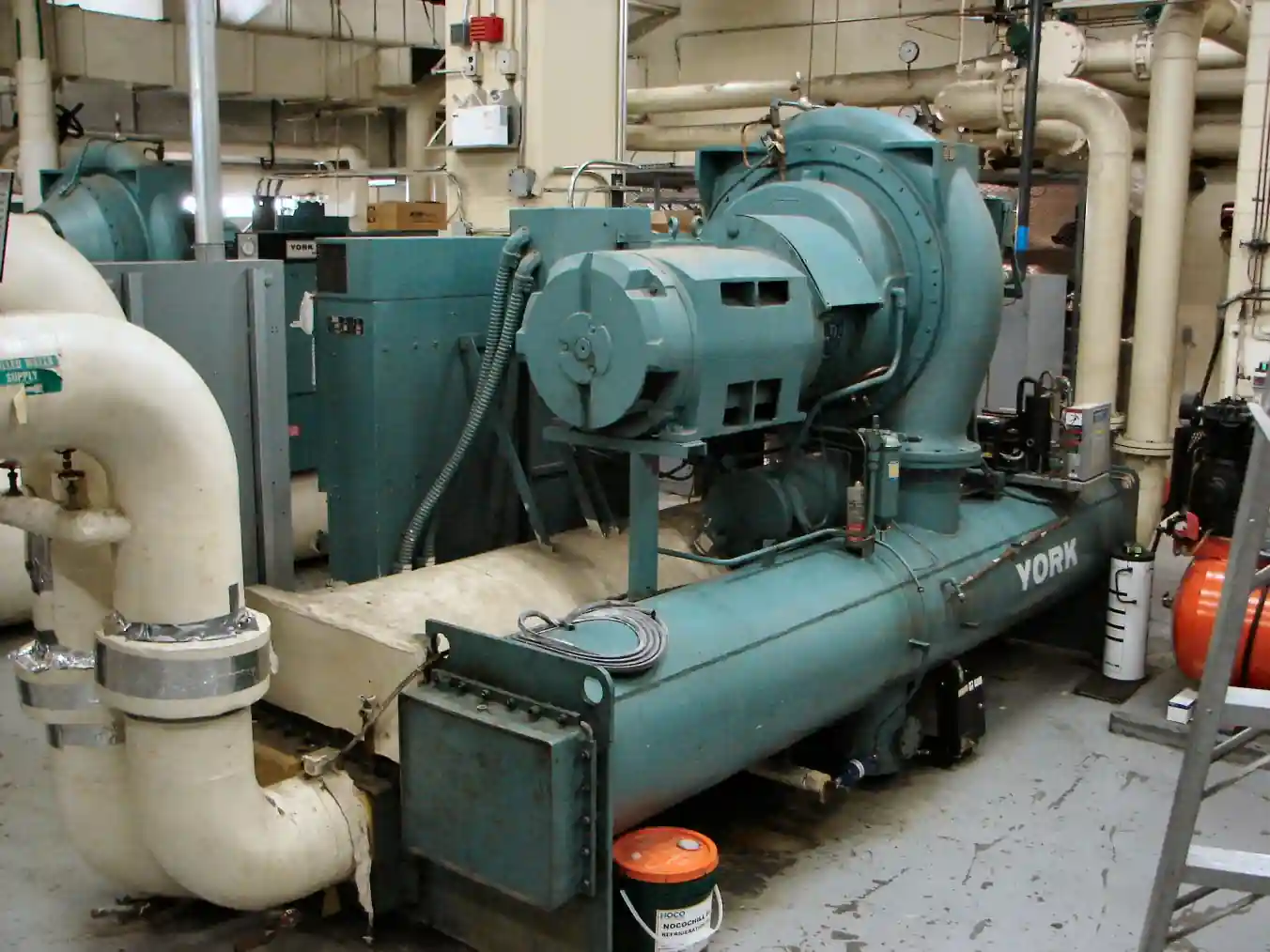
The category encompasses a wide capacity range, from compact bench-top recirculating coolers used in laboratories to large industrial water-cooled screw chillers rated in the hundreds of refrigeration tons. Source data illustrates this breadth clearly: Polarbear's PBR series spans 1.5 TR to 100 TR, while ALL Heat Exchangers' water-cooled screw chiller lineup reaches 227.5 USRT, and the HMC-XC aluminum-profile oxidation magnetic-levitation series from industrychillers.com extends to 795 RT. The underlying thermodynamic cycle is the same across all sizes, but the physical hardware, controls, and supporting infrastructure scale dramatically.
Procurement, engineering, and facility teams use this page to compare manufacturer specifications, understand configuration trade-offs, and align equipment selection with applicable standards. All numerical values in the tables that follow are reproduced verbatim from the cited source documents; no figures have been extrapolated or rounded beyond what the source provides.
A chiller is a machine that removes heat from a process fluid, typically water or a water-glycol mixture, and rejects that heat elsewhere, producing a controlled cold stream for HVAC, industrial, or laboratory use. Chillers are classified by cooling medium (air-cooled or water-cooled), compressor technology, and capacity, and they are a core component of cooling systems across buildings, factories, and research facilities. This reference page consolidates specifications, configuration types, and selection criteria drawn directly from manufacturer technical data.
Chapter 1 / 06
Fundamentals and Working Principle
Every chiller, regardless of size or manufacturer, is built around a vapor-compression refrigeration cycle. A refrigerant circulates through four functional components: an evaporator, a compressor, a condenser, and an expansion device. In the evaporator, the low-pressure, low-temperature refrigerant absorbs heat from the process fluid, which is typically water. The refrigerant boils and vaporizes in this step, cooling the water that circulates through the chiller's evaporator coil. The now-vaporized refrigerant is then drawn into the compressor, where mechanical work raises its pressure and temperature.
The high-pressure, high-temperature vapor leaving the compressor enters the condenser, where it rejects the absorbed heat plus the heat of compression to either ambient air (in an air-cooled chiller) or to a separate water loop such as a cooling tower or plant water (in a water-cooled chiller). The condensed liquid refrigerant then passes through an expansion valve, where its pressure drops sharply, returning it to the low-pressure state required to begin the cycle again. This loop runs continuously while the chiller is in operation, and the process fluid leaving the evaporator becomes the chilled water supply to the downstream load.
The refrigerant selection and component design govern the achievable temperature range and efficiency. Manufacturer data demonstrates the practical envelope. Polarbear's PBR 15 CT (1.5 TR) uses a 1 PH 220-240 V supply and a single refrigerant circuit, whereas the PBR 1000 CT (100 TR) requires a 3 PH 380-420 V supply and operates with 220 A running current. Air-cooled units from top-factories.com (MG-5C through MG-40C/D) deliver chilled water across a 5 to 30 degree C outlet range, while JeioTech's recirculating cooler product family (S5) addresses laboratory requirements for stable low-temperature fluid delivery to instruments such as rotary evaporators and spectrophotometers.
The primary outputs of a chiller are therefore threefold: a chilled fluid stream at a controlled temperature, a heat rejection stream (to air or to cooling water), and a power input to the compressor and auxiliaries. The capacity of a chiller is expressed in tons of refrigeration (TR), in BTU per hour, in kilowatts, or in kilocalories per hour, depending on regional convention. Polarbear's PBR 15 CT is rated at 1.5 TR (18,000 BTU per hour) with a cooling output of 5.3 kW, while the PBR 1000 CT is rated at 100 TR (1,200,000 BTU per hour) with a cooling output listed at 456.0 kW. The relationship between these units is consistent: 1 TR equals 12,000 BTU per hour by the industry-standard definition applied in the Polarbear table.
Modern chillers layer controls and protective devices on top of the basic cycle. According to the Taide-Jiangzhuo product description, common protections include compressor delayed-start protectors, overload protectors, high and low pressure cutouts, anti-freeze switches, temperature control switches, fuse plugs, electronic time protection, and compressor overheat protectors. The unit is typically managed through a microcomputer control panel with an LCD display, and the Taide-Jiangzhuo product claims temperature control accuracy of plus or minus 5 degrees C across an adjustable setpoint range of 5 to 50 degrees C. nVent's TAL24 industrial chiller (S8) similarly uses an integrated controller to manage compressor, pump, and fan operation, and runs on R134a or R513A refrigerant at 230 V, 50 to 60 Hz.
Chapter 2 / 06
Specifications and Key Parameters
The specification table below is sourced directly from Polarbear's Chiller and Heat Cool Pumps Technical Data sheet (S1), which lists sixteen models covering the PBR 15 CT through the PBR 1000 CT. The table reproduces the published figures without modification, including the dual column that pairs each heat-pump model number (HP suffix) with its cooling-only counterpart (CT suffix). All capacity values, electrical characteristics, dimensional data, and pipe connection sizes are taken verbatim from the source.
Reading the Polarbear table from smallest to largest reveals the consistent step in capacity: each successive model doubles or near-doubles the cooling output. The 1.5 TR unit draws 1.8 running kW at 12.5 A, while the 100 TR unit draws 144.79 running kW at 220 A. The 1 PH 220-240 V supply applies only to the two smallest units (PBR 15 and PBR 20); all larger units from PBR 30 upward require a 3 PH 380-420 V supply. This voltage transition is typical for chillers of this class as motor power rises above approximately 2.5 kW.
The same table shows that the cooling water pipe connection scales with capacity, beginning at 1.5 inches for the smallest units and progressing through 2 inch, 3 inch, and finally 6 inch for the PBR 1000 CT. Footprint grows correspondingly, from 30 by 28 by 28 cm at 1.5 TR to 150 by 80 by 94 cm at 100 TR. The heating output column (KW Heating Output Actual) is approximately 1.27 times the cooling output for most models, which is consistent with the heat-pump operating mode where the refrigerant cycle is reversed to deliver heat instead of cold.
Comparison with other sources confirms that the Polarbear data sits within the broader category. The top-factories.com air-cooled scroll chiller family (S2) lists models MG-5C through MG-40C/D, with cooling capacities ranging from 13.1 kW (3.72 tons) at the small end to 109.6 kW (31.16 tons) at the large end, in a 5 to 30 degree C outlet temperature range. The Taide-Jiangzhuo water-cooled piston and scroll chiller range (S4) covers TC-5W through TC-50W with cooling capacities from 14.2 to 152 kW per hour, operating on 380 V at 50 Hz. nVent's TAL24 industrial chiller (S8) is rated at 2300 W nominal at 50 Hz and 2700 W nominal at 60 Hz, using R134a or R513A as the refrigerant. These numbers are reproduced as published; Polarbear's table is the only source covering capacities above 100 TR in the materials provided.
Chillers are most broadly divided by heat-rejection medium into air-cooled and water-cooled categories. Air-cooled chillers reject heat directly to ambient air through fans and finned coils; they are common in smaller capacities and in installations where cooling tower water is unavailable or undesirable. The top-factories.com MG-C/D series (S2) is an air-cooled scroll chiller family with 5 to 30 degree C outlet temperature range, while the Polarbear PBR CT series is described in the source title as a heat-pump or chiller line. Water-cooled chillers reject heat to a separate water loop and require an external cooling tower or fluid cooler; ALL Heat Exchangers' water-cooled screw chiller family (S3) and the Taide-Jiangzhuo TC-W series (S4) are water-cooled designs.
Within each cooling-medium category, chillers are further divided by compressor type. Reciprocating (hermetic piston) compressors, scroll compressors, and screw compressors are the three dominant technologies in the source data. The Taide-Jiangzhuo specifications explicitly list the compressor form as 'fully hermetic piston or scroll type' across the TC-W range, with multi-compressor configurations appearing at the higher capacities: 3.75 kW x 2, 3.75 kW x 3, 7.5 kW x 2, 9.37 kW x 2, 7.5 kW x 3, and 9.37 kW x 4 for the larger models. ALL Heat Exchangers' water-cooled screw chiller line (S3) uses screw compression and extends from 26.2 USRT to 227.5 USRT across thirteen model variants.
Capacity-based segmentation is another useful axis. Laboratory recirculating coolers such as those in the JeioTech catalogue (S5) are designed for stable fluid delivery to benchtop equipment; the JeioTech family includes General, Low Temperature General, High Temperature Precision, and Compact variants. Process chillers for plastics, metal finishing, and printing occupy the mid-range: the industrychillers.com HMC-XC aluminum-profile oxidation magnetic-levitation series (S6) covers 582 to 2796 kW cooling capacity and 165 to 795 RT, designed for industrial process loads. The TopChiller ink and printing chiller family (S7) covers twelve model variants (AC-15AT through AC-60AD) with cooling capacities from 36120 to 173995 kCal per hour, depending on 50 Hz or 60 Hz operation.
Reversible heat-pump chillers form a separate configuration class. Polarbear's dual model numbering (HP for heat-pump models, CT for cooling-only) indicates that the same physical platform can be configured for either mode. The PBR 15 HP, for example, delivers 6.8 kW of heating and 5.3 kW of cooling at 1.5 TR, and the PBR 1000 HP delivers 450.0 kW of heating and 456.0 kW of cooling at 100 TR. nVent's TAL24 industrial chiller (S8) is described as a single-mode cooling unit with a specified pump, fluid connection, and tank, targeted at enclosure or process cooling where a fixed cold-water supply is required.
Refrigerant choice also distinguishes configurations. nVent's TAL24 uses R134a or R513A, both of which are low-global-warming-potential HFC or HFO/HFC blends depending on regional regulatory regime. Other sources in the materials provided do not name refrigerants, so any additional refrigerant claims would not be grounded in the supplied sources. Configuration variations such as open-frame versus packaged, indoor versus outdoor rating, and with-or-without integrated hydraulic module are referenced indirectly in the source data (for example, the Polarbear units list integrated pipe sizes but do not explicitly state whether the circulating pump is internal or external, while the Taide-Jiangzhuo table lists circulating pump power and head separately from compressor power).
Air-cooled chillers: Polarbear PBR CT and HP series; top-factories.com MG-C/D scroll series.
Water-cooled chillers: ALL Heat Exchangers MG-W screw series; Taide-Jiangzhuo TC-W piston and scroll series; industrychillers.com HMC-XC magnetic-levitation series.
Reciprocating hermetic piston and scroll compressors: Taide-Jiangzhuo TC-5W through TC-50W.
Screw compressors: ALL Heat Exchangers MG-90W through MG-800W, capacities 26.2 to 227.5 USRT.
Heat-pump (reversible) chillers: Polarbear PBR 15 HP through PBR 1000 HP.
Laboratory recirculating coolers: JeioTech General, Low Temperature General, High Temperature Precision, and Compact variants.
Process chillers for printing and inks: TopChiller AC-15AT through AC-60AD.
Compact industrial chillers: nVent TAL24, 2300 W at 50 Hz, R134a or R513A refrigerant.
Chapter 4 / 06
Selection Criteria for Procurement
The first selection parameter is cooling capacity, which must be matched to the peak process or HVAC load with an appropriate safety margin. Manufacturer capacity figures are normally stated at standard conditions, which for the Polarbear PBR CT series means rated capacity at the listed electrical supply and at the manufacturer's reference ambient and return-fluid conditions, which are not detailed in the source table. For procurement, the rated capacity in TR, kW, or kCal per hour should be cross-checked against the design cooling load calculation prepared by the project's mechanical engineer.
The second parameter is the chilled fluid supply temperature required by the downstream load. The top-factories.com MG-C/D series is rated for 5 to 30 degree C outlet water temperature, which suits comfort cooling and many process loads. ALL Heat Exchangers' water-cooled screw chiller line (S3) is rated at a 7 degree C nominal leaving-fluid temperature, which is a common industrial process benchmark. The Taide-Jiangzhuo product claims an adjustable setpoint range of 5 to 50 degree C with plus or minus 5 degree C control accuracy, which is significantly wider than the 5 to 30 degree C range of the air-cooled MG-C/D family. Selection must therefore confirm that the candidate chiller can deliver the required leaving-fluid temperature under design ambient and load conditions.
The third parameter is the electrical supply. The Polarbear data shows a clear threshold: the 1.5 TR and 2.0 TR units operate on 1 PH 220-240 V, while every model from 3.5 TR upward operates on 3 PH 380-420 V. The Taide-Jiangzhuo TC-W series is supplied at 380 V, 50 Hz, consistent with industrial three-phase practice. The nVent TAL24 is rated at 230 V, 50 to 60 Hz, single-phase. Procurement must verify that the available electrical service matches the chiller's nameplate supply, including phase count, voltage tolerance, and frequency.
The fourth parameter is the heat-rejection method. Air-cooled units require adequate clearance for air intake and discharge and a location that keeps the air-on-coil temperature within the manufacturer's published envelope. Water-cooled units require a cooling tower, condenser-water pump, and associated piping, but they are typically smaller in footprint for a given capacity and quieter in operation. The Polarbear table does not explicitly identify each model as air-cooled or water-cooled, so this determination must be made from the manufacturer's full datasheet rather than from the table alone.
The fifth parameter is the physical installation envelope. The Polarbear dimensions range from 30 by 28 by 28 cm at 1.5 TR to 150 by 80 by 94 cm at 100 TR. The Taide-Jiangzhuo TC-W dimensions range from 850 by 480 by 980 mm at 5 kW per hour to 2400 by 1000 by 1750 mm at 152 kW per hour. Pipe connection sizes must be coordinated with the building or plant piping, and Polarbear's 1.5 inch, 2 inch, 3 inch, 4 inch, and 6 inch progression provides a direct reference. Weight is not stated in the Polarbear table but is given for the Taide-Jiangzhuo series at 150 kg to 910 kg across the TC-W lineup.
Auxiliary and service considerations complete the procurement checklist. The Polarbear table lists current draw in amps and running kW, which supports electrical infrastructure design and operating-cost estimation. The Taide-Jiangzhuo product description lists the protective devices that should be confirmed during factory acceptance testing: compressor delayed-start, overload, high and low pressure, anti-freeze, temperature control switch, fuse plug, electronic time protection, and compressor overheat. The Taide-Jiangzhuo specifications also separate compressor power from circulating pump power, allowing the purchaser to confirm pump head and flow against the plant hydraulic design.
Chapter 5 / 06
Standards, Compliance, and Testing
The source materials do not cite any specific compliance standards, directives, or testing protocols in their published content. The Polarbear technical data sheet (S1) lists model numbers, capacities, electrical data, dimensions, and pipe sizes but does not reference ASHRAE, AHRI, CE, UL, ISO, or other standards. The top-factories.com (S2), ALL Heat Exchangers (S3), Taide-Jiangzhuo (S4), JeioTech (S5), industrychillers.com (S6), TopChiller (S7), and nVent (S8) sources similarly do not include explicit standards citations in the text provided.
The Taide-Jiangzhuo product description, however, lists the safety protection devices that are commonly required by chiller safety standards in general industry practice: compressor delayed start protector, overload protector, high and low pressure protector, temperature control switch, anti-freeze switch, fuse plug, electronic time protection, safety valve, compressor overheat protector, and compressor frequent-start protector. These protective functions map to the requirement sets in widely applied industrial refrigeration standards, but the specific standard numbers, clause references, and test methods are not present in the supplied materials and therefore cannot be quoted.
Refrigerant-related compliance is referenced only in the nVent TAL24 datasheet (S8), which lists R134a and R513A as approved fluids for that model. No further regulatory information about refrigerant management, leakage testing, or recovery obligations is included in the source text. nVent also publishes nominal capacity at both 50 Hz and 60 Hz, which is a common test-point convention for global equipment, but the applicable rating standard (for example, AHRI 550/590 for water-chilling packages or AHRI 551/591 for heat pumps) is not named in the source materials.
Acoustic performance is referenced for the nVent TAL24 only, which lists a noise level at 50 Hz as a published specification. The TopChiller ink and printing chiller datasheet (S7) and the other product sources do not provide decibel ratings in the supplied content, so a comparative acoustic assessment cannot be constructed from these materials alone. Vibration testing, seismic qualification, and EMC conformity are likewise not addressed in the source documents.
For procurement purposes, the absence of explicit standards references in the source materials means that compliance verification must be requested from the manufacturer as part of the bid process. Typical documentation that purchasers should require, based on common industry practice but not on the supplied sources, includes factory test reports, performance curves at part-load conditions, nameplate data, and material certificates for pressure-bearing components. The specific format and content of these documents are not described in the source materials and therefore cannot be quoted as standards clauses or vendor capabilities.
Chapter 6 / 06
Market Landscape and Buying Process
The chiller market represented in the source materials includes a mix of regional manufacturers and global industrial suppliers. Polarbear (S1) is a UAE-based supplier publishing a PBR product line that combines chiller and heat-pump variants. top-factories.com (S2) hosts a Chinese exporter of air-cooled scroll chillers in the 3.72 to 31.16 ton range. ALL Heat Exchangers (S3) is a manufacturer of industrial water-cooled screw chillers up to 227.5 USRT. Taide-Jiangzhuo (S4) is Dongguan City Jiangzhuo Industrial Co., Ltd, offering water-cooled piston and scroll chillers up to 152 kW per hour. JeioTech (S5) is a Korean laboratory equipment manufacturer with a recirculating cooler sub-family. industrychillers.com (S6) supplies specialty chillers for aluminum-profile oxidation, including a magnetic-levitation series up to 795 RT. TopChiller (S7) is a Chinese supplier focused on ink and printing process chillers. nVent (S8) is a global electrical and thermal management supplier with the TAL industrial chiller family.
The capacity spread across these suppliers shows clear market segmentation. Polarbear occupies the 1.5 to 100 TR range with a general-purpose product. ALL Heat Exchangers covers 26.2 to 227.5 USRT in the water-cooled screw segment. industrychillers.com's HMC-XC series covers 165 to 795 RT, addressing high-capacity industrial loads. The TopChiller ink and printing line sits in a narrower capacity window suited to graphic-arts processes. nVent's TAL24 occupies a compact, low-capacity niche at 2300 to 2700 W, and JeioTech covers the laboratory recirculating cooler category that is not addressed in capacity terms by the other sources.
Pricing data is not included in any of the supplied sources, so no price-per-ton or total-cost-of-ownership analysis can be constructed from the materials provided. Lead time, warranty terms, and after-sales service coverage are likewise not addressed. Procurement teams should request these commercial terms directly from the manufacturer or its regional representative.
The typical buying process implied by the source materials begins with the manufacturer's published specification sheet, which is the primary technical reference. Polarbear's table (S1) is the most complete single-document reference in the source set, with sixteen model rows and ten parameter columns. The Taide-Jiangzhuo datasheet (S4) is similarly complete at the lower capacity range. For larger capacities, ALL Heat Exchangers and industrychillers.com provide the necessary product data. The next step in a typical procurement would be a formal request for quotation, supported by the project load calculation, electrical service details, ambient conditions, and chilled-water supply temperature requirement.
Final selection usually requires cross-vendor comparison on capacity, electrical supply, footprint, pipe connection, and refrigerant. Where the source data does not include a parameter, this reference page records 'varies by model' rather than inferring a value. Buyers should request a formal proposal, factory test report, and reference list from each shortlisted vendor, and they should confirm site-specific items such as maximum ambient temperature, altitude derating, voltage tolerance, and harmonized standards compliance directly with the manufacturer. None of these items can be quoted from the supplied source materials.
FAQ
What is a chiller and how does it work?
A chiller is a machine that cools a process fluid, typically water, by circulating it through a vapor-compression refrigeration cycle. Refrigerant absorbs heat in the evaporator, is compressed, rejects heat in the condenser, and expands back to low pressure to repeat the cycle. The chilled water is then delivered to the downstream cooling load.
What is the difference between air-cooled and water-cooled chillers?
Air-cooled chillers reject heat directly to ambient air through fans and finned coils, as in the top-factories.com MG-C/D series. Water-cooled chillers reject heat to a separate condenser-water loop connected to a cooling tower, as in the Taide-Jiangzhuo TC-W and ALL Heat Exchangers MG-W series. Water-cooled units are typically more compact and quieter for a given capacity but require additional plant infrastructure.
How is chiller cooling capacity measured?
Cooling capacity is commonly expressed in tons of refrigeration (TR), BTU per hour, kilowatts, or kilocalories per hour. The Polarbear PBR CT series uses TR and BTU per hour, with 1 TR equal to 12,000 BTU per hour. The top-factories.com and ALL Heat Exchangers sources add kW and kCal per hour to the same data.
What electrical supply do chillers require?
Supply depends on capacity. Polarbear's two smallest units (1.5 and 2.0 TR) use 1 PH 220-240 V, while every model from 3.5 TR upward in the same source uses 3 PH 380-420 V. The Taide-Jiangzhuo TC-W series operates on 380 V, 50 Hz, and the nVent TAL24 is rated at 230 V, 50 to 60 Hz, single phase.
What compressor types are used in chillers?
The Taide-Jiangzhuo TC-W line uses fully hermetic piston and scroll compressors, often in multi-compressor configurations at higher capacities. ALL Heat Exchangers' MG-W product line uses screw compressors in the 26.2 to 227.5 USRT range. Reciprocating, scroll, and screw are the three dominant technologies represented in the source materials.
What safety devices are typically included in a chiller?
According to the Taide-Jiangzhuo product description, common safety devices include a compressor delayed-start protector, overload protector, high and low pressure protector, anti-freeze switch, temperature control switch, fuse plug, electronic time protection, safety valve, compressor overheat protector, and compressor frequent-start protector. The specific standard numbers governing these devices are not cited in the supplied source materials.
Can the same chiller provide both heating and cooling?
Yes. Polarbear publishes paired model numbers for this purpose: the PBR 15 HP through PBR 1000 HP are heat-pump variants, and the PBR 15 CT through PBR 1000 CT are cooling-only variants of the same physical platforms. The Polarbear table lists both KW Cooling Output Actual and KW Heating Output Actual for every model, showing that the heating output is typically slightly higher than the cooling output in reversible mode.