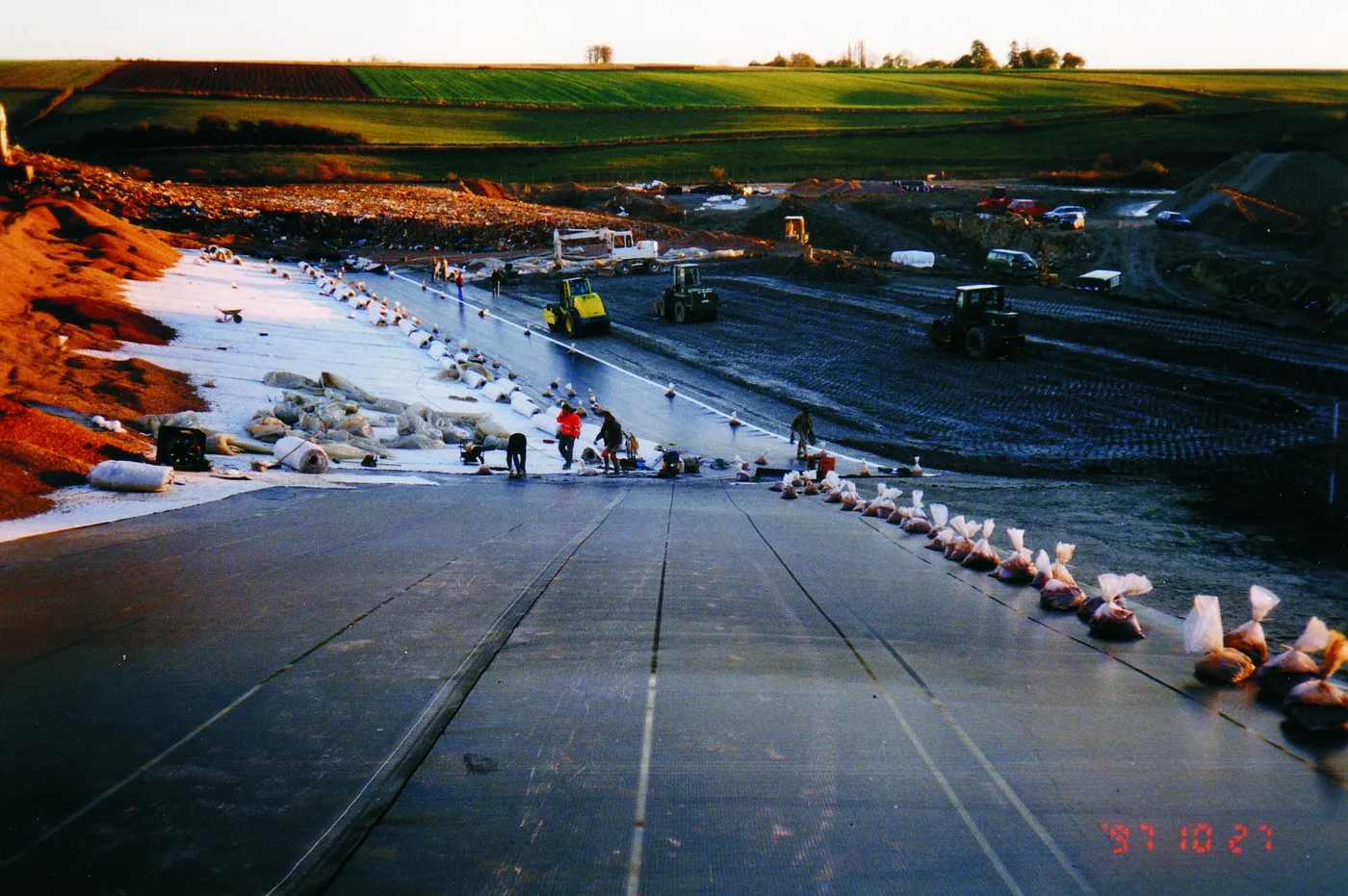
An HDPE geomembrane is a factory-calendered sheet of high-density polyethylene used as a barrier layer against liquids and gases: landfill liners and caps, wastewater lagoons, mining heap-leach pads, canal linings, and secondary containment around fuel and chemical tanks. It is the workhorse of geosynthetic containment because it combines chemical resistance across a wide range of fluids with weldable seams that can be tested non-destructively.
Specifying one is mostly a thickness, resin, and quality-assurance decision. The lines that matter on the datasheet are nominal thickness in mil or mm, density above 0.940 g/cm3, carbon black content and dispersion, tensile properties per unit width, and oxidative induction time. Behind the datasheet sit the subgrade quality, the seam welding process, and the QA program that prove the installed liner is continuous.
The HDPE geomembrane is the heavy-duty member of the site waterproofing family. A generic waterproof membrane or a modified bitumen membrane handles roofs and structures; a waterproof coating liquid-applies where sheets cannot; a waterstop seals concrete joints inside structures. The geomembrane is the choice when the contained fluid is aggressive, the area is measured in hectares, and the design life is decades.
An HDPE geomembrane is bought three times: once as a resin and thickness class, once as a roll of tested sheet, and once as a field of welded, pressure-tested seams. This page decodes the GM13 property table, the thickness decision by application, the welding and QA program, and the RFQ lines that keep all three purchases honest from mill certificate to warranty file.
Chapter 1 / 06
What Is an HDPE Geomembrane
HDPE geomembrane is a thermoplastic sheet, smooth or textured, manufactured by flat-die calendering or round-die extrusion and blown into a bubble, then slit and wound into rolls typically 7 m wide and 100 to 200 m long. The resin is high-density polyethylene, density 0.940 to 0.950 g/cm3, compounded with about 2 to 3 percent carbon black for UV screening and a stabilizer package for oxidative endurance. Width matters because every meter of roll width removed is a seam avoided, and seams are where liners live or die; the roll dimensions, mass, and handling plan are therefore specification lines with the same standing as any tensile number.
The selection question arises whenever a project must keep a liquid in, out, or apart from something: leachate inside a landfill cell, process solution on a heap-leach pad, water in an irrigation canal, or stormwater outside a contaminated site cap. The design conversation is about permeability in practical terms: a properly welded HDPE liner is a barrier whose leakage is measured in seam defects, not in diffusion through the sheet. A pinhole or an unwelded seam edge is the leak; the polymer itself is effectively impermeable over design life when specified and installed correctly.
What is actually being decided is a system, not a sheet. The liner sits on a prepared subgrade, under a drainage or protection layer, anchored in trenches, penetrated by pipes, and seamed in the field by technicians whose equipment and discipline are as much a specification item as the resin. The most common procurement failure is buying the sheet to a premium specification and leaving the installation package to the low bidder.
The geomembrane's neighbors on the jobsite explain its role by contrast. Concrete structures control water with a waterstop at construction joints and integral waterproofing; roofs and plazas use a modified bitumen membrane or sheet-applied waterproof membrane systems; walls get a waterproof coating where geometry is complex. None of those travel to hectares of soft subgrade or survive constant immersion in aggressive leachate. Conversely, the geomembrane does not do structural duty: it relies on the subgrade the way a building relies on its foundation, which is why the two are always specified together.
Scale is the clearest discriminator. A waterproof membrane under a basement answers in hundreds of square meters and a design life tied to the building; a geomembrane liner answers in hectares and a design life tied to a permit. That scale difference is why the two product families have different test vocabularies, different installation trades, and different failure economics: a failed basement membrane dries out and gets re-injected, while a failed heap-leach pad liner stops a mine. Buy by consequence class, not by unit price per square meter.
Chapter 2 / 06
Working Principle and Product Types
How the barrier works
The polymer's semicrystalline structure makes the sheet a barrier to water and most ions; crystallinity plus high density is what separates HDPE from more flexible cousins like LLDPE. The sheet comes with two engineered weaknesses that the specification must manage: seams, created in the field by melting mating surfaces, and stress cracking, a slow failure mode under sustained local tension that resin selection and seam geometry are chosen to resist. The carbon black package and antioxidant additives exist to extend the time before oxidative embrittlement begins; that endurance is quantified by oxidative induction time, OIT, measured to a standard-minute scale at elevated temperature.
Types a catalog actually offers
Thickness is the primary axis. Common classes run 0.75, 1.0, 1.5, 2.0, 2.5, and 3.0 mm, sold in North America as 30, 40, 60, 80, 100, and 120 mil. Surface is the second axis: smooth sheet for general service, and textured (impermeant-embossed or coextruded rough surfaces) where slope stability against a soil cover requires interface friction. Color is a third: black is standard; white-surface sheet is offered to reduce thermal cycling and make defect detection easier in exposed service. Structured profiles, such as spikes or studs for drainage or gas collection composites, extend the family into multifunction geocomposites.
Material variants matter at the edges of duty. LLDPE and mLLDPE geomembranes trade HDPE's chemical armor for flexibility and multiaxial strain capacity, suiting settlement-prone covers and shaped ponds; fPP-R (reinforced flexible polypropylene) serves exposed liner roofs where thermal movement is large; EPDM rubber and PVC sheets serve decorative and agricultural ponds at lower chemical duty, and industrial rubber sheeting in general covers plant-area secondary containment where the fluid list is mild. The HDPE sheet is the conservative default whenever the contained fluid is aggressive or unknown, because its chemical resistance table covers the broadest list.
The polymer family tree clarifies what HDPE is and is not. The same polyethylene resin logic runs through a PE pipe network: pipe-grade PE 4710 compounds and geomembrane resins share density discipline and slow-crack-growth testing philosophy, which is why pipe penetrations through liner boots are preferably polyethylene, weldable by the same fusion thinking. At the far end of molecular weight sits UHMWPE, an ultra-high-molecular cousin whose wear resistance serves chute liners and sliding surfaces; it is not calendered into hectare-scale geomembranes, but its existence explains why "PE" on a datasheet is never enough: density, molecular weight branch, and the stabilizer package each carry the specification. Thermoplastic cousins in other duties, from a plastic pipe irrigation lateral to a plastic-pipe gas main, keep the same lesson: resin class is the engineering decision, polymer brand name is not.
Seaming methods
Double-fusion wedge welding is the production seam: a heated wedge melts both mating surfaces between nip rollers, leaving a double track with an un-welded air channel between them. That channel is the QA gift: pressurize it and hold, per ASTM D5820 practice, and a discontinuous seam anywhere along the track bleeds pressure and announces itself. Extrusion welding is the repair and detail method: a hand extruder fuses a bead of the same resin over a prepared seam or patch, used at T-seams, patches, pipe boots, and repairs. Fillet and cap strips, anchor trench terminations, and penetration boots complete the seam vocabulary; every one of them is a detail standard with its own inspection routine.
Field conditions bound all of it: wedge welding wants ambient temperature roughly between 5 and 40 deg C, a clean dry mating surface, and a subgrade free of debris; outside that window the crew shifts to slower methods or waits. Wind is a welding enemy because it strips heat from the wedge and billows the sheet; low-temperature and high-temperature variants of the procedure exist but each requires re-qualification of weld parameters on trial strips before production seaming resumes. Dawn condensation is the quiet schedule killer on big fields: dew on the seam track forces morning grinding or waiting, so experienced crews sequence details and repairs at first light and production welding for late morning onward.
Chapter 3 / 06
Construction, Materials, and Duty Boundaries
Liner system layers
A modern containment cross-section is a stack with the geomembrane as one ply. A landfill composite liner is, from the bottom up: compacted low-permeability soil, a geosynthetic clay liner, the HDPE geomembrane, a geotextile protection layer, and a leachate collection drainage layer of gravel or a geocomposite. Heap-leach pads and wastewater ponds assemble variants of the same idea. Each layer has a job: the clay and GCL adsorb, the geomembrane blocks, the geotextile protects the geomembrane from puncture, and the drainage layer limits hydraulic head on the liner, which is the variable that converts any defect into a leak rate.
Protection is engineering, not courtesy. A 1.5 mm sheet survives decades under gravel only when the geotextile mass per unit area is chosen against the gravel shape and the overburden load; on drivable surfaces, a layer of sand or fine soil substitutes. Above the liner, reinforcement where vehicles traffic the cover: steel mesh in concrete paving on top of a liner system, or a concrete slab on separation geotextile, converts loads the polymer cannot take. Below it, the subgrade is rolled and proofed so no stone point works against the sheet under the first full load.
Anchorage and terminations
Horizontal anchorage is the anchor trench: a perimeter trench, commonly 0.5 to 1.0 m deep and wide, in which the sheet edge is buried and backfilled so wind and settlement cannot pull the field. Vertical and penetration terminations are mechanical: batten strips into concrete embeds, pipe boots welded around penetrations, and concrete plunge pools where the liner enters a structure. Every termination is a designed detail with standard drawings; ad-hoc terminations are the second-most common defect source after seams.
Adjacent construction the liner must survive
Liner fields never live alone. Anchor walls and pump pads on lagoon projects are laid from block brick or cast concrete; a lightweight AAC block structure on the crest changes the bearing the anchor trench sees and must be in the drawings before deployment, not after. Penetrations arrive as pipes: a PE pipe boot welds cleanly to the sheet, a concrete-encased duct needs a batten and mastic detail, and every pipe that crosses the liner on a bridge or sleeper must be chaired so its joints never drain onto the sheet. Insulation layers appear above liners under paving and plaza build-ups, polyurethane insulation boards in some plaza systems and rock wool in acoustic or thermal build-ups over covered caps; each compressible layer changes the load path to the sheet and belongs in the protection calculation. The liner subcontractor who reviews the surrounding trades' drawings at bid time prices the boots and details honestly; the one who sees them for the first time in the field prices them at change-order rates.
Duty boundaries
State plainly where HDPE geomembrane stops being right. Where large differential settlement or multiaxial stretching is expected, unreinforced HDPE's strain capacity is modest and an LLDPE or reinforced variant fits better. Where the surface must be walked and folded into complex geometry, sheet stiffness fights the installer and a spray-applied waterproof coating or a flexible membrane wins the detail. Inside concrete structures, joints belong to a waterstop, not a glued sheet edge. And in exposed rooftop service, HDPE's thermal expansion works against it; the membrane families built for roofs hold that duty. HDPE also does not like sustained loads above roughly 60 to 80 deg C; hot industrial effluent needs an engineered barrier selection (polypropylene or fluoropolymer families) rather than thicker HDPE.
Chapter 4 / 06
Key Specification Parameters
The decode table maps the specification lines to their test methods and decision meaning. The governing industry reference for the property set is the Geosynthetic Institute's GRI GM13 standard for HDPE geomembranes, which publishes minimum average roll values by thickness; the RFQ should attach the current GM13 table by reference rather than transcribing numbers that drift between revisions.
Parameter
Test method
Typical specified range
What it decides
Nominal thickness
ASTM D5199
0.75 / 1.0 / 1.5 / 2.0 / 2.5 / 3.0 mm
Duty class, puncture margin, seam energy
Density
ASTM D1505 / D792
0.940 to 0.950 g/cm3
Resin class; crystallinity and chemical resistance
Tensile at yield, per width
ASTM D6693
per GM13 table by thickness (kN/m)
Subgrade-bridging and anchorage capacity
Elongation at yield / break
ASTM D6693
approx. 12% / several hundred %
Local strain tolerance and warning behavior
Tear resistance
ASTM D1004
per GM13 table (N)
Crack propagation resistance at defects
Puncture resistance
ASTM D4833 / D5514
per GM13 table (N)
Survival against subgrade and cover stone
Carbon black content / dispersion
ASTM D1603 / D5596
2.0 to 3.0% / rated categories
UV endurance in exposed service
Standard OIT / High-pressure OIT
ASTM D3895 / D5885
minimum minutes per GM13
Oxidative endurance, service life margin
Stress crack resistance
ASTM D5397
single-point NCTL hours per GM13
Long-term performance at sustained local stress
Roll width
as manufactured
5.8 to 10 m by product
Seam count; risk exposure per hectare
Read thickness as a system decision, not a strength upgrade. Thickness adds puncture margin and seam robustness, and it is the single largest cost lever; the right procedure is to choose the class the containment duty and regulatory framework name, then spend the difference on protection layers and QA rather than one class thicker polymer. Landfill base liners commonly run 1.5 to 2.0 mm; caps 1.0 to 1.5 mm; decorative ponds 0.75 to 1.0 mm; mining pads 1.5 to 2.0 mm by heap height; secondary containment 1.0 to 1.5 mm by chemical.
Decode the tensile and OIT lines together when service life matters. Tensile values per unit width scale with thickness, so comparing a 1.0 mm sheet's kN/m against a 2.0 mm table is meaningless without normalizing; what the designer actually consumes is the strain the field can impose, bridging a subgrade rut or anchorage movement, against yield elongation near 12 percent. OIT and stress-crack hours are the life lines: a long design life in a hot climate justifies project-specific minimums above GM13's floor, and those two lines are where premium resin earns its price. Puncture and tear numbers protect the installation phase as much as the service phase; most sheets that fail were damaged in the first month, not the fifteenth year.
The second table decodes the seam acceptance numbers, which is where the installed liner's fate is actually decided.
Seam line
Method
Acceptance basis
Double-wedge track continuity
Air channel pressure, ASTM D5820
Hold pressure per procedure, no bleed-down
Shear strength
ASTM D6392 destructive
Minimum per GM13/GM19 by thickness; failure in sheet, not fusion
Peel strength
ASTM D6392 destructive
Minimum per GM13/GM19; fusion bond, no adhesive failure
Extrusion welds
spark or vacuum test
No leaks at test voltage or vacuum per procedure
Destructive test frequency
project CQA plan
Commonly one per agreed seam length, plus per restart and shift
Chapter 5 / 06
Selection Decision Factors
Work the decision in this order; each step fixes a number or redirects the specification.
Define the contained fluid and its temperature ceiling: chemical list, concentration, and peak temperature decide the polymer family before anything else.
Fix the regulatory frame: landfill, mining, and potable-water duties each name a minimum thickness, QA regime, and documentation path in their governing rules; those minimums are floor, not target.
Choose thickness class from duty: subgrade quality, cover loads, and expected mechanical abuse set the puncture margin; hydraulic head set by drainage design sets the consequence of any defect.
Choose surface texture by interface: slopes with soil covers need textured sheet where interface friction governs stability; flat floors take smooth for weld quality.
Specify resin quality by reference: attach GRI GM13 by edition, plus project-specific minimums for stress crack resistance and OIT where the design life is long or the service is hot.
Engineer the protection and drainage layers as rigorously as the sheet: geotextile mass against cover stone, drainage to keep head low, concrete or paving where traffic crosses.
Buy the installation package with the sheet: seamer qualifications, equipment list, trial welds, destructive testing cadence, and repair protocol under one responsible contract.
Price the system per square meter installed, including QA testing and documentation, not per roll delivered.
The cost table shows the honest structure of a 10-hectare lagoon liner decision; the same shape holds at any scale.
Cost element
1.0 mm smooth
1.5 mm smooth
2.0 mm textured
Material, relative index
100
140 to 155
190 to 210
Seam length per hectare (7 m rolls)
approx. 1,400 m
same
same, slower welding
Protection geotextile demand
higher mass
standard mass
standard mass
Repair and defect sensitivity
highest
moderate
moderate
Typical duty
ponds, caps
landfill base, mining
steep or high-load duty
What to write in the RFQ, verbatim:
Duty: contained fluid analysis, temperature range, design life, and the governing regulation or permit clause.
Sheet: polymer family, nominal thickness, texture, roll width, color; GRI GM13 edition attached by reference with any project-specific minimums named.
QA per roll: manufacturer certification with density, thickness, tensile, tear, puncture, carbon black, OIT, and stress crack results against the GM13 table; conformance testing frequency on delivery.
Installation package: seamer certification, wedge and extrusion equipment, trial weld schedule, air-channel testing per ASTM D5820, destructive testing per ASTM D6392 at stated frequency, repair protocol, and daily QA reports.
System interfaces: subgrade acceptance criteria, protection geotextile specification, anchor trench details, penetration boots, and termination standard drawings.
Documentation: as-built panel layout, seam test log, defect and repair log, and warranty terms with seam coverage stated.
Two clauses carry disproportionate weight in disputes. The conformance-sampling clause: who takes delivery samples, at what frequency, and to which independent lab, decided before the first truck ships, because resin arguments after deployment are unwinnable. The interface clause: a named engineer of record for every termination detail, so that when the mechanical subcontractor's pipe sleeve meets the liner crew's boot, one authority signs the detail instead of two trades each assuming the other owns the joint. Containment projects do not fail on polymer chemistry; they fail at the boundaries between scopes, and the contract is where boundaries are drawn.
Adjacent trades belong in the same plan. Concrete structures that meet the liner need their own joint strategy: a waterstop at every construction joint and dry mortar or appropriate grout for the embedments; an expansion joint in a slab over a liner needs a flexible detail that does not puncture the sheet; rebar and steel mesh in protective slabs must be chaired and capped so nothing sharp bears on the polymer. The liner subcontractor who never sees the concrete drawings is how boots and batten details end up improvised in the field.
Chapter 6 / 06
Field Practice: Installation, Testing, and Repair
Deployment and seaming rhythm
Panel deployment is a logistics exercise: rolls are placed by crane or unloader along their seam lines, unrolled only as far ahead of welding as weather allows, and temporarily ballasted against wind with sandbags on a close grid. Seaming proceeds panel to panel with daily trial welds on both wedge and extrusion equipment before production; the trial weld sets the day's accepted speed, temperature, and pressure parameters from a sample tested in the field lab, usually a small tensile tester dedicated to seam coupons. Keep a master panel drawing live on site: every seam number, test result, and repair plotted as it happens is the difference between a commissioning dossier and an archaeology project.
Non-destructive and destructive testing
Every double wedge seam gets its air channel test; every extrusion detail gets a spark or vacuum test over its full length. Destructive coupons are cut at the CQA plan frequency and beyond it wherever the record raises doubt: at each seamer's start, after every equipment restart, and at any visual anomaly. Coupons go to shear and peel per ASTM D6392 with the pass line drawn from the GM-family seam specification for the sheet thickness; failures quarantine the seam back to the last passing test on both sides, and the repair is retested on the same terms. The coupon hole is patched with an extruded cap of documented size, logged, and mapped.
Defect signatures and repairs
Field defects are few and legible. Fishmouths and wrinkles at seam intersections cause un-bonded channels: cut, reposition, and cap. Burns and over-welds show as thin, glazed tracks: cut out and patch. Stone punctures from poor subgrade or dropped tools: patch with rounded-corner patches, minimum overlap in every direction, extrusion-welded and spark-tested. Wind-lifted panels can tear at ballast lines: treat every lifted panel as suspect for invisible strain at the tear line and replace rather than flatten when the strain marks are visible. A related long-term signature is anchorage fatigue: cyclic wind lift working the sheet against a trench edge that is too shallow, too sharp, or backfilled with stone leaves a stress-whitened line at the fold, the visible precursor to cracking; the fix re-cuts the detail with rounded corners and a geotextile wrap, not a thicker sheet. Survey the finished field by foot or with electrical leak-location methods where the design warrants it; on large landfill and mining fields, dipole or water-covered leak surveys find defects the visual walk misses, at a cost trivial against one exhumation.
Long-term watch items
Exposed liner ages at seams and anchorages first: watch for seam edge lifting, and for stress whitening at points of sustained tension, the visible precursor of stress cracking. The OIT depletion clock runs faster in hot service; monitoring programs on critical cells sample coupons periodically against the baseline values from the delivery certificates. Keep the site's tensile tester, a stock of matching resin extrusion rod, and a trained repair technician on call for the operating life, not just the construction window: the operator who can patch a liner the day a survey finds a leak owns the leak; the one who waits for a mobilization owns the contamination event.
Documentation closes the loop: panel layout, seam log, destructive results, repair map, and warranty certificates filed together, with the resin lot numbers traceable to the mill certificates. When the asset changes hands, that dossier is the liner's medical record; a tensile testing machine in the owner's regional lab and a scheduled leak survey turn it from a construction archive into an operating instrument.
Training and the human factor
The installer is a specification item. Certified seamers carry cards with the machines they are qualified on and the hours behind them; the CQA plan names how many certified seamers the crew must field and what happens when one leaves mid-project (trial welds again before production resumes). Ownership crews deserve the same discipline: the site operator who patrols the liner monthly, keeps vegetation and sharp debris off the field, and knows where the repair kit and the master panel drawing live is the difference between a 30-year asset and a 15-year one. Put the patrol on the maintenance calendar with the same weight as the pump service, because on a lined facility the liner is the asset and everything else is plumbing.
FAQ
What thickness do I need for a landfill liner versus a pond?
Regulatory minimums differ by jurisdiction, but the working pattern is consistent: municipal landfill base liners run 1.5 to 2.0 mm over a composite clay layer, caps run 1.0 to 1.5 mm, wastewater lagoons 1.0 to 1.5 mm, and decorative or agricultural ponds 0.75 to 1.0 mm. Thickness buys puncture margin and seam robustness, not impermeability; the sheet is already the barrier. When in doubt, spend the increment on a heavier protection geotextile instead of one class thicker polymer.
What is GRI GM13 and should it be in my purchase order?
GM13 is the Geosynthetic Institute's standard specification for HDPE geomembranes: a table of minimum average roll values by thickness for density, tensile, tear, puncture, carbon black, OIT, and stress crack resistance. Attaching the current edition by reference, and requiring mill certificates against it with conformance sampling on delivery, is the cleanest way to buy resin quality without transcribing numbers that change between revisions. Project-specific minimums, where your design life or service temperature demands more, sit alongside it.
How are seams tested, and what failure means what?
Double wedge seams are air-channel pressure tested along their full length; a pressure hold proves the fused track is continuous. Destructive coupons at the CQA frequency go to shear and peel per ASTM D6392. Shear failure below minimum means welding parameters were wrong that day; peel failure with adhesive-like separation means contamination or under-temperature fusion; both quarantine the seam back to the last passing test on either side until every increment is proven or repaired.
Can HDPE geomembrane handle slopes with soil cover?
Yes, with textured sheet chosen by interface friction testing. The design compares textured HDPE-to-geotextile-to-soil friction angles against the slope angle with the cover dead weight; smooth interfaces that fail this comparison are where covers slide. Textured surfaces weld slightly slower and demand the same seam QA, so the decision is made on the stability calculation, not on weld speed.
How does temperature limit the material?
HDPE geomembrane serves broadly between roughly -40 and +60 to 80 deg C sustained. Above that band, oxidation accelerates and the mechanical short-term numbers stop describing the polymer; hot effluent streams call for polypropylene or fluoropolymer barriers instead. Welding is its own temperature window, roughly 5 to 40 deg C ambient with procedures for the edges, each re-qualified by trial welds before production continues.
What does installation cost depend on most?
Seam count and weather. Wider rolls and a panel layout that minimizes field seams cut both cost and risk; every meter of seam is a chance for a defect and a coupon. Rain and wind idle the welding crew but not the deployment crew, so schedules that sequence deployment just ahead of welding keep the loss small. The CQA cadence, destructive testing, and documentation are fixed costs of doing it right and price in at a few percent of material; skipping them is the most expensive economy in containment.
How do I find and fix leaks after installation?
Foot survey with the seam log open finds surface damage; electrical leak-location methods, dipole or water-covered depending on the field, find buried defects before the first fill. Repairs are rounded-corner patches or extrusion caps, welded, spark-tested, and mapped. On critical fields, schedule leak surveys at construction end and again after first loading, because the first fill and cover placement move the subgrade and can open defects the dry field never showed.