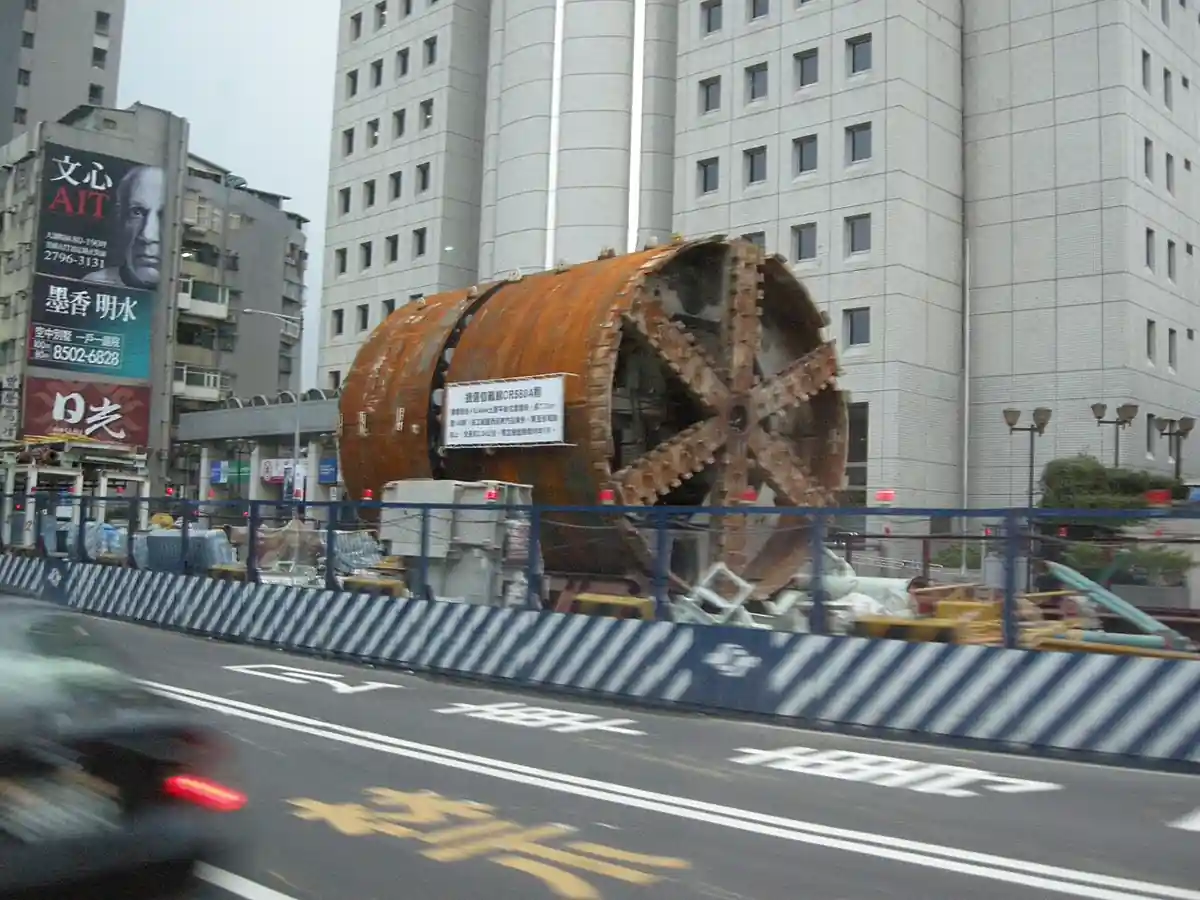
A shield machine is a full-face tunnel boring machine that excavates soft ground or weak, water-bearing rock behind the protection of a cylindrical steel shield, supporting the tunnel face with a controlled pressure and erecting a precast concrete lining as it advances. It is the workhorse of urban metro, water-conveyance, road, and utility tunneling, and the modern descendant of the iron tunnelling shield Marc Isambard Brunel patented in 1818 and used under the Thames from 1825.
The two dominant families are the earth pressure balance (EPB) shield, which supports the face with conditioned excavated soil, and the slurry shield, which supports it with a pressurized bentonite suspension. Choosing correctly between them, and sizing the cutterhead, thrust, segment lining, and face-pressure control to the ground, is the heart of shield-machine procurement.
This guide is written for tunneling procurement engineers and design engineers. Across 6 chapters it covers what a shield machine is, the EPB and slurry types, face-support and segment-lining principles, ground and grain-size applicability, key spec-sheet parameters, and the selection decision sequence, with 7 selection FAQs and manufacturer comparisons. Parameters reference the DAUB and ITA face-support recommendations, ACI 533.5R and EN 1992 (Eurocode 2) for segmental linings, and GB 50446-2017 for shield construction and acceptance.
Chapter 1 / 06
What is a Shield Machine
A shield machine is a self-contained tunneling factory that bores a circular tunnel through soft, unstable, or water-bearing ground while a steel cylinder, the shield, holds the surrounding soil open long enough for a permanent lining to be built. Unlike an open hard-rock machine that braces against competent rock, the shield machine never leaves the ground unsupported: a rotating cutterhead excavates the face, the shield skin supports the bore radially, and a ring of precast concrete segments is erected at the rear under the protection of the shield tail. This continuous chain of support is what lets shield machines drive safely beneath cities, rivers, and the water table.
Functionally a shield machine has five subsystems. The cutterhead at the front, fitted with disc cutters, drag bits, and scrapers, loosens the ground. The shield body, often articulated into front and rear sections for steering, carries the main bearing, drive motors, and bulkhead. The thrust system, a ring of hydraulic cylinders, pushes the whole machine forward by reacting against the last segment ring built. The muck-removal system carries spoil away, by screw conveyor in an EPB machine or by a slurry circuit in a slurry machine. Finally the backup gantries trailing behind house the power packs, control cabin, segment feeder, grouting plant, and (for slurry machines) the slurry feed and discharge lines.
The lineage is well documented. Marc Isambard Brunel patented the tunnelling shield in 1818, and Maudslay completed an 80-tonne rectangular iron shield, about 11 m across and 6.5 m high, that began driving the Thames Tunnel in 1825; the tunnel opened in 1843 as the first beneath a navigable river. Peter Barlow gave the shield a circular cross-section for the Tower Subway in 1870, and James Henry Greathead refined it for the City and South London Railway in 1884. Most modern shield bodies still descend, conceptually, from the Greathead shield. Mechanized rotating cutterheads, the EPB principle (Japan, 1970s) and the slurry principle matured the device into today's pressurized-face machines.
The engineering reason a shield machine exists is face stability. When a tunnel is driven below the groundwater table in sand, silt, or soft clay, the exposed face wants to flow or collapse inward, dragging the ground surface down with it. A shield machine answers this by pressurizing the excavation chamber so that the support pressure inside balances the earth and water pressure outside, holding the face in equilibrium while excavation continues. Everything else about the machine, the cutterhead design, the muck-handling method, the chamber geometry, follows from how that pressure is generated and maintained.
In application scale, shield machines now range from microtunneling pipe-jacking units near 1.7 m diameter to road-tunnel giants exceeding 19 m. The two record machines are the 17.6 m Mixshield used on the Tuen Mun to Chek Lap Kok link in Hong Kong and a 19.25 m Mixshield ordered for the Orlovski Tunnel in St Petersburg. China now manufactures most of the world's shield machines by volume, with CREG having ranked first globally in production and sales for several consecutive years and machines collectively having excavated over 5,000 km of tunnel.
Chapter 2 / 06
Shield Machine Types
Mechanized tunneling makes a fundamental distinction between three soft-ground shield families and the hard-rock shield machines. The two pressurized soft-ground types, EPB and slurry, are defined by how they support the face and remove muck; the hard-rock single and double shields and the open gripper machine are defined by how they react thrust and handle stable rock. The table below compares the principal types by ground, face support, muck removal, and diameter.
The EPB shield (earth pressure balance) supports the face with the excavated soil itself. The cutterhead loosens ground that fills the sealed excavation chamber; the soil is conditioned with water, foam, bentonite, or polymer into a soft plastic paste, and the bulkhead and thrust cylinders press this paste against the face to balance earth and water pressure. A screw conveyor draws the muck out of the chamber, and its rotation speed regulates how much material leaves, which in turn controls the chamber pressure. The EPB shield is the dominant urban-metro machine because it is compact, needs no large surface plant, and reuses the spoil as its own support medium.
The slurry shield, marketed by Herrenknecht as the Mixshield, supports the face with a pressurized bentonite suspension. The suspension penetrates the pore space at the face and forms a near-impermeable filter cake (membrane), through which the support pressure acts. A submerged bulkhead splits the chamber into an excavation part and a working part, where a pressurized air bubble sets the support pressure precisely, with automatically controlled air cushions handling pressures above 15 bar. The slurry carries the muck back through pipes to a surface separation plant that removes solids and recycles the bentonite. Cutting knives and disc cutters excavate the face, and a claw or roll crusher reduces boulders to a pumpable size.
Multi-mode and variable-density machines combine both principles in one shield, switching from slurry-supported to EPB mode as the ground changes. The variable density design muck-removes by screw conveyor but adds a slurry circuit and air-bubble pressure control, giving a continuous spectrum of support-medium density. These machines are the answer to long drives that cross from soft clay into permeable sand and gravel and back, where committing to a single mode would risk face collapse or chamber clogging.
Hard-rock single and double shield TBMs and the open gripper TBM sit at the other end. Single and double shields erect a segmental lining behind a shield in weak or blocky rock; the double shield adds a gripper section so it can advance and ring-build at the same time in good rock, then revert to thrust-against-segments mode in poor rock. The open gripper machine has no shield and no segment lining: it braces radially against stable rock and the crew installs rock bolts, mesh, and shotcrete. These are TBMs but, lacking a pressurized face, are generally not what the industry means by shield machine.
Chapter 3 / 06
Face Support and Lining Principles
Two engineering problems define every soft-ground shield drive: keeping the face stable while excavating, and building a watertight permanent tunnel behind the machine without letting the ground move. The first is solved by face-support pressure, the second by the segmental concrete lining and tail-void grouting. Understanding both is essential before reading any spec sheet.
Face-support pressure is the controlled pressure inside the excavation chamber that balances the earth pressure and groundwater pressure pushing in on the face. If support pressure is too low the face flows inward and the surface settles or sinkholes form; if it is too high the ground heaves or, in shallow cover, blows out to the surface. The required pressure is calculated from the at-rest earth pressure, the water table height, and a safety margin, following the DAUB (German Tunnelling Committee) and ITA recommendations for face-support pressure calculation in soft ground. EPB machines generate this pressure with the conditioned muck and trim it through the screw-conveyor speed; slurry machines generate it with the air cushion over the suspension and trim it within fractions of a bar.
Soil conditioning is what extends the EPB principle beyond pure clays. Conditioning agents, foam, bentonite, polymers, and water, are injected at the cutterhead and into the chamber to turn granular or sticky soils into a homogeneous, low-permeability, low-friction paste. Good conditioning reduces cutterhead torque, prevents clay clogging, lowers permeability so water does not flash through the screw conveyor, and keeps the muck flowing. Conditioning quality is often the single biggest driver of EPB productivity in non-ideal ground.
The segmental lining is the permanent tunnel structure, erected ring by ring inside the shield tail. Each ring is a set of precast reinforced-concrete segments, typically five to ten plus a smaller key segment, lifted by a vacuum or mechanical erector and bolted together radially within the ring and circumferentially to the previous ring. As the machine advances, the annular gap between the segment extrados and the excavated bore is immediately filled with grout, the tail-void grouting that locks the ring in place and is the primary control on long-term settlement. The table below summarizes how the lining scales with tunnel size.
Tunnel Class
Internal Diameter
Typical Segment Thickness
Ring Width
Segments per Ring
Single-track metro
5.4 to 5.8 m
250 to 350 mm
1.2 to 1.5 m
6 (5+1)
Utility / water tunnel
3 to 5 m
200 to 300 mm
1.0 to 1.5 m
5 to 6
Large road tunnel
10 to 15 m
500 to 700 mm
1.8 to 2.2 m
8 to 10 (+key)
Watertightness comes from elastomeric gaskets, usually EPDM, seated in machined grooves around each segment; the gasket is compressed when adjacent segments are bolted, sealing against groundwater inflow at the design water pressure with an appropriate relaxation safety factor. Universal tapered rings are the standard geometry: each ring is slightly wedge-shaped, so rotating the key-segment position lets successive rings steer the tunnel into any curve, up, down, left, or right, with one segment mold. Connection hardware is bolts and dowels: spear bolts on the radial joints within a ring and dowels on the circumferential joints between rings, per the design guidance in ACI 533.5R and EN 1992-1-1, with fire design to EN 1992-1-2.
Chapter 4 / 06
Ground, Grain Size, and Standards
The single most consequential selection decision, EPB versus slurry, is governed by the grain-size distribution of the ground and by the groundwater pressure. The two methods are not interchangeable: forcing an EPB machine through clean, permeable gravel risks water inrush through the screw conveyor and unstable face support, while forcing a slurry machine through plastic clay clogs the separation plant and makes the bentonite impossible to recycle. The applicability map below is the starting point for every shield-machine specification.
EPB applicability. EPB shields were originally developed for fine-grained and mixed-grained soils with a fines content (particles finer than 0.06 mm) of at least about 30 percent by mass. In such soils with adequate consistency, an EPB shield works with little or no conditioning, because the natural fines give the muck the low permeability and plasticity needed to hold face pressure. The application range has since been pushed into mixed and coarse soils by aggressive conditioning with foams, polymers, polymer suspensions, and high-density slurries, but the further the ground is from the clay end of the chart, the more the productivity and cutter wear depend on conditioning skill.
Slurry applicability. Slurry shields are most at home in coarse-grained, highly permeable sand and gravel, where the bentonite suspension can build a stable filter cake on the face and the air cushion gives precise pressure control. In very coarse, open gravels the suspension may flow into the pores faster than it can stagnate, requiring a denser slurry; at the fine end, clays that disperse into the slurry overload the separation plant. Slurry shields also tolerate high water pressure better than EPB, which is why they dominate deep river and subsea crossings. The table contrasts the two methods on the criteria that decide most projects.
Criterion
EPB Shield
Slurry Shield
Best ground
Fine-grained (≥30% fines <0.06 mm)
Coarse sand and gravel, high permeability
Face pressure control
Screw-conveyor speed, less fine
Air cushion, very fine (sub-bar)
Max water pressure handled
Lower, harder to seal
Higher, >15 bar with air cushion
Surface settlement risk
Higher in granular ground
Lower, positive face support
Surface plant footprint
Small
Large (separation plant, slurry lines)
Relative capital cost
Lower
Higher
Boulder handling
Limited, screw blockage
Good, with crusher in chamber
Several published standards and guidelines govern shield design, construction, and acceptance, and a procurement specification should cite the relevant ones explicitly. For face-support pressure calculation, the DAUB and ITA recommendations are the international reference. For the precast segmental lining, ACI 533.5R is the North American guide and EN 1992-1-1 (Eurocode 2) the European structural code, with EN 1992-1-2 for fire. In China, GB 50446-2017, the Code for construction and acceptance of shield tunnelling method, governs the works, and national standards cover full-face boring-machine equipment. British practice references BS 6164 for safety in tunneling. Citing the applicable standards in the contract pins down lining design loads, gasket water-tightness tests, and acceptance tolerances that otherwise vary by supplier.
One more ground parameter deserves a procurement line of its own: abrasivity. Quartz-rich sands and gravels and hard-rock reaches drive cutter and cutterhead wear, which sets the spacing of maintenance interventions and the choice between drag bits and disc cutters. Abrasivity is characterized in the geotechnical baseline report through indices such as the Cerchar abrasivity index and the LCPC test, and a high value should trigger wear-resistant hardfacing, accessible back-loading cutters, and a larger spare-cutter budget.
Chapter 5 / 06
Key Specification Parameters
A shield-machine spec sheet runs to dozens of lines, but a manageable set of parameters drives the technical and commercial decision: excavation diameter, machine type and mode, installed cutterhead power and torque, total thrust, design face-support pressure, cutterhead rotation and tools, advance rate, segment-ring geometry, and main-bearing and seal design. Each is decoded below.
Excavation (bore) diameter is the outer cutting diameter and the first number on every quote. It is larger than the finished internal tunnel diameter by twice the segment thickness plus the annular grouting gap. The bore diameter sets the segment mold, the shield body length, the installed power, and ultimately the price, so it must be derived from the required clear internal diameter for the metro, road, or pipe service, not chosen loosely.
Cutterhead torque and power determine whether the machine can turn the face in the worst expected ground. Total cutterhead torque is the sum of the cutting torque of the individual tools, the main-bearing and seal friction, the friction on the front, perimeter, and back faces of the cutterhead, the shearing torque at the cutterhead openings, and the torque of the mixing bars in the chamber. Sticky clay and over-filled chambers spike the torque, so machines carry a torque reserve and operators respond by slowing advance, adding conditioning, and raising rotation speed. Installed cutterhead power scales steeply with diameter.
Total thrust is the combined force of the thrust cylinder ring that pushes the shield forward against the last segment ring. It must overcome face resistance, shield-skin friction, and trailing-gear drag with a margin, and it sets the compressive load that the segment ring and its packers must carry without cracking. Insufficient thrust stalls the drive in dense or cohesive ground; excessive thrust damages the lining, so thrust and the lining design are specified together.
Face-support pressure capability is the design and maximum chamber pressure, set by the deepest groundwater head plus earth pressure plus the safety margin from the DAUB and ITA calculation. EPB machines are rated by the chamber and screw-conveyor sealing pressure; slurry machines by the air-cushion pressure, with automatically controlled cushions handling above 15 bar for deep crossings. A machine whose rated pressure does not envelope the worst-case head on the alignment is unbuildable for that job.
Cutterhead tools and rotation. The cutterhead carries a mix of disc cutters for hard ground and rock, drag bits and tear knives for soils, scrapers, and gauge cutters at the perimeter. Disc cutters are commonly 17 inch, with 19 inch and 20 inch used for higher thrust per cutter on hard rock. Cutterhead rotation speed is low, typically a few revolutions per minute, and falls as diameter rises. The opening ratio of the cutterhead, the proportion of open area, trades muck intake against face support and is tuned to the ground.
Advance rate: net boring penetration per stroke or per day; soft cohesive ground gives high, consistent rates, while mixed ground with rock spikes cutter wear and slows progress.
Main bearing and seal: the large-diameter slewing bearing and its multi-lip seal system carry the cutterhead and are the machine's life-limiting components; sealing pressure and grease/oil lubrication are key spec lines.
Articulation and steering: active articulation cylinders between front and rear shield let the machine negotiate the minimum design curve radius without overcutting.
Tail seal: wire-brush tail-skin seals injected with sealant keep grout and groundwater out of the shield as segments are built; the number of brush rows scales with water pressure.
Backup and logistics: gantry length, segment-feeder throughput, grouting and conditioning plant capacity, and (slurry) the separation-plant capacity all gate the achievable advance.
Chapter 6 / 06
Selection Decision Factors
Translating the geotechnical baseline and the tunnel geometry into a specific machine specification follows a fixed sequence. Most selection failures come not from a single wrong number but from deciding a downstream parameter before an upstream one is settled. The eight steps below can serve as an RFQ template for a shield-machine procurement.
Ground model and method: from the grain-size envelope, permeability, and groundwater head, decide EPB, slurry, or multi-mode. Fine-grained low-permeability ground favors EPB; coarse permeable ground and high water pressure favor slurry; variable ground along the drive favors a switchable machine.
Diameter and lining: derive the bore diameter from the required clear internal diameter plus twice the segment thickness plus the grouting gap. Fix the ring geometry, segment count, thickness, and gasket water-tightness class against ACI 533.5R or EN 1992 at the same time.
Face-support pressure: calculate the design and maximum chamber or air-cushion pressure from the deepest head per the DAUB and ITA method, and require the machine rating to envelope it with margin.
Cutterhead and tooling: match cutter type (disc versus drag) and spacing, opening ratio, torque, and installed power to the ground strength, abrasivity, and boulder population from the baseline report. Specify back-loadable cutters where ground is abrasive.
Thrust and curve radius: size total thrust to face resistance plus skin friction with margin, check that the segment ring carries the thrust without cracking, and confirm the articulation handles the minimum design curve radius.
Muck and conditioning logistics: for EPB, screw-conveyor capacity, conditioning plant (foam and polymer), and surface muck handling; for slurry, separation-plant capacity, slurry-line diameter, and pump rating. Undersized logistics, not the cutterhead, often caps real advance.
Safety, hyperbaric, and standards: hyperbaric intervention provisions, gas detection, fire suppression, and the cited construction standard (for example GB 50446-2017 or BS 6164). Confirm hyperbaric crew access and saturation diving provisions for high-pressure interventions.
Total cost and schedule: machine price plus refurbishment for reuse, spare cutters and main-bearing, conditioning consumables, separation-plant operation, and the value of advance-rate risk. A cheaper machine mismatched to the ground loses far more in stoppages and settlement claims than the purchase saving.
One dimension that purchasing teams routinely underweight is serviceability and refurbishment: local field-service presence, spare-cutter and main-bearing lead times, the supplier's track record reconditioning machines for a second drive, and how easily cutters can be changed from the back without hyperbaric face entry. Over a multi-year drive these decide downtime far more than headline torque or thrust. Herrenknecht, The Robbins Company, CREG, CRCHI, and the Japanese slurry-shield builders all maintain international service networks, which is why they remain the reliable choices on major projects.
FAQ
What is the difference between a shield machine and a TBM?
Tunnel boring machine (TBM) is the umbrella term for any full-face mechanized excavator. A shield machine is the subset of TBM that carries a steel shield (the cylindrical body) protecting the work area and erecting a segmental lining behind it, used in soft ground or weak, water-bearing rock. Open gripper TBMs, by contrast, have no shield and brace against stable rock walls while the crew installs rock bolts and shotcrete. In practice engineers reserve shield machine for the soft-ground EPB and slurry types, and use TBM loosely for hard-rock gripper and single or double shield machines. All shield machines are TBMs, but not all TBMs are shield machines.
How do I choose between an EPB and a slurry shield?
The decision is driven by grain-size distribution and groundwater. EPB shields suit fine-grained, low-permeability ground, classically soils with at least about 30 percent fines finer than 0.06 mm, where conditioned muck forms a plastic paste that supports the face through a screw conveyor. Slurry shields suit coarse-grained, highly permeable sand and gravel, where a bentonite suspension builds a sealing filter cake and a pressurized air cushion controls face pressure. EPB has a smaller jobsite footprint and lower cost, while slurry gives more precise pressure control, lower settlement risk, and handles high water pressure better. For changing ground, a multi-mode or variable-density machine that switches modes is the safest choice.
What diameters are available and which is right for a metro tunnel?
Shield machines span roughly 1.7 m to over 19 m. Pipe-jacking microtunnel units start near 1.7 m, single-track metro tunnels typically use 6.0 to 7.0 m machines, double-track and large road tunnels use 10 to 15 m, and record machines reach 17.6 m (Tuen Mun in Hong Kong) and 19.25 m (St Petersburg). A standard single-track urban metro bore is the most common case worldwide and almost always specifies an EPB shield around 6.3 to 6.7 m excavation diameter, producing a finished internal diameter near 5.5 m after the segment ring is installed.
What governs the segmental lining and how thick is it?
The lining is precast reinforced concrete segments erected ring by ring inside the shield tail and grouted into the annular gap. Thickness scales with diameter: roughly 250 to 350 mm for 6 m metro tunnels and 500 to 700 mm for 12 to 15 m road tunnels, a common rule being 4 to 6 percent of the diameter. Design follows EN 1992-1-1 (Eurocode 2) in Europe and the ACI 533.5R guide in North America, with gasket selection, bolt and dowel connections, and fire design to EN 1992-1-2. Universal tapered rings let the alignment curve in any direction by rotating the key segment, and EPDM gaskets in machined grooves provide watertightness.
How is the tunnel face kept stable and settlement controlled?
Face stability comes from balancing the support pressure in the excavation chamber against the earth and water pressure of the ground. In an EPB machine the conditioned muck paste transmits the pressure and the screw conveyor regulates it by controlling how fast material leaves the chamber. In a slurry machine a pressurized air bubble over the bentonite suspension holds the pressure, adjustable within fractions of a bar. Face support pressure is calculated per the DAUB and ITA recommendations from at-rest earth pressure, water table, and a safety margin. Tail-void grouting immediately fills the annular gap behind the segments, and together these keep surface settlement within the few-millimeter tolerances required under cities.
What are the main wear and maintenance items on a shield machine?
The highest-wear items are the cutterhead tools: disc cutters (commonly 17 or 19 inch on hard ground), drag bits, scrapers, and the gauge cutters at the perimeter, all of which are replaced during scheduled interventions. Disc cutters are changed when ring wear or bearing failure is detected, increasingly from the back through accessible hubs to avoid hyperbaric face entry. Other critical items are the main bearing and its seal system, the screw conveyor flights (EPB) or the slurry crusher and pumps (slurry), the articulation and thrust cylinders, and the tail-skin wire-brush seals that are renewed periodically. Planned maintenance stops are scheduled at intervals set by the ground abrasivity and the cutter-life prediction.
Which manufacturers build shield machines and how do they compare?
Herrenknecht (Germany) is the long-standing technology leader, with the EPB Shield, Mixshield slurry, Multi-mode, and Variable Density product lines and the largest-diameter machines built. The Robbins Company (USA) is established in hard-rock and single or double shield TBMs. Among Chinese builders, CREG (China Railway Engineering Equipment Group) has ranked first in the world in shield machine production and sales for several consecutive years and exports to 20-plus countries, while CRCHI (China Railways Construction Heavy Industry) and CCCC Tianhe are also major exporters. Japanese makers JIM Technology, Hitachi Zosen, and Kawasaki remain strong in slurry shields. Chinese machines typically price well below European equivalents and now hold most of the global volume.