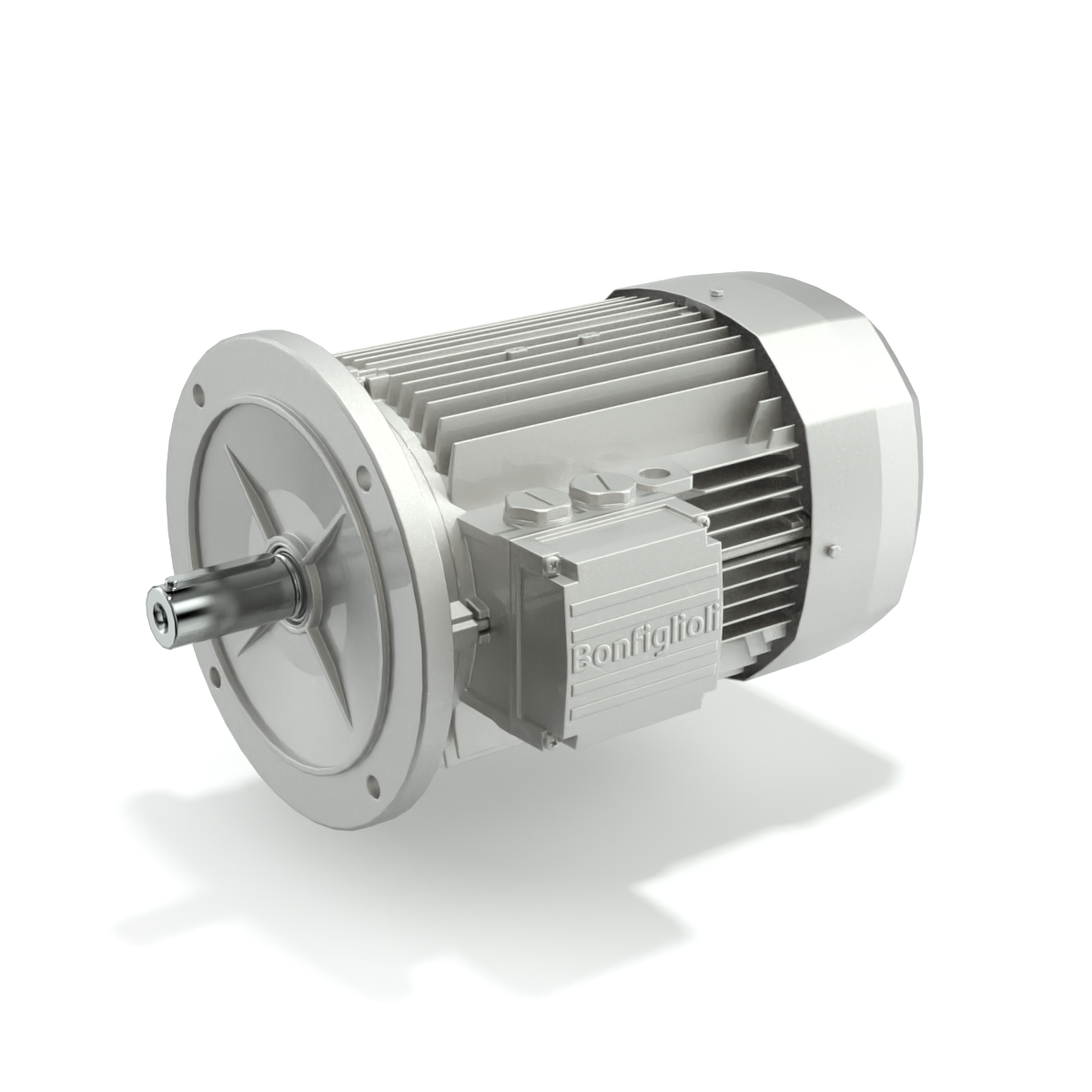
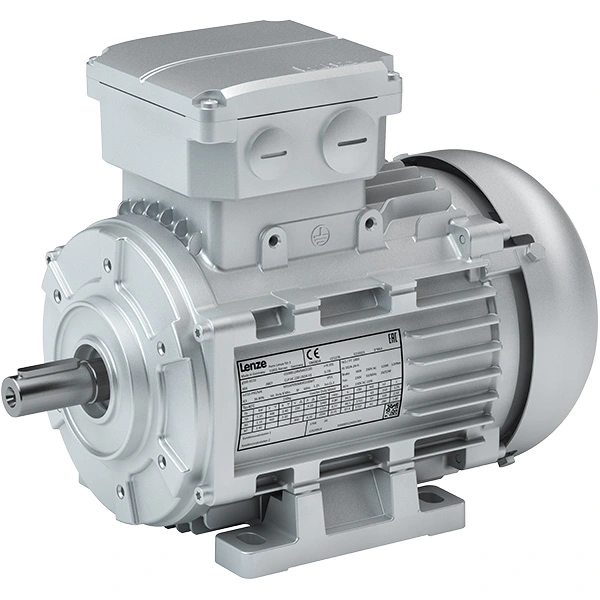
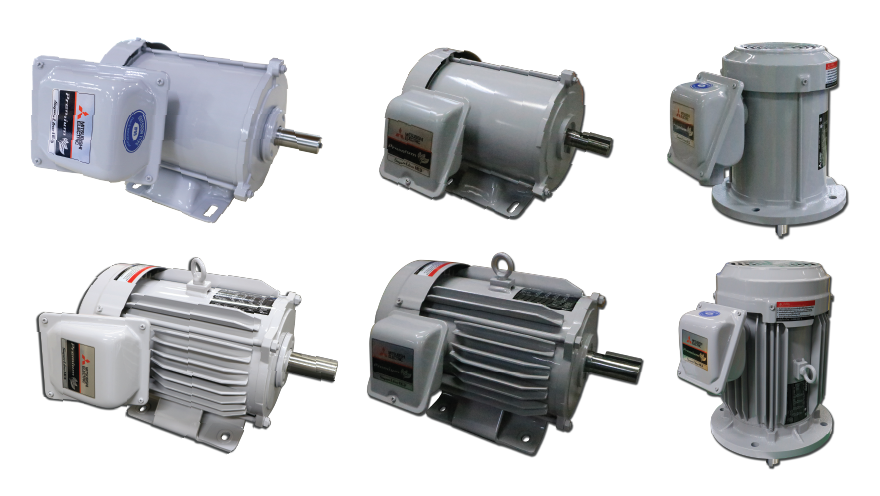
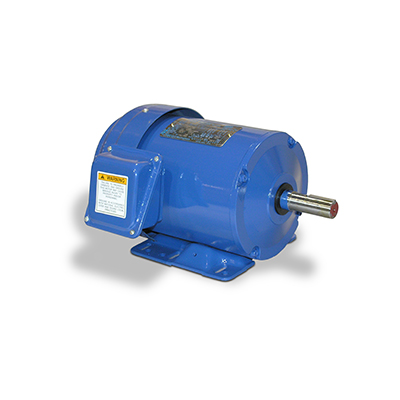
An AC (alternating current) motor is an electromechanical machine that converts AC electrical power into rotary mechanical power. It is the single most widely used prime mover in industry, classified under Electrical & Automation › Drives & Motors. AC motors dominate fixed-speed and variable-speed drive applications for pumps, fans, compressors, conveyors, machine tools, and HVAC because they are robust, low-maintenance, and inexpensive relative to the power they deliver.
Photo: Zureks, CC BY-SA 3.0, via Wikimedia Commons
This guide is aimed at industrial purchasing engineers and design engineers. It covers 6 chapters spanning what an AC motor is and how it works, the major motor families, mainstream technologies, materials and media, the key rated parameters with correct units and governing standards, and the selection decision sequence, with 7 procurement FAQs and a manufacturer overview. All parameters reference the IEC 60034 series, IEC 60085, and NEMA MG-1 public standards.
Chapter 1 / 06
What is an AC Motor
An AC motor is an electromechanical machine that converts alternating-current electrical power into rotary mechanical power. It is the single most widely used prime mover in industry, sitting under Electrical & Automation › Drives & Motors. AC motors dominate fixed-speed and variable-speed drive applications for pumps, fans, compressors, conveyors, machine tools, and HVAC because they are robust, low-maintenance, and inexpensive relative to the power they deliver. Where a process needs continuous rotary motion, an AC motor is almost always the default answer, and the engineering question becomes which family and which rating, not whether to use one.
The core of every AC motor is the interaction between a stationary stator and a rotating rotor. AC current flowing through the stator windings produces a rotating magnetic field whose rotational speed is the synchronous speed, given by the relation n_s = 120 × f / p (rpm), where f is the supply frequency in Hz and p is the number of poles. The constant 120 is what converts cycles per second into revolutions per minute for the formula's pole-pair arithmetic. Cross-verified worked values follow directly: at 50 Hz a 2-pole motor turns 3000 rpm, a 4-pole 1500 rpm, a 6-pole 1000 rpm, and an 8-pole 750 rpm; at 60 Hz the same pole counts give 3600, 1800, 1200, and 900 rpm. Pole count therefore sets the base speed, and a variable-frequency drive changes the speed by changing f.
Two distinct physical mechanisms produce torque, and they define the two great families of AC motor. In an induction (asynchronous) motor, the rotating stator field cuts the rotor conductors and induces a rotor current (Faraday/Lenz law), which then interacts with the field to produce torque. For that induced current to exist there must be relative motion, so the rotor must turn slightly slower than synchronous speed. This lag is called slip, defined as s = (n_s − n) / n_s, and it is typically 1 to 5 percent at full load for standard designs. That is why a motor nominally described as "1500 rpm" on a 50 Hz 4-pole supply actually runs around 1440 to 1480 rpm under load. Crucially, no external rotor power source is needed, which is exactly why the induction motor is the industrial workhorse.
In a synchronous motor, the rotor carries its own magnetic field, supplied either by DC-excited windings (through slip rings or a brushless exciter) or by permanent magnets (PMSM). The rotor locks to the rotating stator field and runs at exactly synchronous speed with zero slip, regardless of load, until the pull-out torque is exceeded. Because it has no inherent starting torque, a synchronous motor needs a starting method such as a damper (amortisseur) cage, a VFD, or a pony motor. The trade-off is precise speed and, for DC-excited machines, the ability to correct plant power factor by over-excitation. This page covers both families, the operating physics above, the key rated parameters with correct units, the governing IEC and NEMA standards, the selection criteria, and the leading manufacturers.
Fig. 1.1 The stator's rotating magnetic field induces current in the rotor; an induction rotor lags synchronous speed by the slip, while a synchronous rotor locks to the field at exactly n_s.
Four engineering realities shape every AC motor decision: the load's torque demand and speed-torque curve, the duty cycle, the efficiency class, and the operating environment. Of these, efficiency increasingly dominates the economics. For a high-runtime motor, the lifetime energy bill dwarfs the purchase price many times over, so an apparently expensive premium-efficiency machine is frequently the cheapest choice across its service life. The rest of this guide builds the framework to make that judgment correctly.
Chapter 2 / 06
Major Motor Types
AC motors divide into three broad families: three-phase induction (the dominant industrial type), single-phase induction (for small powers in residential and commercial use), and synchronous (for precision speed, high efficiency, and power-factor correction). A fourth family, the universal motor, runs on AC or DC and is treated separately. The table below summarizes the principal types and their characteristic duty before each is explained in detail.
Very cheap, low efficiency: small fans, microwaves
DC-excited synchronous
Synchronous
Large (100s of kW+)
Constant speed, power-factor correction
PMSM / SynRM
Synchronous
Fractional to MW
High efficiency (IE4/IE5), servo, EV drives
Three-phase induction motors are the backbone of industry, and they come in two rotor constructions. The squirrel-cage rotor is a set of bare aluminum or copper bars shorted by end rings, with no windings and no brushes. It is the cheapest, most rugged, and lowest-maintenance machine ever devised, and it is the default for the vast majority of industrial drives. The wound-rotor (slip-ring) motor instead carries insulated rotor windings brought out through slip rings, so external resistance can be inserted to boost starting torque and limit inrush current, or to give a measure of speed control. That capability comes at the cost of brushes and slip rings to maintain, so wound-rotor machines are reserved for high-inertia and hard-starting loads such as large crushers, mills, and hoists.
Single-phase induction motors serve small powers, typically under about 3 kW, where only single-phase supply is available. Because a single-phase winding alone cannot create a rotating field, each design adds a phase-shifting trick to start. A split-phase motor uses an auxiliary start winding with a centrifugal switch that drops out near about 75 percent of speed; it gives modest starting torque (about 100 to 125 percent of rated) and high starting current, suiting fans and small tools. A capacitor-start (CSIR) motor adds a start capacitor for high starting torque (typically 200 to 400 percent of rated), good for compressors and pumps. A permanent-split capacitor (PSC) motor keeps a capacitor permanently in circuit for smooth, efficient, quiet running with low starting torque, ideal for HVAC blowers, fans, and office machines. A capacitor-start/capacitor-run motor uses both capacitors for high start torque and good run efficiency. The shaded-pole motor uses a shorted copper ring (a shading coil) on part of each pole to create the phase shift; it is very cheap with very low efficiency and starting torque, found in small direct-drive fans and microwaves.
Synchronous motors run at exactly synchronous speed. The DC-excited type is used in large drives and can correct plant power factor by over-excitation. The permanent-magnet synchronous motor (PMSM) delivers high efficiency in the IE4 to IE5 class and is the standard for EV, servo, and high-efficiency drives. The synchronous reluctance motor (SynRM) reaches IE4/IE5 efficiency with no rotor magnets or rotor copper, an attractive route to premium efficiency without rare-earth material. Finally, universal (series) motors run on AC or DC and reach very high speed, powering handheld power tools and vacuums; they are technically AC-capable but form a separate family from the induction and synchronous machines above.
Chapter 3 / 06
Mainstream Technologies
Beyond the type taxonomy, three technology themes determine how a modern AC motor performs: the torque-production mechanism (induction versus synchronous), the starting and speed-control method, and the efficiency-class technology. Understanding these themes explains why two motors of identical rated power can differ sharply in price, controllability, and lifetime energy cost.
Induction versus synchronous torque production. The induction motor's appeal is self-starting simplicity: the rotating stator field induces rotor current with no external rotor supply, and torque appears automatically whenever slip is present. The penalty is that the rotor always lags by the slip, so speed sags slightly with load and rotor losses are inevitable. The synchronous motor's appeal is exact speed and, for the DC-excited type, controllable power factor; the penalty is the need for a separate excitation source and a starting method. Permanent-magnet and synchronous-reluctance designs eliminate rotor excitation losses entirely, which is the physical reason they reach the highest efficiency classes.
Starting methods. The simplest start is direct-on-line (DOL), connecting the motor straight to the supply; it is cheap but draws locked-rotor current of roughly 600 to 650 percent of full-load current for a NEMA Design B machine, stressing the supply and the driven equipment. Reduced-voltage starting (star-delta, autotransformer, or solid-state soft starter) limits that inrush. A wound-rotor motor limits inrush and raises starting torque by inserting rotor resistance. Synchronous motors start on a damper (amortisseur) cage, a pony motor, or a VFD. Where speed must vary, a variable-frequency drive both starts the motor gently and controls its speed by varying frequency and voltage together.
Speed control and inverter duty. The variable-frequency drive (VFD) is the dominant speed-control technology, and it changes the motor's requirements. VFD-fed motors should specify inverter-duty insulation to withstand the fast voltage edges (dV/dt) of pulse-width modulation, and they need insulated or ceramic bearings to block circulating shaft currents that would otherwise pit the bearing races. IEC 60034-30-2 specifically covers the efficiency of motors operated on a VFD, recognizing that line-fed and inverter-fed performance differ.
Efficiency-class technology. The march from IE1 to IE5 is achieved by reducing each loss mechanism: more and better-grade electrical steel to cut core losses, more copper (and copper rather than aluminum rotor bars) to cut conductor losses, tighter air gaps, and improved cooling. Permanent-magnet and synchronous-reluctance rotors remove rotor losses outright. The result is that full-load efficiency ranges from roughly 84 percent for a small IE2 motor up to about 96.5 percent for a large IE4 machine, with IE5 targeting roughly a further 20 percent loss reduction beyond IE4. The standards that codify these classes are detailed in Chapter 5.
Chapter 4 / 06
Materials and Media
An AC motor is built from a small set of well-understood materials, and their selection directly governs efficiency, thermal life, and reliability. Unlike a process instrument, the working "medium" an AC motor handles is electrical energy in and a mechanical load (the driven equipment) out, with ambient air as the usual cooling medium. The material choices below are what separate an economy single-phase motor from a premium-efficiency industrial machine.
Stator and rotor core. Both cores are built from thin laminated electrical (silicon) steel sheets, insulated from one another and stacked. The lamination and silicon content are deliberate: they minimize eddy-current and hysteresis losses that would otherwise heat the core and waste energy. Thinner, higher-grade steel is one of the primary levers for reaching higher IE efficiency classes.
Stator windings. The windings are insulated copper magnet wire (enamel-coated). Some economy and single-phase motors substitute aluminum to cut cost, accepting higher resistance and lower efficiency. Copper is the premium choice and contributes directly to the lower conductor losses of premium-efficiency designs.
Rotor conductors. In a squirrel-cage rotor the bars and end rings are standardly die-cast aluminum; premium-efficiency machines use copper bars and end rings, which reduce rotor losses at the cost of a more demanding casting or fabrication process. This single change can move a design up an efficiency class.
Insulation system. The winding insulation is a varnish or resin-impregnated system whose thermal class governs the maximum allowable temperature (see Chapter 5). Shaft material is carbon or alloy steel. Bearings are rolling-element (ball or roller), grease- or oil-lubricated; on VFD-fed motors, insulated or ceramic bearings are specified to block damaging shaft currents. The frame and enclosure are cast iron for heavy industrial duty, aluminum for light or HVAC service, or steel, and in totally enclosed fan-cooled (TEFC) designs an internal or external fan moves cooling air over the frame.
The table below maps the principal materials to their function and the trade-off that drives their selection.
Reading a motor nameplate and datasheet is a fundamental skill for purchasing engineers. A datasheet may list dozens of fields, but a defined set of rated parameters, each with a correct unit, drives the selection decision. The comparison table below sets out the principal parameters, their units, and typical ranges; the governing standards follow.
Parameter
Unit
Typical Range / Values
Governing Standard
Rated power (output)
kW (hp)
Fractional (<0.75 kW) to multi-MW; 1 hp ≈ 0.746 kW
Locked-rotor current ~600 to 650% of FLA (NEMA Design B)
NEMA MG-1
Torque
N·m (or % of rated)
Rated, locked-rotor, pull-up, breakdown (maximum)
IEC 60034-1 / NEMA MG-1
Efficiency
%
~84% (small IE2) up to ~96.5% (large IE4)
IEC 60034-30-1
Power factor (cos φ)
—
~0.78 to 0.95 lagging at full load
IEC 60034-1
Slip
%
~1 to 5% standard; NEMA Design D 5 to 13%
NEMA MG-1
Insulation class
°C
A 105, B 130, F 155, H 180 (max hot-spot)
IEC 60085
Ingress protection
IP code
IP55 (TEFC typical); IP23 (drip-proof)
IEC 60034-5
Cooling method
IC code
IC411 = TEFC (frame-surface, shaft-mounted fan)
IEC 60034-6
Duty type
S1 to S10
S1 continuous; S3 intermittent periodic; etc.
IEC 60034-1
Mounting (IM code)
IM Bxx
IM B3 foot-mounted; IM B5 flange-mounted
IEC 60034-7
Frame size
mm (IEC) / designation (NEMA)
IEC 132/160/200 (shaft height); NEMA 56/145T/286T
NEMA MG-1
Service factor (NEMA)
—
e.g. 1.15 = continuous overload margin
NEMA MG-1
Rated power, voltage, and frequency. Rated output power is given in kW (or hp, where 1 hp ≈ 0.746 kW) and spans fractional sizes below 0.75 kW up to multi-MW machines. Low-voltage standards are 230/400 V and 400/690 V on IEC 50 Hz systems, or 208/230/460/575 V on NEMA 60 Hz systems; medium-voltage machines use 3.3, 6.6, or 11 kV. Frequency is 50 or 60 Hz nominal, and together with pole count it sets the synchronous speed.
Current and torque. The nameplate lists full-load (rated) current in amperes; the locked-rotor (starting) current is typically about 600 to 650 percent of FLA for a NEMA Design B motor. Torque is characterized at several points: rated (full-load) torque, locked-rotor (starting) torque, pull-up torque, and breakdown (maximum) torque, usually expressed in N·m or as a percentage of rated torque. Matching this torque curve to the load is the heart of selection.
Efficiency, power factor, and slip. Full-load efficiency runs from about 84 percent for a small IE2 motor up to about 96.5 percent for a large IE4 machine. Power factor (cos φ) is roughly 0.78 to 0.95 lagging at full load and degrades at part load and no load, which is one reason chronic oversizing is harmful. Slip is about 1 to 5 percent for standard designs, rising to 5 to 13 percent for high-slip NEMA Design D machines.
Thermal, protection, cooling, and duty. Insulation class per IEC 60085 caps the winding hot-spot temperature: Class A 105 °C, B 130 °C, F 155 °C, H 180 °C. The common, reliable industrial specification is Class F insulation with Class B temperature rise (about 80 K), which banks thermal margin for long life. Ingress protection per IEC 60034-5 (for example IP55, dust-protected and water-jet-protected, typical for TEFC motors; IP23 drip-proof) describes enclosure sealing. Cooling per IEC 60034-6 is an IC code, for example IC411 = totally enclosed, frame-surface cooled by a shaft-mounted fan (TEFC). Duty type per IEC 60034-1 ranges over S1 continuous, S2 short-time, S3 intermittent periodic, S4 intermittent with starting, S5 with electric braking, S6 continuous-operation periodic, S7 with braking, S8 with load/speed changes, S9 non-periodic load/speed, and S10 discrete constant loads.
Mounting, frame, and service factor. The mounting arrangement (IM code per IEC 60034-7) covers, for example, IM B3 foot-mounted and IM B5 flange-mounted. Frame size is mechanical: an IEC frame number is the shaft-centerline height in mm (for example 132, 160, 200), while NEMA uses frame designations such as 56, 145T, or 286T per NEMA MG-1. The service factor (mainly a NEMA concept), for example 1.15, is the allowable continuous overload margin above rated power.
Governing standards. The IEC 60034 series is the international backbone: IEC 60034-1 covers rating and performance, including duty types S1 to S10; IEC 60034-2-1 defines the standard methods for determining losses and efficiency from tests; IEC 60034-5 the degrees of protection (IP code); IEC 60034-6 the methods of cooling (IC code); and IEC 60034-7 the mounting arrangements (IM code). IEC 60034-30-1 defines the efficiency classes (IE code) for line-operated AC motors, with a scope of 0.12 kW to 1000 kW, rated voltage above 50 V up to 1 kV, 2/4/6/8 poles, at 50 or 60 Hz; the classes are IE1 Standard, IE2 High, IE3 Premium, IE4 Super-Premium, and IE5 Ultra-Premium (IE5 targets roughly a further 20 percent loss reduction versus IE4), while IEC 60034-30-2 covers VSD-fed motors. IEC 60085 defines the thermal (insulation) classification. NEMA MG-1 is the North American equivalent, defining frame dimensions, Design letters, and efficiency: Design B is normal torque and normal starting current (the most common general-purpose machine); Design A has higher maximum torque and higher starting current; Design C gives high starting torque with low starting current (conveyors, compressors); and Design D is high slip (5 to 13 percent) with the highest starting torque (punch presses, hoists, flywheel loads). On the regulatory side, U.S. DOE 10 CFR Part 431 sets a minimum efficiency (IE3/Premium baseline) for many integral-horsepower motors, and the EU and global MEPS regime mandates IE3 (and IE4 for some ratings) for line-fed motors.
Chapter 6 / 06
Selection Decision Factors
To turn the preceding chapters into a specific model, work through the decision sequence below. Most selection mistakes come not from a single wrong answer but from deciding the wrong thing first, for example fixing the frame size before the load's torque demand is understood. These eight criteria can serve as a fixed RFQ template.
Load profile and torque demand: Match the starting and breakdown torque and the whole speed-torque curve to the load. A centrifugal pump or fan needs low starting torque, while a conveyor or crusher needs high starting torque, pointing to NEMA Design C or D or a wound-rotor machine.
Speed and control: Decide fixed-speed direct-on-line versus variable speed via a VFD. With a VFD, favor inverter-duty insulation and bearing protection. The number of poles sets the base speed via n_s = 120 × f / p.
Power and duty cycle: Size for the real duty, whether continuous (S1) or intermittent. Avoid chronic oversizing, which depresses power factor and part-load efficiency rather than buying useful margin.
Efficiency class: Meet or exceed the regional MEPS requirement (IE3 minimum in most markets), and choose IE4 or IE5 for energy-critical, high-runtime loads where the energy saving pays back the premium.
Environment: Specify the enclosure and IP rating, the cooling method, the ambient temperature and altitude derating, and hazardous-area (Ex) certification where the atmosphere requires it.
Voltage and frequency: Confirm what the site actually supplies, then confirm mounting (foot or flange) and frame size for the mechanical fit to the driven equipment.
Insulation and thermal margin: Specify Class F insulation with Class B temperature rise for reliability, and add thermal protection (PTC thermistors) for critical drives.
Total cost of ownership: For high-runtime motors, lifetime energy cost dwarfs purchase price, so the efficiency class usually dominates the decision over the sticker price.
One dimension worth weighing alongside the eight above is the manufacturer's industrial footprint. ABB, Siemens, WEG (including the Marathon industrial motors business acquired from Regal Rexnord in 2024), Nidec (including Nidec Leroy-Somer, Nidec Motor Corporation, and U.S. Motors), Toshiba, Hitachi, TECO (TECO Electric & Machinery, with TECO-Westinghouse in North America), Wolong (which acquired GE's small industrial motors business in 2018), and Cantoni Group are among the principal global suppliers of industrial AC motors across the low- and medium-voltage ranges. Spare-part availability, local service, and a long history of the exact frame and efficiency class you need are practical advantages that only become visible years into the motor's service life.
FAQ
What is the difference between an induction motor and a synchronous motor?
An induction (asynchronous) motor has no external rotor power source: the rotating stator field induces current in the rotor conductors (Faraday/Lenz), and the rotor must run slightly slower than synchronous speed so that relative motion exists. That lag is slip, typically 1 to 5 percent at full load for standard designs, so a 50 Hz 4-pole motor rated 1500 rpm actually runs about 1440 to 1480 rpm. A synchronous motor carries its own rotor field (DC-excited windings or permanent magnets) and locks to the stator field, running at exactly synchronous speed with zero slip regardless of load until pull-out torque is exceeded. Synchronous motors need a starting method such as a damper cage, a VFD, or a pony motor because they have no inherent starting torque. Induction motors, especially squirrel-cage, are the rugged low-maintenance workhorse for most industrial drives.
How do I calculate the speed of an AC motor?
Synchronous speed is n_s = 120 x f / p, where f is supply frequency in Hz and p is the number of poles, and 120 converts cycles per second into revolutions per minute. At 50 Hz a 2-pole motor turns 3000 rpm, 4-pole 1500 rpm, 6-pole 1000 rpm, and 8-pole 750 rpm; at 60 Hz the same pole counts give 3600, 1800, 1200, and 900 rpm. A synchronous motor runs at exactly that speed. An induction motor runs slightly slower because of slip, s = (n_s - n) / n_s, typically 1 to 5 percent at full load, so a nominal 1500 rpm 4-pole 50 Hz machine settles around 1440 to 1480 rpm. To vary speed, a variable-frequency drive changes f, while the number of poles sets the base speed.
What is the difference between a squirrel-cage and a wound-rotor motor?
A squirrel-cage rotor is a set of bare aluminum or copper bars shorted by end rings, with no windings and no brushes. It is the cheapest, most rugged, lowest-maintenance design and the default for the vast majority of industrial drives. A wound-rotor (slip-ring) motor instead carries insulated rotor windings brought out through slip rings, so external resistance can be inserted to boost starting torque and limit inrush current, or for speed control. Wound-rotor machines suit high-inertia or hard-starting loads such as large crushers, mills, and hoists, at the cost of higher price and the maintenance burden of brushes and slip rings. For most pump, fan, and conveyor duties the squirrel-cage motor is the correct default.
What do the IE efficiency classes (IE1 to IE5) mean?
IE codes are the efficiency classes defined in IEC 60034-30-1 for line-operated AC motors, scoped to 0.12 kW up to 1000 kW, rated voltage above 50 V up to 1 kV, 2/4/6/8 poles, at 50 or 60 Hz. The classes are IE1 Standard, IE2 High, IE3 Premium, IE4 Super-Premium, and IE5 Ultra-Premium, where IE5 targets roughly a further 20 percent loss reduction versus IE4. Full-load efficiency typically runs from about 84 percent for a small IE2 machine up to about 96.5 percent for a large IE4 machine. In most markets the MEPS regime mandates IE3 as the line-fed minimum, with IE4 required for some ratings; in the United States DOE 10 CFR Part 431 sets an IE3/Premium baseline for many integral-horsepower motors. IEC 60034-30-2 covers variable-speed-drive-fed motors. For high-runtime loads, lifetime energy cost dwarfs purchase price, so a higher IE class usually pays back.
What do NEMA Design B, C, and D letters mean for starting torque?
NEMA MG-1 Design letters classify the speed-torque and starting-current behavior of polyphase induction motors. Design B is normal torque with normal starting current and is the most common general-purpose choice, with locked-rotor (starting) current typically around 600 to 650 percent of full-load current. Design A offers higher maximum torque and higher starting current. Design C provides high starting torque with low starting current, suited to hard-to-start loads such as conveyors and compressors. Design D is a high-slip design (5 to 13 percent) with the highest starting torque, used for punch presses, hoists, and flywheel loads. Match the design letter to the load's speed-torque curve: centrifugal pumps and fans need low starting torque, while crushers and hoists need high starting torque or even a wound-rotor motor.
What insulation class and IP rating should an industrial motor have?
Insulation class per IEC 60085 sets the maximum winding hot-spot temperature: Class A 105 C, Class B 130 C, Class F 155 C, and Class H 180 C. The common industrial specification for long life is Class F insulation with Class B temperature rise (about 80 K), which leaves thermal margin and extends winding life. Ingress protection per IEC 60034-5 describes enclosure sealing: IP55 (dust-protected and protected against water jets) is typical for totally enclosed fan-cooled (TEFC) industrial motors, while IP23 covers drip-proof open machines. The cooling method per IEC 60034-6 is given as an IC code, for example IC411 = totally enclosed, frame-surface cooled by a shaft-mounted fan (TEFC). For VFD-fed motors, also specify inverter-duty insulation and insulated or ceramic bearings to block shaft currents.
How do I select the right AC motor for my application?
Work through the load and the environment in order. First match starting and breakdown torque and the speed-torque curve to the load: centrifugal pumps and fans need low starting torque, while conveyors and crushers need high starting torque (NEMA C or D, or a wound-rotor motor). Decide fixed speed direct-on-line versus variable speed via VFD; with a VFD favor inverter-duty insulation and bearing protection, and remember that pole count sets base speed. Size for the actual duty cycle (S1 continuous versus intermittent) and avoid chronic oversizing, which hurts power factor and part-load efficiency. Meet or exceed the regional MEPS efficiency class (IE3 minimum in most markets, IE4 or IE5 for energy-critical high-runtime loads). Confirm enclosure and IP rating, cooling method, ambient temperature and altitude derating, and hazardous-area (Ex) certification if needed. Verify on-site voltage and frequency, mounting (foot or flange) and frame size, and a Class F/B-rise insulation margin with thermal protection. Finally, judge on total cost of ownership: for high-runtime motors lifetime energy cost dwarfs purchase price, so efficiency class usually dominates the decision.
AC Motor Manufacturers
Source-backed product routes. Open a company dossier for procurement scope and cited evidence.
On the SpecForge AC motor channel, browse specification sheets for three-phase induction, single-phase induction, and synchronous AC motors, spanning squirrel-cage, wound-rotor, capacitor-start, PSC, shaded-pole, DC-excited synchronous, PMSM, and synchronous-reluctance designs from fractional sizes to multi-MW. This channel covers models from leading manufacturers including ABB, Siemens, WEG (Marathon), Nidec (Leroy-Somer / Nidec Motor Corporation / U.S. Motors), Toshiba, Hitachi, TECO (TECO-Westinghouse), Wolong (GE Industrial Motors), and Cantoni Group, with filtering by rated power (kW/hp), efficiency class (IE1 to IE5), poles and speed, enclosure and IP rating (for example IP55 TEFC), insulation class (A/B/F/H), duty type (S1 to S10), and mounting (IM B3 / IM B5). Every parameter references the IEC 60034 series, IEC 60085, and NEMA MG-1 public standards, helping procurement engineers and design engineers complete a motor selection decision with confidence.