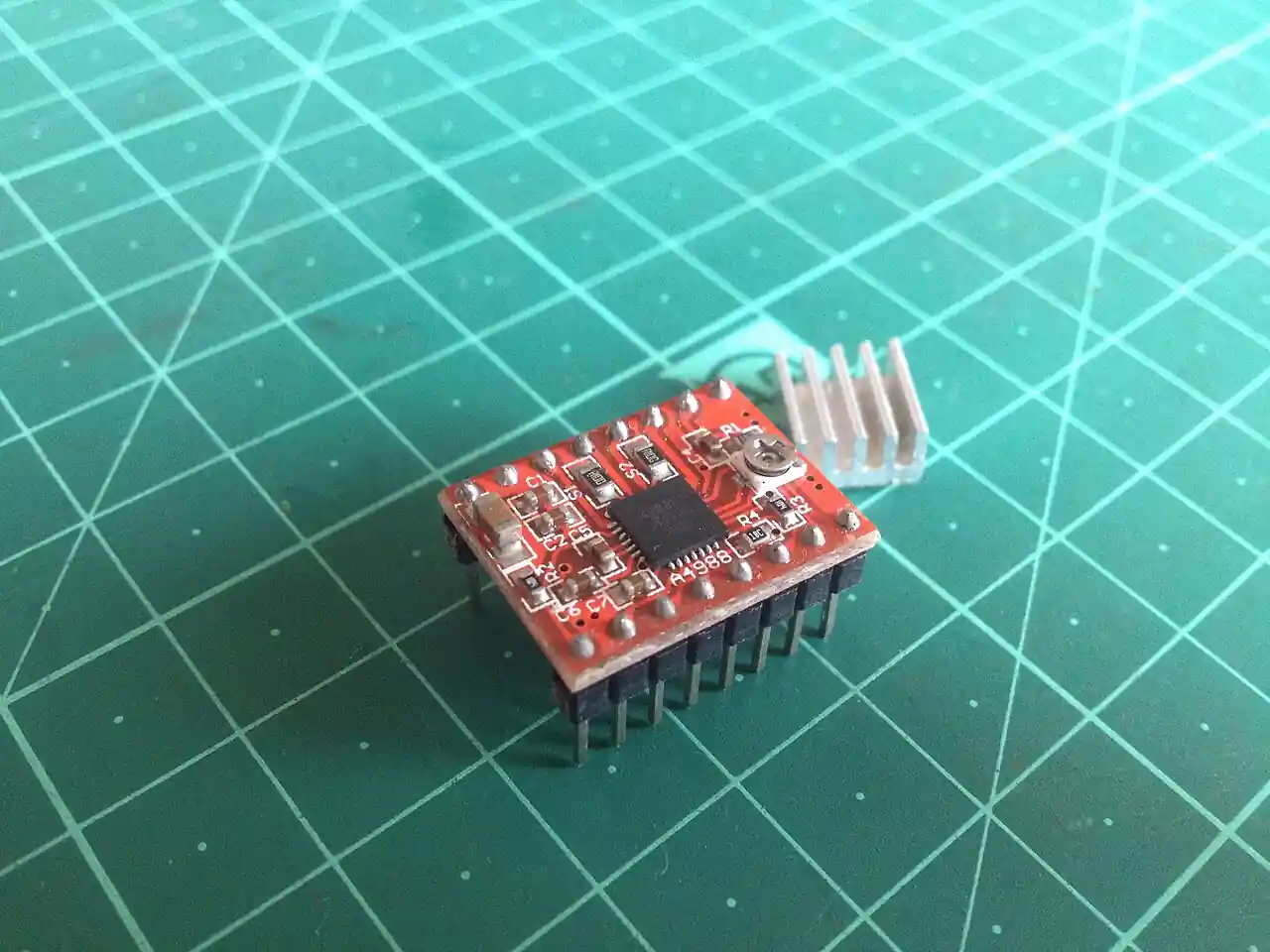
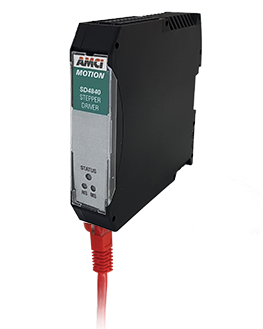
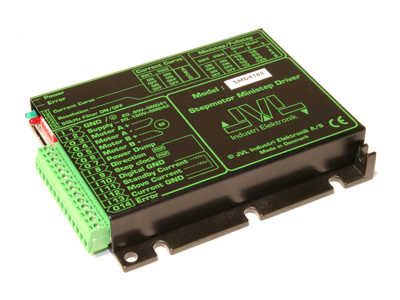
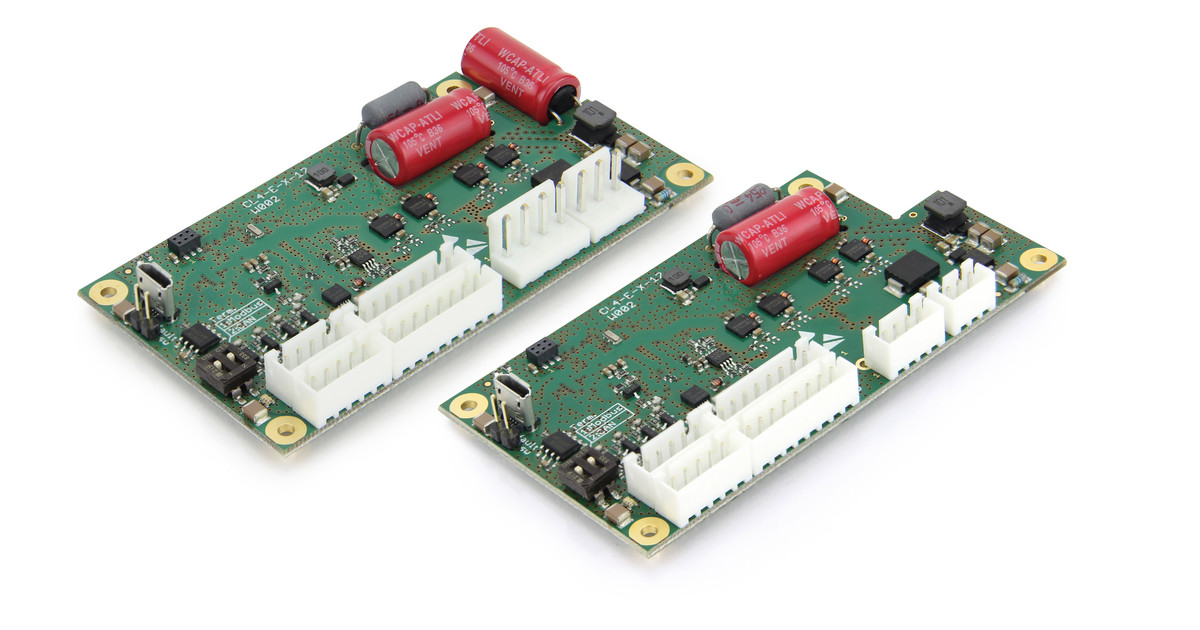
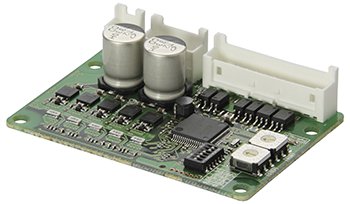
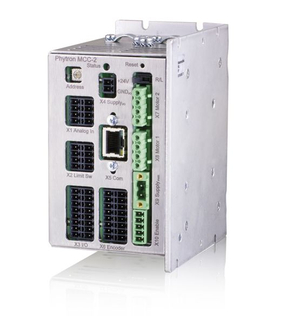
A stepper drive is the power-electronics stage that energises the windings of a stepper motor, converting a low-power step or fieldbus command into precisely regulated coil current. It is the half of a stepper system that does the heavy lifting: a controller decides where to move, and the drive delivers the switching current that makes the rotor advance in fixed, repeatable increments without any feedback device in the simplest case.
Although hobby boards and industrial cabinets both run steppers, the engineering that separates them lives in the drive: chopper current regulation, microstep resolution, resonance damping, supply-voltage headroom, and increasingly closed-loop feedback and fieldbus communication. This guide decodes those choices for buyers and design engineers selecting a drive for positioning duty.
This guide is written for industrial purchasing engineers and design engineers. It spans 6 chapters from what a stepper drive is, through drive types, current-control and microstepping technology, supply voltage and interface standards, to spec-sheet decoding and selection decisions, with 7 selection FAQs. Parameters and safety functions reference public standards including IEC 61800-5-2 (drive functional safety), IEC 61508, ISO 13849-1, the CiA 402 drive profile, and the NEMA ICS 16 motion-control framework.
Chapter 1 / 06
What is a Stepper Drive
A stepper drive is the electronic power stage that switches the high-current windings of a stepper motor in the correct sequence and at the correct current level, so that the rotor advances one discrete step per command. It sits between the motion controller, which generates the trajectory, and the motor, which converts current into torque. On a two-phase hybrid stepper, the most common industrial type, the drive must energise two windings in a sine and cosine pattern, reversing the current direction in each phase through an H-bridge so the magnetic field rotates and the rotor follows it step by step.
The defining trait of a stepper system is that, in its basic form, it positions without feedback. A standard 1.8 degree hybrid motor has 200 full steps per revolution fixed by its tooth geometry, so a controller that counts out exactly 200 pulses knows the shaft has turned one revolution, provided the motor never lost a step. This open-loop simplicity is why steppers dominate cost-sensitive precision motion: 3D printers, laboratory pumps, semiconductor handlers, CNC routers, textile machinery, and stage automation. The drive is what makes that open-loop promise hold up under real load, speed, and temperature.
A stepper drive is not the same thing as a stepper controller, although low-cost integrated products blur the line. The controller produces the motion profile and the train of step pulses; the drive amplifies those commands into winding current. In a classic architecture the controller is a separate indexer or PLC motion card that sends step-and-direction pulses to a stand-alone drive. In a modern fieldbus drive, a CiA 402 motion-control core is embedded so the drive accepts an absolute position command over EtherCAT or CANopen, merging the two roles. An integrated stepper folds drive, controller, and motor into one body.
The history of the stepper drive tracks the history of switching power electronics. Early 1960s and 1970s drives were constant-voltage (L/R) types that simply switched the rated voltage onto the winding through a resistor, an approach that wasted power and lost torque rapidly with speed. The constant-current chopper drive, which applies a high bus voltage and uses pulse-width modulation to regulate average coil current, displaced it through the 1980s and is now near-universal. Microstepping arrived to subdivide the full step and cut resonance, integrated driver ICs shrank the power stage onto a single chip, and from the 2000s onward closed-loop control and real-time industrial Ethernet pushed the stepper into territory once reserved for servos.
Four engineering attributes determine whether a stepper drive is fit for a given machine: the per-phase current it can deliver and regulate, the supply-voltage headroom that sets high-speed torque, the microstep resolution and quality of its current waveform, and whether it runs open loop or closes a loop around an encoder. Every later chapter expands one of these, and the selection chapter reassembles them into a buying sequence.
Chapter 2 / 06
Stepper Drive Types
Stepper drives split along three independent axes: the current-regulation architecture (constant voltage versus chopper), the feedback architecture (open loop versus closed loop), and the packaging (board-level, stand-alone, integrated). A given product is a point in that three-axis space, for example a stand-alone closed-loop chopper drive, or a board-level open-loop chopper IC. The table below summarises the four functional categories a buyer most often chooses between.
Type
Current Control
Feedback
Typical Use
Constant-voltage (L/R)
Series resistor, no regulation
Open loop
Legacy, very low speed only
Open-loop chopper
PWM constant current
Open loop
3D printers, pumps, indexing
Closed-loop (step-servo)
PWM constant current
Encoder, position loop
Dynamic loads, no missed steps
Integrated stepper
PWM constant current
Open or closed loop
Distributed axes, less wiring
Constant-voltage (L/R) drives are the oldest and now effectively obsolete for positioning. They switch the rated voltage onto the winding, sometimes through an external series resistor that sets the steady current, so winding current rises slowly through the coil inductance. Torque falls off sharply as step rate climbs, and the resistor wastes power as heat. You will still meet L/R drives in legacy equipment and the cheapest unipolar dev boards, but no new industrial positioning design specifies them.
Open-loop chopper drives are the workhorse category. They apply a high bus voltage and use a current-sense resistor plus a comparator to chop the supply on and off, holding the average coil current at a set point regardless of speed or supply variation. Because the current, not the voltage, is regulated, the same drive runs many different motors by changing one current setting, and torque is preserved far higher up the speed range than an L/R drive allows. The vast majority of 3D printers, laboratory instruments, and indexing tables run open-loop chopper drives.
Closed-loop (step-servo) drives add an encoder and close position and current loops like a servo amplifier, while keeping the stepper motor and its high pole count. They eliminate step loss, restart smoothly after a transient overload instead of stalling, raise usable torque at speed, and command only the current the load needs so they run cooler and quieter than open-loop drives that hold full current at standstill. The cost is the encoder and a more complex drive, which is why open loop survives where loads are predictable.
Integrated steppers bolt the drive (and often the controller) directly onto the motor body in a single assembly, available in both open and closed-loop variants. They cut panel space and the long motor cable, which reduces electrical noise, and suit distributed machines where each axis carries its own electronics. The trade is exposure of the electronics to motor heat and machine vibration, and the loss of a centralised cabinet for service. Both stand-alone and integrated drives may be board-level for OEM embedding or DIN-rail for cabinet mounting.
Chapter 3 / 06
Current Control and Microstepping
The heart of a modern stepper drive is its chopper, the circuit that forces the winding current to track a commanded waveform. Understanding how the chopper sets current, and how microstepping shapes that current into a sine and cosine pattern, is what separates a correct selection from a noisy, hot, resonance-prone machine. The table below compares the three stepping modes that the chopper can produce.
Step Mode
Steps per Rev (1.8° motor)
Resolution
Torque vs Full Step
Full step
200
1.8°
100%
Half step
400
0.9°
~70%
Microstep 1/16
3,200
0.1125°
~70%
Microstep 1/256
51,200
0.00703°
~70%
Chopper (constant-current) control works by sensing the actual coil current across a small series resistor and comparing it to a reference. When the sensed current reaches the set point, the chopper turns the high-voltage supply off; current then decays until the next switching cycle turns it back on, so the average is held near the target. This is pulse-width modulation applied to an inductive load. The high bus voltage, typically 10 to 24 times the motor rated voltage, forces current into the winding quickly: a 48 V bus brings a 3 A motor to full current in roughly 150 microseconds, while a 24 V bus needs about 300 microseconds, which is why higher voltage buys high-speed torque.
Microstepping drives the two phases with current at sine and cosine ratios rather than fully on or off, so the rotor settles at intermediate positions between the full-step detents. Subdividing a step into 16, 32, 64, 128, or 256 micro-steps smooths motion, sharply reduces audible noise, and cuts mid-band resonance because each micro-step delivers a far smaller impulse than a full step. A 1.8 degree motor at 1/256 microstepping has a nominal command resolution of 51,200 micro-steps per revolution.
Microstepping does not improve absolute accuracy. This is the most common misconception in stepper selection. The micro-step sizes are not guaranteed to be equal because detent torque, magnetic hysteresis, and pole geometry distort the response even with a perfect current waveform, and torque per micro-step falls as resolution rises, so below a load-dependent threshold a commanded micro-step may not move the rotor at all. A stepper carries a small non-cumulative positioning error, on the order of plus or minus 5 percent of one full step. Use microstepping for smoothness and command resolution, never as a substitute for a precision mechanism or feedback.
Advanced chopper modes manage the off-time and decay behaviour to reduce noise and heat. Constant off-time is the classic scheme; proprietary modes such as the SpreadCycle and StealthChop algorithms in the Analog Devices (Trinamic) TMC family add cycle-by-cycle decay control and a quiet voltage-mode chopper that makes the motor nearly silent at low speed. Load-detection features (StallGuard) sense rising torque for sensorless homing, and current-scaling features (CoolStep) cut current when load is light to save energy. These modes matter most where acoustic noise, heat, or efficiency are constraints.
Half step and full step remain useful where torque, not smoothness, dominates. Half step alternates between one-phase-on and two-phase-on excitation to double resolution, and full step energises both phases for maximum torque. Both half step and microstep produce roughly 30 percent less peak torque than full step, a penalty the designer trades against the large gains in smoothness and resonance immunity that microstepping delivers.
Chapter 4 / 06
Supply Voltage and Interfaces
Two practical decisions sit outside the drive's core electronics but determine whether it integrates cleanly into a machine: the supply voltage that powers the chopper, and the command interface that connects it to the controller. Both are governed more by system context than by the motor alone, and both are common sources of mistakes.
Supply voltage sets the ceiling on high-speed torque, because the bus voltage is what forces current into the inductive winding before the next step. The penalty for too much voltage is heat, audible noise, and worse low-speed resonance. As a guideline, NEMA 11 and NEMA 17 motors run on a 24 to 36 V DC drive, NEMA 23 frames on 24 to 48 V DC, and high-torque NEMA 34 frames on 48 to 80 V DC; the largest motors use AC-input drives that rectify 110 or 230 V AC. A common rule of thumb sets the bus at roughly 10 to 24 times the motor rated (nameplate) voltage, then confirms the drive bus rating, with headroom for the regenerative voltage rise during deceleration.
Frame size follows the NEMA mounting standard, where the number is the faceplate width in tenths of an inch. The drive must supply each motor's per-phase current, so frame size loosely tracks drive current rating. The table below pairs common NEMA frames with their typical drive supply voltage and per-phase current range, as an orientation only; always read the specific motor nameplate.
NEMA Frame
Faceplate
Typical Drive Voltage
Typical Phase Current
NEMA 11
28 mm (1.1 in)
24–36 V DC
0.5–1.0 A
NEMA 17
42 mm (1.7 in)
24–36 V DC
1.0–2.0 A
NEMA 23
57 mm (2.3 in)
24–48 V DC
2.0–4.5 A
NEMA 34
86 mm (3.4 in)
48–80 V DC
4.0–8.0 A
NEMA 42
110 mm (4.2 in)
AC input
6.0–10 A
Step-and-direction (also called pulse-and-direction) is the traditional command interface: one input takes a pulse train whose count and rate set the number and speed of micro-steps, and a second input sets direction. For noise immunity over longer cable, drives accept a 5 V differential line-driver pair on each input; for short runs a single-ended open-collector connection is enough. Some drives also accept CW/CCW dual-pulse, or an analog plus or minus 10 V speed command. This interface is simple and universal, but it carries no feedback or diagnostics.
Fieldbus interfaces are now standard on industrial drives. A real-time bus carrying the CiA 402 drive profile, over EtherCAT (CoE), CANopen, PROFINET, EtherNet/IP, or Modbus RTU, lets the controller send absolute position, velocity, and torque targets on one cable and read back status, actual position, and fault codes. EtherCAT dominates new high-axis-count machines for its determinism and low hardware cost; CANopen and Modbus RTU suit slower, lower-axis-count designs. Fieldbus drives also support stored homing routines, programmed motion sequences, and remote parameter setting that bare step-and-direction cannot.
Functional safety appears on higher-end drives as Safe Torque Off (STO), defined in IEC 61800-5-2. STO hardware-blocks the gate-driver signals through redundant channels so the motor cannot make torque even while the drive stays powered, achieving SIL 2 or SIL 3 per IEC 61800-5-2 and IEC 61508, or Performance Level d or e per ISO 13849-1. The STO input can replace the safety contactor between drive and motor. Many low-cost open-loop drives omit STO, so confirm the certificate if your machine safety assessment requires it.
Chapter 5 / 06
Key Specification Parameters
Stepper-drive data sheets list a long parameter table, but only a handful drive the selection decision: per-phase output current, supply-voltage range, microstep resolution, step (pulse) frequency, feedback support, command interface, and protection class. Each is explained below, with the traps that cause field failures.
Output current per phase is the single most important rating. It is the peak or RMS current the drive can regulate in each winding, and it must match or exceed the motor rated phase current. Vendors quote either peak or RMS, and the two differ by a factor of about 1.414, so compare like with like: a drive rated 2.0 A RMS is roughly 2.8 A peak. Open-loop chopper ICs commonly span 1.0 to 3.0 A peak, stand-alone drives 4 to 8 A, and large AC drives up to 10 A or more. Set the current to the motor nameplate, not the maximum the drive allows, or the motor overheats.
Supply-voltage range states the minimum and maximum DC bus the drive accepts, for example 24 to 80 V DC. Stay inside it with margin: deceleration of a high-inertia load pumps energy back into the bus and raises its voltage, and an undersized margin trips the drive on overvoltage or damages its capacitors. Drives with very wide ranges trade some efficiency for flexibility.
Microstep resolution is the number of micro-steps per full step the drive can produce, commonly selectable from full step up to 1/256, sometimes higher by interpolation. Remember from Chapter 3 that resolution is not accuracy; choose enough resolution to smooth motion and meet the controller's command granularity, but do not assume a finer setting positions more precisely.
Maximum step (pulse) frequency limits how fast the controller can clock the drive, typically 200 kHz to 4 MHz for the step input. The required frequency equals target shaft speed in revolutions per second, times steps per revolution, times the microstep factor, so high microstepping at high speed can demand a very fast pulse source. Verify both the drive input and the controller output can sustain the rate.
Feedback and protocol support tells you whether the drive is open loop or can close a loop around an encoder (1000-line 4000-count, 5000-line 20000-count incremental, or a magnetic absolute device), and which command interfaces it offers. The remaining specifications, listed below, round out a complete data-sheet read:
Idle current reduction: the percentage to which the drive cuts holding current at standstill, typically 50 percent, to limit heat when the axis is not moving.
Protection functions: over-current, over-voltage, under-voltage, over-temperature, and short-circuit shutdown, with a fault output or status word.
Operating temperature and ingress: ambient rating (often 0 to 50 degrees C without derating) and enclosure protection, from open board-level to IP65 integrated motors.
Isolation and EMC: opto-isolated step and direction inputs, and CE or UL marking against the relevant EMC and safety standards.
Form factor: board-level IC for OEM embedding, DIN-rail or panel-mount stand-alone, or motor-mounted integrated.
One parameter that is often missing from the data sheet but matters in the field is resonance behaviour: how well the drive damps mid-band resonance, which for a stepper and its load typically sits between 10 and 200 Hz. Microstepping, velocity-dependent electronic damping, and closed-loop control all suppress it, but a bare full-step open-loop drive may stall when the motion profile sweeps the resonant band, so plan the acceleration ramp to pass through it quickly.
Chapter 6 / 06
Selection Decision Factors
To turn the preceding five chapters into a specific part number, work through the sequence below. Most selection errors come not from a single wrong number but from deciding the wrong layer first, for example picking a fieldbus before confirming the motor current. These eight steps double as a fixed RFQ template.
Motor and current first: identify the motor's phase count (almost always two-phase bipolar), frame size, and rated phase current, then choose a drive whose regulated output current equals or exceeds it. Confirm whether the data sheet quotes peak or RMS and convert by 1.414 before comparing.
Supply voltage and speed: set the bus voltage from the required top speed and the motor inductance, using roughly 10 to 24 times the motor rated voltage as a starting point, then verify the value sits inside both the motor and drive ratings with regenerative headroom.
Open loop or closed loop: choose open loop for predictable, well-margined loads where cost dominates; choose closed loop (step-servo) where the load is dynamic, missed steps are unacceptable, the axis is vertical, or you need cooler, quieter running and an alarm on overload.
Microstep resolution: set resolution high enough to smooth motion and meet command granularity, typically 1/16 to 1/256, remembering it raises resolution and smoothness, not absolute accuracy.
Command interface: step-and-direction (5 V differential for long cable, open-collector for short) for a simple standalone axis; a CiA 402 fieldbus (EtherCAT, CANopen, PROFINET, EtherNet/IP, or Modbus RTU) for coordinated multi-axis machines and remote diagnostics.
Functional safety: if the machine safety assessment requires it, specify Safe Torque Off (STO) to IEC 61800-5-2 at the SIL or Performance Level the risk assessment demands, and confirm the certificate, not just a marketing claim.
Environment and form factor: match operating temperature, vibration, and ingress protection to the install location, and choose board-level, DIN-rail, or motor-mounted integrated packaging to fit the panel and wiring plan.
Total cost of ownership: weigh drive price against wiring, commissioning time, energy (idle-current reduction and CoolStep-style scaling cut running cost), and downtime risk. An open-loop drive that saves money upfront but stalls under an unexpected transient can cost far more in scrapped product and lost production.
One last dimension is often overlooked at the purchasing stage but decides the cost of the next decade: manufacturer serviceability and ecosystem: availability of spare drives, software and firmware tools, fieldbus device-description (ESI, EDS, GSDML) files registered with the relevant bus organisation, and local technical support. Established stepper and step-servo suppliers include Oriental Motor (AZ and AR AlphaStep series), Leadshine (CS and CL closed-loop series), Applied Motion Products (STM integrated and StepSERVO), MOONS' (SSDC step-servo), Nanotec (C5-E controllers), Schneider Electric (Lexium), and the Analog Devices Trinamic TMC driver-IC family for OEM boards. Matching the drive's ecosystem to your controller and bus avoids costly integration surprises years after purchase.
FAQ
Why do almost all modern stepper drives use chopper current control instead of a voltage drive?
An old constant-voltage (L/R) drive simply applies the rated voltage to the winding, so current rises slowly through the coil inductance and torque collapses as step rate climbs. A chopper (constant-current) drive instead applies a much higher bus voltage, typically 10 to 24 times the motor rated voltage, and uses pulse-width modulation with a current-sense resistor to chop the supply on and off so the average coil current stays at the set point. The high bus voltage forces current into the inductive winding far faster, for example reaching a 3 A set point in roughly 150 microseconds on a 48 V bus versus about 300 microseconds on 24 V, which preserves torque at higher speeds. Chopper control also lets the same drive run different motors by simply changing the current set point, and it cuts heating by reducing current at standstill.
Does microstepping improve positioning accuracy?
No. Microstepping improves resolution and smoothness, but not absolute positioning accuracy. The driver subdivides each full step into many micro-steps by holding the two phase currents at sine and cosine ratios, which reduces vibration and resonance and lets the rotor sit between full-step detents, but the achievable accuracy is still limited by detent torque, magnetic hysteresis, and pole geometry. Micro-step sizes are not guaranteed to be equal, and torque per micro-step falls as resolution rises, so below a load-dependent threshold the rotor may not actually move when a micro-step is commanded. A stepper has a small non-cumulative positioning error, typically plus or minus 5 percent of one full step, that microstepping cannot remove. Use microstepping for quieter, smoother motion and finer command resolution, not as a substitute for a precision mechanism or closed-loop feedback.
What is the difference between an open-loop and a closed-loop stepper drive?
An open-loop stepper drive runs the motor purely on commanded step pulses with no feedback, so if the load torque exceeds the available torque the motor stalls or loses steps and the controller never knows, and torque margin must be set conservatively. A closed-loop stepper drive adds an encoder (commonly a 1000-line 4000-count or 5000-line 20000-count incremental encoder, or a magnetic absolute encoder) and closes a position and current loop like a servo. Closed-loop control eliminates step loss, restarts after an overload instead of stalling, raises usable torque at speed, reduces heating by commanding only the current the load needs, and removes the audible resonance and the open-loop habit of running full current even at standstill. The trade is higher cost and the need for a feedback device, so open loop remains common where loads are predictable and budget dominates.
How do I choose the supply voltage for a stepper drive?
Higher bus voltage buys high-speed torque, because it forces current into the winding faster, but too much voltage increases heating, audible noise, and resonance at low speed. Small NEMA 11 and NEMA 17 motors typically run on a 24 to 36 V DC drive, NEMA 23 frames on 24 to 48 V DC, and high-torque NEMA 34 frames on 48 to 80 V DC, while larger AC-input drives rectify 110 or 230 V AC for the biggest motors. A common rule of thumb sets the bus voltage at roughly 10 to 24 times the motor rated (nameplate) voltage, then confirms the drive bus rating stays below its absolute maximum with margin for regenerative voltage rise during deceleration. Always check that the chosen supply voltage is within both the motor and the drive ratings, and size the supply current for the per-phase current set point times the number of energised phases.
What causes mid-band resonance in a stepper system and how do drives suppress it?
A stepper motor and its load form a spring-mass system whose natural frequency typically lies between 10 and 200 Hz. When the step rate sweeps through that frequency the lightly damped rotor overshoots each step and rings, and the oscillation can grow until the motor stalls, a failure called mid-band or mid-range resonance. Beating between the commanded speed and the chopper frequency, and feedback of the winding back-EMF into the chopper, can aggravate it. Drives suppress resonance several ways: microstepping breaks the large full-step impulses into many small ones that excite the resonance far less, advanced chopper modes add velocity-dependent electronic damping, and a closed-loop drive simply damps the oscillation with its position loop. Mechanical fixes such as a viscous damper, higher load inertia, or avoiding the resonant speed band in the motion profile also help.
What command interfaces do industrial stepper drives accept?
The traditional interface is step-and-direction (also called pulse-and-direction): one pulse train sets the number and rate of micro-steps and a second line sets direction, accepted either as a 5 V differential line-driver pair for noise immunity over longer cable, or as a single-ended open-collector input for short runs. Some drives also accept CW/CCW dual-pulse or an analog plus or minus 10 V speed command. Modern industrial drives increasingly add a real-time fieldbus carrying a CiA 402 drive profile: EtherCAT over CoE, CANopen, PROFINET, EtherNet/IP, or Modbus RTU, which lets the controller send absolute position, velocity, and torque targets and read back status and diagnostics over a single cable. Fieldbus drives also support programmed homing, stored motion sequences, and remote parameter setting that the bare step-and-direction interface cannot provide.
Do stepper drives support functional-safety functions like Safe Torque Off?
Higher-end industrial stepper and step-servo drives do. Safe Torque Off (STO) is the most basic drive-integrated safety function defined in IEC 61800-5-2: it removes the energy that creates torque by hardware-blocking the gate-driver signals to the power transistors through redundant channels, so the motor cannot produce a turning force even while the drive stays powered and communicating. A correctly certified drive reaches SIL 2 or SIL 3 per IEC 61800-5-2 and IEC 61508, or Performance Level d or e per ISO 13849-1, and the STO input can replace the contactor traditionally wired between drive and motor. Many low-cost open-loop chopper drives, especially compact DIN-rail and board-level units, do not include STO, so if your machine safety assessment requires it you must select a drive that carries the certificate and wire its dual STO inputs to the safety controller.
Stepper Drive Manufacturers
Source-backed product routes. Open a company dossier for procurement scope and cited evidence.