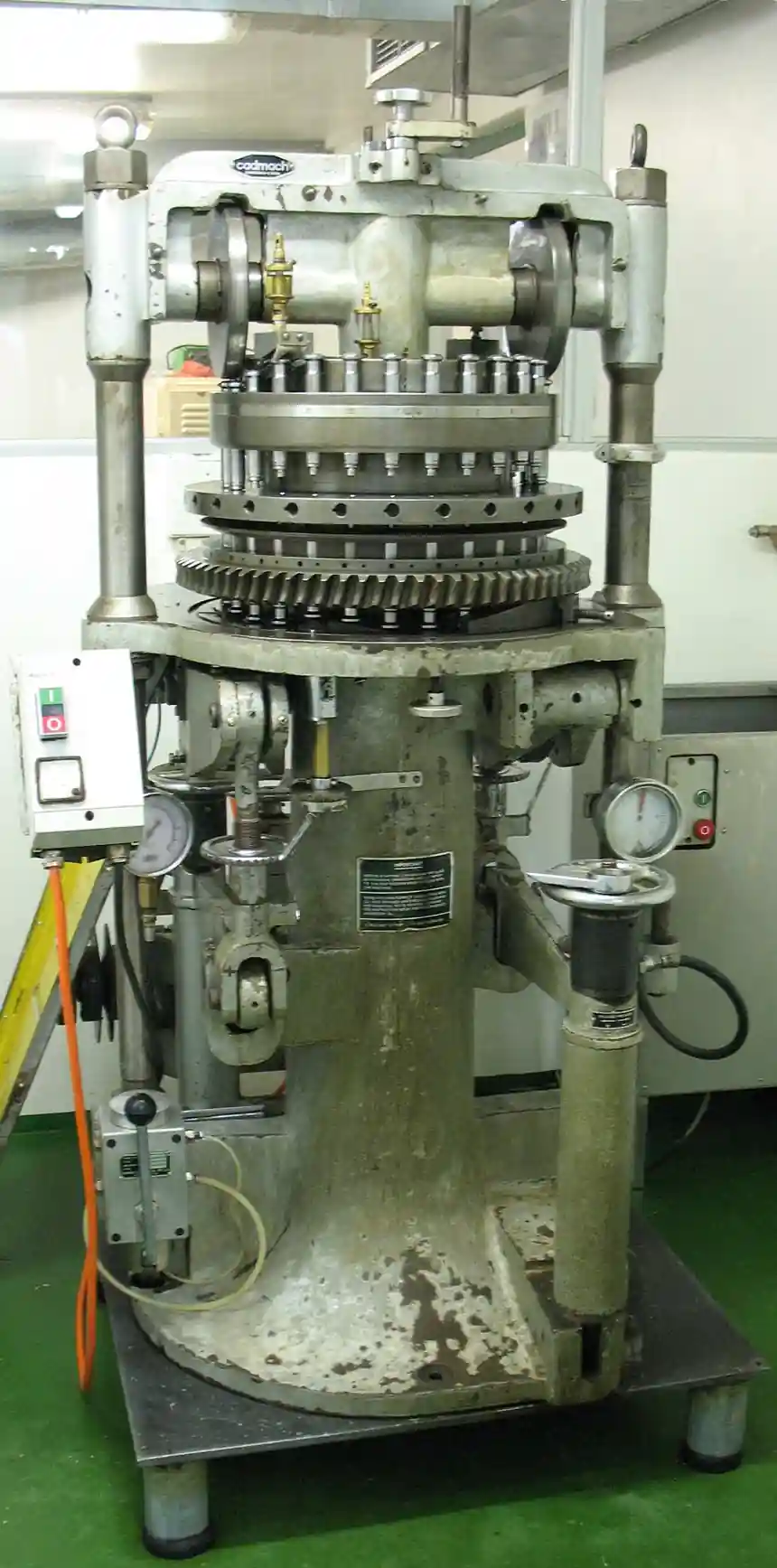
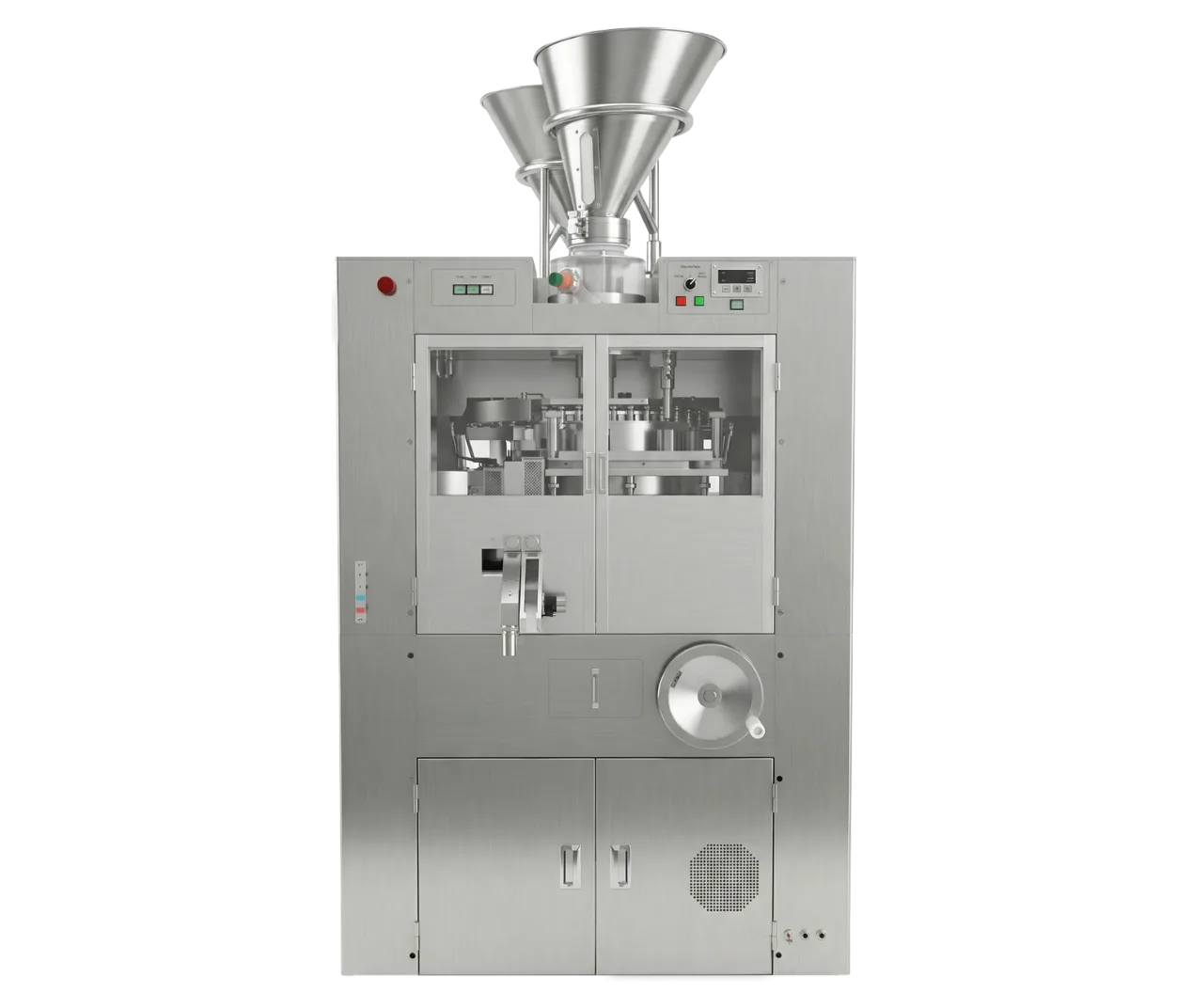
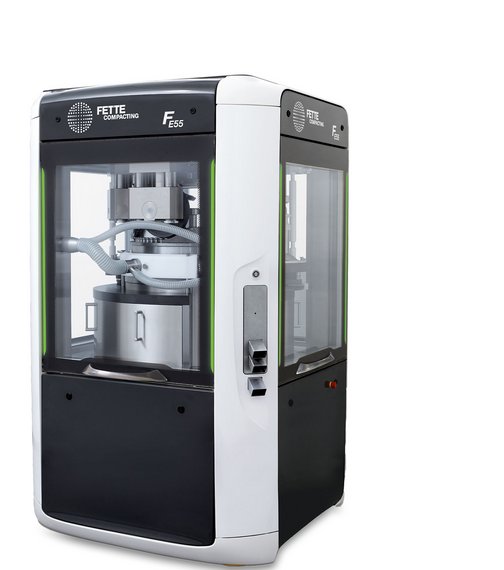
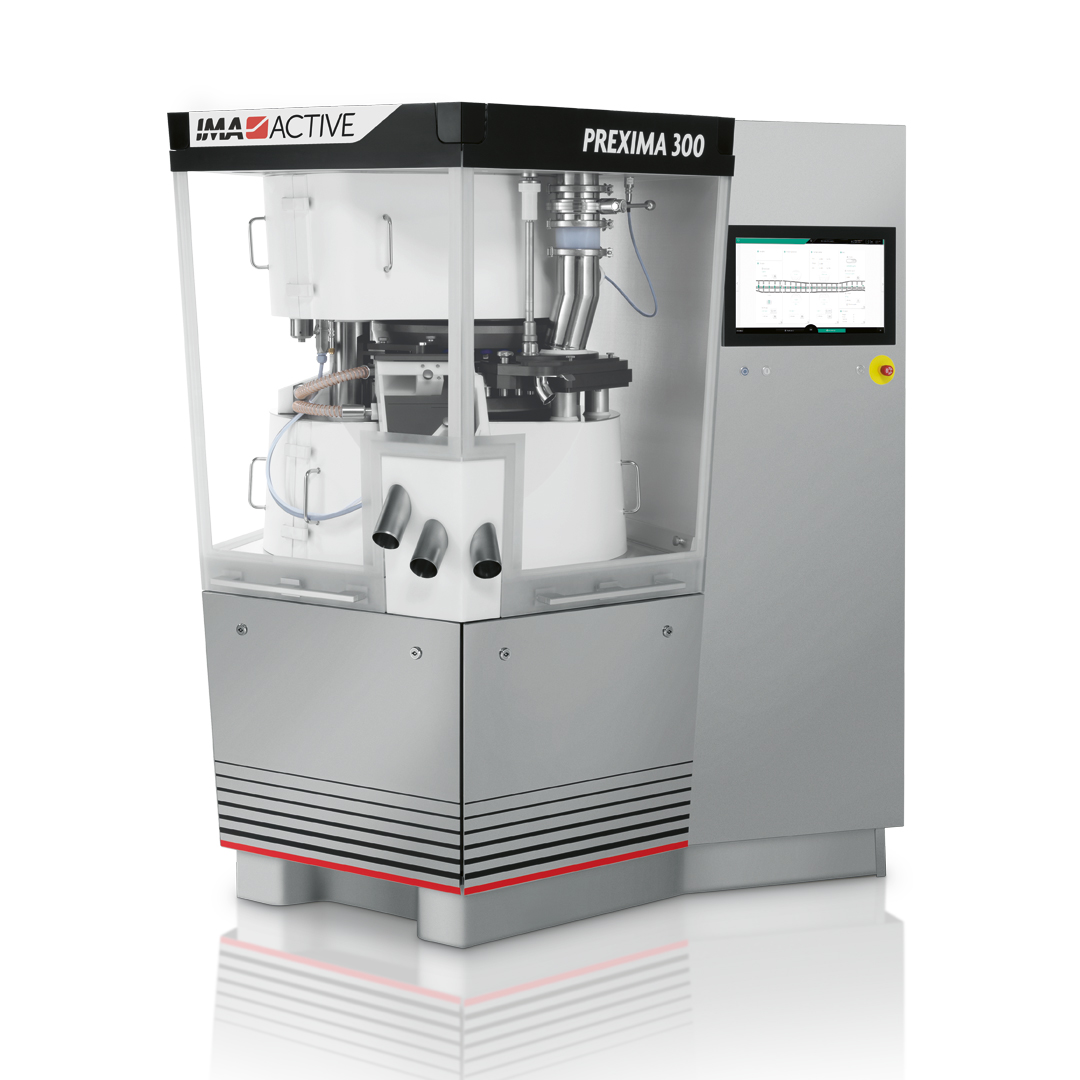
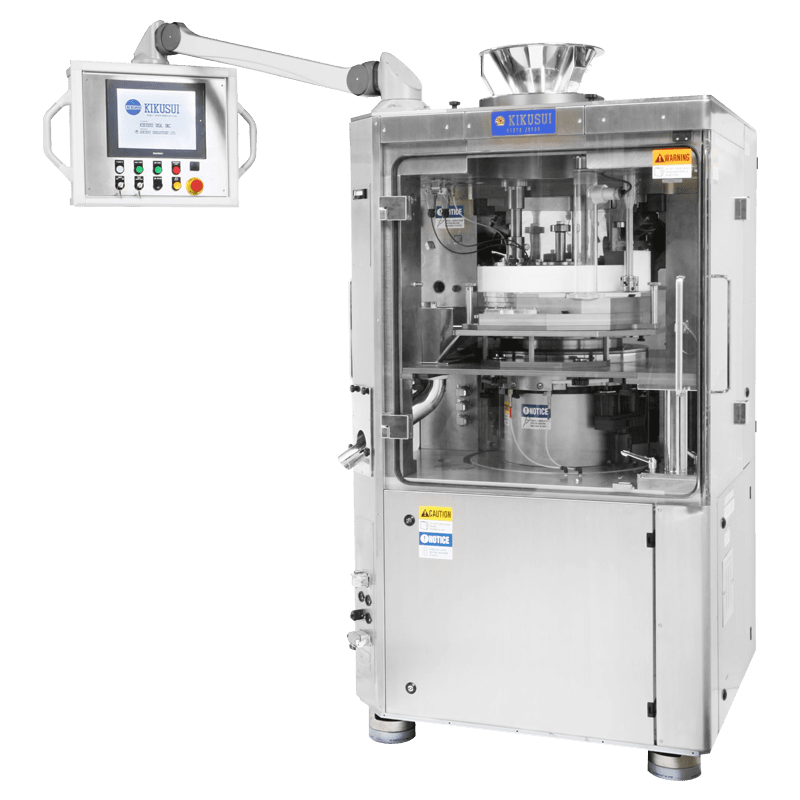
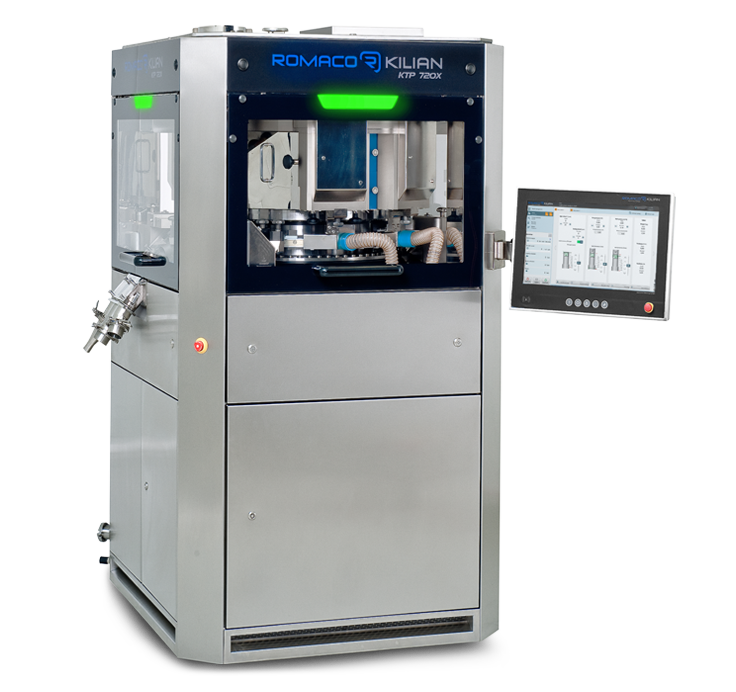
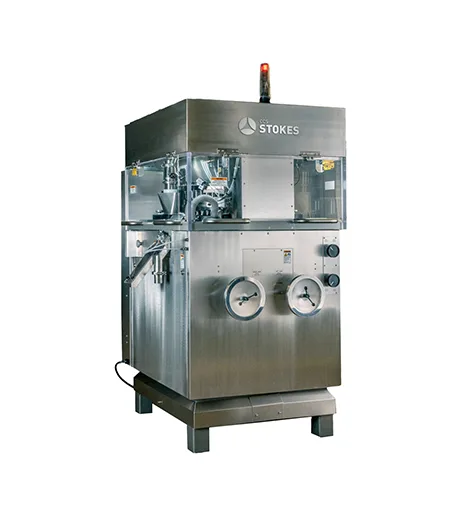
A tablet press, also called a tablet compression machine or tableting machine, compacts a measured volume of powder or granules into tablets of defined weight, shape, and hardness. It is the central machine in solid-dosage pharmaceutical manufacturing and is equally used to press nutraceutical, confectionery, catalyst, detergent, and powder-metallurgy pellets.
Two families dominate: the single-station (eccentric) press for development and low volume, and the rotary press for production. Both rely on a die that meters the dose and a pair of punches that compress it. The difference between a passable tablet and a defective one comes down to compression force control, dwell time, and the precision of TSM or EU standard tooling.
This guide is written for procurement engineers and process engineers specifying tablet presses for pharmaceutical, nutraceutical, and technical-powder lines. It covers 6 chapters from working principle, press types, tooling standards, materials and containment, to spec decoding and selection, with 7 selection FAQs. Tooling dimensions reference the TSM (Tableting Specification Manual, American Pharmacists Association) and EU Eurostandard; manufacturing and qualification reference cGMP 21 CFR Part 211, EU GMP Annex 15, and USP <905> Uniformity of Dosage Units.
Chapter 1 / 06
What is a Tablet Press
A tablet press is a machine that compacts powder or granulated material into a solid tablet of controlled weight, thickness, and breaking force. The principle is volumetric dosing followed by uniaxial compression: powder fills a cavity called the die, an upper and a lower punch enter the die from opposite ends, and mechanical force consolidates the particles until interparticle bonds form a self-supporting compact. The same machine then ejects the finished tablet and refills the die for the next cycle. Tablet pressing is the defining unit operation of solid oral dosage manufacturing, which remains the most common pharmaceutical dosage form worldwide.
Every tablet press, regardless of size, is built from the same four functional elements. The first is the die table or turret, which holds the dies that meter the dose. The second is the punch set, the upper and lower punches whose tip geometry defines tablet face shape, embossing, and break line. The third is the compression system, which on a rotary machine is a pair of large steel rollers that the punch heads ride over to generate force. The fourth is the feed system, which delivers a free-flowing, uniform powder bed into each die; production presses use a paddle force feeder rather than simple gravity filling to guarantee consistent die fill at speed.
The compression cycle proceeds through distinct stages. Filling overfills the die, then a weight-adjustment ramp displaces the lower punch to set the exact dose volume. Pre-compression applies a light first stroke to expel trapped air and pre-densify the bed. Main compression applies the full force as both punch heads pass between the compression rollers, and the duration of peak force is the dwell time. Ejection raises the lower punch to push the finished tablet to the die-table surface, where a scraper deflects it off the machine. On a rotary press all of these stages happen continuously and simultaneously across dozens of stations as the turret spins.
The historical lineage of the modern tablet press runs back to 1843, when William Brockedon patented a machine to compress powder into a pill or lozenge using a die and punch struck by a hammer. The single-station eccentric press followed and remains in use for laboratory work. The decisive industrial step was the rotary press, which by mounting many stations on a rotating turret converted a one-at-a-time hand operation into a continuous high-speed process. Twentieth-century refinements added pre-compression, paddle force feeders, instrumented punches for force measurement, and the standardized TSM and EU tooling that lets a press built by one maker accept tooling from another.
In scale terms a tablet press spans an enormous output range from the same basic physics. A single-station laboratory press makes roughly 60 to a few thousand tablets per hour and is prized for instrumented compression-force studies during formulation development. A production rotary press makes from about 250,000 to over 1,600,000 tablets per hour. Four engineering attributes determine whether a press is right for a given product: maximum compression force, number of stations and turret speed (which together set output), the tooling standard and tablet size envelope, and the containment and GMP rating. A universal tablet press does not exist; selection is the act of matching a formulation and a batch size to a specific frame, tooling, and containment class.
Chapter 2 / 06
Press Types and Classification
Tablet presses are classified first by compression mechanism into single-station and rotary, and rotary presses are subdivided by whether the turret has one or two compression zones (single-sided versus double-sided) and by the number of layers they can press. Choosing the wrong class is the most expensive early mistake: a single-station press cannot reach production volumes, and a high-speed double-sided press is wasteful and hard to clean for small clinical batches. The table below compares the main classes on the attributes that drive selection.
Type
Stations
Typical Output (tablets/h)
Compression
Typical Use
Single-station (eccentric)
1
60 to 6,000
Upper punch only, from one side
R&D, lab, low volume
Single-sided rotary
8 to 45
100,000 to 350,000
One compression zone, both punches
Pharma production, flexible
Double-sided rotary
29 to 115
300,000 to 1,600,000+
Two compression zones per revolution
High-volume pharma, nutraceutical
Bi-layer / multi-layer rotary
varies
100,000 to 400,000
Sequential fill and compress per layer
Modified release, fixed-dose combos
Single-station, or eccentric, presses use one die and one pair of punches. The lower punch is fixed during compression and only the upper punch descends, so the force is applied from the top only and the powder bed is consolidated against a stationary base. This asymmetric compression and the short, snappy stroke make the single-station press ideal for instrumented formulation studies, where engineers measure the force-displacement curve of a candidate blend. Because it presses one tablet per stroke, output is modest, but the machine is compact, inexpensive, and easy to clean and change over, which keeps it as the standard development and very-low-volume tool.
Single-sided rotary presses mount the dies on a rotating turret that passes once per revolution through a single set of pre-compression and main-compression rollers. Both the upper and lower punch heads ride over the rollers, so the tablet is compressed from both ends at once, giving more symmetric density than a single-station press. With typically 8 to 45 stations these machines balance respectable output with a single compression zone that is simpler to instrument, clean, and validate, making them the workhorse for flexible pharmaceutical production and bi-layer work. A representative single-sided platform is the KORSCH XL 400, configurable up to roughly 35 to 45 stations.
Double-sided rotary presses place two complete compression zones on opposite sides of the turret, so each station is filled and compressed twice per revolution, doubling output at a given turret speed. Station counts run far higher, up to the order of 79 to 115, and outputs reach into the millions of tablets per hour. The Fette FE75 is documented to produce up to about 1.6 million tablets per hour with up to 115 stations, and the FE55, with around 87 stations and three press stations, ranges from roughly 78,300 up to 626,400 tablets per hour. The trade-off is higher complexity, more tooling to maintain, and harder changeover, so double-sided machines suit high-volume, stable products rather than frequent small batches.
Bi-layer and multi-layer presses dose and lightly tamp a first powder layer, then add and fully compress a second (or third) layer in a separate fill station, producing tablets with physically distinct layers. They serve modified-release products, taste-masked combinations, and fixed-dose combination drugs where two actives must be kept apart until ingestion. Layer separation at the interface is the characteristic failure mode, so these machines depend heavily on controlled pre-compression of the first layer and precise interlayer weight control, which is why output is lower than for an equivalent single-layer turret.
Chapter 3 / 06
Tooling Standards: TSM and EU
Punches and dies are the consumable heart of the press, and two standards govern almost all of them: TSM, the Tableting Specification Manual published by the American Pharmacists Association, and EU, the European Eurostandard. Both define the same family of barrel diameters so that a turret designed for one will physically accept the other, but the punch head geometry differs, which affects high-speed running and dwell. Within each standard, tooling is further graded by size: B and BB for the smaller barrel, D and DB for the larger. The table below compares the key dimensions that engineers actually specify on a tooling order.
Parameter
B / BB tooling
D / DB tooling
Barrel diameter
0.750 in (19.05 mm)
1.000 in (25.40 mm)
Punch head diameter
1.000 in (25.4 mm)
1.250 in (31.75 mm)
Overall length (nominal)
5.250 in (133.35 mm)
5.250 in (133.35 mm)
Die outside diameter
~30.16 mm (1.1875 in)
~38.10 mm (1.500 in)
Max tablet diameter (round)
~16 mm
~25 mm
Stations per turret
Higher
Lower
B and D refer to barrel diameter, the cylindrical body of the punch that slides in the turret guide. B tooling uses a 0.750 inch (19.05 mm) barrel and handles round tablets up to roughly 16 mm, while D tooling uses a 1.000 inch (25.40 mm) barrel for larger tablets up to roughly 25 mm. Because the B barrel is slimmer, more stations fit on a turret of a given pitch-circle diameter, so B tooling delivers higher output, whereas D tooling trades stations for larger tablets and the heavier compression a D-frame press can apply. The choice is fundamentally a trade between throughput and tablet size or force.
BB and DB are reduced-bore sub-variants. A BB punch keeps the 0.750 inch B barrel but uses a smaller die bore, and a DB punch keeps the 1.000 inch D barrel with a B-size die bore. The point of DB tooling is to press small round tablets on a D-frame press, gaining the higher compression capacity and robustness of the larger barrel while still making a small tablet. This matters when a small but very hard or hard-to-compress tablet would overstress a B punch tip.
TSM and EU differ chiefly in the punch head, not the barrel. The TSM B-type punch has a 37 degree inside head angle, where the head meets the neck, while the EU B-type uses 30 degrees; TSM heads are also thicker overall. The EU punch is about 0.010 inch (0.25 mm) longer than the equivalent TSM punch and uses a smoothly domed head radius. In practice the EU domed head distributes the roller contact load more gradually, which can help at very high turret speeds, while the TSM head is the long-established US convention. The two standards must not be mixed in the same turret because the difference in working length would produce tablets of different thickness from station to station.
Tooling material and finish are as important as dimensions. Punches and dies are made from hardened tool steels, with grades and surface coatings selected for abrasive or corrosive formulations, and tip faces are finished to micron-level tolerance to hold weight and dimension uniformity. Worn or out-of-tolerance tooling is a leading root cause of weight variation, capping, and sticking, so tooling inspection, polishing, and timely replacement are part of the operating cost of any press, not an afterthought. Natoli Engineering is the dominant Western tooling supplier and also builds presses; tooling availability and lead time for a given press frame should be confirmed before purchase.
Chapter 4 / 06
Materials, Containment, and GMP
For pharmaceutical use a tablet press is not just a machine but a qualified piece of GMP equipment, and the material of construction, surface finish, and containment rating are as much a part of the specification as compression force. Regulators expect manufacturing to conform to current Good Manufacturing Practice: 21 CFR Part 211 in the United States and EU GMP in Europe, with equipment qualification documented through Installation, Operational, and Performance Qualification (IQ, OQ, PQ) following EU GMP Annex 15. A press that cannot produce this documentation cannot be used in a regulated dosage line regardless of its mechanical merit.
Product-contact materials are predominantly 316L stainless steel for the die table area, feed frame, and guards, chosen for corrosion resistance and cleanability. Contact surfaces are electropolished to a low roughness so that powder does not lodge in micro-pits and so the machine can be cleaned reliably between batches. Punches and dies themselves are hardened tool steel rather than 316L because they must withstand repeated high-force compression, but the surfaces the powder otherwise touches follow the stainless, smooth-finish rule. Cleaning validation, the documented proof that residue of the previous product is removed below a defined limit, drives much of this material and finish selection.
Containment protects operators from the active ingredient and is rated by Occupational Exposure Band (OEB), which maps to an Operator Exposure Limit (OEL) expressed in micrograms of airborne substance per cubic metre of air over a working shift. As potency rises, the OEL falls and the engineering controls grow more elaborate. The table below summarizes the common OEB bands and what they imply for press construction.
Full isolation, validated WIP, glove access, integrity testing
Practical containment hardware at OEB 3 includes upgraded window and shaft seals, tri-clamp connections in place of bolted joints, and a differential-pressure sensor that monitors a slight negative pressure in the compression zone so any leak draws inward rather than outward. At OEB 4 and OEB 5 the machine moves toward a fully sealed enclosure with wash-in-place capability built from 316L stainless steel, glovebox access for setup, and documented integrity testing of the containment boundary. Each step up in OEB significantly increases machine cost and changeover time, so containment should be specified to the actual potency of the product, not over-specified by reflex.
Finally, instrumentation is part of the GMP story. Production presses carry compression-force measurement that can monitor each individual station, compare it against a setpoint window, and divert any out-of-tolerance tablet automatically. This single-tablet force feedback supports USP <905> Uniformity of Dosage Units by catching weight and density excursions in real time, and it generates the batch records that auditors expect. A press intended for regulated production should therefore be evaluated on its force-monitoring and reject system, its data integrity (electronic records and audit trails consistent with regulatory expectations), and the completeness of its qualification package, not on raw output alone.
Chapter 5 / 06
Key Specification Parameters
A tablet press datasheet can list dozens of figures, but a manageable set of parameters actually decides whether a given machine fits a product: maximum compression force, pre-compression force, number of stations, turret speed and output, tablet size envelope (diameter, fill depth, thickness), tooling standard, and dwell time. Each is decoded below so that two quotations can be compared on a like-for-like basis rather than on marketing headlines.
Parameter
Typical value / range
Why it matters
Main compression force
up to 100 kN
Sets max hardness and largest/hardest tablet
Pre-compression force
a few kN to 20 to 40 kN
De-aerates blend, prevents capping
Stations
1 to 115
With speed, sets output
Turret speed
up to ~100 to 120 rpm
Higher speed cuts dwell time
Tablet diameter
up to ~16 mm (B), ~25 mm (D)
Sets tooling class
Max fill depth
up to ~18 mm
Largest dose volume per tablet
Tablet thickness
up to ~8.5 mm
Geometry and swallowability limit
Maximum compression force is the headline mechanical rating, commonly up to 100 kN on a modern pharmaceutical rotary press for both pre- and main compression on high-end models. It sets the hardest, largest tablet the press can make. The force should be matched to the formulation: a press that can apply far more force than the blend needs simply adds cost, while an under-rated press cannot reach target hardness and pushes the operator into over-speeding or over-filling. Documented examples include the KORSCH XL 400 family rated at 100 kN main compression, with pre-compression also available at high force on the latest generation.
Pre-compression force is a separate, independently adjustable, lighter stroke applied just before main compression, typically a few kN up to the 20 to 40 kN range, to drive entrapped air out of the powder bed and pre-densify it. Adequate pre-compression is the first defense against capping and lamination, especially for light, fluffy, or fast-running blends. A press for difficult formulations should have dedicated pre-compression rollers and the instrumentation to set and record pre-compression force, not merely a token tamping action.
Stations and turret speed together define output. Output equals stations times revolutions per minute times 60 for a single-sided press, doubled for a double-sided press because each station compresses twice per revolution. A 35-station single-sided turret at 60 rpm makes about 126,000 tablets per hour; the same turret at 120 rpm makes about 252,000. The headline million-tablet-per-hour figures come from high station counts on double-sided turrets. Crucially, raising turret speed shortens dwell time, the milliseconds the tablet spends at peak force, and below a formulation-dependent dwell the powder cannot consolidate properly. Large-diameter compression rollers are used specifically to lengthen dwell at a given speed, which is why roller diameter appears on serious datasheets.
The tablet size envelope is given as maximum tablet diameter, maximum fill depth, and maximum tablet thickness. On the KORSCH XL 400, for example, the envelope is up to about 16 mm diameter, up to about 18 mm fill depth, and up to about 8.5 mm tablet thickness. Diameter selects the tooling class (B up to roughly 16 mm, D up to roughly 25 mm), fill depth caps the dose volume, and thickness is constrained by both geometry and swallowability. These three numbers, read together with the tooling standard, define exactly which products a press can run.
The output and quality result must be verified against pharmacopeial limits. USP <905> Uniformity of Dosage Units sets the statistical acceptance for tablet-to-tablet content and weight uniformity, and a press that runs fast but cannot hold weight inside that window is unfit for purpose. This is why force-feedback rejection, weight-control feedback to the fill cam, and dwell time appear on the same datasheet as raw output: they are what make the headline throughput actually usable.
Chapter 6 / 06
Selection Decision Factors
To turn the preceding chapters into a specific machine, work through the decision sequence below in order. Most costly selection errors come not from a single wrong number but from deciding output before deciding product class, or deciding price before deciding containment. These steps double as an RFQ template that a supplier can quote against directly.
Press class and batch size: Decide single-station versus single-sided rotary versus double-sided rotary versus bi-layer, driven by required volume and changeover frequency. R&D and small clinical batches favor single-station or low-station single-sided machines; high-volume stable products favor double-sided.
Tablet specification: Define tablet diameter, shape, weight, thickness, and target hardness. These set the tooling class (B/BB versus D/DB), the fill-depth requirement, and the minimum compression force.
Tooling standard: Choose TSM or EU based on existing tooling inventory and supplier support, and confirm the press turret matches. Never plan to mix standards in one turret.
Output target: Compute required tablets per hour, then derive stations and turret speed from output equals stations x rpm x 60 (x2 if double-sided), and confirm the resulting dwell time is adequate for the formulation rather than just chasing peak rpm.
Compression force and pre-compression: Match maximum main force (up to 100 kN on high-end presses) to the hardest tablet, and confirm independent pre-compression rollers and instrumentation for air-sensitive or capping-prone blends.
Containment (OEB) and GMP: Set the OEB band from the active ingredient's exposure limit (OEB 3 = 10 to 100 ug/m3, OEB 4 = 1 to 10, OEB 5 = below 1) and require the matching enclosure, 316L wash-in-place hardware, and a full IQ/OQ/PQ qualification package under 21 CFR 211 and EU GMP Annex 15.
Instrumentation and data integrity: Require individual-station compression-force monitoring with automatic single-tablet rejection, weight-control feedback, and audit-trailed electronic records to support USP <905> compliance.
Material handling and changeover: Confirm paddle force feeder, fast tooling change, removable turret options, and cleaning approach (manual versus wash-in-place) against the number of product changes the line will run.
Total cost of ownership (TCO): Add tooling sets and replacement cadence, qualification effort, spare parts, scheduled service, and downtime to the purchase price. Tooling and qualification often dominate lifetime cost, so the cheapest press is rarely the cheapest line.
One last dimension that buyers underweight is manufacturer serviceability and tooling supply. A tablet press is a multi-decade asset, so local service engineers, spare-part lead time, the availability of TSM or EU tooling for that exact frame, and the supplier's ability to support requalification after changes matter more over the asset's life than the headline price. KORSCH (XL series), Fette Compacting (FE series), GEA (formerly Courtoy), IMA, Romaco Kilian, and Natoli are the established high-end pharmaceutical suppliers with documented tooling and service networks; for nutraceutical, confectionery, and lower-budget pharmaceutical lines, capable single-station and rotary presses are also available from Chinese and Indian builders at substantially lower cost, where the decisive checks become GMP documentation depth, validated cleaning, and tooling availability rather than the price tag alone.
FAQ
What is the difference between a single-station and a rotary tablet press?
A single-station (eccentric) press has one die and one pair of punches; the lower punch stays fixed and only the upper punch moves down to compress, producing roughly 60 to 6,000 tablets per hour. A rotary press mounts many punch-die stations on a rotating turret that passes between fixed upper and lower compression rollers, so every station is compressed from both sides simultaneously and continuously. Rotary machines reach 250,000 to over 1,600,000 tablets per hour. Single-station presses suit R&D, low-volume, and compression-force studies; rotary presses are the production standard. The compression mechanism, not just the speed, is the real difference: single-station applies force from the top only, while rotary applies it from top and bottom at once.
What is the difference between TSM and EU tooling?
TSM (Tableting Specification Manual, published by the American Pharmacists Association) and EU (Eurostandard) are the two dominant punch and die standards. Both share the same barrel diameters, 0.75 inch for B/BB tooling and 1.0 inch for D/DB tooling, so a press built for one barrel size accepts both standards. The differences are in the punch head: the TSM B-type head has a 37 degree inside head angle, the EU B-type uses 30 degrees; TSM heads are thicker, and the overall TSM punch is about 0.010 inch (0.25 mm) shorter than the EU equivalent. EU punches are slightly longer and use a domed head radius that distributes roller load more smoothly at high speed. Mixing standards within one turret is not permitted because the working length differs.
What is the difference between B and D tooling?
B and D refer to barrel diameter, which sets the maximum tablet size and the maximum die count on a given turret. B tooling has a 0.75 inch (19.05 mm) barrel and accepts tablet diameters up to about 16 mm, allowing more stations per turret. D tooling has a 1.0 inch (25.4 mm) barrel for larger tablets up to about 25 mm but fewer stations. BB and DB are sub-variants with a smaller die bore that share the B and D barrel diameters respectively, used for small round tablets while keeping the higher D-frame compression capacity. Choosing B versus D is a trade-off between output (more B stations) and tablet size or compression force (D handles larger, harder tablets).
What does pre-compression do and why is it needed?
Pre-compression is a first, lighter compression stroke applied a fraction of a second before main compression. Its job is to expel entrapped air from the powder bed and pre-densify the blend so the main compression stroke produces a uniform, void-free tablet. Without it, air trapped in the die can spring back during ejection and cause capping (the tablet top splits off) or lamination (horizontal layer separation). Pre-compression forces are typically a few kN up to 20 to 40 kN, well below the main force, and are independently adjustable. Air-sensitive, light, or fast-running formulations benefit most; for such products the press needs separate pre-compression rollers and instrumentation.
How do I calculate the output of a rotary tablet press?
Output equals the number of stations times turret speed times 60, and for a double-sided press you multiply by two because each station compresses twice per revolution. For example, a single-sided 35-station turret running at 60 rpm yields 35 x 60 x 60 = 126,000 tablets per hour; the same press at 120 rpm yields 252,000. A double-sided 79-station turret at the same speed roughly doubles that. Real throughput is capped by dwell time: above a certain turret speed the powder no longer has time to consolidate, so faster is not always better. Practical pharmaceutical outputs range from about 250,000 to over 1,600,000 tablets per hour depending on stations, speed, and formulation.
What causes capping and lamination, and how does the press prevent it?
Capping and lamination are caused by air trapped in the powder, elastic recovery on decompression, over-compression, or insufficient dwell time. The press counters them with pre-compression to remove air, large-diameter compression rollers that lengthen dwell time so the tablet has more milliseconds under load, and a controlled, gradual ejection cam profile. Formulation factors (binder level, lubricant, granule moisture) matter as much as the machine. On instrumented presses, individual-station force monitoring detects abnormal compression and rejects the affected tablet automatically. Slowing turret speed, reducing peak force, and increasing dwell are the standard mechanical fixes when a batch shows capping.
What containment and GMP requirements apply to a pharmaceutical tablet press?
Tablet presses for regulated pharmaceutical use must meet cGMP expectations under 21 CFR Part 211 (US) and EU GMP, with qualification documented through IQ, OQ, and PQ per EU GMP Annex 15. Product-contact parts are typically 316L stainless steel with electropolished surfaces for wash-in-place cleaning. For potent compounds, containment is rated by Occupational Exposure Band: OEB 3 corresponds to an operator exposure limit of 10 to 100 micrograms per cubic metre, OEB 4 to 1 to 10, and OEB 5 to below 1 microgram per cubic metre. Higher OEB machines add sealed compression zones, differential-pressure monitoring, tri-clamp connections, and full wash-in-place, and require complete material and surface-finish documentation.
Tablet Press Manufacturers
Source-backed product routes. Open a company dossier for procurement scope and cited evidence.