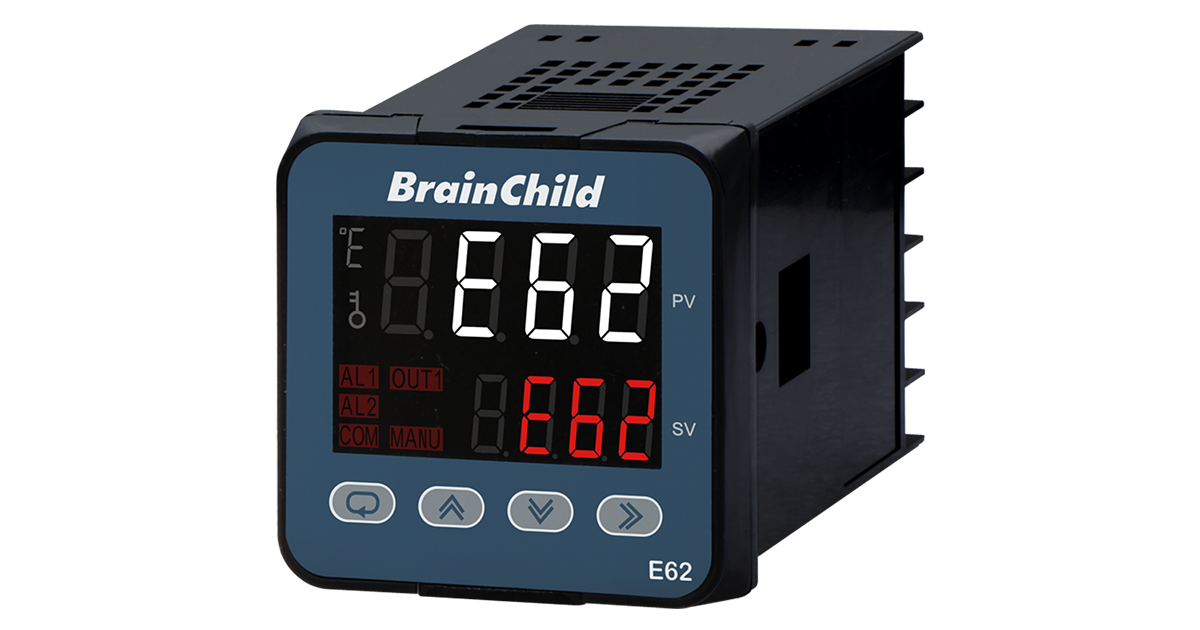
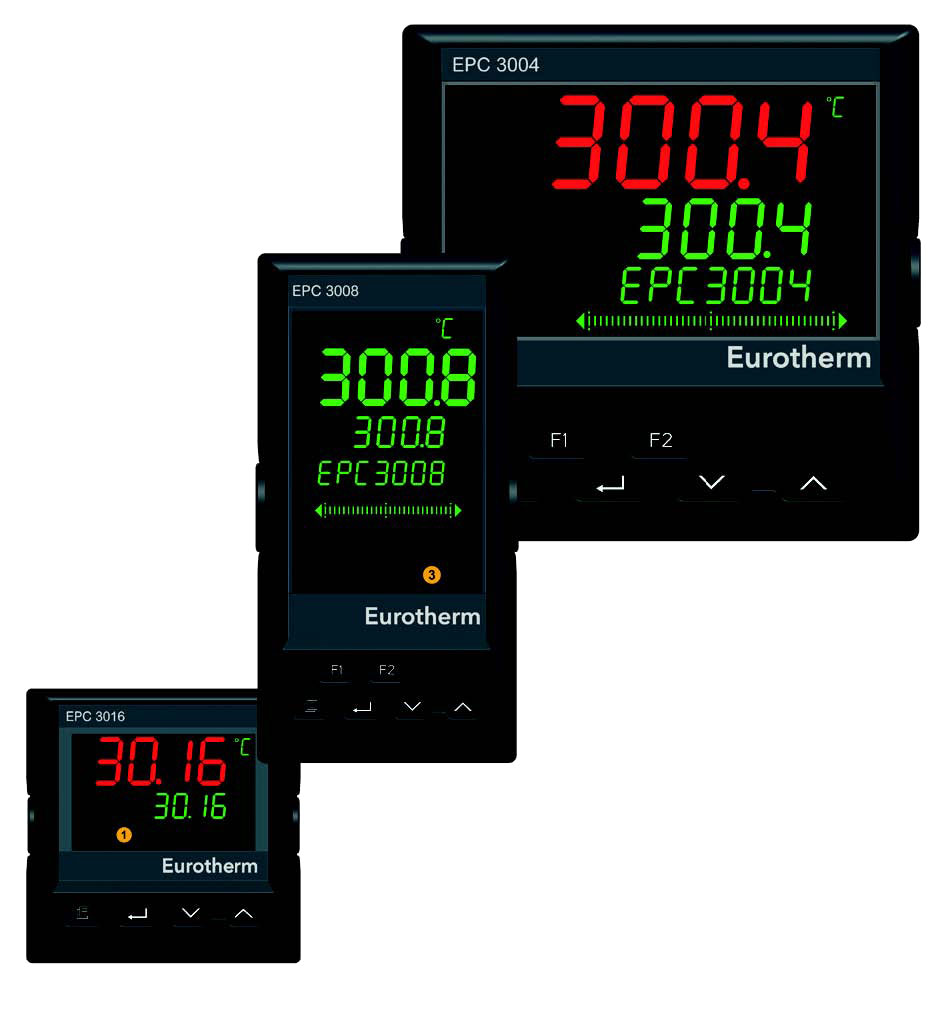
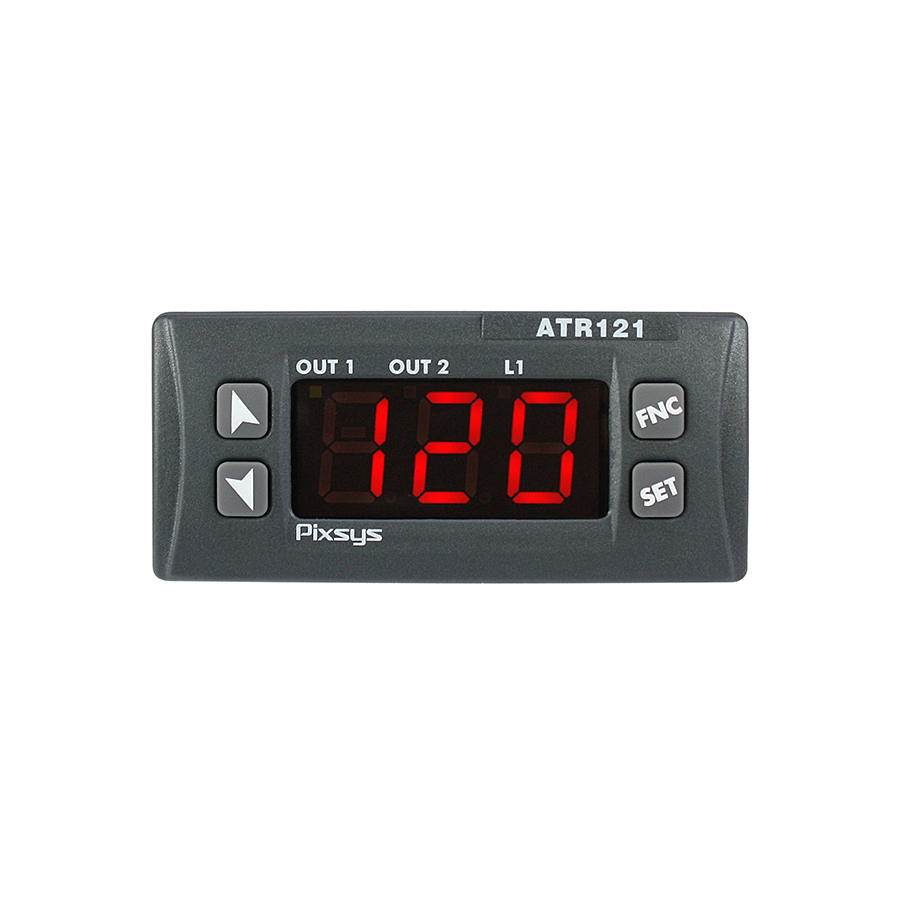
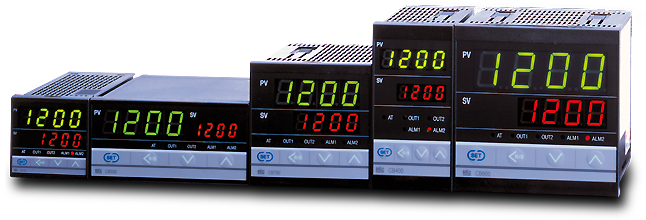
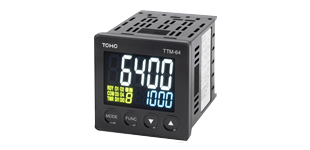
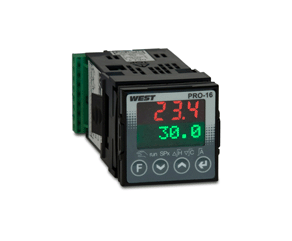
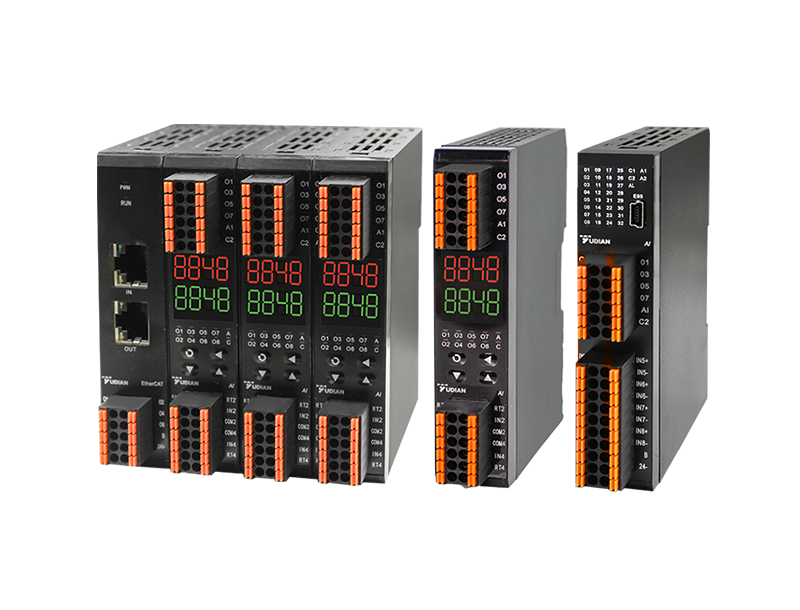
A PID controller is a feedback instrument that holds a process variable such as temperature, pressure, flow, or level at an operator-defined setpoint. It continuously measures the error between setpoint and process variable, then computes a corrective output from three terms: proportional (present error), integral (accumulated past error), and derivative (predicted future error). The three-term algorithm is the most widely deployed control law in industry, running inside standalone panel-mount instruments, inside PLC and DCS firmware blocks, and inside motor drives.
This guide treats the standalone panel-mount PID controller, the dedicated digital instrument that an engineer wires to a sensor and a final control element such as a solid-state relay, contactor, or control valve. It also explains the underlying control terms that apply equally to PID blocks executed in a PLC or DCS.
Photo: K043434, CC BY-SA 4.0, via Wikimedia Commons
This guide is aimed at industrial purchasing engineers and design engineers. It covers 6 chapters from control theory, controller types, input and output families, tuning methods, to spec-sheet decoding and selection, with 7 FAQs and manufacturer comparisons. Parameter conventions reference public standards including IEC 60584 (thermocouples), IEC 60751 (Pt100 RTDs), IEC 61326 (EMC for measurement and control equipment), IEC 61010 (safety), NAMUR NE43 (signal fault levels), and the ISA tuning literature.
Chapter 1 / 06
What is a PID Controller
A PID controller, or three-term controller, is a closed-loop feedback mechanism that drives a process variable toward a setpoint and holds it there with minimal error. At every sample it reads the measured value from a sensor, subtracts it from the setpoint to form the error, and computes a control output that is sent to a final control element. The three terms act on the error in distinct ways: the proportional term responds to the present error, the integral term responds to the accumulated error over time, and the derivative term responds to the rate of change of the error. Combined, they deliver fast correction without the sustained offset of a pure proportional loop and without the violent overshoot of an aggressive proportional-integral loop.
In the most common ISA standard form, the controller output is gain multiplied by the sum of three contributions: the error itself, one over the integral time multiplied by the integral of the error, and the derivative time multiplied by the derivative of the error. A single proportional gain scales all three terms together. The alternative parallel (independent-gains) form gives each term its own gain, so changing the proportional setting does not rescale the integral and derivative contributions. Series (interacting) form, historically used in pneumatic and early electronic controllers, applies the terms in cascade. The three forms are mathematically convertible but their numbers are not interchangeable, which is why a tuning set copied between two brands often misbehaves until it is translated.
The history of three-term control runs from marine steering. In 1922 Nicolas Minorsky published a theoretical analysis of automatic ship steering that contained the proportional, integral, and derivative actions in modern form. Through the 1930s and 1940s pneumatic controllers from Foxboro and Taylor Instrument implemented reset (integral) and pre-act (derivative) using bellows and restrictors. In 1942 John Ziegler and Nathaniel Nichols of Taylor Instrument published their tuning rules, still taught today. Electronic analog controllers followed in the 1950s and 1960s, microprocessor-based digital controllers arrived in the late 1970s, and the algorithm migrated into distributed control systems and programmable logic controllers, where it now runs as a standard function block alongside dedicated panel instruments.
PID remains dominant because it is model-free, intuitive to a maintenance technician, and good enough for the overwhelming majority of single-loop processes. Surveys of process plants repeatedly find that PID and its reduced PI variant account for the large majority of regulatory control loops. More advanced strategies such as model predictive control sit on top of PID rather than replacing it, sending setpoints down to PID loops that do the fast actuation. For the procurement engineer this means a standalone PID controller is rarely the wrong tool; the engineering effort is in matching the sensor input, the output drive, the certifications, and the tuning to the process, not in questioning the control law itself.
Four engineering attributes determine whether a given controller succeeds in a given loop: input compatibility and indication accuracy, output type and switching speed matched to the final control element, tuning flexibility including autotune and anti-windup, and the operating environment including ambient temperature, EMC, and electrical safety ratings. The chapters that follow address each in turn, because a controller chosen on display features alone, but mismatched to the actuator or the sensor, produces a loop that oscillates or settles slowly no matter how it is tuned.
Chapter 2 / 06
Controller Types and Form Factors
PID controllers reach the field in several physical forms, and the form often decides the selection more than the control math does. The dominant industrial format is the panel-mount instrument sized to a DIN cut-out, but the same algorithm also runs in PLC and DCS firmware, in DIN-rail loop controllers, and in temperature limit controllers used purely for safety. The table below compares the main families against the dimensions that matter at purchasing.
The DIN panel-mount sizes are a de facto standard that every buyer must read fluently. A 1/16 DIN instrument fits a 45 by 45 mm cut-out with a 48 by 48 mm front bezel; this is the most common size, used by the Omron E5CC, the Eurotherm 3216, and most economy controllers. A 1/8 DIN fits roughly a 45 by 92 mm cut-out (vertical) or 92 by 45 mm (horizontal) with a 48 by 96 mm bezel. A 1/4 DIN fits a 92 by 92 mm cut-out with a 96 by 96 mm bezel, giving room for a larger display and more I/O, used by the Eurotherm 3504 and similar multi-loop units. Depth behind the panel runs roughly 60 to 100 mm; the E5CC, for example, is about 77 mm deep. Matching the cut-out to an existing panel hole is often the first hard constraint in a retrofit.
The standalone temperature controller is the workhorse: it integrates a universal sensor input, the PID engine with autotune, one or two control outputs, alarm outputs, and a front display in a single sealed box. It is the right choice for discrete heating equipment such as ovens, plastic extruders, packaging sealers, and laboratory furnaces, where the machine is sold as a unit and there is no plant-wide control system. The multi-loop process controller adds cascade, ratio, and override control across two to four loops and is used where one variable must trim another, for example controlling a jacket temperature to regulate a reactor temperature.
The PLC or DCS PID block is not a separate purchase at all but a firmware function executed by a controller the plant already owns. When a process plant runs an integrated control system, putting the loop in the PLC or DCS is usually preferred because it shares the operator interface, alarming, historian, and engineering tools, and it scales to hundreds of loops without buying hundreds of instruments. A standalone instrument still wins for skid-mounted equipment, OEM machines shipped to many customers, and any duty that must keep running if the plant network is down. The limit controller is a deliberately separate device: it provides an independent over-temperature or over-pressure cutout with a latching relay, kept out of the control PID so that a single failure cannot defeat both regulation and protection.
Chapter 3 / 06
Inputs, Outputs, and Communication
A controller is only as good as its measurement input and its actuation output. The input side determines what sensor the controller can read and how accurately; the output side determines what final control element it can drive and how smoothly. A mismatch on either side cannot be fixed by tuning. The table below summarizes the mainstream output options, the dimension where most selection errors occur.
On the input side, a universal-input controller accepts IEC 60584 thermocouples (K, J, T, E, N, R, S, and B), Pt100 and increasingly Pt1000 RTDs to IEC 60751 in 2-wire and 3-wire connection, and DC process signals of 0 to 10 V and 0 to 20 or 4 to 20 mA. The controller performs cold-junction compensation and curve linearization in firmware, because thermocouple voltage versus temperature is non-linear by more than 1 percent and the Pt100 curve, though closer to linear, still needs correction. Representative input specifications are tight: the Yokogawa UT35A quotes analog input accuracy of plus or minus 0.05 percent of full scale with a measurement resolution of 0.1 percent of input span and a 50 ms sampling period; the Omron E5CC quotes plus or minus 0.2 percent of indication or plus or minus 0.8 degrees Celsius for Pt100 and around plus or minus 0.3 percent of indication or plus or minus 2 degrees Celsius for thermocouples. Cold-junction compensation typically adds plus or minus 0.5 to 1 degree Celsius of uncertainty.
Mechanical relay output is a dry contact rated for roughly 250 V AC at 2 to 3 A. It switches contactors, solenoid valves, and small resistive loads directly, but it has a finite contact life of a few hundred thousand operations and cannot cycle quickly, so it is used with time-proportioning cycle times of 10 to 30 seconds on slow thermal processes. SSR drive output, also called logic or voltage-pulse output, is a low-current DC signal of about 12 V DC at 20 to 40 mA that switches an external solid-state relay. Because the SSR has no moving parts, the controller can use a short 1 to 2 second time-proportioning cycle or fast zero-cross firing, giving smooth heater control and effectively unlimited switching life. This pairing is the standard for tight temperature control of electric heaters.
Linear current and voltage outputs turn the controller into a continuous modulating device. A 4 to 20 mA output positions a control valve through its positioner, sets the firing angle of an SCR thyristor power unit, or commands the speed reference of a variable frequency drive. The 4 to 20 mA loop is preferred because it is immune to cable voltage drop over long runs and because, under NAMUR NE43, currents below 3.6 mA or above 21 mA can be reserved to signal a sensor or wiring fault rather than a valid reading. A 0 to 10 V output is simpler but suffers voltage drop on long cables, so it is kept to short runs inside a cabinet.
On the communication side, most modern controllers offer Modbus RTU over RS-485 as a baseline, with higher-end units adding Modbus TCP and Ethernet, and process-grade units adding PROFIBUS, DeviceNet, or EtherNet/IP. The Eurotherm 3500, for example, supports Modbus, Modbus master, DeviceNet, and Ethernet Modbus TCP. Communication lets a SCADA system read the process variable, write setpoints, download ramp/soak profiles, and log alarms without extra wiring. For an OEM machine builder, an RS-485 Modbus port is often enough; for a plant integration, native fieldbus support that the existing control system already speaks saves gateway hardware.
Chapter 4 / 06
Tuning Methods and Standards
Tuning is the act of choosing the proportional, integral, and derivative settings so the loop responds quickly without unacceptable overshoot or oscillation. A controller is only as good as its tuning: the same hardware can hold a setpoint to a fraction of a degree or hunt continuously depending on three numbers. Engineers use a small set of established methods, all of which a buyer should recognize on a datasheet because the controller advertises which ones it automates.
The Ziegler-Nichols ultimate-gain method, published in 1942, is the classical reference. With integral and derivative disabled, the proportional gain is raised until the loop oscillates with constant amplitude; that gain is the ultimate gain Ku and the oscillation period is the ultimate period Tu. Standard formulas then set the gain, reset, and rate as fractions of Ku and Tu. The companion Ziegler-Nichols reaction-curve (open-loop) method instead steps the output manually and reads the process dead time and time constant from the response. Ziegler-Nichols gives aggressive, quarter-amplitude-decay tuning that is fast but lightly damped, so it is often detuned in practice.
Lambda tuning and the related internal model control (IMC) method take the opposite philosophy: the engineer chooses a desired closed-loop time constant (lambda) and computes the gain and reset to hit it, with no derivative on self-regulating loops. Lambda tuning gives smooth, non-oscillating, well-damped responses that reject the natural-frequency oscillation Ziegler-Nichols invites, which is why it dominates in continuous process plants where loop interaction matters. The trade-off is a slower return to setpoint after a disturbance. The choice between aggressive Ziegler-Nichols and conservative lambda tuning is a process-engineering decision, not a controller feature.
Autotune automates all of this. Most modern controllers run a relay-feedback variant of Ziegler-Nichols: the controller forces the output to cycle between two limits, measures the amplitude and period of the resulting limit cycle, estimates Ku and Tu, and computes the PID terms automatically. The cycle completes in one to a few process time constants. Autotune is dependable on stable single-capacity processes such as a heated platen, oil bath, or extruder zone, and it gives a sound starting point on harder loops. It can mistune on long-dead-time processes, on loops disturbed during the test, or on strongly interacting multi-zone systems. Adaptive tuning, such as Watlow TRU-TUNE+, goes further and continuously trims the terms during normal running to track changing process gain. The table below contrasts the methods.
Method
How It Works
Response Character
Best Fit
Ziegler-Nichols (closed loop)
Find ultimate gain and period
Fast, lightly damped
Quick benchmark tuning
Ziegler-Nichols (reaction curve)
Step test, read dead time and tau
Fast, lightly damped
Loops safe to step open-loop
Lambda / IMC
Pick closed-loop time constant
Smooth, well damped
Interacting process loops
Relay-feedback autotune
Controller cycles output, measures
Good starting point
Single-capacity thermal loops
Adaptive (e.g. TRU-TUNE+)
Continuous online trimming
Tracks changing gain
Variable-load processes
Several standards frame the instrument itself rather than the tuning. IEC 60584 defines thermocouple reference tables and tolerance classes; IEC 60751 defines Pt100 RTD curves and classes (AA, A, B, C). For functional behavior on a faulted sensor, NAMUR NE43 standardizes the use of out-of-range 4 to 20 mA currents (below 3.6 mA or above 21 mA, held for at least a few seconds) to flag a sensor or wiring fault, and controllers provide configurable upscale or downscale burnout drive so the output fails to a safe state. For the device, IEC 61326 covers electromagnetic compatibility for measurement, control, and laboratory equipment, and IEC 61010 (with UL 61010 in North America) covers electrical safety. Hazardous-area duties additionally require IEC 60079 type certification under ATEX, IECEx, or NEPSI.
Chapter 5 / 06
Key Specification Parameters
Datasheets for panel controllers list many parameters, but only a handful truly drive selection: input type and indication accuracy, sampling period, control output type and rating, the PID tuning settings the operator can adjust, anti-windup and bumpless transfer, alarm capability, and the environmental and certification ratings. Each is explained below, and the second table reduces three real-world controller families to a single comparison.
Indication accuracy is quoted as a percent of span or input range, often with an absolute floor in degrees. A figure such as plus or minus 0.1 percent FS plus or minus 1 digit on a 0 to 1000 degree Celsius range means roughly plus or minus 1 degree across the range; the Yokogawa UT35A reaches plus or minus 0.05 percent FS on analog inputs, while economy controllers sit nearer plus or minus 0.25 percent. For thermocouple inputs, remember to add the cold-junction compensation error of roughly plus or minus 0.5 to 1 degree Celsius, because it dominates the total at low process temperatures. Sampling period, the interval between measurements and output updates, is 50 ms on the E5CC and UT35A; a shorter sampling period gives tighter control on fast loops, though for slow thermal processes anything under a few hundred milliseconds is ample.
Control output type and rating, covered in Chapter 3, must match the final control element: relay for slow high-current contactors, SSR drive for fast heater control, and linear 4 to 20 mA for modulating valves and power units. The operator PID settings appear as proportional band (or gain), integral time (reset, in seconds or minutes per repeat, or repeats per minute), and derivative time (rate, in seconds). A controller should also expose cycle time for time-proportioning outputs, a manual reset or bias term, and a setpoint ramp rate. Confirm the controller form: ISA standard, parallel, or series, because tuning numbers do not transfer between forms.
Anti-windup and bumpless transfer separate a usable controller from a frustrating one. Anti-windup logic freezes or back-calculates the integral term when the output saturates at 0 or 100 percent, preventing the gross startup overshoot that an unprotected integrator produces. Bumpless transfer holds the output steady when switching between manual and automatic so the process does not jump. Setpoint rate limiting and ramp/soak profiling (a sequence of timed ramps and dwells) keep the error small enough that windup never starts and are essential for heat-treat and curing recipes. The following table compares three established controller families on the parameters that matter.
Parameter
Omron E5CC
Yokogawa UT35A
Eurotherm 3504
Panel size
1/16 DIN (48 x 48 mm)
1/4 DIN (96 x 96 mm)
1/4 DIN (96 x 96 mm)
Control loops
1
1
2
Sampling period
50 ms
50 ms
Sub-second
Analog input accuracy
~0.2% Pt100 / 0.3% T/C
0.05% FS
< 0.1%
Output options
Relay, SSR drive, 4-20 mA
Relay, current, pulse
Relay, SSR, 4-20 mA, VP
Tuning
Autotune
Autotune
Autotune, cascade
Communication
Modbus RTU
Ethernet, Modbus
Modbus, DeviceNet, Ethernet
Alarm capability rounds out the spec. Controllers typically provide multiple independently configurable alarms (the E5CC offers 19 alarm types per alarm, with upper-limit as the default), covering absolute high and low, deviation, and rate-of-change conditions, with hysteresis to prevent chatter. Environmental ratings matter for placement: ambient operating temperature is commonly 0 to 55 degrees Celsius (the Eurotherm 3216 is rated 0 to 55 degrees Celsius), the front bezel carries an ingress rating such as IP65 for washdown panels, and the unit must carry EMC marking to IEC 61326 and safety marking to IEC 61010 or UL 61010.
Chapter 6 / 06
Selection Decision Factors
To turn the preceding five chapters into a specific model, follow the decision sequence below. Most selection mistakes are not a single wrong number but a premature decision at the wrong level, for example choosing a controller by display before confirming it can drive the actuator. These steps work as a fixed RFQ template.
Standalone instrument or control-system block: First decide whether the loop belongs in a dedicated panel controller or in an existing PLC or DCS. OEM machines, skids, and stand-alone heating equipment favor a dedicated instrument; integrated plants usually put the loop in the system they already own.
Sensor input: Identify the measured variable and sensor. Specify thermocouple type (K, J, T, E, N, R, S, B to IEC 60584) or RTD (Pt100 / Pt1000 to IEC 60751, 2-wire or 3-wire), or the process signal (4 to 20 mA, 0 to 10 V). Confirm indication accuracy and, for thermocouples, cold-junction compensation error.
Output drive matched to the final control element: Relay for slow contactors and solenoids; SSR drive for fast, tight heater control; internal triac for direct small-heater switching; linear 4 to 20 mA for modulating control valves, SCR power units, or VFDs. This step decides control quality more than any display feature.
Loops and control strategy: One loop for simple regulation; two to four loops with cascade, ratio, or override for interacting processes. Add ramp/soak profiling for heat-treat, curing, and sterilization recipes.
Tuning and protection features: Require autotune, and confirm documented anti-windup and bumpless auto/manual transfer. For variable-load processes consider adaptive tuning. Verify the controller form (ISA standard, parallel, or series) so existing tuning can be translated.
Panel size and mounting: Match the DIN cut-out to the panel: 1/16 DIN (48 by 48 mm bezel), 1/8 DIN (48 by 96 mm), or 1/4 DIN (96 by 96 mm). Check depth clearance behind the panel and the front-bezel ingress rating (IP65 for washdown).
Communication and integration: Modbus RTU over RS-485 is a sensible baseline; add Modbus TCP, Ethernet, PROFIBUS, DeviceNet, or EtherNet/IP only if the supervising system needs it. Confirm the controller speaks a protocol the existing SCADA or PLC already supports.
Certifications and environment: EMC to IEC 61326 and safety to IEC 61010 or UL 61010 are baseline. Add NAMUR NE43 sensor-fault burnout behavior, functional safety for limit duties, and IEC 60079 hazardous-area certification (ATEX / IECEx / NEPSI) where the area classification requires it. Confirm ambient temperature rating against the cabinet environment.
One last commonly overlooked dimension is manufacturer serviceability and lifecycle: configuration software availability, firmware upgradability, spare-part stock, the ease of cloning a configuration onto a replacement unit during a line-down event, and how long the series will be produced before end-of-life. A controller is a long-lived asset that may run a production line for ten to fifteen years, so a documented configuration backup and a supplier with local stock often matter more than a marginal accuracy advantage. Eurotherm, Watlow, Omron, Yokogawa, Honeywell, ABB, West, Delta, and Fuji all maintain mature controller lines with configuration tooling and replacement support; Chinese suppliers such as Yudian, Shimaden, and RKC offer comparable autotune controllers at lower cost for non-critical loops.
FAQ
What is the difference between PID control and on/off control?
On/off (bang-bang) control switches the output fully on below the setpoint and fully off above it, so the process variable cycles continuously around the target with an amplitude set by the switching hysteresis. It is cheap and robust but never settles, which wastes energy and stresses heaters and contactors. PID control modulates the output continuously: the proportional term reacts to present error, the integral term removes the steady-state offset, and the derivative term damps overshoot by anticipating the rate of change. A well-tuned PID loop holds the process variable within a fraction of a degree with almost no oscillation. On/off suits coarse duties such as room thermostats; PID is required wherever overshoot or cycling is unacceptable, such as plastics extrusion, autoclaves, and semiconductor furnaces.
What do proportional band, reset, and rate mean on the spec sheet?
These are the three classic operator-facing PID terms. Proportional band (PB) is the inverse of proportional gain expressed as a percent of span: a 5 percent PB means the output swings from 0 to 100 percent across 5 percent of the input range, equivalent to a gain of 20 (gain = 100 divided by PB). Reset, or integral time, is the time the integral action takes to repeat the proportional contribution, quoted in seconds or minutes per repeat, or sometimes as repeats per minute (the reciprocal). Rate, or derivative time, is how far ahead in seconds the derivative term projects the error trend. A larger PB and longer reset give gentler, more stable control; a shorter reset and added rate give faster correction at the cost of stability margin.
How does autotune work and can I trust it?
Most modern controllers autotune with a relay-feedback (limit-cycle) method derived from Ziegler-Nichols: the controller deliberately drives the output between two limits, measures the amplitude and period of the resulting oscillation to estimate the ultimate gain and ultimate period, then computes proportional band, reset, and rate from standard formulas. The cycle takes from one to several process time constants. Autotune is reliable for stable, single-capacity processes such as a heated platen or oil bath, and it gives a sound starting point elsewhere. It can mistune on processes with long dead time, strong disturbances during the test, or interacting multi-zone systems, so always verify the result with a setpoint step and fine-tune manually if overshoot exceeds the allowance. Adaptive schemes such as Watlow TRU-TUNE+ continue to trim the terms during normal running.
What is the difference between SSR drive output and relay output?
A mechanical relay output is a dry contact rated for roughly 250 V AC at 2 to 3 A; it switches contactors, solenoid valves, or small loads directly but has a finite life of a few hundred thousand operations and cannot cycle fast. An SSR drive (also called voltage pulse or logic output) is a low-current DC signal, typically 12 V DC at around 20 to 40 mA, that switches an external solid-state relay. Because the SSR has no moving parts, the controller can use time-proportioning with a short cycle time of 1 to 2 seconds or fast zero-cross firing, giving smooth heater control and effectively unlimited switching life. Choose relay output for slow, high-current loads and SSR drive for fast, tight temperature control of resistive heaters.
Which thermocouple and RTD inputs should a universal controller accept?
A universal-input controller should accept the common IEC 60584 thermocouple types: K, J, T, E, N, R, S, and B, with K and J covering most industrial heating. It should also accept Pt100 RTDs to IEC 60751, and increasingly Pt1000, in 2-wire and 3-wire connection. Process inputs of 0 to 10 V and 0 to 20 or 4 to 20 mA let the same hardware read pressure, flow, or humidity transmitters. The controller performs cold-junction compensation and NIST or IEC linearization internally, because the thermocouple voltage-to-temperature curve is non-linear by more than 1 percent. Indication accuracy is typically plus or minus 0.1 to 0.25 percent of span for thermocouples and around 0.1 to 0.2 percent for Pt100, with cold-junction compensation adding roughly plus or minus 0.5 to 1 degree Celsius.
What is integral windup and how do controllers prevent it?
Integral windup occurs when the output saturates at 0 or 100 percent (for example during a large startup step) while the integral term keeps accumulating error. When the process finally reaches setpoint, the oversized integral term overshoots badly before it unwinds. Controllers prevent this with anti-windup logic: they freeze or limit integral accumulation once the output saturates, or back-calculate the integral from the clamped output. Related features are bumpless transfer, which holds the output steady when switching between manual and automatic, and setpoint rate limiting or ramp/soak profiling, which keeps the error small enough that windup never starts. When evaluating a controller, confirm it documents anti-windup and bumpless auto/manual transfer, because their absence shows up as severe startup overshoot.
Which manufacturers and series are common for industrial PID controllers?
For panel-mount temperature and process controllers, the established series include Eurotherm 3200 and 3500 (the 3504 is 1/4 DIN, the 3508 is 1/8 DIN, dual-loop with VP and cascade control), Watlow PM PLUS and EZ-ZONE with TRU-TUNE+ adaptive tuning, Omron E5CC in 1/16 DIN 48 by 48 mm with a 50 ms sampling period, Yokogawa UT35A and UT32A with plus or minus 0.05 percent FS analog accuracy and 50 ms sampling, plus West, Honeywell, ABB, Delta DTK, and Fuji PXR. For loop control inside a larger control system, a PLC or DCS executes the PID block in firmware rather than using a standalone instrument. Domestic Chinese suppliers such as Yudian (AI series), Shimaden, and RKC offer comparable autotune controllers at lower cost for non-critical loops.
PID Controller Manufacturers
Source-backed product routes. Open a company dossier for procurement scope and cited evidence.