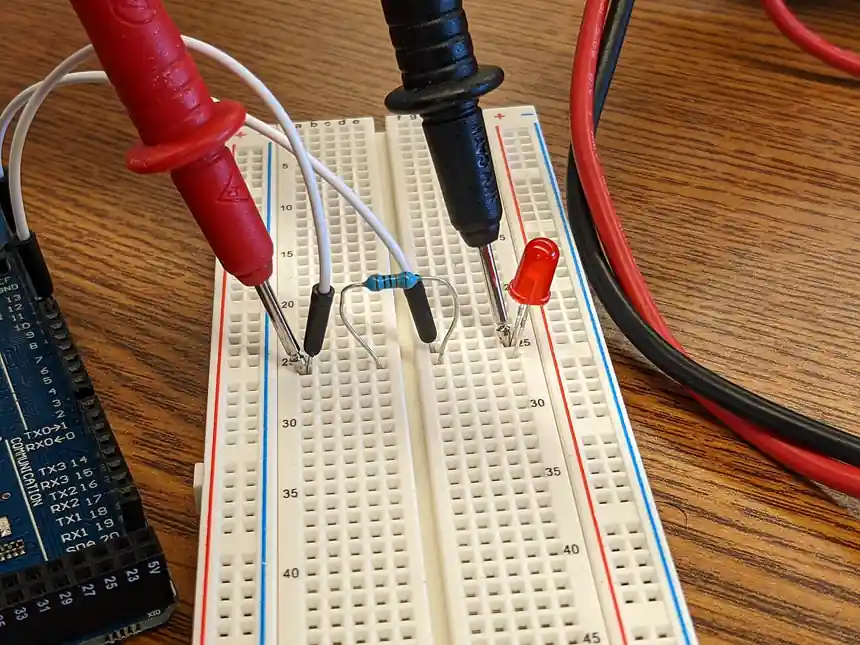
Test leads are the insulated wire assemblies that connect a multimeter, clamp meter, insulation tester, or oscilloscope to the circuit under test. A lead pairs a 4 mm banana plug at the instrument end with a probe tip, hook, or clip at the working end. Though they look like simple wires, they are safety-rated accessories: under IEC 61010-031 the lead, the connector, and the hand-held probe are treated as one assembly, and a damaged lead can silently downgrade the safety rating of an otherwise excellent meter.
This page treats the test lead as the field instrument it really is. The deciding parameters are the measurement category and voltage, the exposed tip geometry, the insulation and conductor materials, and the continuous current rating, because those four together determine whether the assembly is safe at the point of use rather than just on a catalog line.
This guide is aimed at industrial purchasing engineers, test technicians, and design engineers. It covers 6 chapters from what a test lead is, through plug and tip styles, insulation and conductor materials, the safety ratings that come from IEC 61010-031, spec-sheet decoding, to a selection decision sequence, with 7 selection FAQs. All parameters reference the public IEC 61010-1 and IEC 61010-031 measurement and probe-safety standards, with measurement-category impulse values drawn from the published IEC 61010-1 overvoltage tables.
Chapter 1 / 06
What is a Test Lead
A test lead is a flexible insulated conductor that carries an electrical signal between a measuring instrument and the circuit being measured. In its most common form it is a single insulated wire about one meter long, terminated at one end with a 4 mm banana plug that mates with the instrument jack, and at the other end with a contact tip the operator presses against the point of measurement. Test leads almost always ship as a matched pair, one red and one black, so the operator can keep track of polarity at a glance when reading voltage, resistance, continuity, or current.
Functionally a test lead is part of a system, not a standalone object. The relevant safety standard, IEC 61010-031, titles itself around hand-held and hand-manipulated probe assemblies for electrical measurement and test, and it deliberately treats the wire, the connector, and the probe body the operator holds as a single assembly to be rated together. This is the single most important idea on this page: the published category and voltage rating of a test lead is a property of the whole assembly, and a cut jacket, a cracked plug, or a worn tip invalidates the rating no matter how robust the meter at the other end may be.
Structurally a complete lead has four parts. First, the instrument connector, almost universally a 4 mm banana plug, in shrouded (sheathed) form for safety work or unshrouded form for protected low-voltage bench use. Second, the lead wire itself, a stranded copper conductor inside one or two layers of flexible insulation, sized by gauge to carry the rated current and rated for the working voltage by its dielectric strength. Third, the probe body, the hand-held grip carrying the finger guard, the molded barrier that keeps the operator's fingers behind a safe line. Fourth, the contact tip, fixed or interchangeable, which may be a sharp point, a spring-loaded hook, an alligator clip, or a Kelvin clamp.
The history of the modern safety lead tracks the history of measurement-category safety. Through the 1980s most leads were simple PVC wires with bare or lightly shrouded plugs. After a series of arc-flash injuries traced to instruments and accessories that could not survive the transient overvoltages present near the utility source, the measurement-category framework was written into IEC 61010-1, and IEC 61010-031 followed to bring the same discipline to the accessories. The result is the finger-guarded, shrouded, capped-tip lead that is now standard, and the reason a premium lead set costs many times more than a bare wire of the same length.
In application scale the test lead spans an enormous range of duty. The same banana form factor appears on a 5 USD economy multimeter and on a CAT IV 600 V utility-metering safety set, on bench leads handling a few volts of logic signal, and on insulation-tester leads carrying 1000 V DC. A single universal lead does not exist. The engineering question is always the same: match the lead's category, voltage, current, tip geometry, and materials to the specific measurement, and never assume that because a plug fits, the assembly is safe.
Chapter 2 / 06
Plug, Tip, and Clip Styles
A test lead is defined as much by its two ends as by the wire between them. The instrument end is standardized: a 4 mm banana plug, either shrouded or unshrouded. The working end is where the variety lives, and choosing the right tip or clip determines whether a measurement is fast, repeatable, and safe. The table below summarizes the common working-end styles and where each belongs.
Working end
Connection method
Typical use
Hands-free
Fixed sharp probe
Pressed by hand
Spot voltage, resistance, continuity
No
Spring-loaded hook (grabber)
Hooks onto pin or wire
SMD legs, IC pins, fine wires
Yes
Alligator / crocodile clip
Spring jaw bites terminal
Screw terminals, bus bars, battery posts
Yes
Kelvin / 4-wire clip
Dual-contact jaw
Low-resistance, milliohm measurement
Yes
Insulation-piercing clip
Needle pierces jacket
Live in-line testing without stripping
Yes
The 4 mm banana plug is the de facto universal instrument connector. A shrouded, or sheathed, plug has an insulated collar around the pin so that no live metal is exposed even when the plug is only half inserted, and it mates with a recessed jack. This is mandatory for any work on hazardous voltage, generally taken as above 30 V AC or 60 V DC. An unshrouded plug has a bare exposed pin and is acceptable only on protected, low-voltage bench circuits. Inside, a quality banana plug uses a multi-leaf spring of nickel-plated beryllium copper to deliver thousands of low-resistance insertions, whereas a cheap stamped spring loses tension and adds contact resistance that corrupts low-ohm readings.
The fixed sharp probe is the default working end for spot measurements. The exposed tip length is a safety parameter, not just an ergonomic one, because a long tip can bridge two adjacent terminals or arc to a grounded enclosure. This is why premium leads either ship with screw-on caps that shorten the exposed metal or use a retracting sleeve. The interplay between exposed tip length and category rating is covered in Chapter 4.
Clips and hooks turn a two-hand measurement into a hands-free one. The spring-loaded hook, often called a grabber, extends a fine sprung wire to grab an IC leg or a thin wire, ideal for crowded boards. The alligator or crocodile clip uses a sprung jaw to bite a screw terminal, bus bar, or battery post for longer logging sessions. The Kelvin clip carries two electrically separate contacts in one jaw so that a four-wire measurement can cancel lead resistance for milliohm work. Insulation-piercing clips drive a fine needle through a wire jacket to tap a live circuit without cutting it.
Modular lead families let one CAT-rated lead body serve many jobs by accepting push-on accessories at the tip, usually retained by a 4 mm shrouded socket. Pomona and Fluke both build such families, where the lead carries the headline category, for example CAT III 1000 V, and the operator swaps hooks, clips, and extended probes onto it. The catch, treated again in Chapter 5, is that the assembled rating is the lowest rating among the lead, the tip, and the clip, so a low-rated accessory pulls the whole assembly down.
Chapter 3 / 06
Insulation and Conductor Materials
The wire between the two ends is where cost, flexibility, and durability are decided. Two material choices dominate the working life of a test lead: the insulation jacket and the conductor. The table below contrasts the two mainstream jacket materials against the properties that matter in the field.
Property
Silicone insulation
PVC insulation
Flexibility range
-50 to +200 °C typical
-15 to +70 °C typical
Cold-weather behavior
Stays supple
Stiffens, takes a set
Flex-cycle endurance
Tens of thousands of bends
Lower, cracks sooner
Ozone / UV resistance
High
Moderate
Relative cost
High
Low
Typical product
Fluke TL175, Pomona TwistGuard
Fluke TL75 hard-point
Silicone insulation is the premium choice for field and safety leads. It remains flexible across a wide temperature band, on the order of -50 to +200 degrees Celsius for the raw compound, resists ozone and ultraviolet aging, and tolerates repeated coiling without cracking. Fluke specifies its TL175 TwistGuard leads with double layers of flexible silicone, an operating environment of -20 to +55 degrees Celsius, and endurance tested to over 30000 bends without failure. Pomona's TwistGuard family likewise uses two layers of silicone over a high-strand-count conductor. Silicone is the right call for electricians, cold climates, and any lead that gets coiled and uncoiled daily.
PVC insulation is cheaper, stiffer, and adequate for bench use at room temperature. It stiffens in the cold and takes a permanent set if coiled tightly, and it ages faster under UV. Fluke's TL75 hard-point set uses PVC-insulated probes and PVC-insulated right-angle shrouded 4 mm banana plugs, a sensible economy choice for indoor work. The crucial point is that the insulation material does not by itself set the category rating, but a hardened or cracked jacket will fail the dielectric withstand test and silently void whatever rating the lead once carried. Double insulation, two independent layers, is what lets a thin flexible lead achieve a high working voltage in a small diameter, the same reinforced-insulation principle used throughout IEC 61010.
The conductor is stranded copper, sized by American Wire Gauge. Test-lead wire commonly falls in the 16 to 18 AWG range, chosen so the lead can carry the standard 10 A multimeter current path with acceptable temperature rise, while higher strand counts buy flexibility and fatigue life. Thinner 22 AWG wire is common on accessory jumpers with molded alligator clips, but those are signal and low-current leads and must never be used on a 10 A current measurement, where the small cross-section overheats. The conductor cross-section, not the insulation, sets the continuous current limit.
Contact metallurgy closes out the materials story. The banana spring and the probe tip carry the measured current through a sliding or pressing contact, so their plating and base metal govern long-term contact resistance. Nickel-plated beryllium copper and phosphor bronze are the usual spring materials because they hold tension over thousands of cycles, and gold flash is sometimes added at the contact face for low-level signal work where even a few milliohms of oxide-driven resistance would matter. For low-resistance and four-wire measurement, contact quality at both ends dominates the error budget more than the wire itself.
Chapter 4 / 06
Safety Ratings and IEC 61010-031
The category and voltage printed on a test lead is the heart of its specification. It comes from the measurement-category framework of IEC 61010-1, applied to accessories by IEC 61010-031. The categories describe where in an electrical installation the lead may be used, and the reason this matters is transient energy: the closer a measurement point is to the utility source, the higher the impulse overvoltage that a wiring fault or lightning surge can deliver, because there is less series impedance to damp it. A lead must survive that impulse without flashover.
The four categories run from the protected end of the system to the source. CAT I is for circuits not connected to mains, such as protected electronic equipment. CAT II covers circuits plugged into a socket: household appliances, portable tools, and similar load-side equipment. CAT III covers the fixed building installation: distribution boards, circuit breakers, wiring, busbars, junction boxes, switches, and socket outlets in the fixed installation. CAT IV is the source of the installation: the service entrance, electricity meters, and primary overcurrent protection. The table below gives the peak impulse-withstand voltage each category must survive at common working voltages, as published in the IEC 61010-1 overvoltage tables.
Working voltage
CAT II peak
CAT III peak
CAT IV peak
150 V
1,500 V
2,500 V
4,000 V
300 V
2,500 V
4,000 V
6,000 V
600 V
4,000 V
6,000 V
8,000 V
1,000 V
6,000 V
8,000 V
12,000 V
The table explains why a CAT III 600 V instrument is more robust than a CAT II 1000 V one even though the second shows a bigger voltage number: the CAT III 600 V device withstands a 6000 V impulse while the CAT II 1000 V device withstands 6000 V as well, but the CAT III installation is a harsher transient environment. Category and voltage must always be read together, and the rule for selection is simple: the lead's category and voltage must meet or exceed the environment where it is used. A whole measurement chain is only as safe as its lowest-rated link, so the meter, the leads, and any accessory must all carry the required category.
For test leads specifically, IEC 61010-031 adds requirements that act on the physical probe. The protective finger guard, the molded barrier that keeps the operator's hand behind a safe line, is mandatory and replaces the older simple barrier. Just as important is the exposed tip length. The rating ceiling of a lead is constrained by how much bare metal can contact live parts at once, because a long tip can short adjacent terminals or arc to a grounded surface. This is why manufacturers offer tip caps and retracting sleeves.
The two flagship designs illustrate the mechanism. Fluke states its TL75 hard-point set is rated CAT II 1000 V uncapped, and that fitting the supplied protective caps raises the rating to CAT III 1000 V and CAT IV 600 V, because the cap leaves only a short tip exposed. The Fluke TL175 TwistGuard achieves the same result without loose caps: a patented twist sleeve changes the exposed tip from 19 mm down to 4 mm, so one lead reads CAT II 1000 V, CAT III 1000 V, and CAT IV 600 V across its tip positions, at 10 A maximum. In both cases the wire and insulation are unchanged. Only the exposed metal length, and therefore the clearance to live parts, is being managed. Note also the difference between certified and self-declared ratings: a lead independently tested and listed to IEC 61010-031 by a recognized body carries more weight than one that merely prints a category on the packaging.
Chapter 5 / 06
Key Specification Parameters
A test-lead datasheet is short, but every line on it is load-bearing. Six parameters drive the buying decision: measurement category and voltage, maximum current, conductor gauge and length, insulation material and operating temperature, plug and tip style, and the certification status. Each is decoded below.
Measurement category and voltage is the headline figure, and as Chapter 4 showed, it is a property of the complete assembly. Read it as a pair, for example CAT III 1000 V or CAT IV 600 V, and confirm whether the rating depends on caps being fitted or a sleeve being retracted. A lead that is only CAT II without its caps must not be relied on for panel work, and a lead that prints a category with no reference to a recognized test body should be treated with caution on hazardous voltage.
Maximum current is set by the conductor cross-section and the banana contact, and is typically 10 A for general multimeter leads, matched to the 10 A current jack on common meters. The Fluke TL175 and Pomona TwistGuard families are both rated 10 A maximum. Heavier 20 to 30 A leads exist for clamp accessories and power-supply work but require larger gauge and clips. Because the 10 A current path on a meter is often only briefly fused or unfused, the lead must share that rating honestly: a thin accessory jumper used on a current range is a fire risk.
Conductor gauge and length trade reach against resistance and bulk. Common multimeter leads run roughly one meter, around 0.9 to 1.5 m, in 16 to 18 AWG stranded copper. Longer leads add resistance that matters on low-ohm and current measurements, where every additional milliohm shows up in the reading, which is exactly why four-wire Kelvin connections exist. Pick the shortest length that reaches comfortably.
Insulation and operating temperature determine field durability. Silicone double insulation, as on the Fluke TL175 with its -20 to +55 degrees Celsius operating range and 30000-bend endurance, is the durable choice; PVC is the economy choice for indoor bench use. Confirm the stated operating-temperature window, not just the raw compound rating, because the assembly rating is what is guaranteed.
Plug and tip style must match both the instrument and the work. The list below captures the choices that recur on almost every datasheet:
Shrouded 4 mm banana plug: mandatory for hazardous voltage, mates only with a recessed jack, no live metal exposed when half inserted.
Unshrouded 4 mm banana plug: bare pin, acceptable only on protected low-voltage bench circuits below about 30 V AC or 60 V DC.
Straight vs right-angle plug: right-angle plugs, as on the Fluke TL75, relieve strain at the meter and lie flat against the case.
Fixed vs interchangeable tip: modular leads accept hooks, clips, and extended probes on a 4 mm shrouded socket for one-lead-many-jobs flexibility.
Capped or retracting tip: the mechanism that lets one lead reach a higher category by shortening exposed metal.
Certification status is the parameter buyers most often skip. A lead independently tested and listed to IEC 61010-031 by a recognized certification body, with the mark on the product and a traceable report, is a different proposition from one that simply prints a category on the bag. For any work above low voltage, treat third-party certification as a hard requirement, not a nice-to-have, because the lead is a personal-protective item.
Chapter 6 / 06
Selection Decision Factors
To turn the preceding five chapters into a specific order, follow the decision sequence below. Most selection mistakes come not from a single wrong line item but from deciding the cheap, visible things first, such as length and color, and leaving the safety-defining things, such as category and tip geometry, to chance. These seven steps work as a fixed purchasing template.
Measurement category and voltage: First fix where the lead will be used, then require a category and voltage that meet or exceed it: CAT II for socket-side appliance work, CAT III for panels and fixed wiring, CAT IV for the service entrance. Confirm whether the rating needs caps fitted or a sleeve retracted.
Maximum current: Match the lead to the highest current path it will see. For general multimeter use the 10 A rating common to the Fluke TL175 and Pomona TwistGuard is right; never put a thin accessory jumper on a current range.
Plug type and instrument fit: Shrouded 4 mm banana for hazardous voltage matched to a shrouded jack; unshrouded only for protected low-voltage bench work. Choose straight or right-angle to suit the meter and bench layout.
Working end and accessories: Pick fixed probe, hook, alligator, Kelvin, or piercing clip per the task in Chapter 2, and prefer a modular family if the same lead body must serve several jobs. Remember that the assembled rating equals the lowest of lead, tip, and clip.
Insulation and environment: Silicone double insulation for cold, outdoor, and high-flex field work; PVC for indoor bench economy. Confirm the stated operating-temperature window covers the worksite.
Length and conductor gauge: Choose the shortest length that reaches comfortably to minimize added resistance, and a gauge, commonly 16 to 18 AWG, sized for the rated current and the desired flexibility.
Certification and total cost of ownership: Require third-party listing to IEC 61010-031 for any non-trivial voltage. Price the lead as a consumable: a premium silicone safety set costs more upfront but survives years of flexing, whereas a cheap set cracks, fails the dielectric, and must be retired, and a single arc-flash incident from an under-rated lead dwarfs any saving.
One last dimension that buyers overlook is serviceability and inspection discipline. Test leads are wear items, and the practical lifetime cost is dominated by how often they are inspected and replaced. Before every use, check for cracked or hardened insulation, exposed copper near the tip or plug, a bent or pitted tip, a banana plug that no longer clicks home, and any arc burning. Run a continuity check and flex the lead while watching the reading: an intermittent internal break can read open under vibration and produce a dangerous false zero-volt indication on a live circuit. Modular families from Fluke, Pomona, Hioki, and similar makers ease this by letting worn tips and clips be swapped rather than scrapping the whole set, but the core rule stands: a damaged lead degrades the safety category of the entire measurement system, so replace it rather than nurse it along.
FAQ
What is the difference between a test lead and a test probe?
A test lead is the complete flexible assembly: an insulated wire terminated at one end by an instrument connector (usually a 4 mm banana plug) and at the other by a contact tip. A test probe, in standards language, is the hand-held end the operator holds against the circuit, with the finger guard, body and tip. IEC 61010-031 actually titles itself around hand-held and hand-manipulated probe assemblies, which means it governs the probe, the lead wire and the connector as one safety system. In everyday purchasing the two words are used loosely, but on a datasheet the CAT rating always belongs to the whole assembly, not to the wire alone.
What do CAT II, CAT III and CAT IV mean on a test lead?
They are measurement categories defined by IEC 61010-1 and applied to accessories through IEC 61010-031. They describe where in an electrical installation the lead may be used, because transient overvoltage energy rises as you move toward the utility source. CAT II is circuits plugged into a socket, CAT III is the fixed building distribution (panels, breakers, busbars), and CAT IV is the service entrance and origin of the installation (meters, primary protection). The number tied to a voltage, for example CAT III 1000 V, fixes the impulse withstand the lead must survive. At 1000 V working voltage that means an 8000 V peak transient for CAT III and a 12000 V peak for CAT IV.
Why does putting caps on the probe tips raise the CAT rating?
The rating ceiling of a test lead is limited by how much bare metal can touch a live conductor at once. A long exposed tip can bridge adjacent terminals or arc to a grounded enclosure, so a 19 mm uncapped probe is held to a lower category than the same probe with a cap that leaves only about 4 mm exposed. Fluke states the TL75, rated CAT II 1000 V uncapped, reaches CAT III 1000 V and CAT IV 600 V once the supplied caps are fitted. The TL175 solves the same problem with a twist sleeve that retracts the exposed tip from 19 mm to 4 mm. The conductor and insulation are identical in both states: only the exposed metal length, and therefore the clearance to live parts, changes.
Should I choose silicone or PVC insulated test leads?
Silicone stays flexible from roughly -50 to +200 degrees Celsius, resists ozone and UV, and survives tens of thousands of flex cycles, which is why premium safety leads such as the Fluke TL175 and Pomona TwistGuard use double silicone. Fluke rates the TL175 for a -20 to +55 degrees Celsius operating environment and over 30000 bends. PVC is cheaper and stiffer, takes a set in the cold, and is typical of economy and hard-point leads such as the Fluke TL75. For field electricians, cold climates and frequent coiling choose silicone. For occasional bench use at room temperature PVC is acceptable. The insulation material does not by itself set the CAT rating, but a cracked or hardened jacket fails the dielectric test and voids it.
Are all 4 mm banana plugs interchangeable?
Mechanically most 4 mm plugs mate with most 4 mm jacks, but safety leads use shrouded (sheathed) plugs whose insulated collar fits a recessed jack so no live metal is exposed when half inserted. Unshrouded plugs have bare pins and are only acceptable on protected low-voltage circuits below about 30 V AC or 60 V DC. The internal spring contact also matters: quality plugs use nickel-plated beryllium copper multi-leaf springs for thousands of low-resistance insertions, while cheap plugs lose grip and add contact resistance. For any work above 30 V always use shrouded plugs matched to a shrouded instrument jack.
How much current can a test lead carry?
Most multimeter test leads are rated 10 A, set by the conductor cross-section (commonly 16 to 18 AWG) and the banana contact, and matched to the 10 A current jack found on typical meters. Heavier 20 to 30 A leads exist for clamp accessories and power supplies but need a larger gauge and clip. Remember that the 10 A path on a meter is usually unfused or briefly fused, so the lead, the jack and the meter must share the rating. Never use a thin 22 AWG accessory lead, common on alligator-clip jumpers, on a 10 A current measurement: it can overheat and melt the insulation.
What interchangeable tips and clips are available?
Modular lead sets accept push-on accessories at the probe tip, usually held by a 4 mm shrouded socket. Common options are spring-loaded hook (grabber) clips for fine pins and SMD legs, alligator and crocodile clips for hands-free connection to terminals, large insulation-piercing or Kelvin clips for 4-wire low-resistance work, and threaded extension probes. Pomona and Fluke both build modular families where one lead body carries CAT III 1000 V and you swap the working end. Each accessory carries its own CAT and current rating, and the assembled rating is the lowest of the lead, the tip and the clip.