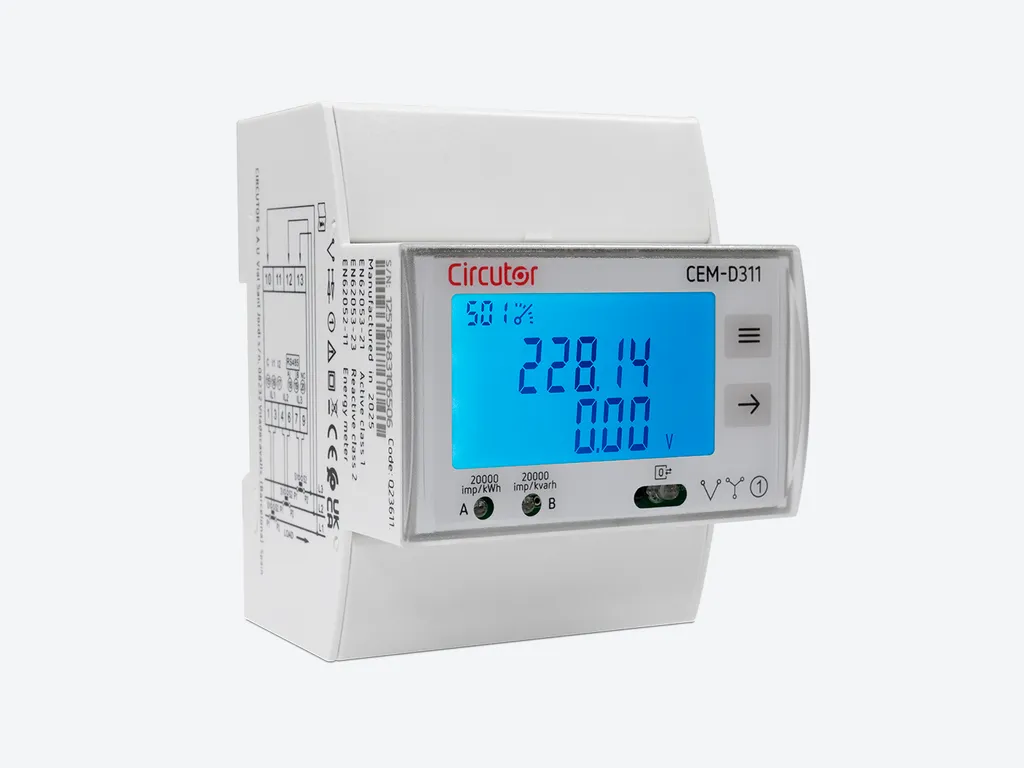
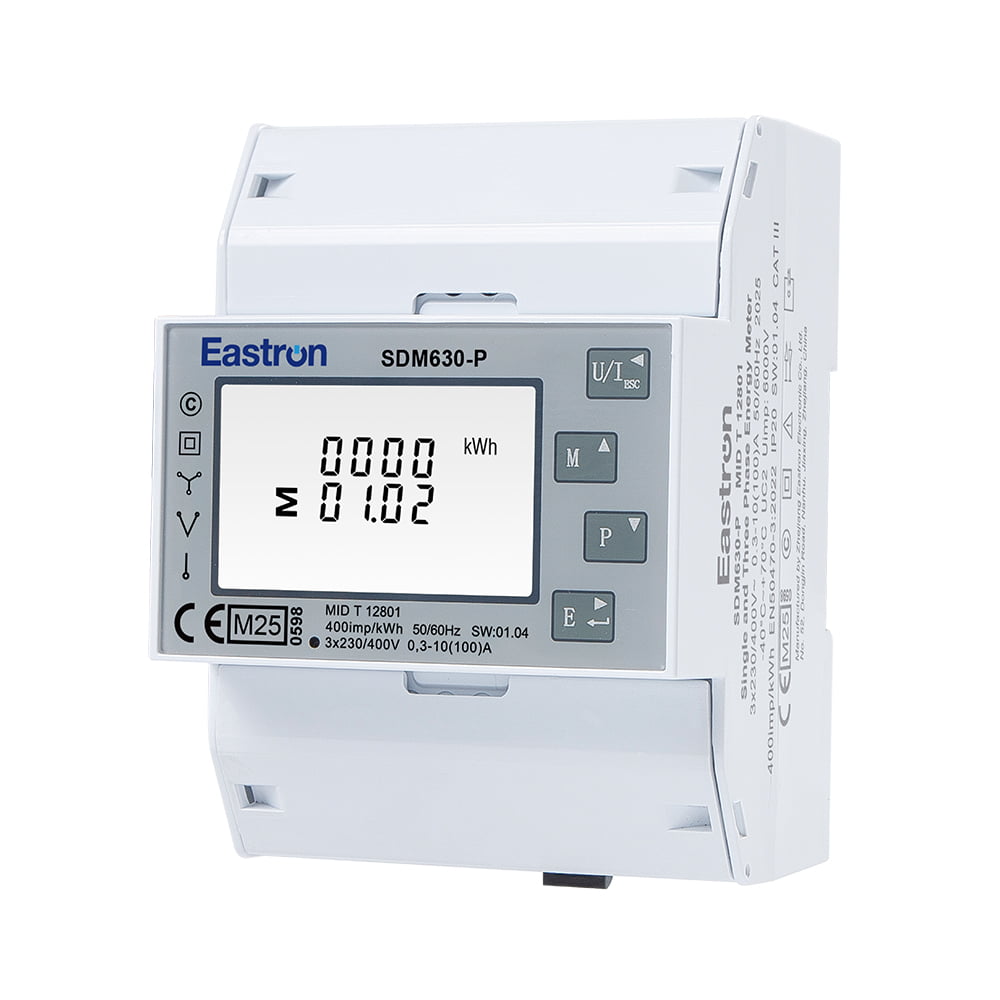
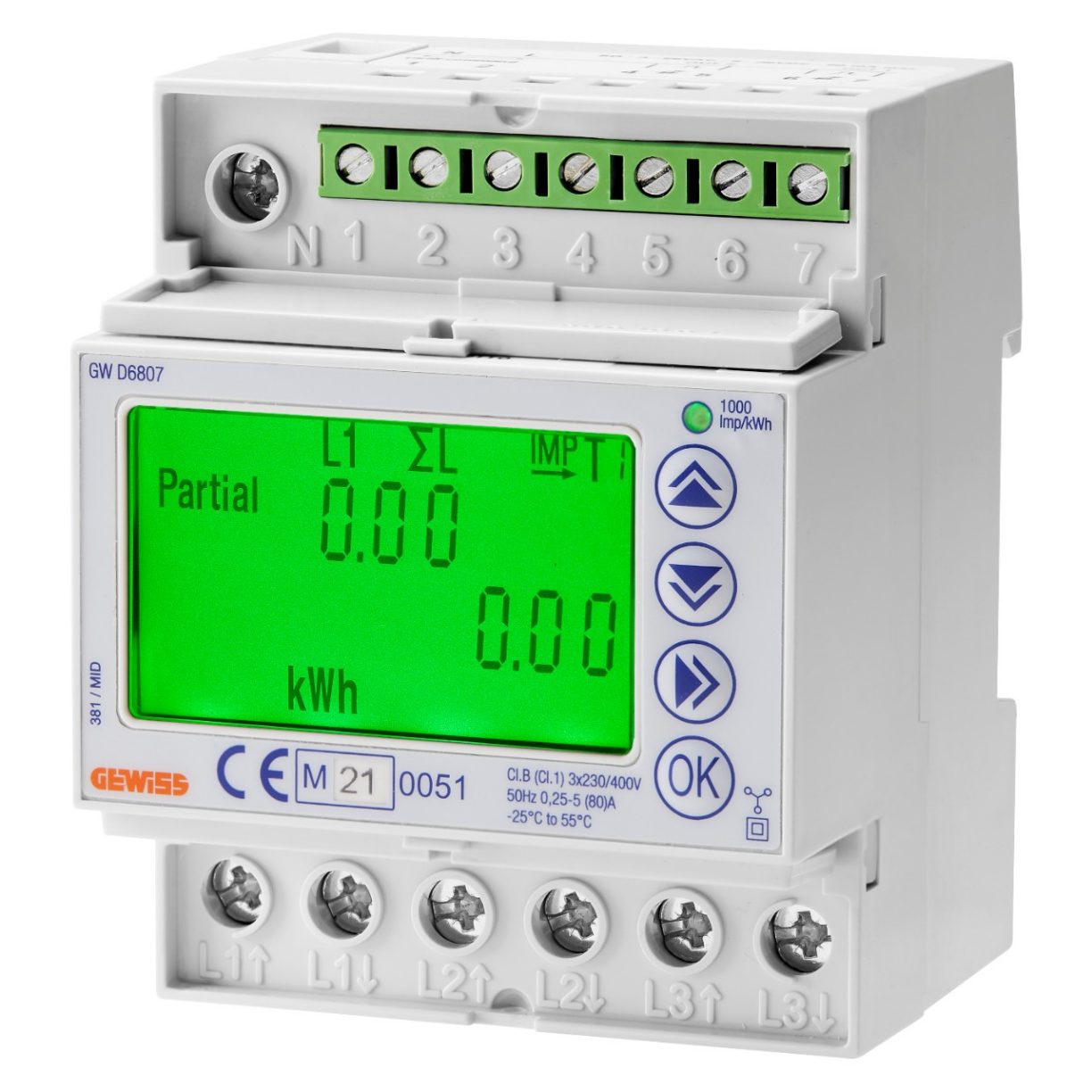
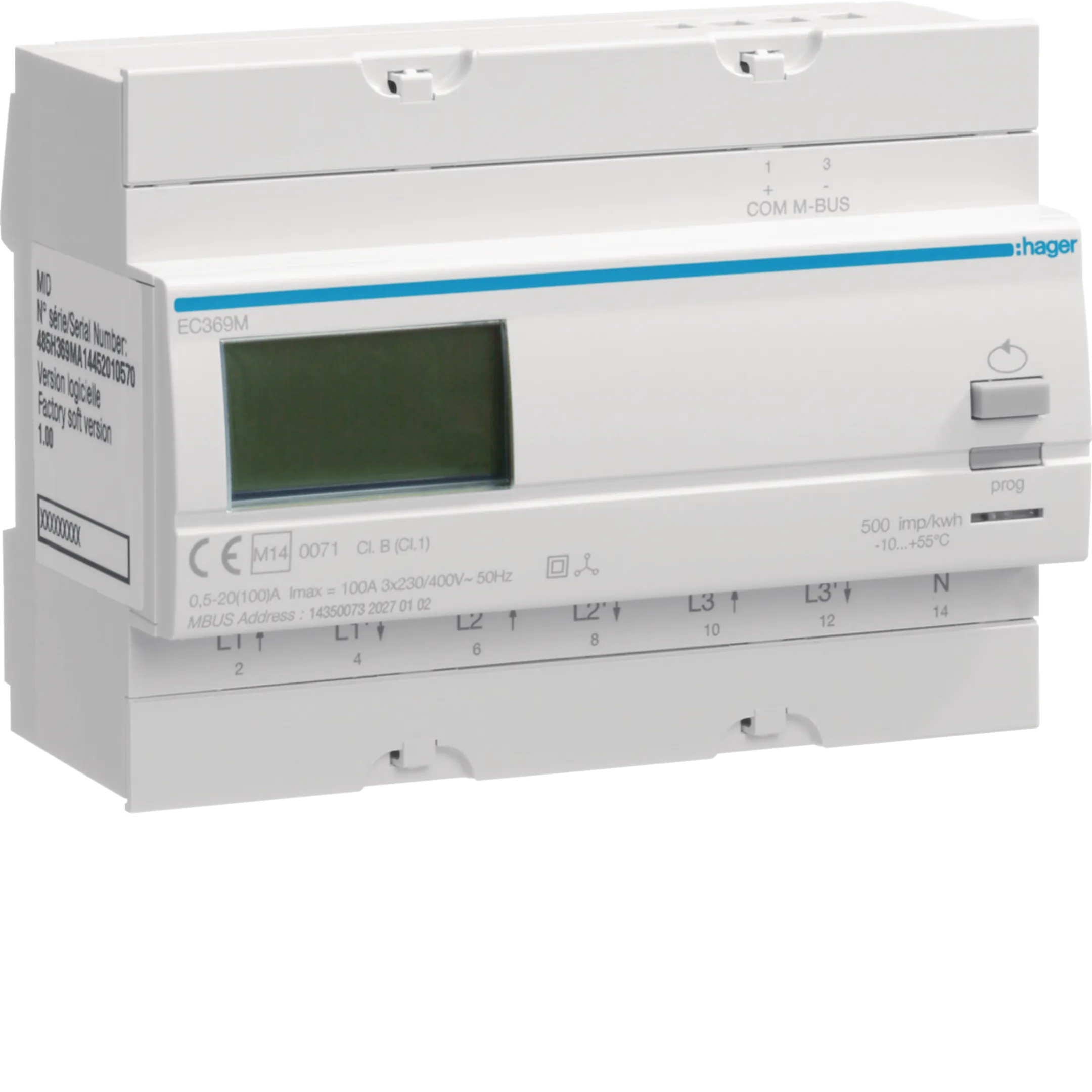
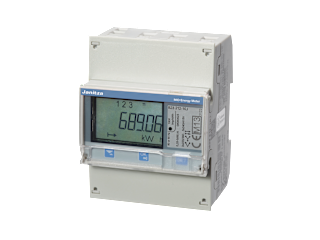
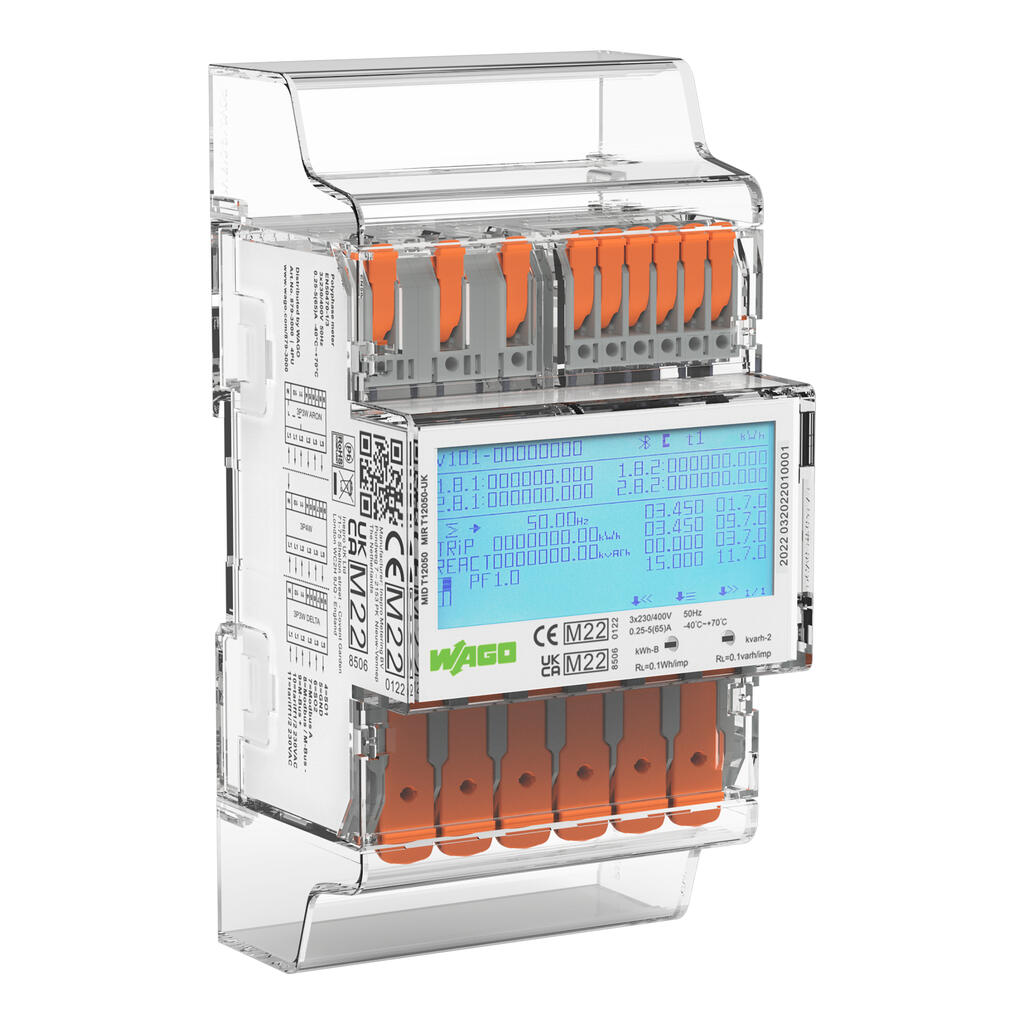
An electricity meter, also called an energy meter or kWh meter, is a legally controlled instrument that measures and registers the electrical energy delivered to a residence, a building, or an industrial site. Its primary output is active energy in kilowatt-hours (kWh), the unit settled on the bill, although modern meters also record reactive energy, demand, voltage, current, and power quality. Because the reading translates directly into money, an electricity meter is held to a metrology accuracy class under standards such as IEC 62052-11 and the IEC 62053 series, and in most jurisdictions it cannot be installed for billing without type approval.
This guide separates the two questions that selection collapses together: which metrology class and connection type the application demands, and which communication and tariff features the utility head-end or facility power monitoring system requires. The two are independent, and getting one right does not guarantee the other.
This guide is written for procurement engineers, facility managers, and metering specialists. It covers 6 chapters from what a meter is and how it works, through type classification, measurement technologies, accuracy classes and standards, and spec-sheet decoding, to a selection decision sequence, with 7 selection FAQs. All parameters reference the public standards IEC 62052-11, the IEC 62053 series (Parts 21, 22, 23, 24), EN 50470 under the EU Measuring Instruments Directive 2014/32/EU, ANSI C12.20, and the IEC 62056 (DLMS/COSEM) communication suite.
Chapter 1 / 06
What is an Electricity Meter
An electricity meter measures the electrical energy consumed by a circuit and accumulates it as a running total. Energy is the time integral of instantaneous power, and instantaneous power is the product of voltage and current. The meter therefore senses the line voltage and the load current continuously, multiplies them, and integrates the result over time. The registered quantity is active energy, expressed in kilowatt-hours, where one kilowatt-hour equals the energy a one-kilowatt load consumes in one hour, or 3,600,000 joules. This single number, accumulated over a billing period, is what a utility invoices.
What separates an electricity meter from a laboratory-grade power meter is legal control. Because the reading settles money between a buyer and a seller, the meter is a legally controlled measuring instrument: it carries a defined accuracy class, it must pass type tests before manufacture, and in many jurisdictions it requires periodic re-verification. Standards bodies codify this. IEC 62052-11 defines the general requirements and test conditions for metering equipment, while the IEC 62053 series defines the class-specific accuracy requirements per measurement type. In the European Union, the Measuring Instruments Directive 2014/32/EU (MID) and its harmonized EN 50470 standards govern meters placed on the market; in North America, ANSI C12.20 defines accuracy and performance.
The history of the electricity meter tracks the history of the grid itself. In the 1880s Thomas Edison developed a direct-current electrochemical meter, and in 1883 Hermann Aron patented a clock-dial electromagnetic meter. The decisive step for alternating current came in 1889, when Otto Blathy of the Ganz Works presented the first AC induction kilowatt-hour meter at the Frankfurt fair, and in 1894 Oliver Shallenberger of Westinghouse refined the induction principle so that disc speed was proportional to power. The rotating-disc induction meter that resulted dominated for roughly a century. From the 1990s onward, solid-state (static) meters with digital signal processing displaced it, and from the 2000s the smart meter added two-way communication, turning a passive register into a networked grid sensor.
In scale, electricity metering is one of the largest installed instrument populations on earth. There are on the order of two billion electricity meters in service worldwide, and the smart-meter segment alone is a multi-billion-dollar annual market growing at high single-digit rates as utilities replace legacy stock under advanced metering infrastructure (AMI) programs. A single distribution utility may operate millions of devices, which is why fleet-level concerns, type approval, firmware management, and re-verification scheduling, dominate metering economics far more than the unit price of any one meter.
Four engineering attributes determine whether a given meter fits an application: its accuracy class, its connection type (direct or transformer-operated), the set of energy quantities it registers (active, reactive, apparent, four-quadrant), and its communication and tariff capability. The chapters that follow take each of these in turn, because a mistake in any one of them can make an otherwise excellent meter unusable for the job.
Chapter 2 / 06
Meter Types and Classification
Electricity meters are classified along several independent axes at once: by phase configuration (single-phase or three-phase), by connection method (direct or transformer-operated), by the energy quantities they register, and by their functional role (revenue billing, prepayment, or smart AMI). A real purchase order combines values from each axis, for example a "three-phase, four-wire, CT-connected, four-quadrant, DLMS smart meter." Choosing the wrong value on any axis is the most common selection error. The table below summarizes the primary axes.
Direct (whole-current); CT-operated; CT and VT-operated
Up to ~100 A vs. larger and MV services
Energy quantities
Active only; active plus reactive; four-quadrant
Residential vs. industrial and prosumer
Functional role
Revenue; prepayment; smart AMI; sub-meter
Billing, credit control, grid sensing
Single-phase versus three-phase. A single-phase, two-wire meter serves a single line and neutral and covers most residential supplies. Three-phase meters measure all three line conductors; a three-wire variant suits a delta supply with no neutral, while a four-wire variant (three lines plus neutral) is the standard for commercial and industrial wye supplies and can also handle unbalanced loads. Phase count must match the service; a single-phase meter cannot legally settle a three-phase load.
Direct versus transformer-operated. A direct-connected, or whole-current, meter carries the entire load current through its internal sensing shunts and is practical up to roughly 100 A, which covers small services. Beyond that, the meter is wired through external current transformers (CTs) with a standard 5 A or 1 A secondary, and the meter multiplies its scaled reading by the CT ratio (for example 200:5) to recover primary energy. The CT rating notation, such as 5(6) A, states the rated and maximum secondary current. At medium voltage, voltage transformers (VTs) are added so the meter sees a safe scaled voltage as well. Crucially, the metering CT and VT errors add directly to the meter error, so transformer-operated revenue metering pairs an S-class meter with class 0.2 or 0.5 instrument transformers to IEC 61869.
Energy quantities. The simplest meters register active energy only (kWh) for residential billing. Industrial meters add reactive energy (kvarh) and apparent energy (kVAh), because industrial tariffs often penalize a poor power factor. A four-quadrant meter records both import and export of active and reactive energy, which is mandatory wherever on-site generation, such as rooftop solar, can push energy back onto the grid.
Functional role. A plain revenue meter accumulates a register read manually or remotely. A prepayment meter requires the customer to load credit, via a smart card or a 20-digit encoded token, and disconnects the supply through an internal relay when the credit is exhausted. A smart AMI meter adds two-way communication, time-of-use tariffs, outage notification, and power-quality logging, turning the meter into a distribution-grid sensor. A sub-meter is a non-revenue instrument used inside a facility to allocate cost between tenants or processes, often in the compact form of a DIN-rail or digital panel meter; it may use the same technology but typically carries no billing approval.
Chapter 3 / 06
Measurement Technologies
Two families of measurement technology have served the grid: the electromechanical induction meter and the modern electronic (static) meter. They reach the same answer, accumulated kilowatt-hours, by entirely different physics. The table below contrasts the two on the metrics that matter for selection and field service.
Induction (electromechanical) meters work by electromagnetic induction. A voltage coil and a current coil produce magnetic fluxes through a non-magnetic but conductive aluminum disc; because the voltage-coil flux is delayed roughly 90 degrees by the coil's inductance, the two fluxes together induce eddy currents and a torque proportional to the instantaneous product of voltage and current, that is, to power. A permanent magnet provides an opposing eddy-current brake, so the disc reaches a steady speed proportional to power, and a gear register counts revolutions to integrate energy. The defining specification is the meter constant Kh, the watt-hours per revolution: instantaneous power equals 3600 times Kh divided by the seconds per revolution, so a technician can verify the meter by timing the disc against a known load. Induction meters are rugged and need no power supply of their own, but they cannot measure reactive energy natively, cannot communicate, and wear mechanically, which is why they are being retired.
Static (electronic) meters replace the disc with a measurement engine. The line voltage is scaled by a resistor divider and the current is sensed by a shunt, a current transformer, or a Rogowski coil (the same clamp-on principle a portable clamp meter uses for spot checks); both are sampled by an analog-to-digital converter against a precision voltage reference, and a digital signal processor multiplies the instantaneous samples and integrates them to compute active, reactive, and apparent energy. Because the computation is in firmware, one device can register all energy quantities in all four quadrants, apply multiple time-of-use tariffs, and log power-quality events that a dedicated power quality analyzer would otherwise capture. The dominant error sources are no longer mechanical but electronic: drift in the input preamplifier and the stability of the voltage reference. Static meters need a small internal power supply and so add a clock battery and capacitors that bound their service life, but they enable everything the smart grid requires.
The smart meter is a static meter plus a communication module and a tariff and load-control function. It is not a separate sensing technology; it is the static metrology engine joined to a network stack, which Chapter 5 covers under output and protocol. The combination is what allows remote reading, remote disconnect, outage detection, and time-of-use pricing across millions of endpoints, and it is the form factor that utility AMI rollouts now specify by default.
Chapter 4 / 06
Accuracy Classes and Standards
Accuracy class is the single most important metrology specification, and it is also the one most often misquoted across regions, because the same physical accuracy carries different labels under IEC, European MID, and ANSI frameworks. The accuracy class states the maximum permissible percentage error of the registered energy under reference conditions; the actual error is also bounded across a range of currents, temperatures, and power factors defined in the standard. The table below maps the principal active-energy classes across the three frameworks.
Max. permissible error
IEC 62053-21 / -22
EN 50470-3 (MID)
ANSI C12.20
±2.0%
Class 2
Class A
n/a
±1.0%
Class 1
Class B
n/a
±0.5%
Class 0.5S
Class C
Class 0.5
±0.2%
Class 0.2S
n/a
Class 0.2
±0.1%
Class 0.1S
n/a
Class 0.1
The IEC structure. Since the 2020 revision, IEC 62052-11 holds the general requirements and test conditions common to all meters, while the class-specific accuracy limits live in the IEC 62053 series. Part 21 covers static active-energy meters of Classes 0.5, 1, and 2 for whole-current (direct) connection. Part 22 covers transformer-operated static active-energy meters of the tighter S classes, 0.1S, 0.2S, and 0.5S, where the S signifies that the accuracy is held down to 1 percent of rated current, which matters because CT-fed meters often run at low load fractions. Part 23 covers static reactive-energy meters of Classes 2 and 3, and Part 24 unifies and extends the reactive-energy requirements; Part 23 is being phased out in favor of Part 24 for new designs.
The European MID framework. Meters placed on the EU market for billing must conform to the Measuring Instruments Directive 2014/32/EU, whose harmonized standards are the EN 50470 series. EN 50470-1 carries the general requirements (analogous to IEC 62052-11) and EN 50470-3 the active-energy classes. MID class indexes A, B, and C correspond to IEC Classes 2, 1, and 0.5S respectively, so a meter marked Class B is the MID equivalent of an IEC Class 1 device. Residential meters are typically Class B; commercial and industrial revenue metering moves to Class C.
The North American framework. ANSI C12.20 defines accuracy and performance for revenue meters in Classes 0.1, 0.2, and 0.5, with the percentage equal to the class number. ANSI C12.1 covers the broader code for electricity metering, while ANSI C12.18, C12.19, and C12.22 define the optical, data-table, and network communication layers used by North American AMI. A meter approved to a strong IEC class still needs the locally recognized approval, ANSI in North America or MID in Europe, before it can be installed for billing.
Reading the class correctly. A class number alone is incomplete without its current range and reference conditions. A Class 0.5S meter is only Class 0.5S across its specified current span and within its reference temperature band and power-factor range; outside that envelope the standard allows larger errors. For transformer-operated revenue metering, remember that the instrument-transformer error stacks onto the meter error, so a Class 0.5S meter behind a class 1 CT does not deliver 0.5 percent system accuracy. Specify the meter class and the CT and VT class together.
Chapter 5 / 06
Key Specification Parameters
A meter datasheet may list 20 or more parameters, but selection turns on a smaller set. The most decision-relevant are the reference and rated voltage, the current ratings, the accuracy class, the starting current, the meter constant, the energy quantities and tariff structure, the output and communication protocol, and the environmental and safety ratings. Each is explained below.
Voltage and frequency. The reference voltage (Un) and frequency (50 Hz or 60 Hz) must match the supply. Single-phase meters are commonly rated 230 V; three-phase four-wire meters are rated 3 by 230/400 V. The meter must also tolerate the standard voltage variation range, typically about plus-or-minus 20 percent of Un, without losing class.
Current ratings. For a direct meter, the basic current (Ib) and the maximum current (Imax) define the load span, written as Ib(Imax), for example 10(100) A, meaning a 10 A reference rating that registers accurately up to 100 A. For a transformer-operated meter, the rated secondary current (In) and its maximum are written with parentheses, for example 5(6) A or 1(2) A, and the meter is paired with an external CT of the chosen ratio. The current ratings, not the physics, are what set the boundary between a direct and a CT-connected installation.
Starting current and meter constant. The starting current (Ist) is the lowest current at which the meter begins to register, specified as a small fraction of Ib, for example 0.4 percent of Ib for a Class 1 meter; below it the meter must not creep. The meter constant, expressed in impulses per kilowatt-hour (imp/kWh) on the calibration LED or the S0 pulse output, defines the relationship used to verify the meter on a test bench against a working standard of Class 0.05 or better.
Energy quantities and tariffs. The spec states whether the meter registers active only, active plus reactive, or full four-quadrant energy, and how many time-of-use tariff registers and demand registers it maintains. Maximum-demand metering records the highest average power over a sliding window (commonly 15 or 30 minutes), the basis for industrial demand charges.
Output and communication. The communication stack is the meter's interface to the metering system. The main options are listed below.
Optical / S0 pulse: A local infrared optical port (per IEC 62056-21) and an S0 pulse output proportional to energy, used for local reading and simple data logging.
DLMS/COSEM: The dominant utility application protocol, defined by the IEC 62056 series, modeling the meter as COSEM objects addressed by OBIS codes so any compliant head-end can read any compliant meter.
Power-line communication (PLC): Narrowband PLC such as G3-PLC or PRIME carries data over the distribution wiring itself, widely used because no separate network is needed.
RF mesh and cellular: Sub-GHz RF mesh self-heals across many meters; cellular options include LTE Cat-M and NB-IoT for direct connectivity.
ANSI C12.18 / C12.19 / C12.22: The optical, data-table, and network layers used by North American AMI; Modbus RTU is common for industrial sub-meters.
Environmental and safety. Revenue meters typically carry an ingress rating of IP54 for indoor or sheltered use, an operating temperature range of about -40 to +70 degrees C for outdoor pole or pad mounting, and protection class II double insulation. They must pass the electromagnetic compatibility and dielectric tests in IEC 62052-11. Outdoor and exposed installations should confirm the UV-stable enclosure rating and the surge-withstand level.
Chapter 6 / 06
Selection Decision Factors
To turn the preceding chapters into a specific model, follow the decision sequence below. The most common selection failures come not from a single wrong number but from settling a downstream choice before an upstream one. These steps work as a fixed RFQ template.
Service and phase configuration: Confirm single-phase two-wire, three-phase three-wire, or three-phase four-wire, plus the nominal voltage and frequency. This is the first gate; everything else follows from the supply.
Connection method and current rating: If the load is under roughly 100 A, choose a direct meter and specify Ib(Imax), for example 10(100) A. Above that, choose a transformer-operated meter with In(max) such as 5(6) A and select the CT ratio; at medium voltage, add VTs.
Energy quantities and tariffs: Decide active only, active plus reactive, or four-quadrant (mandatory with on-site generation or export). Specify the number of time-of-use registers and whether maximum-demand metering is required.
Accuracy class and approval: Pick the class your authority recognizes, IEC 62053 Class 1 or 0.5S, EN 50470 MID Class B or C, or ANSI C12.20 Class 0.5 or 0.2, and confirm the meter holds valid type approval in your jurisdiction. For CT metering, match a metering-grade CT class to the meter class.
Communication stack: Match the meter to the head-end the utility or facility already operates, DLMS/COSEM over PLC, RF mesh, or cellular, or ANSI C12.22, or Modbus for industrial sub-metering. A meter with the wrong stack cannot be integrated regardless of its metrology.
Functional features: Decide whether an internal disconnect relay, prepayment, load limiting, anti-tamper detection, or power-quality logging is required, and confirm the firmware supports remote upgrade.
Environment and mounting: Confirm the ingress rating (IP54 typical), the operating temperature range for the install location, the mounting form (DIN-rail, panel, or socket base), and the surge and EMC withstand for the site.
Lifecycle and total cost of ownership: Treat the meter as a regulated asset. Account for the type-approval acceptance, the recertification or sample-test calendar, the clock-battery and relay service life (around 15 to 20 years), spare-part availability, and firmware support, not just the unit price.
One dimension that buyers routinely underweight is manufacturer and approval serviceability: whether the model holds the specific type approval your regulator accepts, whether the vendor's head-end software is already deployed in your network, and whether type-approved spares and an accredited calibration service exist locally. For utility AMI, Landis+Gyr (E360 and Revelo), Itron (OpenWay CENTRON and Riva), Honeywell Elster, Iskraemeco (AM550), Sagemcom, Kamstrup, and Sensus are the established suppliers; for industrial and panel sub-metering, Schneider Electric (iEM3000 and PowerLogic PM5000), ABB, Siemens, and Carlo Gavazzi are common. The decisive question is rarely brand prestige but whether the device is approved, integrable, and serviceable in your specific jurisdiction and head-end.
FAQ
What is the difference between an electricity meter and an energy analyzer?
A revenue electricity meter is a legally controlled measuring instrument: it accumulates billable active energy (kWh) under a metrology accuracy class such as IEC 62053-21 Class 1 or IEC 62053-22 Class 0.5S, and it must hold a type approval before it can settle money. An energy analyzer or multifunction power meter focuses on diagnostics: it shows real-time voltage, current, power factor, harmonics, and demand, but it usually carries no billing approval. The line is regulatory rather than physical. Many modern meters do both, yet only the registers covered by the metrology certificate are valid for billing. If a register is used for invoicing, the device needs MID or local utility approval; if it only drives a dashboard, it does not.
What does accuracy class 1 or class 0.5S actually mean?
Accuracy class is the maximum permissible percentage error of registered energy under reference conditions. Under IEC 62053-21 a Class 1 meter stays within plus-or-minus 1.0 percent at unity power factor, and a Class 2 meter within plus-or-minus 2.0 percent. Transformer-operated meters use the S classes of IEC 62053-22: Class 0.5S means plus-or-minus 0.5 percent and Class 0.2S means plus-or-minus 0.2 percent, with the S denoting tightened limits down to 1 percent of rated current. In Europe the MID maps these to EN 50470-3 class indexes: Class A equals IEC Class 2, Class B equals Class 1, and Class C equals Class 0.5S. In North America ANSI C12.20 defines Class 0.2 and Class 0.5. The class is only guaranteed across the meter's specified current, temperature, and power-factor envelope.
When do I need a CT-connected meter instead of a direct-connected one?
Direct-connected (whole-current) meters carry the full load current through their internal shunts and are practical up to roughly 100 A, which covers most residential and small commercial services. Above that, the conductor and terminal sizing become impractical, so the circuit switches to a transformer-operated meter wired through external current transformers, typically with a 5 A or 1 A secondary. The meter then reads a scaled current such as 5(6) A and multiplies by the CT ratio (for example 200:5) to recover primary energy. CT metering also lets the meter sit away from the busbars and is mandatory for medium-voltage settlement, where voltage transformers are added as well. Always match the meter's S-class to a metering-grade CT (class 0.2 or 0.5 to IEC 61869-2), because the CT error stacks directly onto the meter error.
What is the difference between active, reactive, and apparent energy?
Active energy (kWh) is the real work delivered to a load and is what residential bills are based on. Reactive energy (kvarh) is the energy that oscillates between source and inductive or capacitive loads without doing net work; it is metered under IEC 62053-23 or the unified IEC 62053-24 in Class 2 and Class 3. Apparent energy (kVAh) is the vector combination of the two. Industrial tariffs frequently bill reactive consumption or a power-factor penalty, because a poor power factor forces the utility to size cables and power transformers for current that delivers no useful work. A four-quadrant meter records import and export of both active and reactive energy, which is essential where on-site generation or solar export exists.
What is a meter constant and how do I verify a meter in the field?
A meter constant relates registered energy to a countable physical event. On an induction meter it is Kh, the watt-hours per disc revolution; on a static meter it is the pulse output, expressed in impulses per kilowatt-hour (imp/kWh) on the calibration LED or the S0 terminal. To verify, apply a known stable load, count pulses over a measured time, and compare the implied power against a reference standard. For example, instantaneous power equals 3600 times Kh divided by the seconds per revolution. A test bench compares the meter under test against a working standard of Class 0.05 or better across several current and power-factor points. Field verification down to 1 percent of rated current is the reason S-class meters specify performance at very low load.
How do smart meters communicate, and what is DLMS/COSEM?
Smart meters add a communication layer on top of the metrology engine. The dominant application-layer standard is DLMS/COSEM, defined by the IEC 62056 series, which models the meter as COSEM objects addressed by OBIS codes (for example 1.0.1.8.0 for total imported active energy) so that any compliant head-end can read any compliant meter. The physical link below it varies: narrowband power-line communication (PLC, often G3-PLC or PRIME), RF mesh in the sub-GHz band, or cellular such as LTE Cat-M and NB-IoT. North American AMI often layers ANSI C12.18, C12.19, and C12.22. Choosing a meter therefore means choosing both an approved metrology class and a communication stack that the utility head-end already supports.
Which manufacturers are credible for utility and industrial metering?
For regulated utility AMI, the established players are Landis+Gyr (E360 and Revelo platforms), Itron (OpenWay CENTRON and Riva polyphase meters), Honeywell Elster, Iskraemeco (AM550), Sagemcom, Kamstrup, and Sensus. For industrial and panel sub-metering, Schneider Electric (iEM3000 and PowerLogic PM5000 series), ABB, Siemens, and Carlo Gavazzi are common. Selection hinges less on brand and more on three matches: the metrology certificate (IEC 62053, EN 50470 MID, or ANSI C12.20) accepted by your authority, the communication stack supported by your head-end, and local availability of type-approved spares and calibration service. A meter that is excellent but uncertified in your jurisdiction cannot legally settle energy.
Electricity Meter Manufacturers
Source-backed product routes. Open a company dossier for procurement scope and cited evidence.