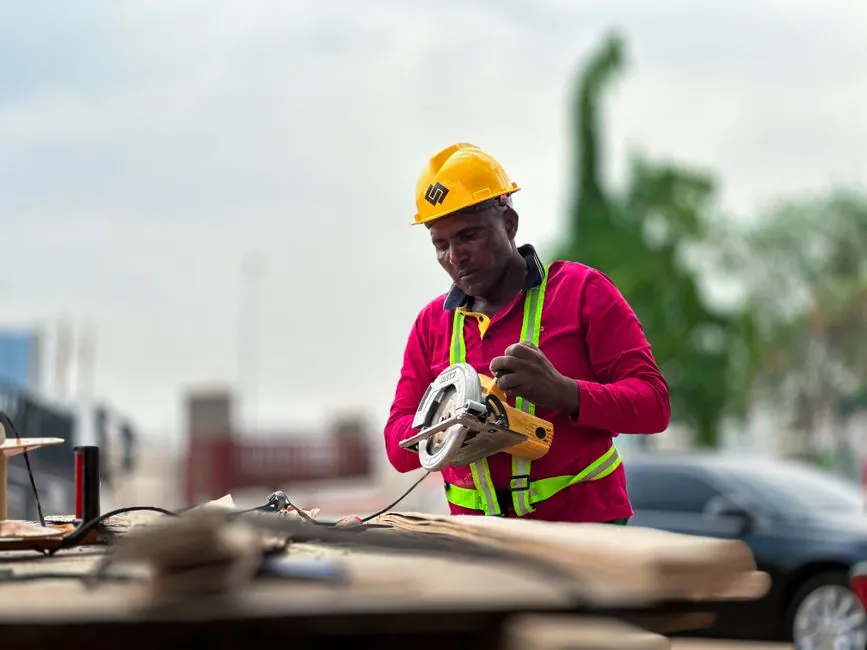
On UK and EU building sites, 110V centre-tapped-to-earth (CTE) systems are the de-facto standard for corded marble cutters, because the secondary winding is earthed at its mid-point, so neither live conductor exceeds 55V above earth potential [S3][S4].
A 110V CTE portable transformer steps site mains down from 230V, and the same motor power is delivered at roughly double the current of a 230V tool, which is why cable cross-section and transformer sizing matter more than plug type [S1][S4]. HSE does not legally mandate 110V, but the Electricity at Work Regulations 1989 require risk to be reduced to the lowest reasonably practicable level, and 110V CTE is the accepted method for meeting that goal for portable corded tools [S3].
Why 55V-to-earth Changes the Safety Calculus
A 110V CTE secondary is split into +55V and -55V legs around an earthed centre tap, so the maximum touch voltage a worker can experience in a single fault is 55V, well below the IEC threshold for extra-low voltage of 50V AC and dramatically safer than a 230V direct mains fault [S3][S4]. On a 240V single-phase mains the same line-to-earth fault delivers the full 230V, which is survivable in most cases but remains a recognised electrocution risk on construction sites [S3].
For a wet-cut marble saw, where water cooling spray, dust slurry, and a handheld body posture coexist, the difference between 55V and 230V exposure is the difference between a tingle and a cardiac-arrest threshold shock, which is why HSE construction-industry guidance lists 110V CTE as the preferred mitigation for portable corded tools on site [S3][S5]. A site manager refusing a 230V cutter is exercising contractual authority under their risk assessment, not citing a statute, but the practical effect on what reaches the operator is identical [S3].
Current, Cable, and Transformer Sizing for Marble Cutters
Power equals voltage times current, so a 1.4 kW wet-cut marble saw draws roughly 12.7A at 110V but only 6.1A at 230V, which is why 110V leads must be physically larger to keep voltage drop and heating within safe limits [S1][S2][S4]. The 1.5 mm² csa 110V cable is only acceptable for lighting or a single light-load power tool, while any load above 800W needs a minimum 2.5 mm² csa, and 4 mm² csa is recommended wherever cable runs allow [S4].
Transformer sizing is the second hidden cost. Common portable 110V site transformers come in 3 kVA, 3.3 kVA, and 5 kVA ratings, supporting roughly 3, 3.3, and 5 kW of connected load, but only for short bursts of about 5 minutes, after which continuous output drops to 1.5, 1.5, and 2.5 kW respectively for sustained cutting [S4]. A crew running two simultaneous 1.4 kW marble saws off a single 3 kVA transformer on extended tile cutting will trip thermal protection well before the workday ends, which is why matching transformer continuous rating to summed tool nameplate wattage is the first engineering check, not the last [S4].
When 230V With RCD Is Acceptable
HSE guidance explicitly allows 230V portable tools on construction sites where 110V is not reasonably practicable, provided the supply is protected by an RCD that trips within 30 milliseconds at 30 mA of residual current [S3]. This is a conditional acceptance, not a loophole, and the residual risk at 230V line-to-earth remains higher than at 55V even with a fast RCD, because the RCD is an electromechanical device with a non-zero failure rate [S3][S4].
For a marble cutter specifically, 230V is rarely the right call, since the tool is always used near water for dust suppression, the operator grips a metal-bodied handle, and a second person is usually nearby holding the slab, which is exactly the multi-fault exposure case the 110V CTE system was designed to mitigate [S3][S5]. The defensible 230V use case on a tile-cutting job is a quick trim from a mains-fed 110V transformer secondary tap, or a short-duration finishing cut in a dry, single-operator, low-traffic zone where the RCD is tested that morning and the cable run is short and protected [S3].
Decision Matrix: 110V vs 230V for a Corded Marble Cutter
Comparing the two options on the four criteria that drive the call: shock risk at fault is very low for 110V CTE (max 55V to earth) and high for 230V (full 230V to earth), even with a 30 mA/30 ms RCD [S3][S4][S5]. Cable and infrastructure cost is higher for 110V because the current roughly doubles, requiring 2.5–4 mm² csa leads and a portable transformer, versus a standard 1.5 mm² 230V lead plugged into a wall or distribution board [S1][S4]. Site acceptance is the inverse: most UK principal contractors will refuse a 230V marble cutter on a live construction site, while 110V CTE is the default accepted method under HSE construction guidance [S3][S4][S5]. Operator setup time is longer for 110V (transformer placement, lead routing, lead-size check) and minimal for 230V (plug and play), which is the one criterion where 230V wins decisively [S1][S2].
For wet-cut diamond-blade marble saws on shared slabs in occupied buildings, specify 110V CTE with a transformer whose continuous kVA rating covers the sum of all simultaneously running tools, and oversize the lead to 4 mm² csa for any run over 10 metres. For a single dry-cut trim saw used by one operator in a finished-room setting with a tested RCD on the distribution board, 230V is acceptable and faster to deploy, though most UK site rules still prohibit it [S3][S4].
What This Means for Tool Selection and Procurement
Sunrise Tools reports that roughly 75% of its single-phase construction and maintenance angle grinders, drills, dust extractors, and mixers are shipped in 110V form, a procurement signal that mirrors HSE-recognised best practice and the contractual reality on most UK commercial sites [S4]. For a procurement engineer building a tool fleet, the practical implication is that 110V CTE should be the default SKU, with 230V RCD-fed units held as a small minority for finishing work in dry, low-traffic zones where site rules permit [S3][S4].
For teams also managing rebar, couplers, and slab work on the same site, the mechanical coupler versus lap-splice decision follows a similar logic of trading higher upfront complexity for lower long-run site risk. Cordless marble saws are steadily displacing the 110V-versus-230V debate on finishing cuts, but for sustained wet cutting of full-size slabs the corded 110V CTE platform remains the engineering default on UK and EU construction sites [S3]. Marble cutter selection should therefore default to 110V CTE with transformer and lead sized to continuous load, not peak nameplate. For broader site-tool context beyond cutters, the construction tools and construction machinery and equipment reference pages lay out the adjacent categories that share the same 110V CTE supply convention.