For impact tools sized to deliver 2,000 to 3,600 ft-lbs of breakaway torque, the drive interface decides whether the tool survives a year on a mine site or fails in a week. A #5 spline drive couples through roughly a dozen teeth on a hub about 1.6 inches in diameter, while a 1 inch square drive transmits all reaction through four sharp corners on a 1.000 inch male stub [S3][S4].
The two interfaces are dimensionally incompatible, but they overlap in the same torque class, which is exactly why buyers of large pneumatic air impact wrenches have to commit to one socket system before they commit to a tool.
Where the two drive systems overlap on the spec sheet
1 inch square drive impacts and #5 spline drive impacts cover nearly the same working envelope: heavy truck and bus wheel work, large agricultural equipment, mining and rail, and big-engine industrial assembly. A representative 1 inch square impact in the heavy class is rated near 1,800 ft-lbs maximum torque, while top-tier #5 spline pneumatic wrenches reach 3,600 ft-lbs maximum torque at 3,500 RPM free speed, as listed for the Chicago Pneumatic CP6120-D35L at part number 6151590130 [S5].
Drive-size labelling itself is a clue: 1 inch square, 1-1/2 inch square, and #5 spline all sit in the "industrial heavy" category, with 1/2 inch and 3/4 inch square reserved for automotive and light-truck work [S4][S7]. Choosing between the two is really a question of which interface you want to standardize sockets, adapters, and breaker bars around.
Why spline drive holds up longer at high torque
The mechanical case for #5 spline is contact area. A 1 inch square stub has four flat faces, each roughly 1 inch tall, taking 100% of the torque reaction. Under cyclic impact loading, those corners work-harden, micro-crack, and chip, which is the failure mode mechanics describe as "snapping the drive square off a 3/4 inch impact" after sustained loosening work [S1].
A #5 spline hub distributes the same reaction load across many teeth, and the teeth are short relative to their width, so peak stress per tooth is lower and wear is gradual rather than catastrophic. Field reports from heavy-truck tire shops and power-plant maintenance crews consistently describe spline drive as lasting "much longer" under heavy impact, with "more torque and less wear" than equivalent 1 inch square drive [S1][S3].
That longevity is the reason commercial fleets historically spec'd #5 spline: longer service life offset the higher unit cost, and the non-standard interface reduced socket pilferage [S1]. The same logic shows up in impact drill design philosophy, where distributing shock across multiple engagement points is preferred over single-feature drive lugs.
Why square drive still wins for many shops
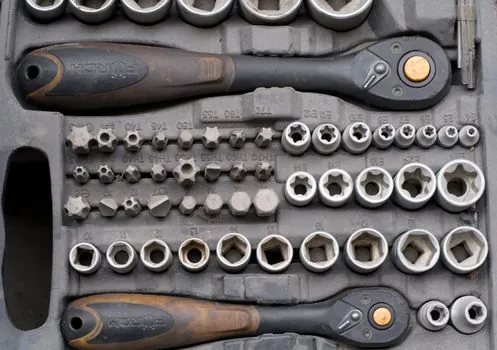
Square drive has three structural advantages that do not go away with torque rating. First, socket availability: 1 inch square is the de facto standard for heavy truck, agricultural, and construction tooling, so every 1-1/8 inch, 1-5/16 inch, 1-1/2 inch, and 1-5/8 inch impact socket is stocked in 1 inch square, including common 6-point deep and 6-point shallow patterns [S6]. Second, manual compatibility: a 1 inch square breaker bar, ratchet, or torque multiplier drops onto the same sockets, which is critical when an operator needs to torque, not just impact.
Third, cross-platform flexibility: square drive accepts adapters down to smaller drives, and the anvil on a square impact can be replaced as a wear item. For a single farm or small fleet that already owns a 1 inch square socket library, the marginal cost of buying a second 1 inch square impact is far less than duplicating the entire socket set in spline [S1]. A shop already running 1/2 inch and 3/4 inch square impact wrenches inherits the same logic at the heavy end.
Decision matrix: pick by use case, not by spec sheet
Choose #5 spline drive when the application is sustained high-torque loosening (above roughly 2,500 ft-lbs), the tool runs on a dedicated 185 cfm shop compressor, sockets above 1-1/2 inch are required, and the tool is mounted or reaction-armed rather than handheld. This describes mine-truck wheel service, large tillage disc arbor bolts, locomotive traction-motor work, and power-plant bolting [S1][S3][S5].
Choose 1 inch square drive when the operator needs a hand-held tool, the job mixes impact work with breaker-bar and torque-wrench follow-up, the shop already owns 1 inch square sockets and accessories, or the torque requirement stays below about 2,000 ft-lbs. This describes most agricultural, construction, and general heavy-truck service [S1][S7].
For the specific case of 1-5/8 inch hex fasteners, the most common 6-point pattern in this class, sockets are readily available in both #5 spline and 1 inch square drive, so the tiebreaker becomes the compressor capacity, the reaction strategy, and the existing socket inventory [S1][S6].
Standards, ratings, and the limits of vendor claims
There is no single governing standard that assigns torque ratings to pneumatic impact wrenches by drive size. Manufacturers rate maximum torque at free speed under a defined air pressure (typically 90 psi / 6.2 bar) and a defined hose ID, and those numbers are not directly comparable across vendors without normalizing air supply. Buyers should treat "3,600 ft-lbs max torque" claims as a vendor test number, not a working load [S5].
Socket-side standards do exist: heavy-duty impact sockets in #5 spline and 1 inch square are made to ASME B107.33 and DIN 3129 style specifications, with 6-point geometry to maximize fastener-flats contact and reduce rounding. For fastener-torque verification, follow up with a calibrated torque multiplier or hydraulic wrench rather than trusting impact run-down [S6].
Practical spec checklist before buying
Verify four numbers before committing: required breakaway torque (typically 20 to 30% above the fastener's installed torque), maximum working air pressure and CFM at that pressure, square drive anvil or spline hub availability in the socket sizes you need, and reaction strategy for the largest fastener. For pneumatic impact wrenches in the 1 inch / #5 spline class, plan on 50 to 100 cfm at 90 psi sustained, and a 3/4 inch minimum air hose [S2][S5].
Also confirm socket-to-tool fit before bulk purchase: a #5 spline drive 1-5/8 inch impact socket from one supplier will fit any #5 spline anvil, but spline-to-square adapters wear faster than direct-drive sockets, so buy direct-drive wherever possible [S3][S6].
The next decision node, once drive type is fixed, is power source: pneumatic for sustained high-torque shop work, DC electric or battery for portable field work. A related reference on heavy-equipment motion control and torque strategy sits in servo drive and slewing drive spec pages, where reaction-load and duty-cycle thinking transfers directly. For now, watch for 2026 product releases from Chicago Pneumatic, Ingersoll Rand, and Universal Tool in the #5 spline category, and any cross-listing of square-to-spline adapter wear-life data, since that is the metric that decides which interface pays back over a 5-year service life.
Background reading: ANSI Z89.1 vs EN 397: Hard Hat Standard Test Criteria.