
Northern European HRC was estimated at €742 per tonne ex-works for the week ending 11 September 2026.
What the November 2026 Steel Price Index Shows
This is a price series, not a universal mill quote. Nucor's published US consumer spot price was US$1,295 per ton for the week of November 9, 2026. The comparison mixes a producer-specific base price with a broader market benchmark, so it should be used as a pricing reference, not a guaranteed invoice price.
For US buyers, the cost base was still tightening in November. Nucor's US$1,295 per ton CSP was the 17th consecutive weekly increase and stood US$65 per ton above the October 5 level of US$1,230 per ton [S4]. Buyers comparing steel plate and rebar against HRC should therefore distinguish index direction from an executable mill offer.
HRC, Plate and Rebar Compared by Price Basis
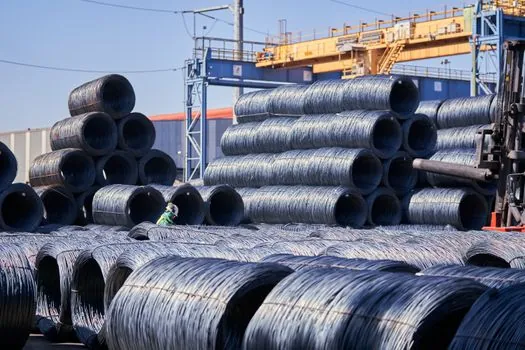
Three benchmarks have different commercial jobs: HRC represents flat-rolled coil used in sheet fabrication, plate serves structural and pressure applications, and rebar serves reinforced concrete. In Northern Europe for the week ending September 11, HRC was estimated at €742 per tonne ex-works, rebar at €738 per tonne delivered, and CRC at €845 per tonne [S5].
Northern European HRC was estimated at €742 per tonne ex-works for the week ending 11 September 2026. This comparison shows relative product pricing, not delivered cost equivalence.
A separate European market series recorded HRC at €755 per tonne on September 2 and €741.67 per tonne on September 25 [S6]. For comparison purposes, HRC offered the clearest mill-market signal, rebar required delivered long-product terms, and plate was embedded in the broader US producer-price series rather than supplied as a standalone November benchmark in the research.
Regional Price Signals and Currency Exposure

The SSG index placed SHFE hc2701 at 3,193 CNY per tonne, front-month US Midwest HRC futures at US$1,292 per short ton, and a US HRC benchmark at US$1,295 per short ton [S7]. The US figures align with Nucor's November 9 consumer spot price, while the Chinese futures contract provides a separate renminbi-denominated exposure [S4][S7].
US dollars per tonne and US dollars per short ton are not interchangeable. One short ton equals 907.18477 kilograms, while one metric tonne equals 1,000 kilograms, so a quote converted between units changes by roughly 10.26% [S2][S7]. Currency conversion is also incomplete without a settlement date and exchange rate: the 3,193 CNY/t SHFE contract and the US$1,429/t HRC benchmark represent different products, markets and delivery structures [S2][S7].
For Europe, the September tracker estimated €742 per tonne ex-works for HRC and €738 per tonne delivered for rebar [S5]. European buyers can therefore use the September values as a directional benchmark, but a procurement decision still needs freight, surcharges, grade, thickness, certification and delivery terms. The relevant technical distinction between steel plate and coil also affects the processing route, because plate is commonly cut and drilled as discrete parts, while HRC is converted into sheet products.
Cost Drivers Behind the HRC and Rebar Price Rise
Purchase price is only one component of delivered steel cost. The first driver is mill base price: Nucor moved from US$1,230 per ton on October 5 to US$1,280 per ton on November 2 and US$1,295 per ton on November 9 [S4]. That US$65 per ton increase over five weeks directly raised the material cost before fabrication, freight, coatings or installation.
The second driver is product conversion. A cold-rolled price of about €845 per tonne was approximately €103 per tonne above the €742 HRC benchmark in Northern Europe on September 11 [S5]. DOM mill lead times were running from May to as late as August 2027 in November 2026.
The fourth driver is regulatory and carbon cost. A new import-quota safeguard was cited as one of the drivers of rising European steel prices in September 2026. These figures are directional cost estimates, not guaranteed procurement premiums.
Total cost of ownership also changes the ranking. A lower mill quote can lose its advantage if it excludes coating, fabrication, freight, inspection, inventory carrying cost or delayed installation. That is particularly important for buyers choosing between HRC, steel plate and reinforcing steel, because conversion yield, cut scrap and schedule risk differ by fabrication route [S4][S5].
Supply, Lead Times and Failure Modes in 2026
US raw-steel output reached 2.053 million net tons in the week ended October 31, 2026, up 15.7% week over week and 19.2% year over year, while capability utilization rose to 88.9% [S4]. Output then fell 13.4% week over week to 1.778 million net tons in the week ended November 7, with utilization at 77.0% [S4]. This swing shows why a one-week production figure is a poor standalone price predictor.
Mill order books were described as full in November, with several mills not yet accepting January bookings [S4]. Sheet and coil lead times of 9–10 weeks were stable for roughly one month, but DOM tubing extended from May to as late as August 2027, and December surcharges were US$108–US$125 per ton [S4]. For buyers, the principal failure mode is not only paying a higher headline rate; it is accepting a longer production slot, a surcharge reset, or a mill allocation that does not match the installation schedule.
The European constraint set was different but equally procurement-relevant. Low Rhine water restricted barge logistics and hot-metal output through July and August 2026, while distributors built inventories before the summer shutdown [S5]. That sequence connects logistics disruption and restocking to the September price increase without requiring a broad claim about construction demand.
Who Should Use Each Price Signal
HRC benchmarks suit purchasers of flat-rolled material, especially manufacturers comparing coil conversion economics. The US series is useful for recognizing a US-dollar market move; SHFE hc2701 is useful for Chinese futures exposure; Northern European HRC provides a euro-denominated ex-works reference [S2][S5][S7].
Rebar benchmarks are more appropriate for reinforced-concrete packages because the Northern European rebar figure was delivered at about €738 per tonne, compared with HRC at €742 per tonne ex-works [S5]. Plate buyers need a grade-specific and thickness-specific mill quotation because plate conversion, testing and machining can dominate the comparison with generic HRC or rebar prices [S4].
These indicators are not for users who need a final landed cost or fabrication-ready price. A quotation should state grade, dimensions, quantity tolerance, delivery location, freight responsibility, surcharge mechanism, coating, mechanical-property requirements and inspection documents. The steel price index is an anchor for negotiation, while the mill quotation and freight terms determine the amount actually payable.
How to Track the Next Price Signal

Two trackable markers can test whether the November price structure is holding. First, the US producer-price series for hot-rolled bars, plates and structural shapes was 319.107 in October, with the next scheduled release set for December 15, 2026 [S3]. Second, US HRC production and capability utilization provide a supply check, after 88.9% utilization in the week ended October 31 and 77.0% in the week ended November 7 [S4].
Procurement teams should also monitor mill order-book openings and lead times rather than relying on one benchmark. A November HRC value of US$1,429 per tonne, Nucor's US$1,295 per ton CSP, and European HRC near €742 per tonne are separate reference points with different units, locations and commercial terms [S2][S4][S5]. A disciplined steel purchasing plan converts each benchmark into a grade-specific quote, then compares installation timing, fabrication yield and total delivered cost before committing volume.