Truck-mounted concrete pump list prices in 2026 cluster between roughly $80,000 for short-boom Chinese builds and $300,000+ for premium 5-section European units, with the swing dominated by boom reach, rated output and chassis tier [S5][S6].
The price spread reflects real engineering spread: a 38 m four-section boom on a 4-axle chassis is a fundamentally different machine from a 62 m five-section unit on a 5-axle carrier, and buyers should expect a 3-4x delta for that reach jump [S5].
2026 Price Bands by Boom Reach and Brand Tier
Short-boom units (28-39 m) from Chinese OEMs such as XCMG, SANY, Zoomlion, Lovol and Shantui list in the $80,000-$130,000 range on aggregator channels as of mid-2026, with the XCMG HB56 (56 m class) sitting in the upper half of that band [S5]. Mid-range 40-47 m booms from the same suppliers run $130,000-$200,000, while 50-63 m five-section booms on multi-axle carriers cross $200,000 and reach $300,000+ when optioned with high-pressure kits and longer outrigger spreads [S5].
European OEMs price structurally higher: Putzmeister's M20-4 hybrid mixer-pump configuration (110 m³/h rated output) carries the engineering content of a hybrid driveline plus integrated mixer drum, putting it in the upper tier [S1]. Schwing's SPTO 1250 mobile unit — 73 m³/h output at 65 bar (942 psi) pumping pressure — sits in the same premium mobile segment [S2]. For a deeper breakdown of the chassis and driveline side of the cost stack, the 2026 Dump Truck Buying Guide: Chassis, Body and Price Bands covers the carrier-side levers that swing the same kind of numbers.
The Four Spec Levers That Move the Price
Four technical parameters do almost all the work in a truck-mounted concrete pump quote. (1) Vertical boom reach — each 5-7 m of additional reach adds one boom section, more high-tensile steel (typically Weldox 700 / S690QL class) and roughly $20,000-$35,000 to the list. (2) Rated output in m³/h, which scales piston diameter, hydraulic flow and S-valve size; the gap between a 70 m³/h workhorse (SPTO 1250 at 73 m³/h, [S2]) and a 110 m³/h high-output unit (M20-4, [S1]) maps to roughly a 30-50% price step. (3) Pumping pressure — 65 bar (942 psi) on the SPTO 1250 is standard for structural pours [S2], while high-pressure 80-85 bar kits for high-rise or long horizontal pushes add a smaller but real premium. (4) Chassis tier — 4-axle vs 5-axle vs 6-axle carriers from Sinotruk, Mercedes, MAN or Scania swing the bottom line independently of the pump pack.
A side-by-side comparison of the main options on three decision criteria, drawn from public 2026 listings:
· Chinese short-boom (XCMG HB56 / SANY / Zoomlion 38-47 m): low cost ($$), mid output (60-90 m³/h typical), long lead time variability.<br/>· European mid-range mobile (Schwing SPTO 1250 class): high cost ($$$$), 73 m³/h at 65 bar [S2], tight delivery, OEM service network.<br/>· European hybrid / premium (Putzmeister M20-4 hybrid): highest cost ($$$$$), 110 m³/h with hybrid driveline [S1], lowest fuel/site-noise footprint, often EU/US spec.<br/>· Used / refurbished 4-section 42-52 m: lowest cost ($), output depending on rebuild scope, warranty and emissions compliance the main risk line.
Who a Truck-Mounted Concrete Pump Is For — and Who It Is Not
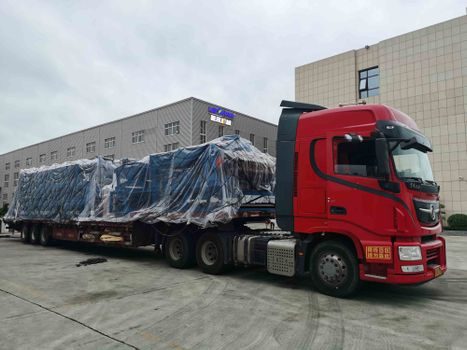
A truck-mounted pump is the right answer when the site has truck access, pour volumes above ~30 m³/shift, and reach requirements that a trailer pump or concrete pump truck line pump cannot cover. High-rise shells, bridge decks, industrial slabs with rebar congestion, and large foundation mats are the canonical use cases where boom reach and output per shift dominate the cost equation. [S1]
It is the wrong answer when daily volume drops below ~20 m³/day (a trailer pump or a concrete mixer truck-and-bucket line is cheaper), when site geometry blocks boom rotation, or when the project duration is short enough that mobilization costs (typically $3,000-$8,000 per move) eat the labour saving. For poured-in-place work on tight urban lots under 8 m clearance, a stationary boom or truck-mounted crane-style placing boom is often specified instead.
Lead Time, Sourcing Channels and HS-Code Reality
Lead time in 2026 for a new Chinese-built unit runs 30-60 days ex-works for short-boom SKUs and 60-120 days for 5-section 56-63 m booms, with sea freight from Qingdao, Shanghai or Lianyungang adding another 25-40 days to most non-Asian ports [S6]. European-built units typically quote 90-180 days depending on chassis availability, with 2026 chassis allocation still tight at MAN and Mercedes on multi-axle configurations.
On the import side, truck-mounted concrete pump units move under HS subheading 8413 40 / 8413 70 in most customs systems, and China-side export listings confirm ongoing shipments under those codes with standard MFN duty treatment in major markets [S3][S4]. Buyers running parallel imports for fleet replacement should validate the exact 6-digit code and any anti-dumping or CCC relevance with their broker before issuing a PO, because the supporting 8- and 10-digit declarations vary by destination [S3].
Lifecycle Cost Levers Buyers Often Miss
The three lifecycle items that swing TCO most — and that almost never show in a headline price — are wear-parts consumption, fuel, and chassis maintenance. S-valve and wear-plate life on a 70-80 m³/h machine is typically 8,000-15,000 m³ between changes, with a replacement set running $2,500-$5,000; high-pressure 85 bar kits eat the same parts 20-30% faster. Fuel at full load on a 6-cylinder Stage V / Tier 4f chassis sits at 25-40 L/h depending on boom duty cycle, which is why hybrid configurations such as the Putzmeister M20-4 are increasingly specified for European urban sites with emissions-restricted hours [S1].
Residual value follows brand tier closely: 5-year resale on a Schwing or Putzmeister typically retains 45-55% of list, while Chinese OEM units retain 30-40% over the same window — a gap that, for a 5-year project fleet, materially changes the lease-vs-buy math. For a parallel spec cut on the carrier side and how chassis choice flows into payload and routing rules, the Dump Truck vs Truck-Mounted Concrete Pump: 2026 Spec Cut for Site Engineers comparison lays out the trade side by side.
Common Failure Modes and Specification Traps
Four specification traps account for most of the post-purchase regret on truck-mounted concrete pumps. (2) Mismatched boom reach vs site geometry — a 47 m boom cannot serve a 6 m deep pit with a 4 m pour deck overhead. (3) Ignoring outrigger spread and counterweight, which determines whether the unit can set up on soft ground or next to an excavation. (4) Chassis emissions tier vs delivery region — Euro V / Stage V units cannot be registered in California or under Stage V zones, regardless of price. [S2]
Operator certification and boom-fold sequence training are the operational side of the same problem: an incorrectly sequenced five-section boom under load is the dominant cause of structural incidents on this equipment class, and most OEM warranty terms now require documented operator credentials before honouring boom-section claims.
Track the following three signals over the next two quarters to time a 2026-H2 purchase: (a) chassis allocation at MAN, Mercedes and Scania for 5-/6-axle carriers, (b) Chinese OEM Q3 2026 export pricing on 47-56 m booms, where aggregate listing pages are updated monthly [S5], and (c) any movement on the HS 8413 subheading lines that affects import duty into the buyer's destination market [S3][S4].