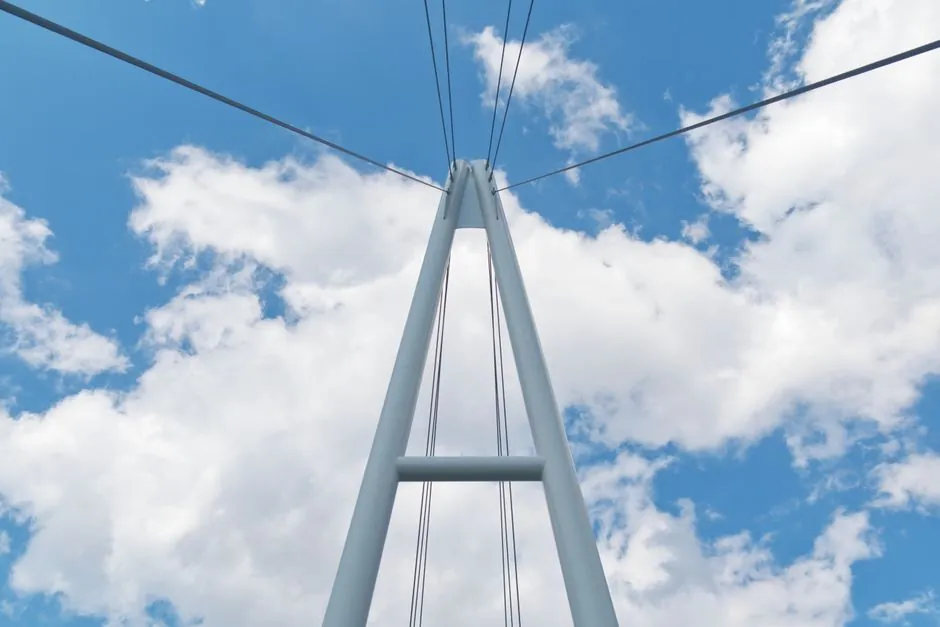
For architectural cable balustrades, 3.2 mm (1/8") and 4.8 mm (3/16") 316 stainless 1x19 strand is the workhorse infill, with the 3/16" size carrying a 4,270 lb minimum break strength and the material rated for continuous service up to 900°F [S4][S7]. 1x19 is the construction of choice for linear runs because it carries more metallic cross-sectional area than 7x7 or 7x19, which translates into higher breaking strength and lower elastic stretch [S4].
316 grade (AISI 316 / T316) is the default for exterior and coastal balustrade work because of its 2-3% molybdenum content, which raises pitting resistance in chloride-rich environments well above 304 [S4]. The same strand is dual-rated for marine rigging and architectural railings, and 1x19 is recommended specifically where runs are straight and terminations are fixed, not where the cable must bend around sheaves [S1][S5].
Construction and Strand Geometry
1x19 means one straight core wire surrounded by 18 outer wires, all helically laid in a single operation, producing a near-rigid, smooth-surfaced strand that resists flex fatigue at terminations [S1]. The 1x19 geometry uses thicker individual wires than 7x7 or 7x19, which is why it is described as the strongest and least flexible of the three common architectural constructions [S4].
In balustrade catalogs, 1x19 is sold by diameter and length reel, with 1/8" (3.2 mm) and 3/16" (4.8 mm) dominating residential orders, and 3/16" or 1/4" specified for commercial runs with wider post spacing [S1]. The strand is also supplied in 1.2 mm for lightweight architectural and signage use, and in 4.0-5.0 mm for shade sail and structural tie-down applications [S6]. Strand surface is left as bright drawn, not PVC coated, because coating is reserved for 7x7 or 7x19 handrail and safety applications where a softer touch is required [S5].
Mechanical Ratings: Diameter vs Minimum Break Strength
Minimum break strength (MBS) scales steeply with diameter. Lexco Cable publishes 2,100 lb MBS for 1/8" 316 1x19, while a 3/16" 316 1x19 strand is rated near 4,270 lb in distributor catalogs [S1][S7]. Higher 1/4" 316 1x19 sizes used in commercial balustrade runs scale further, with reel packaging going from 100 m (residential) up to 305 m and 1,000 m project reels [S5].
316 service ceiling is 900°F (≈482°C) in continuous exposure, well above any realistic balustrade or pool-deck ambient [S4]. The metallic cross-section advantage of 1x19 over 7x7 and 7x19 directly raises breaking load per unit diameter: for the same 3.2 mm wire, 1x19 is the strongest, then 7x7, then 7x19, while flexibility runs in the opposite order [S4]. That is the core engineering trade-off in balustrade spec: choose 1x19 when the line is straight and post spacing is wide, choose 7x7 when the run bends through corners.
316 vs 304 for Exterior and Coastal Service
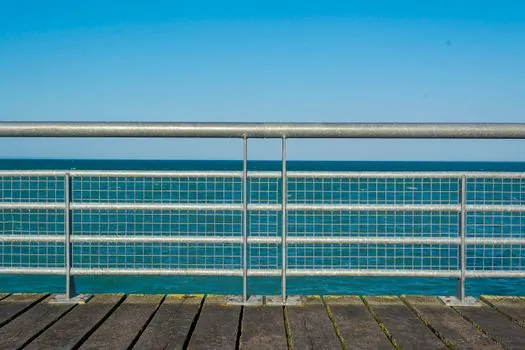
Both 304 and 316 are routinely offered for cable railing, with 304 accepted for dry interior residential work [S1]. 316 contains 2-3% Mo, which is what gives it best-in-class pitting resistance in marine and salt-water exposure, plus broader chemical resistance across pulp-and-paper, photographic, food-processing, and textile plant atmospheres [S4].
For pool decks, coastal balconies, and any site within roughly 1 km of breaking surf, 316 is the responsible default: chloride-driven pitting and stress-corrosion cracking on 304 become visible inside 2-5 years in those atmospheres, while 316 routinely exceeds 15-20 years with only rinse maintenance. This is the same reason 316 is the de facto spec for sailboat standing rigging, where failure is not an option [S4]. Material selection is therefore not a cost question at the strand level (price spread is narrow per foot) but a corrosion-life question. For a deeper background on the alloy family, see the stainless steel and stainless pipe reference pages.
1x19 vs 7x7 vs 7x19: When to Pick What
1x19 is specified for straight, terminator-to-terminator runs, posts typically spaced 1.2-1.5 m apart, because the strand barely stretches and reads as a clean horizontal line under hand-rail tension [S1][S5]. 7x7 adds flexibility for runs that change direction or pass through intermediate saddles, at the cost of more visible stretch under load. 7x19 is the softest, used where the cable must spool or wrap, not as a primary balustrade infill.
Distributor guidance now standardises on 3.2 mm 1x19 316 as the normal balustrade specification, with 7x7 reserved for terminations on curved stair railings and balustrades that need to navigate corners without a fitted post [S5]. 7x19 is excluded from primary infill because its fine outer wires scuff and tear at swage terminations under cyclic load. For projects requiring heavier structural or catenary use, the same suppliers offer 4.0 mm and 5.0 mm 7x19 in 305 m and 1,000 m reels [S5]. The strand family is documented in more detail on the steel strand and prestressing strand encyclopedia pages.
Terminations, Fittings, and Hardware Compatibility
1x19 strand is incompatible with standard wire-rope clips and is almost always terminated with swage fittings, threaded swage studs, jaw-and-swage bottlescrews, or mechanical quick-lock inserts sized for the exact 3.2 mm or 4.8 mm wire [S5]. A typical M6 right-hand-thread swage stud or 5 mm jaw/swage bottlescrew is rated for 3.2 mm wire; under- or over-sized terminators are the single most common field failure mode.
1/8" 316 1x19 with 2,100 lb MBS carries roughly a 4-5x working-load factor at the usual 200-300 lb hand-rail tension, well inside the OSHA-style 2.5-4x safety margin typically applied to guard-rail infill [S1]. For commercial and public-assembly projects, post spacing must be computed against the 4 lb/ft equivalent lateral load required by IBC, and the strand selected so the calculated tension under that load stays below roughly 25% of MBS. 316 1x19 in 3/16" or 1/4" gives that headroom on wider post spacings up to 2.0 m [S1][S7].
Project Sourcing and Reel Formats
316 1x19 is stocked in 100 m, 250 ft, 305 m, and 1,000 ft reel formats, with 1/8" 250 ft reels typical for residential decks and 3/16" 1,000 ft reels for commercial runs and marine-grade projects [S2][S3]. Korean-origin T316 1/8" 1x19 on a 250 ft reel is a common distributor SKU for both architectural cable railing and light marine rigging, illustrating the dual-market supply chain [S2]. Domestic US-made 316 1x19 is also available for projects that must meet Buy America or domestic-content clauses [S4].
Specification should pin five numbers on the drawing: diameter (1/8" or 3/16"), construction (1x19), grade (AISI 316 / T316), minimum break strength (2,100 lb or 4,270 lb), and termination type (swage stud, bottlescrew, quick-lock). For coastal and pool-deck projects, add the requirement that all exposed hardware be 316 stainless, since mixing 304 fittings with 316 strand is the most common corrosion-failure site in service. Documentation for handrail and balustrade hardware sub-assemblies is catalogued on the architectural hardware encyclopedia page. Maintenance: freshwater rinse on a 3-6 month cycle is the documented field practice to keep chloride surface films below the pitting threshold.
For related coverage, see Best Color Mark Sensor for Water Treatment: A Spec-Anchored Selection Map.
