Type 304 is an austenitic stainless steel containing at least 18% chromium and 8–10.5% nickel, while Type 430 is a ferritic grade with higher chromium and lower nickel content [S1, S2, S4]. That single difference in nickel drives almost every downstream spec decision: corrosion resistance, formability, weldability, magnetism, and price.
For general process equipment exposed to moisture, food acids, or outdoor atmospheres, 304 (UNS S30400, EN 1.4301) is the default; 430 (UNS S43000, EN 1.4016) is the budget ferritic for dry indoor panels, appliance trim, and heat-resisting parts up to roughly 759°C where nickel cost is unacceptable [S1][S2][S5].
Composition and Metallurgical Family
Austenitic 304 is face-centered cubic and non-magnetic in the annealed condition because the nickel-stabilized FCC lattice cancels net magnetic moments, per the Essentra Components technical note [S2]. Ferritic 430 is body-centered cubic and ferromagnetic, which is the simplest shop-floor test to tell the two apart before any lab work.
The carbon cap at 0.08% is the practical welding limit; above it, you move to 304L (0.030% C max) to avoid intergranular corrosion in the heat-affected zone.
Typical 430 composition is C ≤ 0.08%, Si ≤ 1.00%, Mn ≤ 1.00%, P ≤ 0.040%, S ≤ 0.015%, Cr 16.0–18.0%, with no nickel and no controlled nitrogen [S1][S5]. The 1% lower Cr and total absence of Ni are the metallurgical reason 430 cannot match 304 in chloride-bearing or acidic media, and the reason it is cheaper on the London Metal Exchange nickel line.
Corrosion Resistance in Real Service
Field observations reported by Worthy Hardware note that 430 components show visible rust spots fairly quickly in outdoor or damp service, while 304 parts in the same exposure hold their passive film [S3]. The 8–10.5% Ni in 304 stabilizes the austenite and improves performance in reducing acids; 430's straight-chromium film breaks down faster in chlorides and mildly acidic food media.
Ryerson's market note flags the same behavior: 430 is more prone to rust in certain conditions, which limits its suitability for prolonged exposure to corrosive environments, even though it shares the 17–18% Cr baseline with the austenitic side [S4]. That is why 430 is rarely seen in chemical tanks, food processing wetted parts, or marine hardware.
Cleanroom World specifies 430 as a grade for mildly corrosive conditions or where scaling resistance is the main driver at moderate temperatures, with oxidation resistance to roughly 759°C, the upper limit of useful ferritic heat resistance here [S5]. Beyond that temperature, the scaling rate on straight-chromium ferritics accelerates and 309/310 austenitic grades take over.
Magnetism, Forming, and Welding
430 is consistently magnetic, while annealed 304 is not, but the thyssenkrupp note is worth repeating: 304 can develop measurable magnetism along heavily cold-worked edges, so a magnet alone is not a positive ID on a finished part [S1]. For engineered assemblies where magnetic response matters (induction heating, MRI zones, magnetic sensor mounts), 430 is the deliberate choice.
Formability splits cleanly: the nickel in 304 gives the deep-drawing ductility used for kitchen sinks, chemical vessels, and stretched panels, while 430 is more prone to cracking during pressing and drawing per the Essentra technical write-up [S2]. Worthy Hardware also notes 430 is more brittle in press operations and shows lower ductility than 304 in stamping trials [S3].
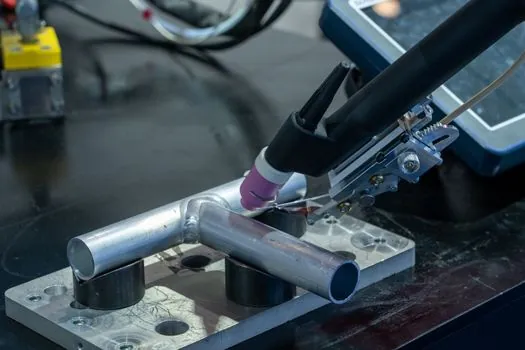
Welding behavior diverges just as sharply: 304 is readily welded by TIG, MIG, and resistance methods with standard 308L filler, while 430 has limited weldability and should not be used in the welded condition for dynamic or impact-loaded structures per the Cleanroom World data sheet [S5]. When 430 must be welded, a 430-grade filler pre-heated to 150–200°C and a post-weld anneal are typical to restore ductility in the HAZ.
Mechanical and Thermal Limits
Strength is roughly comparable between 304 and 430 in the annealed condition, with 304 carrying a slight edge in tensile strength and a large edge in ductility per the Worthy Hardware guide [S3]. Where 430 fails mechanically is at low temperature: as a ferritic BCC structure, it is liable to brittle fracture below about 0°C and is explicitly excluded from cryogenic service [S5].
For elevated-temperature oxidation in furnace furniture, heat shields, and appliance combustion chambers, 430 holds scaling resistance up to roughly 759°C, better than 304 in cyclic oxidation at 600–800°C because of the absence of nickel that can volatilize as NiO [S5]. 304 is generally preferred where sustained strength above 500°C is needed, but 430 is preferred where thermal conductivity and cost dominate, since 430 has higher thermal conductivity than 304 per Essentra Components [S2].
For projects where these stainless grades sit alongside alloy steels in the same BOM, the same chromium-molybdenum logic that drives 4130 vs 4140 selection for aerospace tubing shows up here: small carbon and alloy deltas change the welding and impact behavior far more than the strength number suggests.
Application Fit and Decision Matrix
Ryerson's director of supply chain, Jim Reed, puts the difference in plain terms: 430 ends up on everyday items like BBQ grill panels because of aesthetic appeal and adequate corrosion resistance in outdoor exposure, while 304 dominates cutlery, kitchenware, and surgical equipment where the corrosion budget is tighter [S4]. The same logic extends to industrial enclosures and access hardware, where a card vs biometric access control reader housing on a 304 chassis costs more up front but avoids the surface rust that 430 shows in a coastal loading dock.
For magnetic door hardware, the magnetic-vs-non-magnetic question is exactly the 304-vs-430 question in disguise, the same trade-off a spec writer hits when choosing between a maglock and an electric strike on a stainless housing. Use 430 if the part must hold a magnet or sit in an inductive sensing field; use 304 if the part must not attract iron filings or interfere with sensors.
The decision matrix for a process engineer reads roughly: choose 304 when the service is wet, food-contact, mildly acidic, hygienic, or welded, and the extra nickel cost is justified, with a typical Cr/Ni window of 18/8 to 19.5/10.5 [S1][S2]. Choose 430 when the part is dry, indoor, decorative, magnetic, heat-resisting up to ~759°C, or cost-driven, accepting the 16–18% Cr and zero-nickel composition [S1][S3][S5]. For chloride-rich wet service, neither is correct, and 316 (2–3% Mo) or 316L/317L per 316L vs 317L chloride pitting guidance is the proper step up.
Avoid 430 below 0°C, in any welded dynamically loaded structure, in outdoor chloride exposure, in food-contact wetted surfaces, and in any reducing acid, all of which are documented limits rather than opinion [S3][S5]. Avoid 304 when the budget is tight and the environment is genuinely dry and indoor, when magnetism is required, or when the higher thermal conductivity of 430 is beneficial in a heat sink or cooking surface [S2][S4].
Cost, Sourcing, and Standards Background
304 costs more than 430 primarily because of its 8.0–10.5% nickel content, while 430 contains 0% Ni and is therefore tied to the chromium and iron price lines on the LME rather than the nickel line [S1][S3]. As alloy prices fluctuate, the absolute cost gap moves, but the structural ratio of 304 being the premium general-purpose grade and 430 being the cost-down ferritic has held for decades.
Both grades sit under the ISO/AISI numbering system used by the American Iron and Steel Institute, with 304 widely dual-certified to ASTM A240/A276/A312 for plate, bar, and pipe, and 430 commonly supplied to ASTM A240 for sheet and strip used in appliance and automotive trim [S2][S5]. For stainless pipe service, 304/304L is the de facto spec; 430 pipe exists but is restricted to low-pressure, non-corrosive, and heat-resisting applications such as furnace tubes and exhaust components.
The underlying stainless steel family tree that contains both grades also drives the industrial valve trim choices seen in chemical and food plants, where 304 bodies and 430 internal trim parts show up in the same assembly for cost reasons, with the wetted path upgraded to 316 where chlorides or acids enter the picture.
Trackable signals to watch: LME nickel settlement pricing versus chromium and iron pricing (the swing factor for the 304/430 cost gap), any new ferritic grades with improved low-temperature toughness aimed at replacing 304 in non-corrosive service, and any updates to ASTM A240 that tighten the 430 carbon or sulfur limits for welded applications.