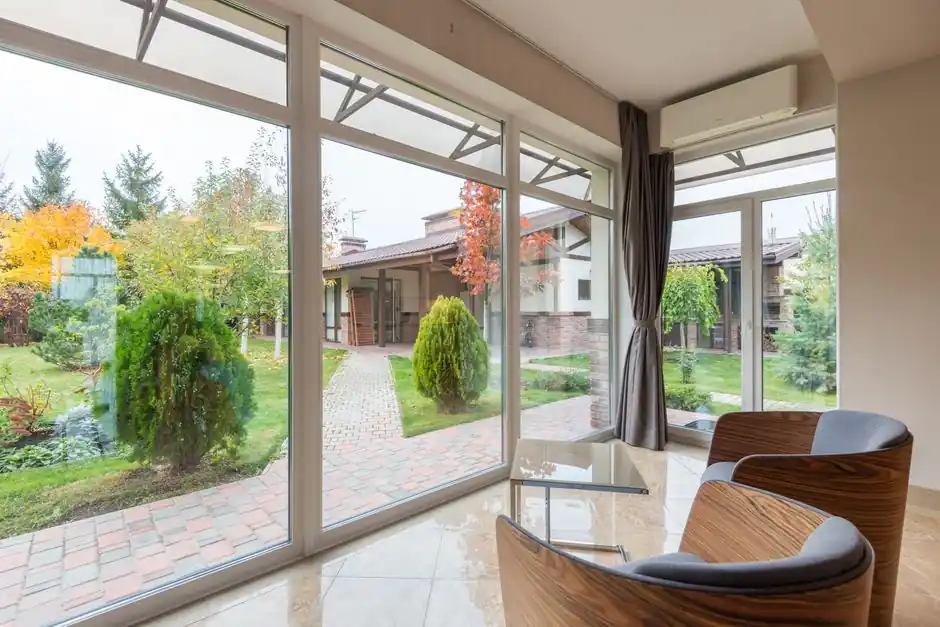
The 5+12A+5 double-glazed unit (5mm outer pane, 12mm argon-filled cavity, 5mm inner pane) is the most widely specified insulating-glass make-up for standard residential aluminium windows and doors, per current industry selection guidance [S1][S5]. The 6+16Ar+6 configuration (6mm outer pane, 16mm argon cavity, 6mm inner pane) is the upgrade path for larger openings and higher acoustic or thermal load, with thicker glass delivering roughly 18-22% lower coincidence-frequency transmission loss in the 1-2 kHz traffic-noise band [S3]. Both are assembled as standard double-glazed insulating glass units (IGUs) for the aluminium window and door market, not vacuum or triple-glazed units.
Glass covers 70-80% of the total window surface area in a typical system window and door assembly, so the IGU specification drives most of the thermal, acoustic, and safety performance, while the aluminium profile supplies structure and the thermal-break path [S2]. For B2B buyers comparing 5+12A+5 versus 6+16Ar+6, the decision is not "which glass is best" but "which combination of glass thickness, cavity width, gas fill, and coating matches the project brief, frame size, and budget."
Configuration Breakdown: What Each Make-Up Actually Is
5+12A+5 is two 5mm annealed or tempered lites separated by a 12mm spacer bar with an argon-filled cavity (A denotes the gas fill), per current aluminium-window and door and window curtain wall sourcing guides [S1][S5]. 6+16Ar+6 follows the same construction logic but lifts each lite to 6mm and widens the cavity to 16mm, with the wider gas column and thicker glass moving both the U-value (thermal transmittance) and the Rw-weighted sound reduction number downward and upward respectively [S3][S5].
The standard glass-thickness ladder for residential IGUs in 2026 is 4mm, 5mm, 6mm, and 8mm single lites, with 5mm and 6mm accounting for the majority of standard residential and light-commercial window and door production [S6]. The 12mm and 16mm cavity widths sit inside the typical 6-20mm range used for residential and light-commercial double-glazed units, with 12mm the most common spacer width and 16mm the typical upper bound for two-pane IGUs before the gas column starts to lose convective benefit [S1][S2].
Thermal Performance: U-Value and Argon Cavity
Argon-filled double-glazed units in the 12-16mm cavity range typically achieve centre-of-glass U-values around 1.0-1.3 W/m²K with a single Low-E coating (coating emissivity 0.05-0.15), and around 1.5-1.8 W/m²K as a standard uncoated air-or-argon-filled IGU; a plain 4/16/4 air-filled unit sits at roughly 2.7 W/m²K per the comparison reference [S2]. A 5+12A+5 unit is a competent thermal insulator for mild-climate residential builds, while 6+16Ar+6 gives the same or slightly better centre-of-glass U-value and noticeably better edge performance because the wider 16mm cavity allows a deeper warm-edge spacer and reduces the proportion of the perimeter that is high-conductance aluminium [S1][S4].
Triple-glazed reference data shows that the 6Low-E+12Ar+6+12Ar+6Low-E build reaches a centre-of-glass U-value of 0.6-0.76 W/m²K, which is the lower bound any double-glazed unit is benchmarked against in 2026 passive-house selection [S4]. Vacuum glass drops further to roughly 0.4-0.5 W/m²K but is a different product class, sold at a premium and typically specified where the slimmest possible frame and the lowest U-value are both required [S4]. For a 5+12A+5 or 6+16Ar+6 aluminium-window IGU, expect the whole-window Uw to land roughly 0.2-0.4 W/m²K above the centre-of-glass Ug, with the spread driven by spacer type (aluminium versus warm-edge) and frame thermal-break depth.
Acoustic Performance: Thicker Glass, Wider Cavity

Insulating glass with a 5mm+12A+5mm or 6mm+12A+6mm construction reduces perceived exterior noise by more than 31 dB on the standard weighted sound reduction index for these make-ups [S3]. Laminated acoustic glass (6.38mm or 8.38mm PVB-laminated) in either configuration pushes acoustic insulation into the 42-45 dB range, which is the figure typically quoted for European urban-window installations near traffic arteries [S2].
The acoustic gain from going 5+12A+5 to 6+16Ar+6 is real but smaller than the gain from adding a PVB or SGP interlayer: the thicker 6mm lites shift the coincidence dip down to lower frequencies, and the wider 16mm cavity decouples the two lites further, but the combined Rw improvement usually lands in the 2-4 dB range on standard EN ISO 10140 laboratory tests. For projects near airports, highways, or rail corridors, the standard guidance is to specify 6+16Ar+6 (or 5+12A+5) with at least one laminated lite and a warm-edge spacer, not to rely on cavity width alone [S2][S3].
Mechanical, Safety, and Curtain-Wall Constraints
5mm glass is the standard annealed/tempered thickness for typical residential aluminium sliding windows, casement windows, and swing doors, while 6mm is the more common starting point for aluminium door and window curtain wall panels, balcony doors, and any large fixed lite where glass size exceeds roughly 2.0 m² of unsupported area [S5][S6].
For ground-floor accessibility, glass doors, and balustrade-adjacent glazing, at least one lite in the IGU must be tempered (toughened) or laminated to meet typical safety-glazing rules; both 5+12A+5 and 6+16Ar+6 can be built as fully tempered, fully laminated, or tempered-plus-laminated combinations [S2][S5]. Aluminium systems used with 6+16Ar+6 need a slightly deeper glazing rebate (typically 24-28mm IGU thickness versus 22-26mm for 5+12A+5), and the wider cavity requires a 16mm warm-edge or stainless-steel spacer to control thermal bridging and gas retention [S1][S4].
Cost, Lead Time, and Sourcing Reality
Indicative European supply pricing for 2026 places a standard double-glazed unit (4/16/4 air-fill) at €40-60/m², a Low-E double at €55-80/m², a Low-E plus solar-control double at €70-100/m², acoustic laminated at €80-120/m², and triple-glazed Low-E at €100-150/m² [S2].
Lead times for both make-ups are short (2-4 weeks for stock 5+12A+5 and 3-5 weeks for 6+16Ar+6 from most Asian OEM glass processors) because both are catalog items at major insulated-glass factories, while laminated acoustic and triple-glazed variants sit at 4-6 weeks and vacuum glass is typically 6-10 weeks [S3][S4]. For B2B buyers sourcing overseas, the practical decision is often driven by what the local fabricator stocks: a 5+12A+5 line is the bread-and-butter build, 6+16Ar+6 is a standard upgrade, and anything beyond that (asymmetric thickness, triple-glazed, vacuum) should be ordered with a confirmed production slot.
Selection Matrix: 5+12A+5 vs 6+16Ar+6 at a Glance
For standard residential windows and doors up to roughly 2.0 m² with a Low-E requirement, 5+12A+5 argon is the most cost-effective choice, hitting the typical 1.0-1.3 W/m²K centre-of-glass U-value band at the lowest €/m² [S1][S2]. For larger lites, high-rise, coastal, or acoustic-sensitive projects, 6+16Ar+6 argon is the better default, delivering a 2-4 dB Rw improvement, 20% more glass mass for wind load, and a slightly better whole-window Uw thanks to the wider cavity and warm-edge compatibility [S3][S5].
Specifiers should not choose 5+12A+5 when the project has laminated-glass safety requirements (add at least one laminated lite), when the unsupported glass area exceeds 2.0 m², or when the noise target is above 38 dB Rw, and should not choose 6+16Ar+6 when the frame rebate is too shallow for a 24-28mm IGU or when the budget is fixed at the entry-level Low-E tier [S2][S5]. For most mid-range 2026 European residential builds, 6+16Ar+6 Low-E argon is the new default, with 5+12A+5 reserved for cost-engineered and large-volume production where the glass-to-frame ratio is moderate.
Standards, Sourcing Checks, and Common Mistakes
For overseas sourcing, the common mistakes to avoid are: quoting a 5+12A+5 with air fill instead of argon (drops U-value by 0.2-0.3 W/m²K), specifying 6+16Ar+6 with an aluminium spacer on a thermal-break profile (defeats the wider-cavity benefit), and ordering one lite tempered plus one annealed when the project brief actually requires both lites tempered for safety symmetry [S5].
Track the next decision node: confirm the cavity gas concentration at the IGU factory (request a 90% argon certificate), check the warm-edge spacer brand, and verify the Low-E coating position (typically #2 surface for double-glazed units, meaning the cavity-side face of the outer pane). A practical follow-on comparison is 5+12A+5 versus 5+12A+5 Low-E versus 6+16Ar+6 Low-E on the same project quote, because the coating upgrade usually moves U-value further than the thickness or cavity change for the same price band [S1][S2].
For related coverage, see ATEX 2G vs EPL Gb vs Zone 1: equivalence decoded for specifiers.