
AAC block and AAC brick refer to the same Autoclaved Aerated Concrete masonry unit, with the regional naming split driven by unit size: larger units in the 600 mm length class are called blocks, while smaller AAC units in clay-brick dimensions are sold as bricks [S1][S3].
Both names cover a precast, steam-cured mix of cement, lime, fly ash, gypsum and a small dose of aluminium powder that hydrogen-foams the slurry before autoclaving, yielding a cellular calcium silicate hydrate body at 550-650 kg/m³ [S4]. For the full material class, see the AAC block reference and the related block and brick entry.
Why two names exist for one product
Indian and Middle-Eastern suppliers typically stock AAC units from roughly 600 mm long down to 230-240 mm long, and many catalogs simply label the larger format a block and the smaller one a brick, even though both pass IS 2185 (Part 3) for structural use [S4]. The same trade sells both under one product line, with Magicrete, BirlaNu Aerocon and UltraTech all listing an AAC range that includes both size families on their 2025-2026 spec pages [S3][S4].
Two physical factors drive the naming: dimensional class relative to the conventional 225 x 115 x 75 mm clay brick, and the production mould that defines the green cake. A mould cut to yield a 600 x 200 x 100 mm unit exits the autoclave as a block; the same plant cutting 230 x 100 x 75 mm slabs from a sister mould produces what dealers call an AAC brick [S1][S4].
Standard sizes and the 8-12 brick equivalence
A standard AAC block is 600 mm or 625 mm long by 100-300 mm high by 230-240 mm wide, while a standard AAC brick matches clay-brick geometry at 225 x 115 x 75 mm; the 600 mm block covers the same wall area as roughly 8-12 clay bricks, which is the productivity lever cited across spec sheets [S1][S4].
The AAC block dimensional table from NextBlock lists 600/625 mm length, 100-300 mm height and 230/240 mm width, against 225 x 115 x 75 mm for the conventional brick, with the AAC block holding a ±5 mm tolerance versus ±5-15 mm on fired clay [S1]. Magicrete's 2025 guide repeats the 600 mm block benchmark and the 8-12 brick equivalence for a 9 m² wall, and ties the size family back to IS 2185 (Part 3) tolerance inspection after autoclaving [S4]. For conventional fired sizes, see the fired brick reference page.
Density, weight and structural load: AAC vs fired brick
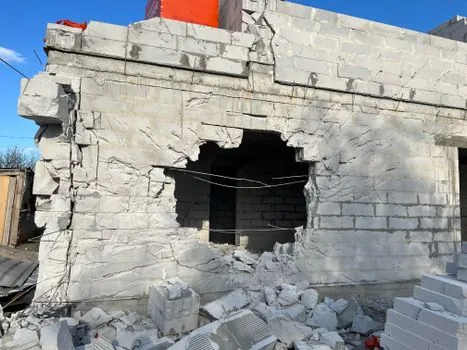
AAC block and AAC brick share the same 500-650 kg/m³ density band, roughly one-third of the 1400-1900 kg/m³ range of fired clay brick, which is the single biggest reason designers pick the larger block format for high-rise walls and the smaller brick format for partition infill [S1][S4].
Dead-load reduction is the structural consequence: lighter walling lowers foundation and column sizing in multi-storey builds, and AAC's cellular pore structure also delivers better thermal insulation and acoustic damping than fired brick, with a 0.4% drying shrinkage versus 0.8% for conventional brick [S1][S2]. Compressive strength is the trade-off designers must check, since fired brick typically outperforms AAC in raw compressive class, even though AAC is sufficient for most wall applications when correctly reinforced [S2].
Selection criteria: when to call it a block, when to call it a brick
Use the 600 mm AAC block format for external load-bearing walls, high-rise partitions and any application where speed, low dead load and reduced mortar joints are priorities; the smaller AAC brick format fits infill, non-load-bearing partitions and renovation work where a clay-brick module simplifies tie-in to existing masonry [S1][S3][S4].
Three decision criteria usually settle the call: wall area per unit (block covers 8-12 brick equivalents, brick covers 1), structural role (block for load-bearing exterior, brick for partition) and dimensional tolerance class (AAC at ±5 mm, fired clay at ±5-15 mm) [S1][S4]. BirlaNu's 2026 comparison adds construction speed, structural load and lifecycle maintenance as the performance axes, and concludes the AAC family wins on each for modern mid-rise and high-rise work, while fired clay remains a regional default where AAC supply is thin [S2].
Limitations, failure modes and inspection points
AAC units are porous and need correct mortar coverage plus a weather-grade render in wet-exposure zones, since the cellular structure that delivers insulation also absorbs water if left uncoated; both block and brick formats share this failure mode [S2][S4].
Dimensional inspection against IS 2185 (Part 3) tolerance, a wet-saw or hand-saw cut check, and a post-autoclave moisture test are the three field checks repeated across manufacturer QC pages; Magicrete's flow specifies cooling, dimensional verification and packaging only after the autoclave cycle at 200-210°C and 1.2-1.3 MPa for 10-12 hours [S4]. Fire rating is a non-issue for both AAC formats, with the cellular body rated for exposure up to roughly 1200°C as cited in block manufacturer literature [S1][S2].
For process engineers mapping wall materials against the broader construction machinery and equipment chain, the actionable signal is to lock block-vs-brick format at the design stage, since switching from 600 mm block to 230 mm brick mid-project changes mortar consumption, wall weight per square metre and labour output, all of which feed back into the structural and MEP sizing. The 2025-2026 spec pages from Magicrete and BirlaNu both frame AAC block as the smart default for new Indian projects while keeping AAC brick in the catalog for partition and retrofit work, so procurement specs should call out the size family, IS 2185 (Part 3) compliance and required compressive class rather than relying on the block/brick label alone [S3][S4].
Background reading: ASTM A48 Class 20 vs Class 40 Gray Iron: Strength, Matrix, and Spec Trade-Offs.