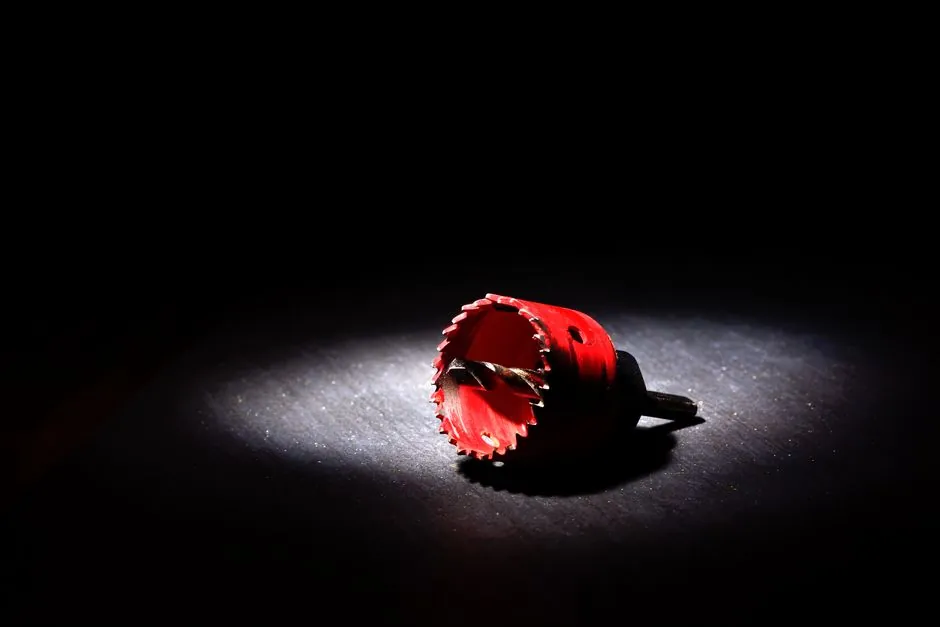
A 5/8-inch arbor identifies the blade center-hole diameter, whereas a diamond knockout is a removable insert that can adapt one blade body to a different saw spindle.
Most portable circular saws sold in North America use a 5/8-inch arbor, while some handheld and worm-drive saws use a diamond-shaped interface; the blade diameter alone does not establish compatibility [S2][S3].
5/8-Inch Arbor and Diamond Knockout Serve Different Functions
A 5/8-inch arbor is the nominal diameter of the blade center hole, also called the bore, and it must match the saw spindle for a secure mount [S2]. Arbor size is not interchangeable with blade diameter: diameter establishes cutting depth, while the bore establishes whether the blade can be mounted [S2].
A diamond knockout is a pre-sized insert formed in the blade around the center hole. Removing it changes the effective opening to accommodate a different spindle configuration, such as a round 5/8-inch arbor on a saw that otherwise expects the diamond profile [S3][S5]. The feature is commonly identified on portable-saw blades, while 10-inch table-saw blades generally do not carry this knockout arrangement [S1].
The practical distinction is simple: “5/8-inch arbor” describes the installed bore dimension, and “diamond knockout” describes a removable geometry feature. A product can have both, as demonstrated by a 6-1/2-inch, 40-tooth carbide blade with a 5/8-inch arbor and diamond knockout [S4].
Compare Bore Size, Knockout and Reducer by Decision Criterion
Against a fixed 5/8-inch bore, a diamond-knockout blade offers greater machine flexibility, but only when its knockout opens to the exact required diameter. A fixed-bore blade is simpler because there is no insert to remove, while a reducer ring offers a different path when the blade bore is larger than the saw spindle. [S2]
For a saw specified for a 5/8-inch round arbor, choose a blade with either a native 5/8-inch bore or a knockout that converts to 5/8 inches. Do not select by “diamond arbor” wording alone. Confirm the actual opening after knockout removal and compare it directly with the spindle measurement [S2][S5].
Use Cases: Portable Saws, Worm Drives and Table Saws
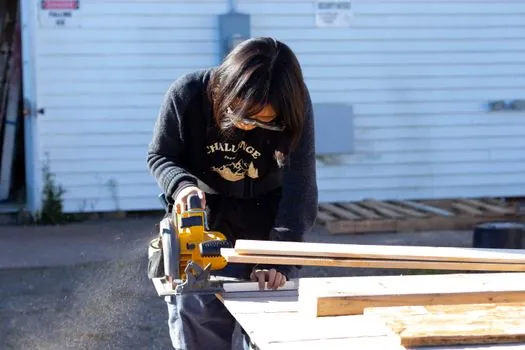
Portable handheld saws are the main use case for the 5/8-inch versus diamond-knockout decision. A 6-1/2-inch, 40-tooth finish blade for plywood and finish wood is offered with a 5/8-inch arbor and diamond knockout, and its laser-cut plate is identified as a true 5/8-inch bore with that removable feature [S4]. A related 7-1/4-inch product uses the same 5/8-inch and diamond-knockout configuration [S4].
Older worm-drive saws are a different fitment case. Forum records describe a Skil 8-1/4-inch worm-drive saw that required a diamond-arbor blade and a replacement blade whose insert had to be removed [S3]. A round insert can restore a previously knocked-out blade to a round-arbor machine, while a matching diamond spindle requires the diamond-shaped opening [S3].
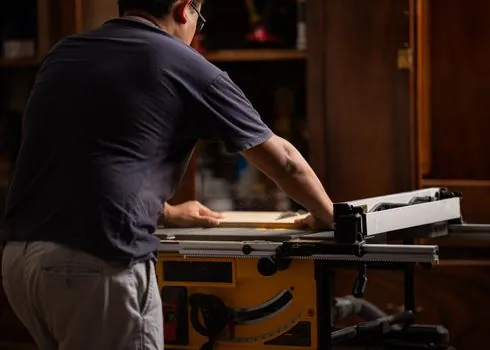
Table saws should not inherit the portable-saw rule. In a collection of 10-inch blades, none of the 10-inch examples had a diamond knockout, while 10-1/4-inch circular-saw blades are associated with this feature [S1]. Diameter, spindle size and guard configuration must be checked separately when selecting a cutting machine blade.
Wrong Fit Creates Wobble, Vibration and Uneven Wear
An undersized bore can prevent full seating, while an incorrect adapter can leave play between the blade and spindle. A loose blade may wobble during operation, producing vibration, uneven wear, poor cut quality and, in severe cases, blade or segment damage [S5]. A high-quality blade does not compensate for an incorrect arbor fit [S5].
Do not remove a knockout unless the saw requires that configuration. Leaving an unnecessary insert in place can prevent flush seating, while failing to remove a required insert can leave the blade unable to mount [S5]. Bent or damaged mounting flanges also compromise alignment and must not be used as a workaround for an incorrect bore [S5].
For a diamond-concrete blade, the same geometry logic applies, although saw families differ: 20 mm and 1-inch arbors are common on handheld cut-off saws, while 7/8-inch arbors are common on angle grinders [S5]. This is why an angle grinder blade listing and a portable circular-saw blade listing should not be matched solely by the word “diamond.”
Selection Procedure: Measure Before Removing Any Insert
First identify the saw and measure its spindle or arbor rather than infer the bore from the blade diameter. A 7-1/4-inch blade may have a different center hole from another blade of the same outside diameter, which is why arbor size is printed and specified as an exact measurement [S2].
Second inspect the blade center. If the blade already has a 5/8-inch round opening, do not disturb it. If it has a removable diamond-shaped insert, determine whether that insert or the insert location is intended to match the saw’s spindle [S2][S3]. Third verify that the blade sits flush against the mounting flange with no gap or play, then tighten the arbor in accordance with the saw manufacturer’s instructions [S5].
For purchasing, record four items: saw type, nominal blade diameter, measured spindle diameter or profile, and the required flat-blade size. A 6-1/2-inch, 40-tooth blade with a 5/8-inch arbor and diamond knockout shows how those specifications coexist in one catalog record [S4]. The same record identifies use for hardwood, softwood and plywood finish crosscuts, demonstrating why tooth count and body construction should be matched to the cut after arbor compatibility is resolved [S4].
Sourcing and Specification Limits for Replacement Blades
The available technical information supports a clear dimensional rule: arbor size determines mounting compatibility, while a diamond knockout provides a removable conversion feature [S2][S5]. It does not establish a universal saw-to-blade chart, so the saw maker’s model designation and a physical spindle measurement remain the controlling references.
Specification evidence is concrete at the product level. One 6-1/2-inch blade is a 40-tooth carbide-tipped finish and plywood model with a 5/8-inch arbor, diamond knockout, laser-cut plate, thin laser-cut kerf, stabilizer vents and a non-stick Perma-Shield coating [S4]. A separate 6-1/2-inch, 54-tooth blade is listed for aluminum cutting with a 5/8-inch arbor and diamond knockout [S4]. Same arbor, different tooth count and application.
Before accepting a blade, verify the nominal bore after any knockout removal, check the spindle, inspect the flange and confirm full seating. A 5/8-inch marking with an unchanged diamond insert is not proof of a 5/8-inch round-bore fit, and the phrase “arbor reducer” does not establish compatibility until the ring bore, outside diameter and saw flange arrangement have all been checked [S2][S5].
The trackable purchase signal is therefore a complete fitment record: 5/8-inch or 20 mm bore, round or diamond spindle profile, blade diameter, tooth count, material application and whether an insert remains to be removed [S2][S4][S5].