
Choose by matching fire-class ratings and hazards to the space, while confirming that operators can lift the selected unit, discharge it safely, and comply with the required placement rules.
Rating comparison: 5 lb, 10 lb and 20 lb
Nominal agent weight does not determine firefighting capability; the label rating indicates the extinguisher's capability, and the larger the numbers on the rating, the larger the fire it can put out [S2][S5]. The numerical A rating measures Class A capability, the numerical B rating measures Class B capability, and C identifies suitability for fires involving energized electrical equipment [S2][S5].
These are rating comparisons, not discharge-time guarantees. One supplier notes that a 10 lb ABC extinguisher may provide more protection than a standard 5 lb unit (2025-02) [S4].
The selected cylinder's label should be checked because the label rating indicates its capability [S2][S5].
Selection criteria: hazard, distance and operator capability
Select the extinguisher for the fire risk, not merely for the nominal agent weight. The relevant checks include the combustible or flammable material present, potential fire size and intensity, agent effectiveness, ease of use, operator training, ambient conditions, adverse chemical reactions, operator safety, and maintenance needs [S5].
The 5 lb unit is appropriate where ordinary combustibles present the principal risk, travel distance is short, and a larger cylinder would be difficult to handle. The 10 lb unit is the stronger general-purpose choice for offices, retail areas, light industrial spaces, and business properties needing more Class A and B capability than the 5 lb model. The 20 lb unit fits higher-hazard spaces with more demanding Class A capability, provided trained users can lift and control it [S1][S3][S4].
Operator capability is a hard selection constraint. Most people can lift and operate a 5 lb-capacity extinguisher, while the 10 lb model may be difficult for some users [S1]. If not, a 10 lb unit can be a better operational match than a nominally stronger but unmanageable cylinder.
Where each size fits, and where it does not

A 5 lb ABC extinguisher is most defensible for light general-duty applications, individual work areas, and supplementary coverage where the fire load is limited and unobstructed access is assured. A 20 lb ABC extinguisher serves higher-risk areas requiring more capacity, but its higher rating does not make it suitable for every hazard or every user.
ABC dry chemical addresses Class A, B and C fires in one unit, but monoammonium phosphate residue can damage electronics and metals, especially when wet [S2][S3]. Where sensitive equipment dominates, supplement or substitute with a clean-agent or CO2 extinguisher as appropriate, while retaining an extinguisher matched to ordinary combustibles. Detailed rating terminology is covered in 2A:10B:C Fire Extinguisher Ratings Explained.
Do not use general ABC units as a substitute for hazard-specific equipment. Class D agents are selected for combustible metals such as magnesium, lithium and titanium, while Class K agents address cooking oils and fats [S2]. A 5 lb, 10 lb or 20 lb designation does not override those hazard distinctions. The basic equipment context is also covered in the fire extinguisher reference.
Placement, handling and failure limits
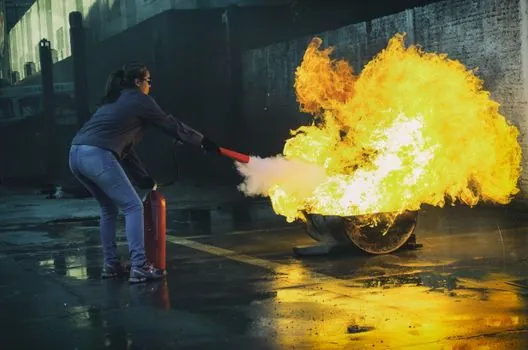
Most portable extinguishers discharge completely in as few as 8 to 10 seconds, and selection should consider the nature and potential severity of the fire, effectiveness, ease of use, personnel training, and suitability for the environment [S5]. A larger rating is of limited value if the user cannot reach the fire, maintain a safe path, deploy the unit effectively, or avoid the discharge cloud. The extinguisher must be large enough for the potential fire and suitable for the environment, including temperature, wind, drafts, vapors and fumes [S5].
That rule concerns mounting height, not discharge performance or travel distance.
Use the labeled rating as the performance reference, inspect serviceability, maintain accessibility, and train personnel before relying on any unit [S5]. Larger capacity does not correct an unsuitable agent, an inaccessible location, an untrained operator, or a Class D or Class K hazard.
Commercial vehicles and mobile deployment
A 10 lb ABC extinguisher rated 4-A:80-B:C is identified as a standard choice for commercial vehicles because it exceeds the cited minimum by 8 times and addresses Class A hazards involving tires and cab materials (2026-10) [S6]. This rating differs from the general 10 lb example of 4-A:60-B:C, demonstrating why procurement should verify the exact label rather than infer capability from nominal weight [S2][S6].
For mobile applications, the 10 lb format provides a useful compromise between protection and handling burden. The 20 lb format adds capacity but increases the mass that must be carried and controlled in a vehicle or confined work area. Confirm the applicable vehicle rule, exact extinguisher listing, mounting arrangement and accessibility before purchase.
Purchasing and verification checklist
Verify the agent type, UL or equivalent listing, fire-class rating, gross weight, discharge performance and service history before accepting delivery. A 5 lb unit at 3-A:40-B:C, a 10 lb unit at 4-A:60-B:C and a 20 lb unit at 10-A:80-B:C form a practical comparison, but only the marking on the specific cylinder establishes its rating [S2].
Specify 5 lb when handling ease and low burden dominate a low-hazard space. Specify 10 lb when the hazard warrants stronger general Class A and B performance and trained personnel can operate it. Specify 20 lb only when the risk assessment supports the higher rating, the location can safely accommodate it, and users can handle its nearly 30 lb gross weight [S1][S3].
Track three procurement signals for each planned purchase: the exact label rating, the trained-user weight assessment, and the travel distance from the extinguisher to the hazard. Those three checks resolve most 5 lb versus 10 lb versus 20 lb decisions before the unit reaches the site.