
A 2A:10B:C fire extinguisher provides the equivalent suppression capacity of 2.5 gallons of water for Class A fires and covers a Class B fire area of up to 10 square feet [S1][S2].
The multipurpose rating combines three fire classes, but it does not cover flammable metals, cooking oils and fats, or every commercial or industrial hazard.
What Each Part of 2A:10B:C Means
The “2” in 2A represents a multiple of 1.25 gallons of water, so 2A equals the firefighting effectiveness of 2.5 gallons of water applied to ordinary combustibles [S1][S3]. Class A fires involve materials such as wood, paper, cloth, rubber, trash, and plastics [S2][S5].
The “10” in 10B represents a square-foot rating for flammable-liquid fires, allowing the extinguisher to extinguish a Class B fire up to 10 square feet in size under the classification test [S1]. Class B hazards include gasoline, oil, paints, lacquers, solvents, grease, and other flammable liquids [S2][S5].
The “C” confirms suitability for fires involving energized electrical equipment, with a non-conductive extinguishing agent [S1][S5]. It carries no size number because Class C capability is based on electrical performance rather than an extinguishing area [S2].
Class A, B, and C Hazard Coverage
Class A capability addresses ordinary combustibles including wood, paper, cloth, rubber, trash, and plastics, while Class B covers flammable liquids such as gasoline, oil, paint, and lacquer [S2][S5]. Class C applies to energized wiring, appliances, tools, outlets, and other electrical equipment [S1][S7].
Five primary fire classes are commonly distinguished: A for ordinary combustibles, B for flammable liquids, C for energized electrical equipment, D for combustible metals, and K for cooking oils and fats [S1][S5]. A 2A:10B:C unit therefore addresses the first three classes, not Class D or Class K [S1].
The rating identifies tested fire classes and capacity, while the extinguisher type identifies the active agent and its operating behavior [S5].
2A:10B:C Compared with Other Ratings
The direct comparison is capacity against fire class, not cylinder size: 2A supplies twice the Class A water-equivalent of 1A, 10B covers 10 square feet of Class B fire, and C adds electrical capability [S1][S3]. A 4A extinguisher has the water-equivalent effectiveness of 5 gallons, twice the Class A capacity of 2A [S3].
Within Class B ratings, 10B, 20B, 40B, 60B, and 80B describe progressively larger fire areas, while 1A through 10A describe increasing Class A capability [S5]. A 2A:40B:C model has four times the stated Class B capacity of a 2A:10B:C model, although both retain the same 2A rating [S8].
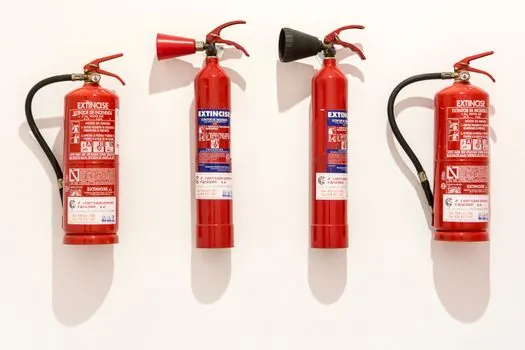
For equipment selection, the rating must match the hazard and travel distance. The classification label normally appears on the canister near the manufacturer information and operating instructions, and a UL Listed or ULC Listed mark provides independent certification evidence [S1][S5].
Where a 2A:10B:C Extinguisher Fits
A 2A:10B:C rating is appropriate for locations exposed to a mixture of ordinary combustibles, flammable liquids, and energized electrical equipment, including offices, warehouses, apartments, homes, and commercial work areas [S1][S2]. It is also a practical choice where one multipurpose unit must cover the three common fire classes rather than separate A, B, and C devices [S5].
Fire extinguishers are designed for specific fire classes, and Class D extinguishers for flammable metals and Class K extinguishers for cooking oils and fats are distinct types often found in factories and commercial kitchens, respectively [S1]. A 2A:10B:C designation also does not make it a substitute for a commercial-kitchen suppression system or an industrial special-hazard system.
Lithium-ion batteries and other battery fires create a separate selection problem because the underlying combustible chemistry and thermal behavior may not match ordinary ABC dry chemical assumptions. A dedicated comparison in Lithium Battery Fire Extinguisher vs ABC Selection Guide evaluates that distinction before a label is selected.
Operational Limits and Safe Use
If any of those conditions are not met, the correct action is to alert others, leave the building, and call emergency services [S1].
The operating sequence is PASS: pull the pin, aim low at the base of the fire, squeeze the lever, and sweep the discharge across the fire base [S1].
The rating is a laboratory classification, not a guarantee that one cylinder will control an uncontrolled fire. Class B capacity can reach 10 square feet, while Class A capacity is an effectiveness equivalent rather than a promise to cover a floor area [S1][S3].
Certification, Maintenance, and Purchasing Checks
Purchasing decisions should confirm the complete 2A:10B:C classification, a UL Listed or ULC Listed label, extinguisher type, physical size, serviceability, and the listed agent [S1][S5]. A label rating alone does not establish that a unit is maintained, correctly mounted, inspected, or capable of being handled by the intended operator.
Dry-chemical extinguishers are offered in familiar sizes including 2.5-pound, 3-pound, 5-pound, 10-pound, 15-pound, 20-pound, and 30-pound configurations, while catalog ratings include 1A:10B:C, 2A:40B:C, 3A:40B:C, and 4A:80B:C [S4]. The numerical class rating, not nominal dry-chemical weight alone, defines the tested capability [S5].
One 5-pound ABC dry-chemical model is marketed with a 2A:10B:C rating, demonstrating that the physical cylinder size and the formal fire-performance rating are separate purchasing variables [S4]. For facilities requiring more than the 10-square-foot Class B capacity, moving to a higher B rating is a direct specification change rather than an assumption based on a heavier cylinder [S5][S8].
Verify the label, listed agent, certification mark, gauge condition if equipped, inspection status, placement, and operator accessibility before accepting the unit into service, then document each interval through the facility’s inspection program.