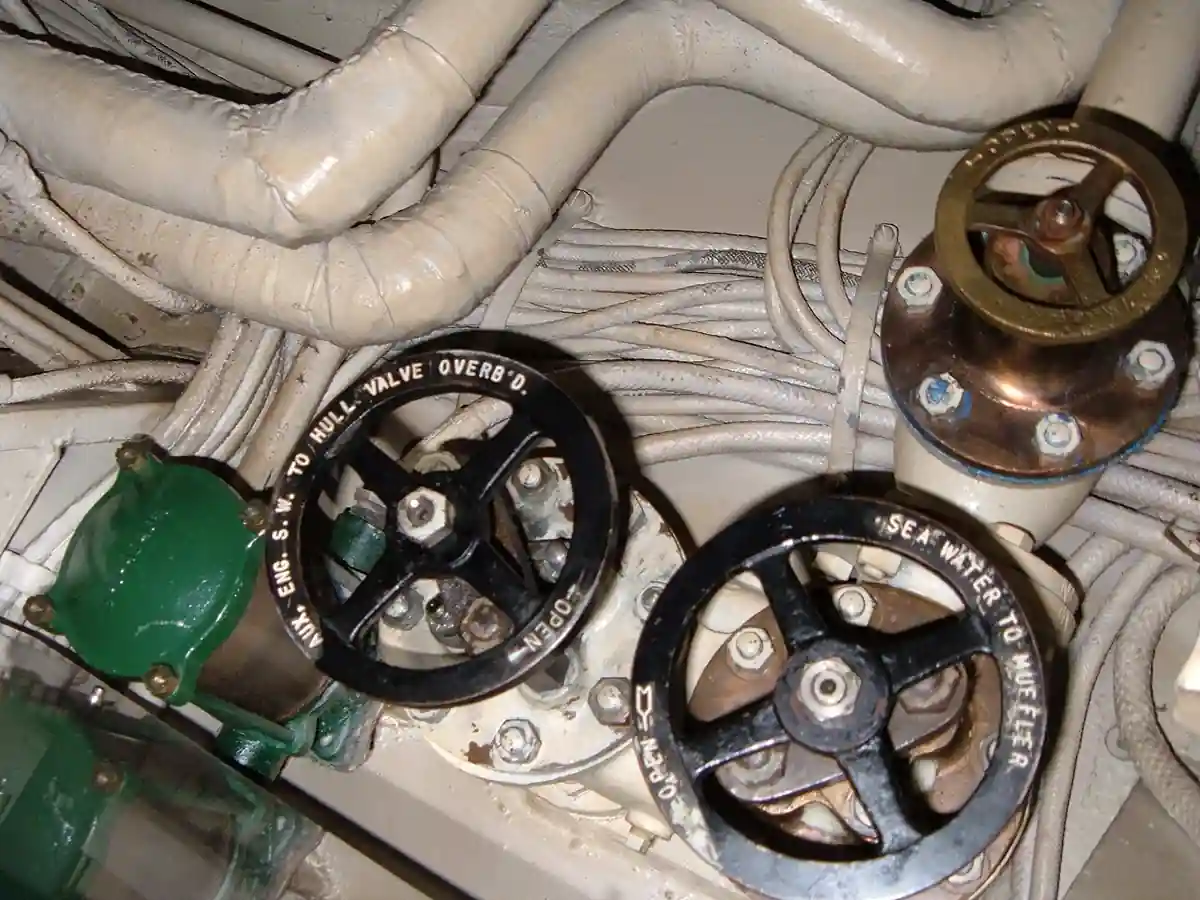
A marine valve is any valve placed in the piping of a sea-going vessel, offshore platform, or coastal installation and qualified to operate in that environment. Sources describe a broad product family that includes cast steel globe valves, bronze angle valves, resilient-lined butterfly valves, bolted-bonnet gate valves, and combined screw-down non-return valves, each with its own media, pressure, and size envelope. Procurement teams typically select these fittings from IMPA-coded catalogs, class-approved datasheets, or detailed engineering specifications such as those found in Star Marine Technology's Marine Solution Guide 2025.
Marine duty places distinctive demands on the valve. Service fluids include seawater ballast, bilge, freshwater cooling, fuel oil, lube oil, compressed air, inert gas, steam, and cargo oil, all routed through pipework that flexes with the hull and is exposed to salt-laden atmospheres. Vendors therefore quote materials, pressure classes, face-to-face dimensions, and seat leakage rates that are traceable to standards such as JIS F, DIN 3352, BS 5154, EN 593, API 609, API 598, and ISO 5208, and they offer class society certification through Lloyds, DNV, Bureau Veritas, RINA, ABS, and Germanischer Lloyds on request. The chapters that follow summarize the working principles, specifications, types, selection logic, compliance regime, and market landscape for this product category.
Marine valves are pipeline fittings engineered for shipboard and offshore service, isolating, throttling, or preventing backflow of fluids in water, oil, fuel, and gas systems. They are specified to recognized standards such as JIS, DIN, ANSI, EN, and API to ensure dimensional interchangeability, pressure integrity, and class society approval. The category spans globe, gate, ball, butterfly, check, angle, and safety valve configurations in cast steel, ductile iron, bronze, and stainless steel bodies.
Chapter 1 / 06
Fundamentals and Working Principle
A valve is a mechanical device that modulates flow by opening, closing, or obstructing a passage within a pipe. In marine service the valve must perform that basic function while also withstanding salt corrosion, ship motion, limited maintenance access, and the inspection regime of a classification society. Sources describe handwheel-operated globe valves, lever or gear-operated butterfly valves, and threaded safety relief valves as the typical mechanical interfaces that allow crew members to actuate the valve in normal operation.
Marine globe valves such as the cast steel PN10 model in the All-K Marine catalog use a straight-through body in which a disc is lifted off or pressed onto a horizontal seat by a handwheel-driven stem. The straight-through design is described as offering low flow resistance, while the metal-to-metal seat provides dependable shut-off for water, oil, and gas. The disc and seat are listed in stainless steel while the body and bonnet are WCB cast steel, illustrating the standard arrangement of a tougher pressure-containing body with corrosion-resistant trim in the wetted flow path.
Angle and butterfly valves operate on different principles. The marine bronze angle valve in the sources uses a 90-degree body pattern with quarter-turn operation and threaded ends rated to 16 kgf/cm², which the vendor equates to about 228 psi or 1.57 MPa. The marine and offshore resilient-lined butterfly valve datasheet from Supreme Valves describes a concentric disc that rotates 90 degrees within a Viton or EPDM liner, achieving bubble-tight shut-off and functioning as both an isolating and a throttling element for seawater ballast, fuel, mud, and freshwater service.
Safety and non-return functions are added to the basic isolating role in some marine valve types. The Zava Marine stainless steel signal safety relief valve is a thread-end pressure relief device for air systems, while the Halcyon ANSI marine angle SDNR valve combines a screw-down non-return function in a single angle body, providing manual shut-off and automatic prevention of reverse flow in ship and offshore piping. Across all of these designs, the working principle is the same: an internal obturator moves between open and closed positions to control fluid passage, with the body geometry, seat type, and actuation method chosen to suit the specific marine media, pressure class, and size.
Isolating valves: globe, gate, ball, butterfly, and angle designs that start or stop flow on command.
Throttling valves: globe and butterfly variants that regulate flow rate by partial closure.
Non-return valves: check and SDNR designs that close automatically when flow reverses.
Safety and relief valves: spring-loaded devices that open at a set pressure to protect piping systems.
Chapter 2 / 06
Specifications and Key Parameters
The principal parameters that define a marine valve are body material, nominal pressure, size range, end connection, seat or disc material, actuation method, and applicable standard. The All-K Marine cast steel globe valve datasheet lists body material as cast steel (WCB), nominal pressure as 10 kgf/cm², equivalent to approximately 1.0 MPa or PN10, and size range from DN15 to DN150 (½ inch to 6 inch). The disc and seat are stainless steel, the connections are flanged to JIS, DIN, or ANSI, and the IMPA cross-reference code is 750421.
The marine bronze angle valve is specified in bronze for corrosion resistance, with a pressure rating of 16 kgf/cm² (about 228 psi or 1.57 MPa), threaded BSP or NPT connections, a 90-degree angle, water/oil/compressed air media, and a temperature range from minus 10°C to 150°C. It is categorized under IMPA 75, the valves and cocks section of the International Marine Purchasing Association coding system. The resilient-lined butterfly valve datasheet from Supreme Valves lists a body of ductile iron GGG40 or cast iron GG25, a disc of stainless steel 304 or 316, a seat of high-grade Viton (FKM) or resilient EPDM, a stem of 316 or duplex steel, and an operator that is a hand lever for sizes up to DN80 or a worm gear above that.
Pressures and tests are quoted in PN or bar for the DIN/JIS versions and in Class for the ANSI versions. The Supreme Valves shell test is 2.4 MPa (24 bar), or 1.5 times PN16, while the seat test is 1.76 MPa (17.6 bar), or 1.1 times PN16, with bubble-tight zero leakage. The size range for the resilient-lined butterfly is DN50 to DN500 (2 inch to 20 inch), with wafer or lugged end connections and face-to-face dimensions to EN 558 or API 609. For Johnson Valves marine gate valves the published pressure ratings step down with size: PN16 for 25 to 150 mm and PN10 for 175 to 300 mm on the cast iron model, and PN16 across the 40 to 150 mm range on the ductile iron model, with temperatures from minus 10°C to 120°C or up to 180°C on the bronze body variants.
The Star Marine Technology solution guide lists stainless steel marine valves in body materials of ASTM A351 CF8M (SS316) and CD3MN (Duplex), trim in SS316, 17-4PH, or Stellite, pressure classes from ANSI 150 to 600 and PN16 to PN100, sizes from DN15 to DN600 (½ inch to 24 inch), and end connections including flanged (RF, RTJ), butt-welded, and socket-welded. The standard temperature range is minus 20°C to plus 200°C, with cryogenic and high-temperature variants available. The Halcyon stainless steel marine deck valve offers Stellite hard-facing for steam and erosive service and soft-seat inserts of PTFE, PEEK, or reinforced FKM achieving Rate A bubble-tight closure per EN 12266-1.
The values below consolidate the source data into a single reference table. Where a vendor or standard does not publish a value for a given parameter, the entry reads 'varies by model' rather than being inferred from a different product line. Source attribution is given per row so that no single vendor's range is presented as the entire category.
Parameter
Cast Steel Globe (All-K, IMPA 750421)
Bronze Angle (All-K)
Resilient-Lined Butterfly (Supreme Valves)
Marine Gate (Johnson Valves)
Stainless Steel Marine (Star Marine Tech)
ANSI Angle SDNR (Halcyon)
Stainless Deck Valve (Halcyon)
Body material
Cast Steel (WCB)
Bronze
Ductile Iron GGG40 / Cast Iron GG25
Cast Iron or Ductile Iron or Bronze (varies by model)
Seat: High-Grade Viton (FKM) or EPDM; Disc: SS 304 / 316; Stem: SS 316 / Duplex
Bronze or Stainless Steel trim; Bronze disc on bronze models
Trim: SS316, 17-4PH, or Stellite
Per ANSI / ASME
Soft seats PTFE, PEEK, or reinforced FKM; Stellite hard-facing optional
Actuation
Handwheel
Quarter-turn (per datasheet)
Hand lever (≤DN80) or worm gear
Handwheel (inside screw, non-rising stem)
varies by model
Manual screw-down with non-return
Manual
Temperature range
varies by model
-10°C to 150°C
varies by model
-10 to 120°C (cast iron/ductile iron); up to 180°C (bronze)
-20°C to +200°C standard
Per ANSI / ASME
Per datasheet
Applicable standards
Standard marine valve design (per datasheet)
IMPA 75 category
EN 593 / API 609, API 598, ISO 5208
DIN 3352 T2; BS 5154 & BSMA 65 Part 9 (bronze models)
JIS, DIN, ANSI / ASME (per solution guide)
ANSI / ASME
EN 12266-1 (Rate A seat tightness)
Source ref
S1
S2
S3
S4
S6, S10
S7
S8
Chapter 3 / 06
Types and Configurations
Globe valves are characterized by a spherical body shape and a disc that moves perpendicular to the seat. The All-K Marine cast steel globe valve uses a straight-through globe pattern with a handwheel and a metal-to-metal seat, and is described in its datasheet as a cast steel PN10 isolating valve for moderate-pressure marine pipework. The vendor lists fresh water, seawater, air, and oil among the applicable media, and the disc and seat are upgraded to stainless steel to resist corrosion in those services.
Gate valves lift a wedge or gate out of the flow path to provide full-bore, low-turbulence isolation. Johnson Valves offers several marine gate variants: a cast iron bolted-bonnet design to DIN 3352 T2 with PN16 ratings in the 25 to 150 mm range and PN10 in the 175 to 300 mm range, a ductile iron version with PN16 across 40 to 150 mm and PN10 across 175 to 300 mm, and three bronze body designs with PN16 ratings up to 200 mm and PN10 from 250 to 350 mm. All are wedge type, inside screw, non-rising stem, with an open and shut indicator on the body.
Butterfly valves rotate a disc 90 degrees within a resilient seat and are favored for larger line sizes because of their compact face-to-face dimension. The Supreme Valves marine and offshore resilient-lined butterfly valve is concentric and supplied in wafer or lugged body patterns, with sizes from DN50 to DN500, PN10 or PN16, and Viton or EPDM liners. VisVana's catalog lists wafer, lug, and U-type double flanged butterfly valves for marine service at PN16, PN16-25, and PN10/16/Class 150, with size ranges from DN40 up to DN1400, indicating that butterfly construction scales into line sizes rarely served by gate or globe valves.
Angle valves change flow direction by 90 degrees in the same fitting, which simplifies pipework and reduces the number of joints. The All-K Marine bronze angle valve is a quarter-turn threaded valve rated to 16 kgf/cm², with a temperature ceiling of 150°C, marketed for water, oil, and compressed air. The Halcyon ANSI marine angle SDNR valve extends the angle pattern with an internal non-return feature, so the same body both isolates flow manually and prevents backflow automatically, a useful arrangement for ship and offshore piping where a separate check valve would add weight and length.
Ball, safety, and check valves complete the marine valve family. Zava Marine groups butterfly, globe, ball, safety, API/American standard, and brass or copper valves under its marine valve category, while Star Marine Technology documents stainless steel marine valves in pressure classes ANSI 150 to 600 covering ball, gate, globe, check, and butterfly configurations in cast or forged stainless and duplex bodies. The combined portfolio therefore covers full-bore ball isolation, spring-loaded pressure relief, automatic backflow prevention, and quarter-turn butterfly throttling within the same marine specification framework.
Globe valves for moderate pressure isolation and throttling.
Gate valves for full-bore on/off duty in ballast, cargo, and seawater lines.
Butterfly valves for compact, large-bore isolation in seawater and fuel service.
Angle valves for right-turn pipework with threaded or flanged ends.
Ball valves for tight shut-off in stainless and duplex pressure classes.
Safety and relief valves for overpressure protection on air and process systems.
Check and SDNR valves for automatic prevention of reverse flow.
Chapter 4 / 06
Selection Criteria for Procurement
The first procurement filter is the media and its corrosivity. Bronze and stainless steel bodies are quoted for seawater, compressed air, and oil, with the All-K Marine bronze angle valve specifically calling out corrosion resistance as a reason for choosing bronze in saltwater service. Cast iron and ductile iron bodies appear in Johnson Valves gate valves for air, inert gas, oil, seawater, and water, while Supreme Valves offers aluminium bronze and nickel-aluminium-bronze discs as an upgrade for severe seawater service on butterfly valves. Stainless steel in ASTM A351 CF8M (SS316) and CD3MN (Duplex) is the body material listed in the Star Marine Technology solution guide for higher pressure classes.
The second filter is the pressure class and temperature envelope. The cast steel globe valve is rated PN10 (10 kgf/cm²), the bronze angle valve is rated 16 kgf/cm², the Johnson cast iron and ductile iron gate valves step from PN16 down to PN10 as size increases, and the stainless marine valve range extends from PN16 to PN100. Temperature ceilings vary from 120°C on cast iron gate valves, to 150°C on the bronze angle valve, to 180°C on bronze gate valves, and up to 200°C as a standard ceiling on stainless marine valves, with cryogenic and high-temperature variants available on request.
The third filter is end connection and dimensional standard. Flanged bodies are quoted to JIS, DIN, or ANSI, allowing the same valve to be matched to the predominant shipyard convention in Asia, Europe, or the Americas. Threaded connections in BSP or NPT are offered for compact angle valves, while butt-welded and socket-welded ends are available on stainless marine valves. Face-to-face dimensions follow EN 558 or API 609, which is the standard cited for the butterfly valve, allowing drop-in replacement of like-class valves from different vendors.
Documentation, certification, and traceability close the procurement decision. Suppliers offer material test certificates to EN 10204 3.1 as standard and 3.2 on request, positive material identification, hydrostatic and pneumatic test reports, dimensional checks, and marking to MSS SP-25 including size, class, material, heat number, tag number, and serial number. Class society type approval is referenced by Johnson Valves, which lists Lloyds, Bureau Veritas, DNV, RINA, ABS, and Germanischer Lloyds as available inspections, and by All-K Marine, which states that inspection certificates can be supplied to satisfy class and flag requirements.
Media compatibility: bronze or stainless trim for seawater, stainless or duplex for fuel and chemical service.
Pressure class: match PN, Class, or kgf/cm² rating to the system design pressure with margin for surge.
Temperature range: confirm body, seat, and packing ratings against minimum and maximum operating temperature.
End connection and standard: JIS, DIN, or ANSI flanges, threaded BSP or NPT, or welded ends to suit the shipyard.
Class society approval: Lloyds, DNV, BV, RINA, ABS, or GL certification as required by the vessel flag and owner.
Documentation: EN 10204 3.1 or 3.2 material certificates, pressure test reports, PMI, and MSS SP-25 marking.
Chapter 5 / 06
Standards, Compliance, and Testing
Marine valve design and testing is governed by a layered set of standards. Star Marine Technology states that its marine valves conform to JIS and DIN specifications, ensuring interchangeability, dimensional accuracy, and global acceptance, with JIS-compliant valves widely used in Asian shipyards and DIN-standard valves meeting the dimensional and performance requirements of European operators. Johnson Valves publishes compliance to DIN 3352 T2 across its cast iron and ductile iron marine gate valves and to BS 5154 and BSMA 65 Part 9 for its bronze gate valves, with PN ratings and temperature limits stated against those documents.
The Supreme Valves datasheet lists an extensive design code set covering steel gate, globe, check, ball, and butterfly valves: API 600 and BS 1414 for steel gate valves, API 623 and BS 1873 for steel globe valves, API 594 and BS 1868 for check valves, API 608 for metal ball valves, API 609 for butterfly valves, and API 6D for pipeline valves. Dimensional references include ASME B16.5 for pipe flanges, ASME B16.10 for face-to-face and end-to-end dimensions, and ASME B16.25 for buttwelding ends, while marking and casting quality follow MSS SP-25 and MSS SP-55. Pressure testing is performed to ISO 5208 and inspection to API 598, with optional fire testing to API 607 or ISO 10497 and fugitive emission testing to BS EN ISO 15848-1 Class B.
Seat tightness is graded against a recognized leakage class. The Halcyon stainless steel deck valve datasheet cites EN 12266-1 Rate A as the bubble-tight zero-leakage standard achieved with PTFE, PEEK, or reinforced FKM soft seats, and the Supreme Valves datasheet defines its seat test as 1.1 times rated pressure with bubble-tight zero leakage. Shell testing is consistently set at 1.5 times rated pressure as a minimum, with the Supreme Valves shell test quoted numerically as 2.4 MPa (24 bar) for a PN16 valve. Hydrostatic testing is performed with water at ambient temperature, with pneumatic testing available on request and non-destructive testing such as 100 percent magnetic particle or dye penetrant inspection available on machined surfaces when specified.
Class society and certification regimes sit on top of the base standards. Johnson Valves advertises type approvals from Lloyds, DNV, Bureau Veritas, RINA, ABS, and Germanischer Lloyds, with 3.1 and 3.2 material certification on request. All-K Marine notes that material certificates, pressure test reports, and other documentation can be supplied to satisfy the ship's class and flag requirements. The Supreme Valves documentation table lists EN 10204 3.1 material test certificates as standard, with 3.2 as a higher-level option, alongside PMI, dimensional checks, and full marking per MSS SP-25.
Standard / Code
Scope (per source)
Source ref
JIS
Japanese Industrial Standard for marine valve dimensions and pressure classes, widely used in Asian shipyards
S6
DIN 3352 T2
Marine quality bolted bonnet gate valve design referenced by Johnson Valves
S4
BS 5154 and BSMA 65 Part 9
Design basis for bronze body marine gate valves in the Johnson Valves range
S4
EN 593 / API 609
Resilient-lined butterfly valve design standard, double flanged, lug, and wafer type
S3
API 600 / BS 1414
Steel gate valves, flanged and butt-welding ends
S3
API 623 / BS 1873
Steel globe valves, flanged and butt-welding ends
S3
API 594 / BS 1868
Check valves, flanged, lug, wafer, and butt-welding
S3
API 608
Metal ball valves, flanged, threaded, and welding end
S3
API 6D
Pipeline valves including ball, check, gate, and plug
S3
API 598
Valve inspection and testing
S3
API 607 / ISO 10497
Fire test for soft-seated quarter-turn valves
S3
ASME B16.5
Pipe flanges and flanged fittings
S3
ASME B16.10
Face-to-face and end-to-end dimensions of valves
S3
ASME B16.25
Buttwelding ends
S3
ASME B16.34
Valves, flanged, threaded, and welding end
S3
EN 558
Face-to-face dimensions for butterfly valves (per Supreme Valves datasheet)
S3
EN 12266-1
Valve leakage rate, Rate A bubble-tight (per Halcyon deck valve)
S8
ISO 5208
Pressure testing of metallic valves
S3
BS EN ISO 15848-1 Class B
Fugitive emission testing
S3
MSS SP-25
Standard marking system for valves
S3
MSS SP-55
Quality standard for steel castings
S3
EN 10204 3.1 / 3.2
Material test certificates, 3.1 standard, 3.2 on request
S3, S4
Lloyds, DNV, BV, RINA, ABS, GL
Class society type approval and inspection (per Johnson Valves and All-K Marine)
S1, S4
Chapter 6 / 06
Market Landscape and Buying Process
The marine valve market consists of a mix of specialized marine suppliers, general industrial valve manufacturers with marine lines, and trading companies that hold IMPA-coded inventory for ship chandlers. All-K Marine operates as a marine parts supplier offering cast steel globe valves and bronze angle valves catalogued by IMPA code, with 750421 the IMPA reference for the cast steel globe valve and IMPA 75 the broader category for valves and cocks. Zava Marine lists marine butterfly, globe, ball, safety, API/American standard, and brass or copper valves under its marine valve category, alongside deck equipment, mooring gear, and propulsion components, illustrating the bundled ship-chandler model.
Independent valve manufacturers publish detailed engineering datasheets aimed at shipyards and offshore operators. Johnson Valves in the United Kingdom describes a marine gate valve family in cast iron, ductile iron, and bronze with multiple size and pressure combinations. Supreme Valves in India publishes a comprehensive marine and offshore butterfly valve datasheet that covers EN 593 and API 609 design, materials, testing, and certification, with a documentation table that includes EN 10204 3.1 and 3.2 certificates, PMI, and NDT. Halcyon Valve in the United States markets an ANSI marine angle SDNR valve and a stainless steel marine deck valve aimed at ship piping and offshore service. VisVana in Turkey lists wafer, lug, and double flanged marine butterfly valves in PN16, PN16-25, and PN10/16/Class 150 pressure classes up to DN1400.
The buying process typically starts with a piping material specification or class-approved valve list, against which vendors are invited to quote. Star Marine Technology positions JIS- and DIN-compliant valves for shipyards that build to those standards, with global acceptance as a procurement argument. Class society approval is a near-universal requirement: Johnson Valves offers Lloyds, DNV, Bureau Veritas, RINA, ABS, and Germanischer Lloyds inspections, and All-K Marine states that material certificates, pressure test reports, and other documents can be supplied to satisfy the ship's class and flag requirements. Documentation under EN 10204 3.1 is treated as standard, with 3.2 available on request, and inspection certificates under MSS SP-25 are used for marking traceability.
Quotation and ordering channels include direct contact by email and phone, datasheet downloads, and PDF specification sheets. All-K Marine invites buyers to contact the company for pricing, availability, and bulk orders, and provides a downloadable datasheet and image for each valve. Johnson Valves publishes product PDF datasheets such as JV060015, JV060014, IW2, and IW3 alongside each marine gate valve listing. The Star Marine Technology Marine Solution Guide 2025 acts as an editorial specification document for stainless steel marine valves and for the marine valve category in general, summarizing body materials, pressure classes, sizes, end connections, and temperature limits across the product family.
Marine parts suppliers and ship chandlers offering IMPA-coded valves, exemplified by All-K Marine and Zava Marine.
Specialized valve manufacturers publishing class-approved datasheets, exemplified by Johnson Valves, Supreme Valves, Halcyon, and VisVana.
Solution-guide publishers such as Star Marine Technology that frame stainless steel marine valves in JIS and DIN contexts.
Buyers specify piping class, media, pressure, temperature, end standard, and class society before requesting quotes.
Vendors respond with datasheets, dimensional drawings, material certificates, and test reports under EN 10204 3.1 or 3.2.
Bulk orders, spares, and class inspection are coordinated through the supplier's sales contact and flagged against IMPA 75 references.
FAQ
What is a marine valve?
A marine valve is a pipeline fitting used in shipboard or offshore piping to isolate, regulate, or prevent backflow of fluids such as seawater, freshwater, fuel oil, lube oil, compressed air, inert gas, or steam. Sources describe globe, gate, butterfly, angle, ball, check, and safety relief variants built in cast steel, ductile iron, bronze, or stainless steel and qualified to standards such as JIS, DIN, BS, EN, API, and ASME.
What pressure classes are typically available?
Common ratings cited in the sources are 10 kgf/cm² (about 1.0 MPa or PN10) on the cast steel globe valve, 16 kgf/cm² (about 228 psi or 1.57 MPa) on the bronze angle valve, PN10 and PN16 on the resilient-lined butterfly, PN10 and PN16 stepped by size on the Johnson Valves marine gate family, and ANSI 150 through 600 with PN16 through PN100 on the stainless steel marine valve range.
Which materials are used for marine valve bodies and trim?
Body materials quoted in the sources include cast steel WCB for the PN10 globe valve, bronze for the angle valve and bronze gate valves, ductile iron GGG40 and cast iron GG25 for the butterfly valve, and stainless steel ASTM A351 CF8M (SS316) or CD3MN (Duplex) for higher pressure classes. Trim is upgraded to stainless steel 304 or 316, Viton, EPDM, PTFE, PEEK, 17-4PH, or Stellite depending on media and temperature.
Which standards apply to marine valve design, testing, and certification?
Design standards referenced in the sources include JIS, DIN 3352 T2, BS 5154, BSMA 65 Part 9, EN 593, API 600, API 609, API 623, API 594, API 608, API 6D, and ASME B16.34. Testing and inspection follow API 598, ISO 5208, MSS SP-25, MSS SP-55, and EN 12266-1, with fire testing per API 607 or ISO 10497 and fugitive emission testing per BS EN ISO 15848-1 Class B. Class society approvals are available from Lloyds, DNV, Bureau Veritas, RINA, ABS, and Germanischer Lloyds.
What end connections are offered on marine valves?
Flanged ends to JIS, DIN, or ANSI are the most common connection type, with RF and RTJ facings on stainless steel marine valves. Threaded BSP or NPT connections are offered on compact angle valves, while butt-welded and socket-welded ends are available on stainless steel marine valves. Wafer and lugged bodies are used for resilient-lined butterfly valves in PN10 and PN16 drilling.
How are marine valves tested before delivery?
Hydrostatic shell testing is performed at 1.5 times rated pressure (for example 2.4 MPa or 24 bar on a PN16 butterfly), and seat testing is performed at 1.1 times rated pressure (for example 1.76 MPa or 17.6 bar on a PN16 butterfly) with bubble-tight zero leakage. Pneumatic testing, 100 percent MPI or dye penetrant inspection on machined surfaces, positive material identification, and visual and dimensional checks to MSS SP-55 are available on request.
What documentation accompanies a marine valve order?
Material test certificates to EN 10204 3.1 are supplied as standard with 3.2 certificates available on request, alongside hydrostatic and pneumatic test reports, PMI reports, dimensional inspection records, and marking per MSS SP-25 covering size, class, material, heat number, tag number, and serial number. Class society inspection certificates from Lloyds, DNV, Bureau Veritas, RINA, ABS, or Germanischer Lloyds can be arranged to satisfy flag and owner requirements.