An 8 m³ concrete mixer truck is the most commonly specified drum size for general construction, while a 12 m³ unit moves roughly 50% more concrete per trip but only where chassis rating, road geometry and local gross-vehicle-weight (GVW) law all allow it [S1][S4].
The two sizes straddle the 9–10 m³ "sweet spot" identified across manufacturer and operator guidance: below that band the 8 m³ truck wins on mobility and payload headroom, above it the 12 m³ truck wins on trips-per-pour and diesel-per-cubic-meter [S2][S3]. Picking between them is a chassis-and-route decision, not a marketing one.
Drum Volume vs Rated Mixing Capacity: The 8 m³ vs 12 m³ Numbers
Rated capacity is the design load the drum can mix and carry, not the geometric space inside the shell; a 10 yd³ (≈7.6 m³) rated drum can physically hold roughly 14 yd³ of space, but only the rated figure is mixed without segregation or spillage [S2]. Standard rear-discharge transit mixers cover 6–12 yd³ (4.5–9 m³) and the dominant single-trip size for ready-mix is 8 m³ [S3][S4].
For the 8 m³ class, a 6x4 chassis (six wheels, four driven) typically carries 8–9 m³ before hitting axle limits, while a smaller 4x2 chassis tops out at 6–7 m³ [S4]. The 12 m³ class sits at the top of the standard range: large rear-discharge trucks are quoted at up to 10–12 yd³ (7.6–9.2 m³) in metric-friendly sizing, and Chinese-market sources list 12 m³ as the most common upper-tier size for infrastructure pours [S2][S4].
Chassis, Weight and Road-Law Constraints
An 8 m³ truck fully loaded weighs on the order of 32 tonnes (truck plus concrete), which lines up with most road GVW limits in Europe, the UK and parts of North America without special permits [S4]. A 12 m³ truck pushes that figure up by roughly 4–5 tonnes of wet concrete alone (concrete runs about 4,056 lb/yd³, ≈2,400 kg/m³), which usually forces a tri-axle or quad-axle chassis to stay legal [S5].
Two-axle mixer chassis typically max out near 16,000 kg total and pair with smaller drums, while three-axle chassis accommodate drum volumes up to about 6 m³ in the AMIX reference data and scale upward on heavy-duty frames [S5]. Where a 12 m³ unit is specified, buyers should confirm the chassis manufacturer's GVW rating and the local bridge/axle-load formula before ordering; overloading risks fines, brake fade and accelerated drum-bearing wear [S1][S4].
Trip Efficiency, Fuel and Site Productivity
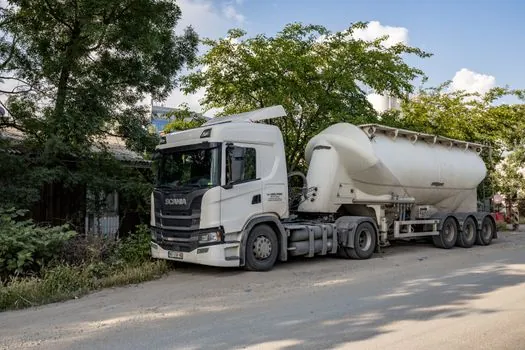
Per-trip productivity is the clearest argument for the 12 m³ size: 14 m³-class trucks carry 30–50% more concrete per trip than 8–12 m³ units, with proportionally fewer trips, fewer dispatch slots and lower driver-hours per cubic meter placed [S6]. For a continuous slab or large foundation pour, that delta can be the difference between finishing in one shift and finishing in two.
The 8 m³ truck wins the opposite metric: better maneuverability on tight urban sites, lower fuel use on lightly loaded return trips, and easier compliance with bridge and alley weight restrictions [S1][S3]. Front-discharge variants in the 8–10 yd³ (6–7.6 m³) band add operator visibility for cramped sites, but are less common outside North America and carry a price premium [S3].
Concrete Quality and Discharge Envelope
Drum geometry matters as much as nominal volume. Both 8 m³ and 12 m³ drums use a continuous-rotation auger to keep mix homogeneous in transit, with workability retained up to about 4 hours of plastic life under efficient route planning, which lets a plant serve a roughly 50 km radius without a re-temper [S3].
The two sizes share the same discharge constraints in practice: rear discharge needs clearance for the chute swing, and front discharge needs a clear cab-forward arc. Buyers comparing the two should also weigh drum maintenance cycles and hydraulic system load, which scale with drum volume, and remember that a 12 m³ drum is heavier to clean and inspect than an 8 m³ drum on the same wash rack.
Decision Map: Pick 8 m³ or 12 m³ by Project Profile
Choose an 8 m³ truck when the project is urban or suburban, the route includes weight-restricted bridges, the site has tight chute access, or the average pour is under 8 m³ per drop. Choose a 12 m³ truck when the project is a large foundation, highway segment, wind-farm pad or commercial slab, the haul road is rated for full GVW, and continuous placement above 9 m³ per drop is the norm [S1][S2][S6].
Buyers running mixed fleets often standardize on an 8–10 m³ truck as the workhorse and bring in 12 m³ units only for dedicated high-volume contracts; volumetric mixers (3–7.6 m³ on-site batch) cover the small and custom-mix tail [S2]. For comparison, compact 20–28 m boom pumps on 2-axle chassis pair naturally with 8 m³ trucks on tight sites, while larger boom-pump spreads typically match 12 m³ trucks to keep the pump fed.
Common Sizing Mistakes and Trackable Signals
The most common error is buying a 12 m³ truck for a route that cannot legally accept its GVW, which forces partial loads and wipes out the per-trip efficiency gain [S4]. The second is under-specifying chassis axles for an 8 m³ truck on rough ground, which shortens drum-bearing life and raises tire-replacement frequency [S1].
Trackable signals before purchase: the chassis maker's GVW plate, the local bridge-formula axle limit on the planned haul route, the average pour size from the last 90 days of dispatch tickets, and the site's chute-clearance envelope. Confirm with the supplier the exact rated capacity stamped on the drum, since drum sizes vary between manufacturers [S4]. A 12 m³ unit on a legal chassis and a clean route will out-produce an 8 m³ unit per shift; everywhere else, the 8 m³ truck is the safer bet.
The underlying component specifications are covered under concrete pump truck, and truck mounted concrete pump.