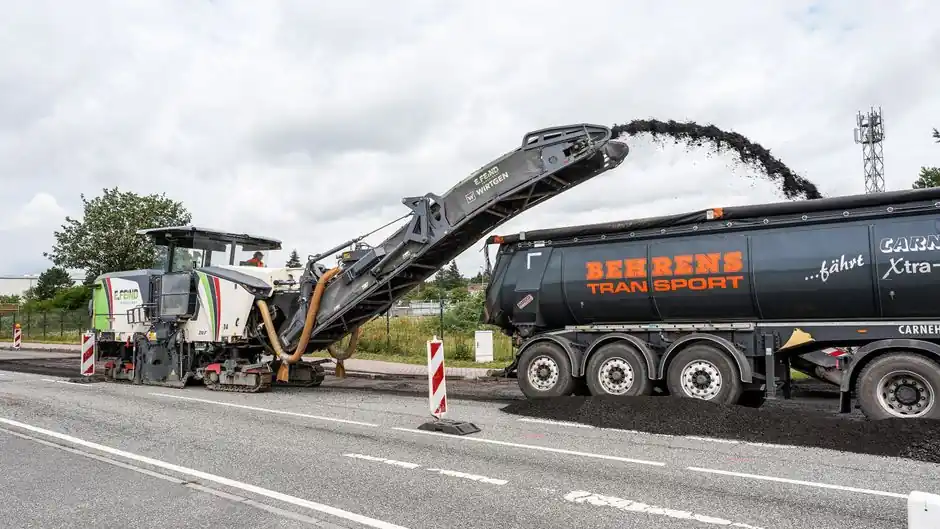
Cold milling machine size classes are organised by drum milling width, with the industry convention splitting the fleet into small (under 1 m), compact (1-2 m), half-lane (~2 m / 6-7 ft) and full-lane (3-4.4 m / 12-14.5 ft) categories, and the cut-to-truck match typically deciding which class a contractor actually buys [S1][S3][S6].
WIRTGEN's own catalog spans working widths from 350 mm (1 ft 2 in) on the W 35 XRi small mill up to 4.4 m (14 ft 5 in) on its large-class machines, with single-pass depths up to 1 ft 2 in (350 mm) on the heaviest units [S1]. AEM and ARRA terminology, widely used in North America, formally calls these machines "cold planers" and groups them into full-lane, half-lane, and smaller commercial classes [S3].
Small Milling Class: Drum Width Under 1 m (39 in)
WIRTGEN's small milling class covers 350 mm to 1,000 mm (14 in to 3 ft 3 in) drum widths, with the W 35 XRi at 14 in / 4 in depth / 45 kW and the W 100 Ri at 3 ft 3 in / 12 in depth / 160 kW defining the band, and operating weights from 4.6 t up to 14.8 t (10,252-32,518 lbs CE) [S1].
These wheeled, rear-drum machines use a height-adjustable, slewing discharge conveyor for direct truck loading and a swiveling right rear wheel for flush-edge cuts next to curbs and obstacles, which is the structural reason they dominate tie-in work and partial-depth patching on streets below interstate class [S1]. Independent market sizing puts the "under 1 m" sub-segment on its own trajectory separate from the wider cold milling machine market, which was valued at $2.2 billion in 2022 and is projected to grow from $2.7 billion in 2026 to $3.6 billion by 2030 at a 6.1% CAGR [S2][S6].
Compact Milling Class: Drum Width 1 m to 2 m (39-79 in)
Compact milling machines bridge the small and large classes, with WIRTGEN's W 100 Fi through W 150 Fi spanning 1.0 m to 1.5 m (3 ft 3 in to 4 ft 11 in) at up to 330 mm (13 in) milling depth and 265-313 kW (355-420 hp), with operating weights around 20-21.4 t (44,092-47,179 lbs CE) [S1].
Front-loading geometry, four-track chassis, and a 12-13 in depth rating let these machines remove full asphalt layers in confined job sites where a half-lane unit cannot turn around, and the same chassis typically accepts ECO, fine-milling, or standard drums to switch between layer removal and surface texturing [S1]. For a deeper look at how the 1-2 m class converts drum width into square yards per hour, see this production rate breakdown by class.
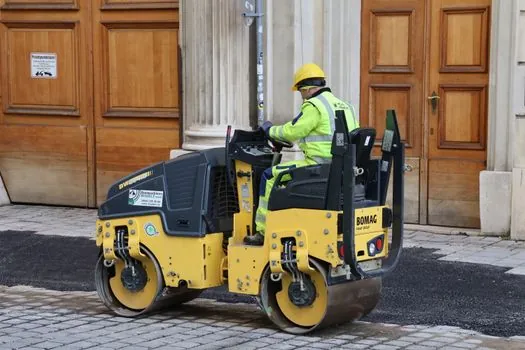
Half-Lane Class: Drum Width ~2 m (~6-7 ft), 60,000-90,000 lb

Half-lane cold planers typically weigh 60,000 to 90,000 lb (27-41 t) and run 600-800 hp engines driving roughly 7 ft (2.1 m) cutting drums, with some models accepting interchangeable drums from 2 ft up to 12.5 ft wide to handle side streets, interstates, and large parking lots on a single chassis [S3].
The 2 m drum is the productivity sweet spot for most contractors because it matches a standard 12 ft traffic lane in two passes, fits on standard lowboy trailers without permits in most US states, and keeps engine sizing in the 600-800 hp band where fuel burn and parts inventory stay manageable [S3]. BOMAG, Wirtgen, and Terex all sell into this class, and the half-lane stronghold on the market is explained by the same versatility ratio: one chassis covers work that would otherwise need a small unit plus a full-lane unit on the yard [S3].
Full-Lane Class: Drum Width 3-4.4 m (12-14.5 ft), 110,000 lb+
Full-lane cold planers cut 12-12.5 ft swaths standard and can be configured up to 14.5 ft (4.4 m), commonly twin-engine, weighing upward of 110,000 lb (50 t) and capable of cutting a full lane up to 14 in deep in a single pass [S3][S4][S7].
The full-lane class exists for one reason: sustained tonnage output. Wirtgen's Jeff Wiley puts the productivity threshold at 40-45 minutes of cutting per hour, and the largest machines can load 18-20 t of milled asphalt into a haul truck in 1-3 minutes, so a contractor who cannot stage enough trucks to keep that cycle fed wastes the machine's hourly cost [S3]. Independent equipment guides cite the same ceiling, with full-lane units milling up to 16 ft (4.9 m) wide and 12 in (300 mm) deep in a single pass on the heaviest high-capacity models [S4].
Size-Class Comparison: Drum Width vs Operating Envelope
The four working tiers line up against four selection criteria, drum width, single-pass depth, operating weight, and engine power, as follows: small mills cover 350-1,000 mm at 100-320 mm depth, 4.6-14.8 t CE weight, and 45-160 kW; compact mills cover 1.0-1.5 m at 330 mm depth, ~20-21 t, and 265-313 kW; half-lane covers ~2.1 m (interchangeable 0.6-3.8 m) at 300+ mm depth, 27-41 t, and 447-597 kW (600-800 hp); full-lane covers 3.7-4.4 m at 350-360 mm depth, 50+ t, and twin-engine 900+ hp combined [S1][S3][S4][S5].
Cutting tooth spacing stays roughly constant at 5/8 in (12-19 mm) on conventional drums across the classes, which is the reason drum diameter, not just width, scales up with machine weight to maintain uniform tooth engagement at higher ground speeds [S4]. Operators moving between classes need to reset grade-control calibrations, because the larger drums have a wider averaging footprint and behave differently against a non-contact averaging sensor than a 1 m drum on a small mill [S4].
Selection Rules: Drum Width Is the First Filter, Not the Only One
Drum width is the first filter, but transport weight, truck match, and manoeuvrability break ties: state-specific hauling rules in the US often prohibit moving 110,000 lb-plus full-lane units at night or during spring thaw periods, which pushes contractors who cross state lines toward the half-lane class even when a full-lane machine would cut the schedule in half [S3].
Skid-steer cold planer attachments occupy a separate niche below the 1 m class, milling 13-47 in wide at 5-9 in depth, and the rule of thumb is that a 100 ft project on a skid-steer attachment burns a full day, which is why these attachments only pencil out on localized manhole, valve, and patch work [S5]. For contractors evaluating used half-lane inventory, the production-rate math per drum class is laid out in this square yards per hour reference. The underlying cold milling machine platform, including the four-track chassis, hydraulic track motors, and traction-locking logic, is the same engineering core scaled across all four size classes.
Two trackable signals for the next planning cycle: WIRTGEN's catalog currently tops out at 14 ft 5 in (4.4 m) working width, while the roadresource.org equipment note puts the high-capacity ceiling at 16 ft (4.9 m), so any spec sheet quoting widths above 4.4 m should be cross-checked against the OEM's published drum options before procurement; second, the 2026 mid-year market value of $2.7 billion implies the small (under 1 m) and full-lane (above 2 m) sub-segments are both expanding faster than the headline 6.1% CAGR, since the 1-2 m compact class is the segment most exposed to half-lane cannibalization on mid-size jobs [S2][S4][S6].
Detailed specification references: cold chamber machine, and cold box core machine.