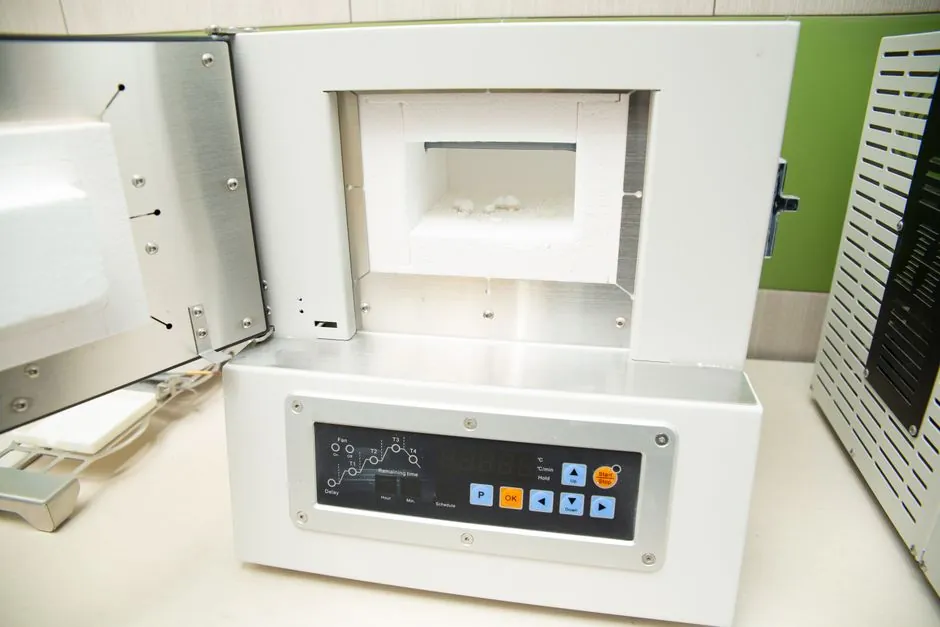
96% polycrystalline alumina delivers an AC dielectric strength in the 16-17 kV/mm band at room temperature, while 99.5% and 99.9% grades push that figure higher, with the gap widening dramatically once parts run above 200°C because silica-rich grain-boundary phases in the 96% body start to conduct [S1][S4].
Engineers who only spec to a room-temperature kV/mm number miss the real decision point: above roughly 200°C the dissipation factor of 96% alumina rises faster than that of 99.5%+ material, so a part that is safe on the bench can become lossy on the engine or in a SiC package [S1][S6].
Dielectric Strength at Room Temperature
Published manufacturer data puts 94% alumina at 16.7 kV/mm (AC, 1 MHz-class test) with 0% porosity, and CoorsTek notes that the same family of alumina ceramics is commonly subdivided from 80% to above 99% purity, with higher purity correlated to higher dielectric strength and lower dielectric loss [S3][S4]. The 99.5% and 99.9% grades do not jump to exotic numbers; they tend to land in the high-teens to low-20s kV/mm range per published spec sheets, because the room-temperature limit is set mostly by the alumina grain itself, not by the silicate grain-boundary phase that the 96% body relies on for sinterability [S2][S4].
For thin-wall insulators, feedthroughs, and HV standoffs, the practical effect is a 20-30% headroom upgrade when stepping from 96% to 99.5%, which lets a designer either shrink the wall thickness or widen the safety margin at the same geometry [S2]. The alumina ceramic property page is the right starting reference for any project that hinges on these numbers, since purity, grain size, and porosity all enter the dielectric-strength equation together.
High-Temperature Behavior: Where Purity Actually Wins
NASA Glenn testing of a 99.99+% HTCC alumina against 96% polycrystalline alumina shows the dissipation factor of HTCC alumina is lower than that of 96% alumina at and above 400°C, with the gap widening as temperature rises toward 550°C [S1]. The mechanism is that the glassy silicate phase in conventional 96% HTCC/LTCC bodies becomes ionically conductive at elevated temperature, while a glass-free high-purity body keeps its loss tangent low because there is no alkali-bearing intergranular film to activate [S1][S6].
High-purity alumina (99.9%+ Al2O3) exhibits substantially lower loss tangent at elevated temperatures than 96–99% alumina because residual silica impurities in the lower-purity body increase dielectric loss [S6]. For any application above 300°C, that loss-tangent delta, not the room-temperature kV/mm delta, is the parameter that should drive the spec [S1][S6].
Decision Matrix: 96% vs 99.5% vs 99.9% Alumina
Use the table below to pick a grade against the criteria that actually matter in production: [S5]
1) Dielectric strength (RT, AC): 96% lands near 16-17 kV/mm; 99.5% and 99.9% grade slightly higher in the high-teens to low-20s kV/mm band. 2) Dissipation factor above 400°C: 96% rises sharply because of silicate phase; 99.5%+ stays low, and 99.99+% HTCC stays lowest of all [S1][S4]. 3) Mechanical strength and density: 96% beats 94% on flexural strength and density per the Accuratus 94% / 96% data block, and remains the workhorse for metallized parts because the silicate phase helps adhesion [S4][S5]. 4) Cost and availability: 96% is the cheapest widely-metallized grade; 99.5% typically costs more, and 99.9%+ nano-powder HTCC material is a specialty buy with longer lead time [S1][S2].
The cross-grade rule is simple: if your part sits below 200°C and needs brazed or thick-film metallization, stay on 96% and save the budget; if it sits above 300°C, or if you need low loss at RF and microwave frequencies, jump to 99.5% or higher [S1][S3][S6]. When 99.9% or higher is selected, designers commonly pair the ceramic with sensors and feedthroughs built around a pressure sensor housing, where stable dielectric behavior across temperature protects measurement accuracy.
Application Fit by Purity Tier
Per industry material guides, 96% alumina is widely used for medical equipment, wear-resistant nozzles, and connector housings, where balanced performance and cost matter more than extreme temperature stability [S5]. The 99% to 99.5% band fits pumps, bearings, seals, semiconductor components, and vacuum chambers, where lower outgassing and stronger corrosion resistance earn the price premium [S2][S5]. The 99.8% to 99.9% band is reserved for plasma etch chambers, high-voltage insulation, and medical vacuum components, where any trace of alkali or silica can contaminate the process or fail the dielectric margin [S2][S5].
Semiconductor etch and deposition parts are the cleanest example of why purity is forced upward: 99.5% or 99.9% is specified when low outgassing is critical, because every alkali ion left in the chamber is a defect source on the wafer [S2]. The same logic, contamination control, drives laser-tube and high-vacuum use cases toward the high-purity tier.
Where 96% Still Wins, and Where It Should Be Replaced

Keep 96% alumina when the part is a metallized substrate for a power module, a thick-film hybrid, a connector housing, or any brazed assembly below 200°C. The silicate phase in the 96% body is actually a feature here, not a bug, because it wets metal-glass and thick-film inks and produces a hermetic brazed joint [S4][S5]. For these jobs the room-temperature 16-17 kV/mm figure is fine, and the cost saving over 99.5% is real.
Replace 96% with 99.5% or higher when the part sits above 200-300°C in service, when it carries RF or microwave energy where loss tangent matters, or when it must survive plasma, vacuum, or corrosive chemistries without outgassing alkali [S1][S2][S6]. A spec that says only "alumina, 96% min" is acceptable for general industrial insulators but is too loose for SiC device packaging at 500°C, plasma chamber parts, or high-voltage feedthroughs in aerospace.
What Spec Sheets Don't Tell You
Three real-world failure modes are worth flagging for any engineer comparing these grades. Second, the dissipation-factor gap between 96% and 99.5%+ widens as temperature rises; a 96% part that is loss-tangent stable on a bench can heat itself in a continuous RF field, which then raises loss, which then heats it more, a thermal-runaway pattern that 99.5%+ avoids [S1][S6]. Third, the metallization route must match the grade: 96% is friendly to standard thick-film Au and Ag inks, while a 99.9% glass-free HTCC body may need a co-fired Mo-Mn or a specialized thick-film system because there is no silicate to bond to [S1][S4].
The published AC dielectric strength of 94% alumina is 16.7 kV/mm with 0% porosity, and the same source reports a density of 3.69 g/cc and a maximum use temperature of 1700°C with no load, so even the lowest commercial grade is a serious high-temperature material once the dielectric-loss question is settled [S4]. For a pressure transmitter isolator or a flow meter liner that runs in hot, chemically active service, 99.5% is the safer pick on all three counts: dielectric headroom, low loss at temperature, and chemical inertness [S2][S5].
Track two signals going forward: 2026 updates to high-purity (>99.9%) HTCC co-firing process data, which continue to lower the cost gap with 96% bodies, and any tightening of semiconductor chamber OEM purity specs, which historically pull the broader high-purity alumina market along with them. For related spec decision work across adjacent material systems, see the super austenitic vs super duplex seawater spec guide, which uses the same criterion-by-criterion pattern for a different alloy family.