
Absolute pressure transmitters measure pressure referenced to a sealed vacuum, not to atmosphere, which makes them the right pick for vacuum monitoring, sealed-system pressures, and barometric correction on a differential pressure transmitter [S1][S4].
The 2026 supplier field lists at least 72 manufacturers and 278 precision-pressure models in the DirectIndustry index, of which 142 are absolute-pressure units, 155 relative, 72 differential, and 27 vacuum-flavored, with membrane and sensitive-element technology dominating the catalog at 207 and 101 models respectively [S3].
Span limits and calibration range determine the right body size
The ABB 266ASH ships with a calibrated span of 0.3 to 10000 kPa abs, equivalent to 2.25 mmHg to 1450 psia, and a base accuracy of ±0.075% of span, which is a representative industrial-grade benchmark rather than a laboratory spec [S1].
At the low end, the Valcom VESW/VESY miniature series covers 50 to 100 kPa abs with 50 kPa abs and 100 kPa abs calibration points, a compact footprint of roughly 150 g, and a response of 5 ms or less, making it a fit for OEM skid builds and small-pane instrumentation where panel real estate matters [S4].
Buyers should write span as a calibrated range, not a maximum rating: specifying 0 to 50 kPa abs on a 100 kPa abs body halves the usable resolution of the device, because base accuracy is a percentage of the configured span, not of the sensor full scale. For general-purpose process work, a pressure transmitter with PED Category III compliance and SIL2/SIL3 certification per IEC 61508 covers the majority of hazardous-area, safety-instrumented loops that come across a plant engineer's desk in 2026 [S1].
Accuracy, long-term stability, and what the datasheet number actually means
ABB publishes ±0.075% base accuracy for the 266ASH as the reference turndown benchmark, with the in-field replaceable electronics module handling auto-configuration when a board is swapped, which matters for plant uptime because re-ranging the spare can be done without a bench rig [S1].
Valcom's miniature series publishes three separate non-linearity values: ±0.25% R.C. on the 1 to 5 V output (VESW) and ±0.5% R.C. on the 4 to 20 mA output (VESY), plus a hysteresis of ±0.2% R.C. or less, so specifiers who care about linearity should weight the voltage-output variant if both outputs are otherwise equivalent [S4].
Temperature effects are quoted as ±0.5% R.C. per 10 °C on both zero and span for the VESW/VESY across a compensated range of −10 to 80 °C, with a safe ambient/process band of −20 to 100 °C; for process lines that swing across the full −20 to 100 °C window the effective error envelope roughly doubles at the band edges, which is a real number to fold into loop-error budgets [S4].
Long-term stability is the spec that is rarely on page one: ABB uses the phrase "long-term stability" with no number on the 266ASH overview page, which is typical of mid-tier industrial offerings; buyers who need an explicit stability figure, e.g.
Wetted materials and diaphragm selection: where most field failures start
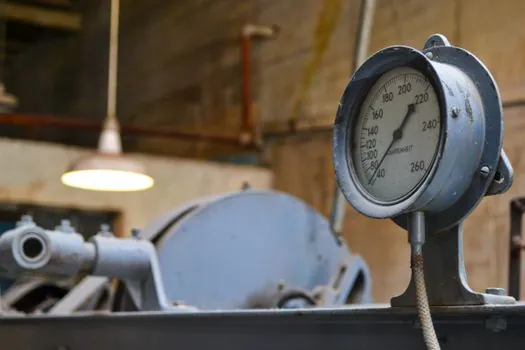
Diaphragm material is the single largest cause of premature failure on absolute pressure transmitters, and the data is concrete: the Valcom VESW/VESY uses an SUS316L pressure port with a Hastelloy C-22 equivalent diaphragm assembly, specified as compatible with water, oil, gases, and any medium that will not corrode 316L or C-22 [S4].
That same datasheet publishes a safe overload rating of 300% R.C. and an ultimate overload rating of 400% R.C., meaning a 100 kPa abs body can be exposed to 300 kPa abs without permanent shift and to 400 kPa abs without rupture, a ratio that is a good sanity check when a vendor is silent on overload [S4].
For aggressive chemistry, a Hastelloy C-276 or C-22 diaphragm is the conservative default in chlorides, sour service, and wet HCl; for steam and hot water, 316L is usually fine but the temperature window matters because the VESW/VESY is rated to 100 °C safe, 80 °C compensated, and any plant running saturated steam at 150 °C or higher needs a higher-rated body, not a 316L miniature [S4].
Buyers who do not need a true absolute reference can also consider a differential pressure transmitter with one leg capped to vacuum, but that adds a reference chamber and a second source of leak; for clean, low-range absolute measurements, a purpose-built absolute body is mechanically simpler and usually cheaper over the lifecycle [S4].
Output protocols: HART versus PROFIBUS PA versus FOUNDATION Fieldbus
The ABB 266ASH is offered in three protocols out of one body: HART over a 4 to 20 mA analog loop, PROFIBUS PA, and FOUNDATION Fieldbus, and the public driver list is explicit about DTM and EDD files for HART, DTM plus GSD for PROFIBUS, and EDD/CF for FOUNDATION Fieldbus [S1].
HART runs as a frequency-shifted signal superimposed on a 4 to 20 mA analog loop, so a plant that already has a 4 to 20 mA DCS can drop a 266ASH in with two wires and keep the analog fallback; PROFIBUS PA and FOUNDATION Fieldbus are fully digital fieldbuses on the same two-wire segment, and a HART handheld will not talk to either, so a buyer must pick the protocol up front and order the matching variant rather than swap firmware in the field [S1].
The ifm PT05 series is the alternative if a 4 to 20 mA analog output is all that is required: it covers 0 to 10 bar abs (0 to 145.04 psi) in a threaded stainless steel housing, with a process temperature band of 0 to 80 °C and a "compact" form factor marketed for restricted-space installations, which fits skid builders and OEM panels rather than a full IEC 61508 SIS loop [S2].
For a level application where a pressure transmitter is being repurposed to read hydrostatic head, a level transmitter page usually documents the same HART/PA/FF options, but the spec is fundamentally the same sensor in a different housing, so the protocol decision carries over without a separate trade study [S1].
Configuration, commissioning, and the TTG-style hands-off workflow

ABB's 266ASH supports three configuration paths: local keys plus LCD, handheld terminal, PC tool, and the TTG (Through The Glass) infrared link, which lets a tech configure the device without breaking the windowed front cover, an obvious gain in hazardous areas where a cover-off event can require a hot-work permit [S1].
The plug-and-play display, combined with auto-configuration on the in-field replaceable electronics module, is what the OEM pitches as a maintenance cost reducer, and on a large plant with hundreds of spares the math is real: a stock of pre-calibrated electronics that recognize any sensor body cuts bench time to near zero [S1].
Valcom's VESW/VESY is a simpler category: it ships with a fixed calibration (50 kPa abs or 100 kPa abs) and a fixed output (1 to 5 V or 4 to 20 mA), and configuration is done at order time via a model code rather than in the field, which is appropriate for a $300-class OEM component but not for a $2000 SIS-loop device [S4].
Who should NOT pick a generic absolute pressure transmitter
Three duty profiles break a general-purpose absolute pressure transmitter and need a specialty body: (1) sanitary/biopharma CIP/SIP at 140 °C with steam-sterilization cycles, where a 3-A certified flush-diaphragm sanitary housing is mandatory; (2) hydrogen service at high pressure, where NACE MR0175-compliant materials and a specific permeation-rated diaphragm are required, neither of which a 266ASH or PT05 datasheet claims; (3) custody-transfer gas metering, where an absolute pressure input must be paired with a flow computer and a metrology-approved body, not a general-purpose industrial transmitter [S1][S2][S4].
For vacuum ranges below 50 kPa abs, the VESW/VESY's 50 kPa abs floor is the practical lower limit on a miniature, and most industrial absolute pressure transmitters start their calibrated range at 0.3 kPa abs or higher, so a buyer chasing 0 to 10 kPa abs is looking at a different, more expensive sensor class entirely [S1][S4].
For high-temperature processes above 150 °C on the VESW/VESY, the safe-temperature limit of 100 °C is the hard wall; pushing beyond it requires a remote-diaphragm seal with a capillary and a fill fluid, and that changes the spec to a pressure transmitter with a seal assembly rather than a direct-mount absolute body [S4].
Sourcing, supply chain, and what 2026 actually shipped

DirectIndustry's 2026 index lists 76 companies and 293 precision pressure transmitter products, of which 142 are absolute-pressure units, and the technology mix is dominated by membrane (207) and sensitive-element (101) sensing, with MEMS at only 7, indicating that MEMS has not displaced traditional diaphragm designs in industrial absolute pressure as of mid-2026 [S3].
Output mix is also informative: 238 analog versus 137 digital, 42 two-wire, 24 three-wire, 16 wireless, with NB-IoT at 6, Bluetooth at 5, and LoRaWAN at 4, so a 4 to 20 mA analog still leads by roughly 1.7:1 over digital, and wireless is still a minority even in 2026 [S3].
Connector mix shows M12 at 38, terminal block at 19, bare wires at 8, which is consistent with a market that is split between DIN-rail and panel-mount form factors, and the M12 connector is the dominant field-wireable option in 2026 [S3].
ABB's 266ASH remains in the ABB product catalog as of 2026-08-07, with HART, PROFIBUS PA, and FOUNDATION Fieldbus variants simultaneously listed, which is itself a buying signal: vendors who carry all three protocols usually also stock spare electronics and have a multi-year service commitment, whereas a single-protocol specialist can be dropped on shorter notice [S1].
For buyers comparing absolute pressure transmitter pricing against variable area flowmeter price and cost guide for 2026 specifiers, the rule of thumb is that an industrial-grade absolute pressure transmitter body runs roughly the same order of magnitude as a precision flowmeter body, while miniature OEM units like the VESW/VESY are typically an order of magnitude cheaper than the ABB 266ASH class, and that ratio is worth keeping in mind during a bill-of-material review [S1][S4].
Standards and certifications to verify on the datasheet before signing the PO
For a European chemical plant build, the required minimum on a 266ASH-class body is ATEX 2014/34/EU for Group II, Category 2 (Zone 1) or Category 3 (Zone 2), plus IECEx for non-EU jurisdictions, and PED Category III for the process side; the 266ASH is documented to comply with PED Category III in its public datasheet [S1].
For SIS duty the 266ASH carries SIL2/SIL3 certification issued by TÜV Nord per IEC 61508, which is the real number that should appear on the certificate, not a vendor-side paraphrase; the TÜV Nord certificate is the line item to ask the vendor for, because IEC 61508 SIL claims without a third-party certifier name are not auditable in a HazOp [S1].
For sour service (H₂S-bearing hydrocarbons), NACE MR0175/ISO 15156 compliance is the required material standard; buyers should ask for an explicit NACE MR0175 certificate on the wetted side because 316L alone is not NACE-compliant for all NACE service classes, and a Hastelloy diaphragm only addresses the diaphragm, not the pressure port [S4].
For explosion-proof enclosures in North America, NEC Class I Division 1 is the common request, and the equivalent IEC 60079-1 flameproof (Ex d) marking on a European IECEx body covers the same duty; buyers should not assume the ATEX/IECEx cert alone is accepted on a US site, and conversely a UL-listed Class I Div 1 unit is not automatically accepted under ATEX [S1].
Useful cross-references for an absolute pressure transmitter selection project in 2026: the capacitance level transmitter spec-first selection for 2026 plants page covers a similar HART/PA/FF protocol trade study on the level side, and the TDR level meter buying guide 2026 page is the right companion when an absolute pressure transmitter is being evaluated as an alternative to a TDR for short-tank level measurement in clean liquids.
Final spec-check list before signing a 2026 purchase order: calibrated span in kPa abs or bar abs, not just sensor full scale; base accuracy in % of span with a turndown ratio stated; long-term stability per year with a number; wetted material grade (316L, Hastelloy C-22, C-276) and whether the diaphragm is welded or O-ring sealed; safe and ultimate overload in %R.C.; process temperature compensated and safe bands; output protocol and matching driver files; and the third-party cert numbers for ATEX/IECEx/SIL/NACE that the plant's HazOp requires. If the datasheet does not show a number, ask for the full PDF; if the full PDF does not show the number, treat the spec as unverified [S1][S2][S3][S4].