A terminal block is a modular junction element that joins two or more electrical conductors at a fixed, inspectable point. Mounted side by side on a DIN rail inside a control cabinet, terminal blocks marshal field wiring, distribute power and signals, and bond protective earth, forming the backbone of almost every industrial control panel. They are designed for semi-permanent connections that an electrician can open, test, and re-terminate with a tool rather than for repeated plug-in cycles.
While "terminal block" is the generic term, the device family spans simple feed-through blocks, ground (PE) blocks, fused and disconnect blocks, multi-level and sensor-distribution blocks, and pluggable variants. The connection technology, the rated conductor cross-section, and the rated voltage and current are the three parameters that drive selection, and all three are governed by the IEC 60947-7 series and, for North America, by UL 1059.
This guide is written for industrial purchasing engineers and panel design engineers. It covers 6 chapters spanning what a terminal block is, the main block types, the four connection technologies, conductor sizing and DIN rail standards, the spec-sheet parameters that matter, and the selection decision sequence, plus 7 selection FAQs and manufacturer comparisons. All parameters reference the IEC 60947-7-1, IEC 60947-7-2, IEC 60947-7-3, UL 1059, and EN 60715 public standards.
Chapter 1 / 06
What is a Terminal Block
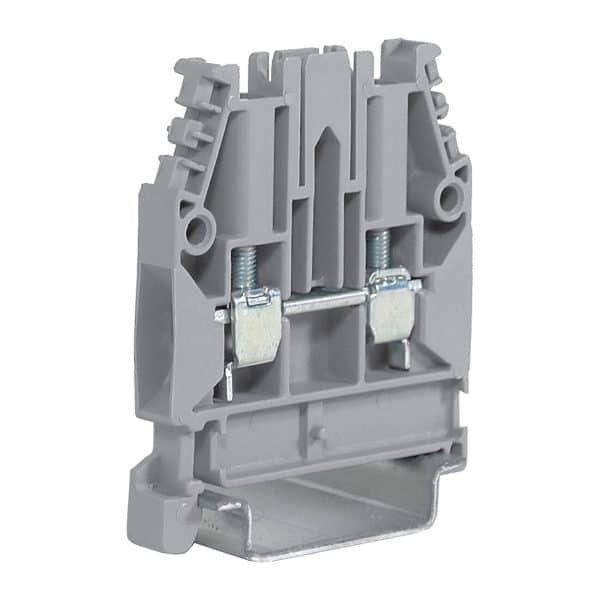
A terminal block, also called a terminal connector or DIN rail terminal, is a modular insulated housing that holds one or more current bars and clamping units, joining incoming and outgoing conductors at a single accessible point. Its job is deceptively simple: provide a low-resistance, mechanically stable, electrically insulated junction that an electrician can wire in the field, label, test, and later open without disturbing the rest of the panel. Inside a control cabinet, hundreds of these blocks snap onto a shared DIN rail to form a terminal strip, the marshalling layer between field cables and the controllers, drives, and protective devices.
Functionally a terminal block separates the act of field wiring from the act of internal panel building. The panel shop wires the cabinet side once; the installer on site wires the field side into the same block. Because each conductor enters its own clamping unit, a terminal strip also documents the wiring: every block can carry a printed marker, so the strip becomes a readable map of the installation. This is why terminal blocks dominate marshalling and distribution even though a crimped splice would be cheaper for a single joint.
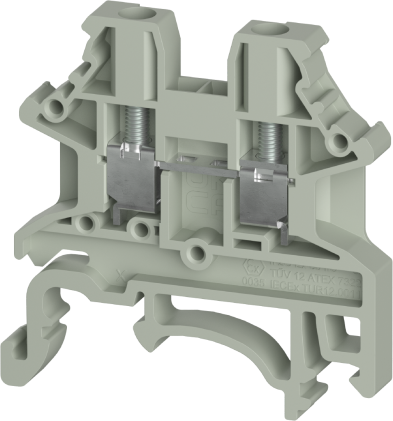
The structure of a feed-through block has three functional parts. First, the insulating housing, usually molded from polyamide (PA 6.6) rated for flame retardance to UL 94 V0, which sets the air clearance and creepage distances that determine rated voltage. Second, the current bar, a copper-alloy conductor (often brass or electrolytic copper) that is frequently tin-plated or nickel-plated to resist oxidation and hold contact resistance stable over decades. Third, the clamping unit, the screw, spring cage, or push-in spring that presses the conductor against the current bar. The clamping technology, covered in Chapter 3, is the single most consequential design choice.
The product category has a long industrial lineage. Weidmueller is widely credited with commercializing the modern rail-mount feed-through terminal block in 1948, and the DIN rail mounting concept that lets dissimilar devices share one rail became a defining feature of European control cabinet practice. Over the following decades the screw clamp was joined by the tension-clamp spring (popularized for vibration-prone applications) and, more recently, by tool-free push-in technology, which now dominates new panel designs because it roughly halves termination time.
In scale, terminal blocks are among the highest-volume components in any electrical installation: a mid-size machine cabinet may hold several hundred, and a process plant marshalling cabinet several thousand. Because they are individually cheap but collectively numerous and labor-intensive to wire, the real cost driver is not the unit price but the installed cost, which includes wiring time, ferrule crimping, testing, and the lifetime risk of a loose joint. That economic reality, not headline ampacity, is what pushes panel builders toward spring and push-in technologies and toward standardizing on a single manufacturer ecosystem.
Chapter 2 / 06
Terminal Block Types
Beyond the basic feed-through block, the terminal block family includes several functional variants that share identical mounting feet and snap onto the same 35 mm DIN rail side by side, so a single terminal strip can mix functions. Choosing the wrong functional type, for example using a plain feed-through where a fused or disconnect block was needed, forces a redesign of the strip layout. The table below summarizes the principal functional types.
Feed-through blocks are the default. A single conductor enters each side and passes through one current bar, optionally with a center bridge slot for cross-connecting adjacent poles into a common potential. Double-deck and triple-deck variants stack two or three independent circuits in the footprint of a single block to save rail length, which matters in dense signal cabinets.
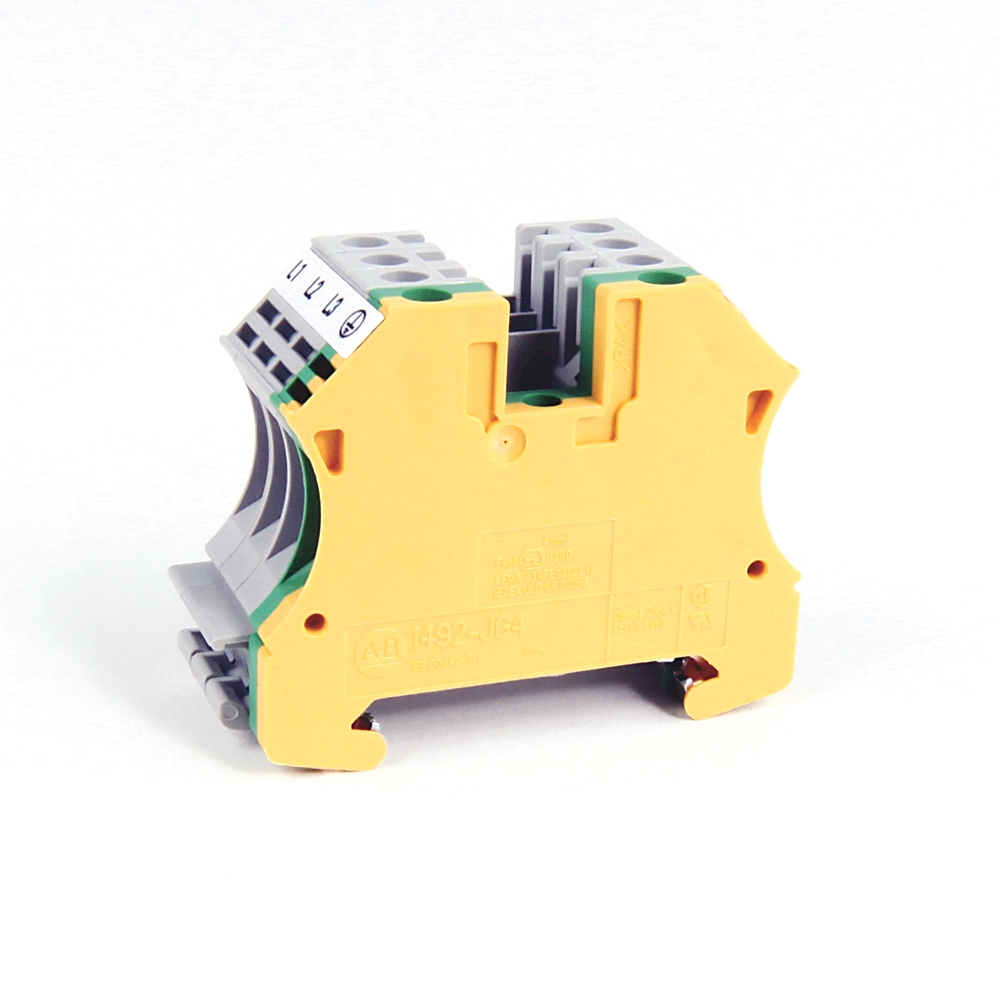
Ground or PE blocks connect the protective-earth conductor directly to the metal DIN rail rather than to an isolated current bar. The block foot makes metal-to-metal contact with the rail, so the rail itself becomes the earth bus and must be bonded back to the cabinet earth bar. PE blocks carry green-and-yellow insulation by convention and are governed by the dedicated standard IEC 60947-7-2, which imposes stricter contact-integrity requirements than ordinary feed-through blocks because the earth path is safety-critical.
Fused blocks integrate a fuse holder, often a hinged or swing-open carrier for a 5 by 20 mm or 5 by 25 mm glass fuse, into the block body so each circuit gets local overcurrent protection without a separate fuse rail. Many carry an LED blown-fuse indicator. They follow IEC 60947-7-3. Disconnect and test blocks contain a knife-edge or sliding link that lifts to break the circuit, letting an electrician isolate or inject a test signal without unscrewing any wire, which is essential for current-transformer and instrumentation loops that must be shorted before disconnection.
Multi-level and sensor-distribution blocks address signal density. A three-level sensor block can route the supply, the signal, and the ground of a three-wire proximity sensor through one block width, with internal jumpers pre-distributing the common supply and ground rails across the strip. Power and high-current blocks sit at the other extreme, using bolted lugs or large stud clamps to terminate feeders up to 300 mm2 (600 kcmil), the upper limit of the IEC 60947-7-1 scope.
Chapter 3 / 06
Connection Technologies
The clamping technology is the defining engineering choice of a terminal block, because it sets the installation time, the long-term contact reliability, the vibration tolerance, and the skill level required of the installer. Four technologies dominate industry: screw clamp, spring cage (tension clamp), push-in, and insulation displacement (IDC). The table below compares their key engineering characteristics.
Technology
Tool to Terminate
Vibration / Retighten
Relative Speed
Best For
Screw clamp
Screwdriver, torque set
Can loosen; periodic retighten advised
Slowest
Mixed or unknown conductors, retrofits
Spring cage
Screwdriver opens cage
Maintenance-free
Medium
Vibration, transport, rail vehicles
Push-in
None for solid or ferruled
Maintenance-free
Fastest
High-volume new panels
IDC
Insertion tool
Maintenance-free, not re-openable
Fast
Mass-terminated permanent wiring
Screw-clamp terminals press the conductor against the current bar with a captive screw, often driving an intermediate clamping yoke so the screw tip never directly bites the wire. The screw clamp accepts almost any conductor, solid or stranded, over a wide cross-section range, which makes it the most forgiving choice for retrofits and field repairs where conductor type is unknown. Its weakness is that joint quality depends on the installer applying correct torque (commonly 0.5 to 0.8 Nm for a 2.5 mm2 block), and the joint can loosen under vibration, thermal cycling, and copper creep, so panel maintenance regimes schedule periodic retightening. Premium screw blocks such as the Phoenix Contact UT series add an anti-loosening feature (Reakdyn) that resists vibration-driven backout.
Spring-cage (tension-clamp) terminals replace the screw with a stainless-steel spring that applies constant contact force. The installer opens the cage with a screwdriver, inserts the conductor, and releases; the spring then holds the wire indefinitely without any torque setting. Because the contact force is built into the spring and not the operator, spring-cage joints do not loosen under vibration and require no retightening, which is why they are mandated in railway rolling stock, transport equipment, and other shock-prone applications.
Push-in technology is a pre-tensioned spring contact that needs no tool at all for the most common conductors: a solid wire or a stranded wire fitted with a ferrule is simply pushed straight into the contact chamber and locks automatically, with a release lever or push-button to open it. Manufacturer benchmarks credit push-in with cutting termination time by roughly 50 percent versus screws, and push-in joints can resist higher conductor pull-out forces than spring-cage while remaining vibration-proof and retighten-free. WAGO popularized the approach with its Push-in CAGE CLAMP (TOPJOB S 2002 and 2200 families), and Phoenix Contact (PT and PTV) and Weidmueller (PUSH IN) offer parallel lines. Because push-in needs a rigid conductor tip, bare fine-stranded wire must either be ferruled or have the spring opened with a tool first.
Insulation displacement (IDC) terminals slot the insulated conductor into a sharpened metal fork that cuts through the insulation and contacts the copper in one motion, with no stripping. IDC is the fastest method for mass termination of solid telecom and signal wiring, but the connection is essentially permanent and not intended for repeated re-opening, so it suits fixed installations where wires will not be changed. Across all four technologies the trend in new panel design is decisively toward push-in, driven by the labor savings and the elimination of retightening, while screw clamps persist where conductor variety or field serviceability outweighs speed.
Chapter 4 / 06
Conductor Sizing and DIN Rail Standards
The single most important sizing relationship is between the rated conductor cross-section and the rated current. Under IEC 60947-7-1 the current rating of a feed-through block is determined by the cross-section of the conductor it clamps, the conductivity of the current bar, and the resulting temperature rise, which the standard caps at a 30 K maximum. IEC 60947-7-1 applies to conductors from 0.05 mm2 (30 AWG) up to 300 mm2 (600 kcmil), at rated voltages up to 1000 V AC (up to 1000 Hz) or 1500 V DC. The table below lists the nominal IEC ratings that recur across major manufacturer catalogs.
Cross-section
AWG (approx.)
Nominal Rated Current
Typical Block Width (pitch)
1.5 mm2
16 AWG
17.5 A
5.2 mm
2.5 mm2
14 AWG
24 A
5.2 to 6.2 mm
4 mm2
12 AWG
32 A
6.2 mm
6 mm2
10 AWG
41 A
8.2 mm
10 mm2
8 AWG
57 A
10.2 mm
16 mm2
6 AWG
76 A
12.2 mm
35 mm2
2 AWG
125 A
16 mm
These nominal currents assume a single block carrying its rated conductor in open air at the standard ambient. In real cabinets the figures must be derated. When many fully loaded blocks sit shoulder to shoulder, the heat each generates raises the temperature of its neighbors, so a densely packed strip cannot run every block at its catalog rating. Elevated ambient temperature inside a sealed cabinet, and reduced conductor lengths that carry less heat away, further reduce the usable current. As a working rule, leave headroom rather than operate continuously at the nominal rating, and consult the manufacturer derating curve for grouped blocks.
The other half of the spec is the DIN rail itself. Terminal blocks snap onto a standardized mounting rail whose mechanical profiles are defined by IEC and EN 60715. The dominant profile for terminal blocks is the 35 mm top-hat rail, designated TH35 (European catalogs) or TS35 (often used in North America), and offered in two depths: 7.5 mm and the stiffer 15 mm. The 15 mm deep rail resists flexing under long, heavily loaded terminal strips and is preferred for power distribution, while the 7.5 mm version suits lighter signal cabinets; most rail-mount blocks accept either depth. The rail does double duty for PE blocks, whose metal foot bonds to the rail to create the earth path, so a grounded, corrosion-free rail is part of the safety system, not just a mounting bracket.
Conductor preparation completes the picture. Each block specifies a stripping length (commonly 8 to 12 mm for small blocks) that must be respected so the bare copper fully engages the clamp without leaving exposed strands outside it. Fine-stranded conductors should be fitted with insulated ferrules (wire-end sleeves) sized to the cross-section and barrel length, both to prevent stray strands and, for push-in terminals, to give the spring a rigid tip to grip. Matching the conductor type, the stripping length, and the ferrule to the block is as important to a reliable joint as the headline ratings.
Chapter 5 / 06
Key Specification Parameters
A terminal block datasheet lists many values, but only a handful drive selection: rated voltage, rated current, rated and clampable cross-section, the certified standards, the pollution-degree and overvoltage context, and the connection data (stripping length and torque). Each is decoded below, with the widely used Phoenix Contact UT 2,5 feed-through block cited as a concrete reference point.
Rated voltage is set by the air clearance and creepage distance between adjacent live parts, qualified by pollution degree and overvoltage category. The same physical block therefore carries several voltage numbers. The Phoenix Contact UT 2,5, for instance, is rated 1000 V at pollution degree 3 and overvoltage category III under IEC, while its UL rating is stated separately (commonly 600 V) because UL uses a different test basis. Read the voltage in context: the usable figure falls as pollution and altitude rise above the rated conditions, and the IEC and UL columns are not interchangeable.
Rated current is the maximum continuous current per pole under the 30 K rise limit, tied to cross-section as shown in Chapter 4. The UT 2,5 is rated 24 A, consistent with the 2.5 mm2 nominal. Distinguish the IEC rated current from the UL ampacity, which is tested with different conductor lengths and may differ. Rated and clampable cross-section are two numbers: the nominal cross-section that defines the current rating, and the actual range of conductors the clamp accepts. The UT 2,5 nominally rates at 2.5 mm2 but clamps roughly 0.14 to 4 mm2 (26 to 12 AWG), so one block covers several wire gauges.
Certified standards tell you where the block may legally be installed and to which safety regime it was tested:
IEC 60947-7-1: feed-through terminal blocks for copper conductors, the baseline international standard.
UL 1059: the North American standard; tests three blocks horizontally for a maximum 30 K rise at 25 degrees Celsius ambient and assigns a Use Group.
CSA C22.2 No. 158 (Canada) and IEC 60079-7 (Ex e, hazardous-area blocks) for region- and zone-specific approvals.
Connection data rounds out the sheet. For screw blocks this is the tightening torque (typically 0.5 to 0.8 Nm for a 2.5 mm2 block) and the screw thread; for all blocks it is the stripping length (often 8 to 12 mm) and whether ferrules are required. Housing material and flammability (commonly PA 6.6, UL 94 V0) and the operating temperature range (frequently around -60 to +110 degrees Celsius for the insulating body) determine survival in harsh cabinets. Finally, the accessory ecosystem, meaning bridges, markers, end plates, and end brackets, is a hidden but decisive parameter, because a block with poor accessory support slows wiring and labeling even if its core ratings are excellent.
Chapter 6 / 06
Selection Decision Factors
To turn the preceding five chapters into a specific part number, follow the decision sequence below. Most selection mistakes come not from a single wrong value but from deciding in the wrong order, for example fixing on a connection technology before confirming the conductor and current. These eight steps double as an RFQ template.
Conductor and current: Identify the largest conductor cross-section the block will ever clamp and the continuous current it must carry, then pick a rated cross-section that matches per the Chapter 4 table, leaving headroom for grouping and ambient derating.
Functional type: Decide feed-through, ground (PE), fused, disconnect or test, multi-level, sensor distribution, or high-current power, since the type sets the standard (IEC 60947-7-1, 7-2, or 7-3) and the strip layout.
Connection technology: Choose screw for mixed or unknown conductors and field serviceability, spring-cage for vibration, push-in for high-volume new panels, or IDC for permanent mass termination. This is the biggest installed-cost lever.
Rated voltage in context: Confirm the IEC rated voltage at the actual pollution degree and overvoltage category of the installation, and confirm the separate UL voltage if the panel ships to North America.
Standards and approvals: Match the destination market: IEC 60947-7-x for global, UL 1059 for the USA, CSA C22.2 No. 158 for Canada, IEC 60079-7 (Ex e) for hazardous areas. Verify the listing on the certificate, not just the catalog claim.
DIN rail and mounting: Confirm the TH35 (TS35) rail depth (7.5 mm or 15 mm), the rail length and grounding for PE blocks, and the end brackets and end plates needed to retain the strip.
Conductor preparation: Specify stripping length, ferrule requirement and size for stranded wire, and tightening torque for screw types, so the wiring instruction is unambiguous on the shop floor.
Accessory and ecosystem fit: Verify that bridges, jumpers, markers, partition plates, and test plugs exist for the chosen family, and standardize the whole strip on one manufacturer to keep accessories interchangeable.
One last and commonly overlooked dimension is serviceability and ecosystem lock-in: local stock of the exact block and its accessories, marker and labeling system compatibility, and whether a maintenance technician five to ten years later can still source a matching block. Standardizing a panel on a single full-line family, such as Phoenix Contact CLIPLINE, WAGO TOPJOB S, or Weidmueller Klippon Connect, keeps bridges, markers, and end plates interchangeable and is usually worth more over the cabinet lifetime than a small per-block price advantage from mixing brands.
FAQ
What is the difference between a terminal block and a connector?
A terminal block is a modular junction element that joins two or more conductors at a fixed point, usually mounted on a DIN rail inside a control cabinet, and it is designed for field-wired, semi-permanent connections that can be opened with a tool or a release lever. A connector is a mating pair (plug and socket) optimized for repeated mate and unmate cycles, often pre-assembled onto cable harnesses. Terminal blocks excel at distribution, marshalling, and protective-earth bonding where each conductor enters individually; connectors excel where a whole multi-pin interface must be coupled in one motion. Many modern terminal block families add a pluggable connector front end, blurring the line.
What is the difference between screw, spring-cage, and push-in terminal blocks?
A screw terminal compresses the conductor against a current bar with a captive screw; it accepts almost any conductor but the joint relies on installer torque and can loosen under vibration and thermal cycling, so periodic retightening is advised. A spring-cage (tension-clamp) terminal uses a stainless-steel spring to apply constant contact force; the cage is opened with a screwdriver or lever to insert the wire, and it is maintenance-free against vibration. A push-in terminal is a pre-tensioned spring contact: a solid conductor or a ferruled stranded conductor is simply pushed in and locks automatically, cutting termination time by roughly 50 percent versus screws. Spring and push-in joints maintain more consistent contact resistance because force is set by the spring, not the operator.
How do I choose the conductor cross-section and current rating?
Start from the conductor the circuit needs, then pick a block whose rated cross-section matches that wire, because the block current rating under IEC 60947-7-1 is tied to cross-section. Typical nominal ratings are about 24 A at 2.5 mm2, 32 A at 4 mm2, 41 A at 6 mm2, 57 A at 10 mm2, and 76 A at 16 mm2, measured under a 30 K maximum temperature rise. Derate when blocks are densely packed, when ambient exceeds 25 to 40 degrees Celsius, or when several loaded poles sit side by side, because heat from neighbors adds up. Always size the block to the largest conductor it will ever carry, and confirm both the IEC and the UL ampacity columns separately, since UL 1059 and IEC tests use different conductor lengths.
What does the rated voltage of a terminal block actually mean?
Rated voltage is governed by the minimum air clearance and creepage distance between adjacent live parts, plus the pollution degree and overvoltage (impulse) category of the installation. A common industrial feed-through block such as the Phoenix Contact UT 2,5 is rated 1000 V at pollution degree 3 and overvoltage category III under IEC. The same block carries a separate UL voltage rating, often 600 V or 300 V depending on Use Group. Never read one number in isolation: the usable voltage drops as pollution and altitude rise above the rated conditions, and the IEC rated voltage and the UL rated voltage are derived from different test regimes, so both columns belong in the selection sheet.
Which IEC and UL standards govern terminal blocks?
The core international family is IEC 60947-7: Part 7-1 covers feed-through terminal blocks for copper conductors, Part 7-2 covers protective-conductor (PE) terminal blocks, Part 7-3 covers safety requirements for fuse terminal blocks, and Part 7-4 covers PCB terminal blocks. IEC 60947-7-1 applies from 0.05 mm2 (30 AWG) to 300 mm2 (600 kcmil) at up to 1000 V AC or 1500 V DC. In North America the relevant standard is UL 1059, which tests three blocks horizontally for a maximum 30 K rise at 25 degrees Celsius ambient and classifies blocks by Use Group; CSA C22.2 No. 158 covers Canada. The DIN rail itself follows IEC and EN 60715 (TH35 top-hat profile).
What is a DIN rail and which profile do terminal blocks use?
A DIN rail is a standardized metal mounting rail that lets terminal blocks, relays, breakers, and power supplies snap on side by side without screws. The profiles are defined by IEC and EN 60715. The dominant profile for terminal blocks is the 35 mm top-hat rail, designated TH35 or TS35, available in 7.5 mm and 15 mm depths; the deeper 15 mm version is stiffer and preferred for long, heavily loaded terminal strips. Most rail-mount blocks accept both depths. The rail also serves as the protective-earth path for PE blocks, whose metal foot bonds directly to the rail, so the rail must itself be grounded back to the cabinet earth bar.
Do I need ferrules on stranded wire, and when?
For screw terminals, fine-stranded conductors should be crimped with insulated ferrules (wire-end sleeves) so individual strands cannot splay, escape the clamp, or create a short to the adjacent pole; many panel standards and the relevant wiring codes require it. For push-in terminals, ferrules are effectively mandatory on stranded wire because the spring needs a rigid tip to push past the contact; solid conductors and ferruled conductors insert directly, while bare fine-stranded wire must first have the spring opened with a tool. Spring-cage terminals can grip bare fine-stranded wire when the cage is held open, but ferrules still improve repeatability. Use a ratcheting crimp tool and match the ferrule cross-section and barrel length to the terminal.
Terminal Block Manufacturers
Source-backed product routes. Open a company dossier for procurement scope and cited evidence.