
Pick an absolute pressure transmitter when the loop must hold calibration against barometric drift, and a vacuum gauge when you only need a local readout of sub-atmospheric conditions on the bench or on a portable cart [S1].
Both products sit on the same physical axis, but their reference side is built differently. An AP transmitter is sealed against a factory vacuum on the low side, so the process pressure is always read against absolute zero; a vacuum gauge, by contrast, senses the process against local atmospheric pressure and therefore drifts with the weather, the season, and the altitude of the plant [S1].
Reference Side and Calibration Stability
An AP transmitter's low-pressure side is permanently evacuated to a hard vacuum at the factory, so its output does not move when a cold front drops the barometer by 10 mbar or when a winter high pushes it 15 mbar higher [S1]. That is why process engineers specify AP units for closed-loop control: the controller sees the same signal at 2 a.m. and at noon regardless of weather, and DCS trim stays put between scheduled calibrations.
A vacuum gauge — whether a Bourdon tube, a diaphragm dial, or a digital Pirani/cold-cathode variant — references the local atmosphere. The reading is intuitive (it goes more negative as the chamber is pumped down) but the zero shifts whenever the plant door is opened on a humid morning versus a dry winter afternoon. For a portable leak-checker pulled onto a service truck this is acceptable; for a feed to a flow computer it is not.
Sensor Technology and Range Trade-offs
AP transmitters are built around four sensing families. Ceramic-capacitive cells dominate the sub-60 bar vacuum-to-moderate-pressure window — the VEGAWELL 52 reaches 60 bar (870.23 psi) max in stainless steel with HART and 4-20 mA outputs and IP68 process protection [S2], while the VEGABAR S14 stretches ceramic sensing up to 25 bar (362.59 psi) on a threaded process connection for gas and liquid service [S4]. Silicon piezoresistive and bonded-foil strain-gauge cells cover the high-pressure and high-overload end — the Supmea SUP-P3000 with HART, analog and digital output climbs to 40 MPa, and the ABB 266NRH with membrane construction survives up to 16,000,000 Pa (2,320.6 psi) absolute with a low range starting at 1,100 Pa (0.16 psi) [S5]. The ABB PGF100 strain-gauge cell, with ranges from 3 mbar to 100,000 mbar, is the example for fine-resolution absolute pressure at very low spans [S6].
A vacuum gauge is built around mechanical deflection, thermal conductivity, or ionization. Bourdon and diaphragm dial gauges are cheap, ATEX-rated, and survive rough field use but cap out around -1 bar gauge; thermal and ionization gauges (Pirani, thermocouple, cold cathode, hot cathode) extend measurement into the rough, medium, and high vacuum regions below 10⁻³ mbar. Once a process drops below a few millibar, no AP transmitter can resolve the span — a dedicated vacuum gauge technology takes over by design.
Output, Wiring, and Loop Integration

Transmitters talk to the DCS. The 2026 catalogue still centres on 4-20 mA plus HART, with ratiometric analog variants for OEM and HVAC use and 24 VDC supply as the default for the SUP-P3000 line [S2][S3][S5]. HART is an FSK signal layered on the analog 4-20 mA loop; it does not replace that loop. For digital-only fieldbus segments the device description must be Foundation Fieldbus or PROFIBUS PA capable — that is a separate conformance path from HART. The membrane-type DMP 321 from BD|SENSORS exposes 4-20 mA plus ratiometric output with ATEX, EMC, IP65/IP67/IP68 ratings, threaded mounting, and stainless steel wetted parts for OEM, HVAC, and building-automation service [S3].
Vacuum gauges, in the industrial-control sense, are usually dials — passive mechanical indicators that need no loop power. Electronic vacuum gauges (Pirani, cold-cathode, hot-cathode) add a 0-10 V or RS-485 signal but the user is typically a lab operator reading a screen, not a control system. The choice between the two product families is therefore also a choice between feeding a controller and informing a technician.
Process Fit, Materials, and Hazardous-Area Use
Most 2026 AP transmitters are 316L stainless steel with threaded or immersed process connections. The VEGAWELL 52 is rated for marine and water-treatment service, with ATEX, IP66, IP67, and IP68 protection and a two-wire loop for suspended mounting in an open well [S2]. The PGF100 from ABB is positioned as compact and sanitary for food and beverage [S6]. The 266NRH handles high-overload absolute pressure on gas and liquid lines with remote diaphragm capability. Across the catalogue, ATEX certification is the norm for European chemical-plant and oil-and-gas deployment, and the same European chemical-plant and oil-and-gas deployment is exactly where the pressure transmitter selection guide recommends matching certification to zone before output protocol.
A pressure gauge or vacuum gauge does not have to be ATEX, but when the application is hazardous, the dial instrument carries the same Ex marking and the same installation rules. The installation footprint, however, is different: a Bourdon or diaphragm dial sits in front of the operator, a transmitter sits behind a barrier and is read from the DCS HMI.
Selection Criteria Compared
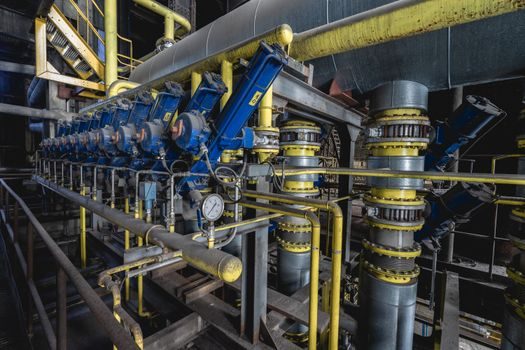
The two product families line up against four decision criteria. Reference stability: AP transmitter has a sealed vacuum reference, vacuum gauge references local atmosphere. Typical use: AP transmitter for control loops and custody transfer below 60 bar, vacuum gauge for spot-checks and sub-millibar high-vacuum work. Output: AP transmitter provides 4-20 mA + HART (and in some lines ratiometric, Foundation Fieldbus, or PROFIBUS PA), vacuum gauge provides local dial or analog/DC signal without a control loop. Cost of ownership: AP transmitter has higher unit cost but lower recalibration frequency, vacuum gauge has lower unit cost but must be re-zeroed on barometric shifts. For plant service above 1 bar absolute, an AP transmitter is the correct default; for leak testing a vacuum chamber at the bench, the vacuum gauge is the correct default. [S1]
Failure Modes, Drift, and Field Cues
An AP transmitter drifts when the reference vacuum leaks — the symptom is a slow upward shift in the absolute reading at known process conditions, and the fix is factory re-sealing. A vacuum gauge drifts when the local barometer changes — the symptom is a daily reading oscillation that correlates with weather fronts, and the fix is a more frequent zero check, not a service call. Recognizing which failure mode is in front of you is the difference between a five-minute loop check and an unscheduled shutdown. Engineers who spec differential pressure transmitters for flow elements run into the same reference-versus-atmosphere logic, and the same decision tree applies: sealed reference for control, atmospheric reference for indication. [S2]
Standards and Sourcing Trail

Hazardous-area conformance for the transmitters and gauges cited is documented in product specifications as ATEX with IP65, IP66, IP67, and IP68 process protection levels [S2][S3][S4]. The ceramic, silicon, membrane, and strain-gauge sensing technologies referenced in the 2026 product lines are described by the manufacturers themselves in the public product data sheets cited [S2][S4][S5][S6]. The English-language vocabulary for AP transmitter versus vacuum gauge, including the canonical definition of an AP transmitter as a device measuring pressure relative to a perfect vacuum reference, comes from Yokogawa's published field-instrument guidance [S1]. When you build a spec sheet, anchor each line to the product data sheet URL; that trail is the only one an inspector will accept.
Watch the next two signals: revised ATEX installation guidance for Ex ec and Ex tb equipment in 2026 documentation cycles, and the spread of Ethernet-APL compatible AP transmitters into greenfield DCS projects, both of which are likely to shift the recommended default for European chemical-plant builds over the next four quarters. Field data for the 2026 product lines above is summarized on the pressure transmitter buying guide and on the strain-gauge installation field sheet for the strain-gauge branch of the same AP family.