A switching power supply, or switched-mode power supply (SMPS), converts electrical power by rapidly switching a power transistor on and off at high frequency and regulating the output through pulse-width or frequency modulation. Compared with a linear regulator that dissipates the voltage difference as heat, an SMPS reaches 80 to 95 percent efficiency at a fraction of the size and weight, which is why it powers nearly every modern industrial controller, server, motor drive, and LED installation.
This guide treats the SMPS as a field-installed industrial component rather than a board-level chip. It covers what the supply does, the dominant power-conversion topologies, the conversion principle stage by stage, the spec parameters that drive selection, the efficiency and safety standards that govern compliance, and a structured selection sequence for procurement and design engineers.
This guide is aimed at industrial purchasing engineers and design engineers. It covers 6 chapters from conversion principle, topology families, efficiency and safety standards, to spec-sheet decoding and selection decisions, with 7 selection FAQs and DIN-rail manufacturer comparisons, helping you build a complete power-supply knowledge framework in 30 minutes. Compliance references throughout cite IEC 62368-1, IEC 61204-3, IEC 61000-3-2, and the US DoE / EU CoC efficiency frameworks.
Chapter 1 / 06
What is a Switching Power Supply
A switching power supply is a power-conversion device that regulates output voltage or current by switching one or more power semiconductors (typically a MOSFET, IGBT, or increasingly a gallium-nitride or silicon-carbide transistor) on and off at high frequency, then using a magnetic element and capacitor to filter the switched waveform into smooth direct current. By adjusting the duty cycle or the switching frequency in response to a feedback signal, the controller holds the output constant even as input voltage and load current vary. This is fundamentally different from a linear supply, where a transistor operates in its active region and the regulator absorbs the surplus voltage as heat.
The defining advantage is efficiency. Because the switching transistor spends almost all of its time either fully on (low voltage across it) or fully off (no current through it), conduction losses are small and the device dissipates far less power than a linear pass element. A well-designed SMPS reaches 80 to 95 percent efficiency, against roughly 40 to 60 percent for a linear supply of the same rating. The high switching frequency, commonly 50 kHz to several hundred kHz, also shrinks the transformer and filter components by an order of magnitude versus a 50/60 Hz line-frequency design, cutting weight and cost.
Structurally, a complete AC/DC switching supply has five functional blocks: (1) an EMI filter and input rectifier that turn the AC line into a raw high-voltage DC bus; (2) an optional power-factor-correction (PFC) stage that shapes input current and meets harmonic limits; (3) the switching converter itself, where the high-frequency transformer provides galvanic isolation and voltage scaling; (4) output rectification and filtering; and (5) the control and protection loop that regulates the output and reacts to fault conditions. DC/DC converters omit the front-end rectifier but keep the same switching core.
The technology has a clear lineage. Early switching regulators appeared in the 1950s and 1960s in aerospace and computing where weight mattered, and the field matured rapidly after dedicated PWM controller integrated circuits arrived in the 1970s. Through the 1980s and 1990s the SMPS displaced the linear supply in nearly all mains-powered equipment as switching transistors, ferrite cores, and controllers improved. Since the 2010s, wide-bandgap semiconductors (GaN and SiC) and resonant topologies such as LLC have pushed efficiency higher and frequency further up, enabling the high power densities seen in modern server and fast-charging supplies.
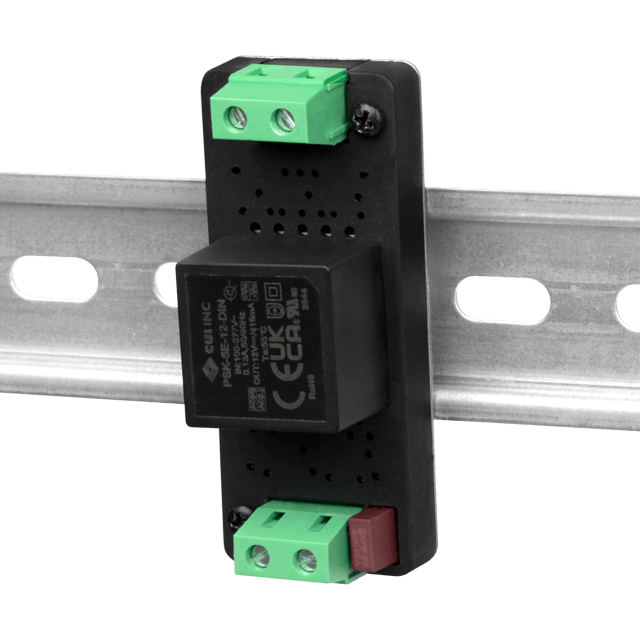
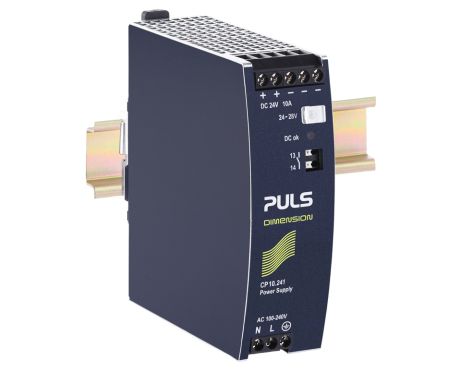
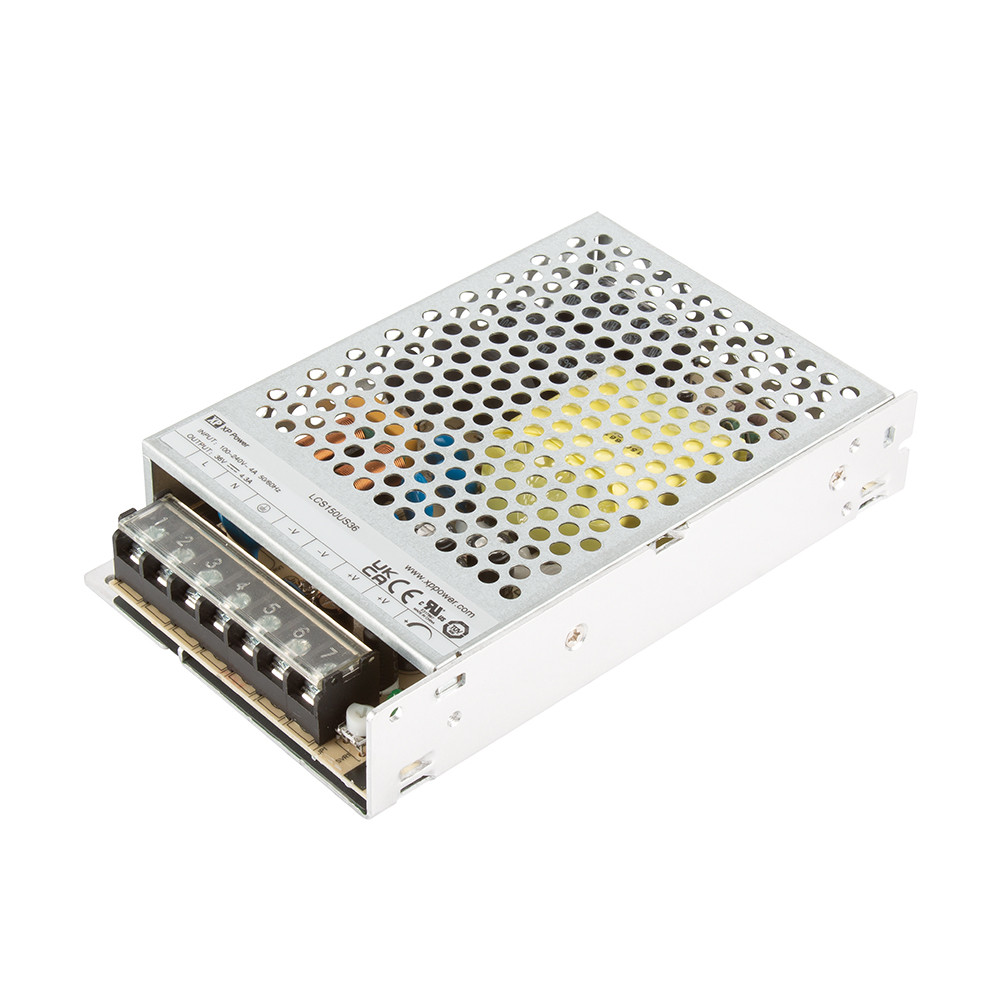
In industrial use, the most common form factor is the enclosed or DIN-rail mounted 24 VDC supply that powers PLCs, sensors, actuators, relays, and HMIs inside a control cabinet. Other common forms include open-frame and U-channel boards for OEM integration, enclosed brick supplies for machinery, rack-mount front-end supplies for telecom and data centers, and external adapters for desktop equipment. The same conversion physics underlies all of them; the differences are packaging, cooling, certification, and the protection and diagnostic features expected in each market.
The power range an SMPS must serve spans many orders of magnitude, and no single design covers all of it. Sub-watt bias supplies keep a controller alive, single-digit-watt adapters run consumer devices, the 60 to 480 W band dominates DIN-rail control cabinets, the kilowatt range powers servers and welding equipment, and front-end supplies above 3 kW feed data-center racks and high-power industrial converters. As power rises, the practical topology shifts from flyback to forward, then to half- and full-bridge and LLC resonant designs, and active power-factor correction goes from optional to mandatory. The engineering task in selection is to map a specific load, environment, and certification requirement onto the right point along this continuum rather than to find a universal part.
Chapter 2 / 06
Power Conversion Topologies
The single most consequential design choice in an SMPS is the converter topology, because it sets the achievable power level, efficiency, parts count, and isolation. Topology selection is driven primarily by output power and whether galvanic isolation between input and output is required. Before the isolated families, it helps to know the three non-isolated building blocks: the buck converter steps voltage down and is the workhorse of point-of-load regulation; the boost converter steps voltage up and is the basis of the active PFC front end; and the buck-boost converter can do either polarity. These appear inside DC/DC modules and as sub-stages of larger AC/DC supplies, but because they share the input and output ground they cannot provide the safety isolation a mains supply requires. The table below compares the mainstream isolated families by typical power band.
Topology
Typical Power Band
Isolation
Relative Complexity
Typical Use
Flyback
Up to ~150 W
Yes
Low
Auxiliary rails, adapters, low-power DIN-rail
Forward / two-switch forward
~100 to 500 W
Yes
Medium
Mid-power industrial, telecom
Push-pull
~300 W to 1 kW
Yes
Medium
Low-voltage input, DC/DC bricks
Half-bridge
~300 W to 1 kW
Yes
Medium-high
High-line AC input, PFC stages
Full-bridge
~500 W to several kW
Yes
High
Server, welding, high-power industrial
LLC resonant
~200 W to several kW
Yes
High
High-efficiency server, telecom, fast charging
Flyback is the simplest and cheapest isolated topology. When the switch turns on, energy is stored in the transformer (more precisely a coupled inductor) while the secondary diode is reverse biased; when the switch turns off, the stored energy transfers to the output. Because it needs only one switch and stores energy in the magnetics, it is ideal for low-power isolated rails and adapters, but transformer flux swing and peak currents limit it to roughly 100 to 150 W before efficiency and stress become impractical.
Forward converters transfer energy directly to the output during the switch on-time rather than storing it, which improves efficiency and power capability versus flyback. The two-switch forward variant clamps switch voltage to the input rail and is widely used in the 100 to 500 W band. Push-pull drives the transformer in both polarities with two switches, giving better core utilization and scaling to higher power, but it carries a shoot-through risk if both switches conduct at once, so dead-time control is critical.
Half-bridge and full-bridge topologies place the switches across the high-voltage bus so that switch voltage stress equals the input voltage, making them well suited to 230 VAC and PFC-fed inputs. The half-bridge typically covers a few hundred watts to about 1 kW, and the full-bridge scales from roughly 500 W to several kilowatts for server, welding, and heavy industrial supplies. LLC resonant converters add a resonant tank so the switches turn on at zero voltage, minimizing switching loss and enabling the highest efficiencies and power densities; the trade-off is design complexity, sensitivity to load range, and a resonant tank that must stay energized, which complicates light-load standby behavior.
Chapter 3 / 06
How an SMPS Works Stage by Stage
Understanding the signal path from the AC inlet to the regulated DC output makes spec sheets far easier to read, because most parameters map onto one specific stage. A typical universal-input AC/DC industrial supply processes power through six stages, each contributing its own losses, ripple, and failure modes. The sequence below traces a 24 VDC enclosed supply from inlet to terminal block.
1. EMI filtering. A line filter of common-mode chokes, X-capacitors, and Y-capacitors at the AC inlet blocks the high-frequency switching noise generated inside the supply from flowing back onto the mains, which is required to pass conducted-emission limits such as CISPR 32 / EN 55032. The same filter attenuates incoming line transients. A metal-oxide varistor and an input fuse provide surge and overcurrent protection at the inlet.
2. Rectification and bulk storage. A bridge rectifier converts the AC line into pulsating DC, and a large bulk electrolytic capacitor smooths it into a high-voltage DC bus, around 300 to 380 V from a 230 VAC line. This bulk capacitor sets the hold-up time, the interval the output survives after the AC drops out. The capacitor is also the most temperature-sensitive lifetime-limiting component in the whole supply.
3. Power factor correction. Above roughly 75 W, the lumpy current a simple rectifier-capacitor input draws would violate harmonic limits, so an active PFC boost stage shapes the input current to track the voltage sine wave, raising power factor toward unity and meeting IEC 61000-3-2. PFC also stabilizes the bus voltage across a wide input range, which is why high-line universal-input supplies almost always include it.
4. High-frequency switching and isolation. The chosen topology (Chapter 2) chops the DC bus into a high-frequency square wave that drives the primary of a compact ferrite transformer. The transformer provides galvanic isolation, a safety barrier rated for reinforced or double insulation between the hazardous mains side and the safe extra-low-voltage output, and scales the voltage by its turns ratio. Operating at 50 kHz to several hundred kHz is what allows this transformer to be small.
5. Output rectification and filtering. The transformer secondary is rectified, increasingly by synchronous MOSFETs rather than diodes to cut conduction loss, then filtered by output inductors and low-ESR capacitors into smooth DC. Residual switching artifacts appear as output ripple and noise, specified in millivolts peak-to-peak, a key parameter for sensitive analog and RF loads.
6. Control and protection loop. A feedback network, isolated across the barrier by an optocoupler or a digital isolator, compares the output against a reference and commands the PWM or frequency controller to hold regulation. The same control IC implements the protection functions: overvoltage, overcurrent and overload, short-circuit, and over-temperature limiting, with either auto-restart (hiccup) or latch-off recovery behavior.
Chapter 4 / 06
Efficiency and Safety Standards
Few component categories are as heavily regulated as power supplies, because they sit at the boundary between hazardous mains voltage and the rest of a machine, and because their aggregate energy consumption is a policy target. Two regulatory families matter for selection: mandatory and voluntary efficiency programs that govern what may be sold and marked, and product safety and EMC standards that govern construction, isolation, and emissions. The table below summarizes the standards most often cited on industrial SMPS datasheets.
Standard
Domain
What It Governs
IEC / UL / EN 62368-1
Safety
Hazard-based safety for IT, AV, and ICT equipment, now the primary supply safety standard
IEC 61204-3
EMC
Low-voltage DC power supplies: EMC requirements and test methods
IEC / EN 61000-3-2
Harmonics
Mains current harmonic limits for equipment up to 16 A per phase
CISPR 32 / EN 55032
Emissions
Conducted and radiated emission limits, Class A (industrial) and Class B (residential)
US DoE Level VI
Efficiency
Mandatory minimum efficiency and no-load limits for external power supplies (US)
EU CoC Tier 2
Efficiency
Voluntary stricter tier adding a 10 percent-load efficiency floor and lower no-load draw
Safety construction. The governing safety standard for most supplies has shifted from the legacy IEC 60950-1 (IT) and IEC 60065 (AV) to the hazard-based IEC 62368-1, whose second edition is accepted in the US, Canada, and the EU. It dictates creepage and clearance distances, the insulation system between primary and secondary, and the isolation barrier rating. Supplies are built as Class I (relying on a protective-earth connection) or Class II (relying on double or reinforced insulation with no earth), a distinction that affects installation and touch-current behavior. Medical and rail applications add IEC 60601-1 and EN 50155 respectively.
EMC and harmonics. A supply must not pollute the mains nor be disturbed by it. IEC 61000-3-2 caps the harmonic currents an SMPS injects into the line, from the 2nd up to the 40th harmonic, for equipment drawing up to 16 A per phase, which is the practical reason active PFC is mandatory above roughly 75 W. Emission limits under CISPR 32 / EN 55032 are split into Class A for industrial environments and the stricter Class B for residential, while the IEC 61000-4 series defines the immunity tests (ESD, surge, fast transient burst) the supply must survive. IEC 61204-3 consolidates the EMC requirements specifically for low-voltage DC power supplies.
Efficiency programs. For external power supplies (adapters), the US DoE Level VI mandate has been in force since February 2016 and sets minimum active-mode average efficiency and maximum no-load power by output-power class; any adapter sold in the US must comply. The EU Code of Conduct (CoC) Tier 2 is a voluntary but widely adopted stricter tier that adds a minimum efficiency requirement at 10 percent of rated load and trims no-load consumption a further 25 to 30 percent versus Level VI. Enclosed and DIN-rail industrial supplies are not external power supplies and fall outside the adapter rules, but the markings are still used in procurement as a shorthand for efficiency quality, and the EU Ecodesign framework imposes separate requirements on many equipment categories.
Chapter 5 / 06
Key Specification Parameters
An industrial power-supply datasheet can list 30 or more parameters, but only about ten drive a selection decision. The ones below are grouped as the parameters appear in the conversion chain: input, output, efficiency, protection, and environment. Reading them correctly prevents the two most common field failures, undersizing for ambient temperature and undersizing for fault-clearing current.
Parameter
Typical Industrial Value
Why It Matters
Input voltage range
85 to 264 VAC universal
Tolerance to weak or wide-range mains
Output voltage / current
24 VDC, 5 to 40 A
Matches load and adjustable trim window
Efficiency
~84 to 94%
Heat, cabinet load, running cost
Ripple and noise
50 to 150 mVp-p
Sensitivity of analog / RF loads
Hold-up time
16 to 20 ms at 230 VAC
Ride-through of brief mains dips
Operating temperature
-10 to +70 degC, derated
Cabinet thermal margin and derating
MTBF
300,000 to 700,000 h
Reliability and maintenance interval
Input voltage range defines mains tolerance. A universal 85 to 264 VAC range lets one model serve both 115 V and 230 V regions and ride out sags, while a narrow 230 V-only input is cheaper but inflexible. Confirm the frequency range (47 to 63 Hz typical) and, for 3-phase units, the wiring configuration. Output voltage and current must match the load, but check the adjustment (trim) window too, often plus or minus 10 to 20 percent, which is used to compensate cable voltage drop on long 24 V runs.
Efficiency is reported at full load and nominal input; a value of 84 percent on a 240 W unit means roughly 46 W of heat inside the cabinet, which the enclosure thermal budget must absorb. Higher-tier supplies reach 92 to 94 percent. Ripple and noise, specified in millivolts peak-to-peak over a defined bandwidth, matters for instrumentation, RF, and precision analog loads; logic and relay loads tolerate far more. Hold-up time is set by the bulk capacitor and scales with the square of input voltage, so it is roughly four times longer at 230 V than at 115 V.
Operating temperature and derating are the most misread specs. The rated power applies only up to a knee, commonly +50 to +60 degrees Celsius; above it the supply must be derated, typically 2.5 to 3.5 percent of rated power per degree Celsius, so a unit rated to +60 degrees may deliver only about 60 percent of nameplate at +70 degrees. Always size against the worst-case internal cabinet temperature, not the 25 degrees laboratory figure. Peak or bonus power is a related spec on better DIN-rail units: a short-term current boost (for example 1.5x for several seconds) used to start capacitive or motor loads and, critically, to deliver enough fault current to trip a downstream branch breaker.
Protection set. A complete industrial supply provides overvoltage protection (OVP), overcurrent and overload protection (OCP/OLP) implemented as constant-current limiting, fold-back, or hiccup mode, short-circuit protection (SCP), and over-temperature protection (OTP). The recovery mode matters: auto-restart (hiccup) is preferred for unattended equipment, whereas latch-off requires a manual or power-cycle reset. MTBF, usually quoted per MIL-HDBK-217F or Telcordia SR-332 at a stated temperature, is a comparative reliability figure, not a guaranteed lifetime; the true wear-out limit is almost always the bulk electrolytic capacitor, whose life halves roughly every 10 degrees Celsius of temperature rise.
Two further parameters round out a procurement comparison. Line and load regulation describe how tightly the output holds as input voltage and load current change; quality industrial units stay within roughly plus or minus 0.5 to 1 percent over the full input range and from no load to full load, which keeps a 24 V rail well inside the input window of downstream electronics. Adjustment and signaling features separate basic from premium lines: a trim potentiometer or digital interface to set output voltage, a DC-OK relay or open-collector signal that tells the controller power is healthy, and an analog or fieldbus diagnostic output for current and temperature. On critical machines these signals turn an opaque power event into a logged, actionable fault, so they belong on the spec checklist alongside the raw electrical numbers.
Chapter 6 / 06
Selection Decision Factors
To turn the preceding chapters into a specific model, work through the sequence below. Most selection errors are not a single wrong number but a decision made too early at the wrong level, for example fixing a wattage before accounting for ambient derating. These nine steps double as an RFQ template.
Output voltage, current, and total power: Sum the steady-state load, then add headroom. A common rule is to size for the continuous load at no more than 70 to 80 percent of the supply rating, leaving margin for aging and inrush.
Inrush and peak load: Capacitive loads, motor starts, and contactor coils draw transient peaks far above their steady current. Confirm the supply's peak or bonus-power rating covers them, and that it can supply enough fault current to trip the downstream protective device.
Ambient temperature and derating: Establish the worst-case temperature inside the enclosure, then read the derating curve at that temperature, not at 25 degrees. Sealed cabinets with no airflow need extra margin.
Input source: Single-phase versus three-phase, nominal voltage and tolerance, frequency, and whether the mains is weak or generator-fed. Choose universal input where supply chain simplicity matters.
Form factor and mounting: DIN-rail for control cabinets, enclosed brick for machinery, open-frame or U-channel for OEM boards, rack-mount for telecom. Verify width on the rail and clearance for convection cooling.
Protection and recovery behavior: Required OVP/OCP/SCP/OTP set, and auto-restart versus latch-off recovery. Unattended machines should auto-restart after a transient fault clears.
Redundancy and hold-up: For critical loads, plan parallel operation with a redundancy (ORing) module, or add a DC-UPS buffer where the bulk-capacitor hold-up of 16 to 20 ms is insufficient.
Compliance and certification: Confirm the safety mark (UL/IEC/EN 62368-1, CE, UKCA, CCC), EMC class (CISPR 32 / EN 55032 Class A or B), harmonic compliance (IEC 61000-3-2), and any sector standard (medical IEC 60601-1, rail EN 50155, marine, ATEX).
Total cost of ownership (TCO): Purchase price plus the cost of wasted energy over the duty cycle, cooling burden, warranty length (3 to 7 years differ widely by brand), and failure-downtime risk. A higher-efficiency, longer-warranty unit often wins over a multi-year run.
One frequently overlooked dimension is manufacturer serviceability and signaling: availability of DC-OK relay and analog diagnostic outputs, preventive-maintenance and digital-twin features on premium lines, local stock and warranty terms, and field replaceability of fuses and fans. These look irrelevant at the quotation stage but determine how a machine behaves through a power event and how fast it returns to service years later. Mean Well, Phoenix Contact, Siemens, Weidmuller, Puls, and TDK-Lambda all maintain broad industrial catalogs and regional support, which is why they recur in machine-build bills of materials.
FAQ
What is the difference between a switching power supply and a linear power supply?
A linear power supply uses a 50/60 Hz transformer and a series pass transistor that burns the voltage difference as heat, giving low noise but typically 40 to 60 percent efficiency and high weight. A switching power supply (SMPS) chops the input into a high-frequency square wave (commonly 50 kHz to several hundred kHz), transforms it through a small high-frequency transformer, then rectifies and regulates it. The result is 80 to 95 percent efficiency, a fraction of the size and weight, and a wide input range, at the cost of switching-frequency ripple and conducted EMI that must be filtered. Linear supplies still win for ultra-low-noise lab and audio references; SMPS dominates everywhere else.
Which SMPS topology should I choose for my power level?
Topology selection follows output power and isolation needs. Flyback is simplest and cheapest, used up to roughly 100 to 150 W for auxiliary and low-power isolated rails. Forward and two-switch forward serve roughly 100 to 500 W. Push-pull and half-bridge cover roughly 300 W to 1 kW. Full-bridge and LLC resonant scale above 500 W to several kW for server, telecom, and industrial supplies, with LLC adding zero-voltage switching for the highest efficiency. Above a few hundred watts, an active PFC front end is also required to meet IEC 61000-3-2 harmonic limits.
What does DoE Level VI mean and do I need it?
DoE Level VI is the US Department of Energy minimum efficiency mandate for external power supplies (adapters), in force since February 2016, setting minimum active-mode average efficiency and no-load power limits by output power class. Any external adapter sold in the US must meet it. The EU Code of Conduct (CoC) Tier 2 is a stricter voluntary tier that adds a minimum efficiency at 10 percent load and cuts no-load draw a further 25 to 30 percent. Enclosed industrial and DIN-rail supplies are not external power supplies, so they fall under different rules, but procurement teams still use the marking as an efficiency proxy.
How much output power derating do I need at high ambient temperature?
Switching supplies are rated for full output only up to a knee temperature, commonly +50 to +60 degrees Celsius for convection-cooled industrial units. Above that knee, output must be derated linearly, typically 2.5 to 3.5 percent of rated power per degree Celsius up to the maximum +70 degrees Celsius. A 240 W unit rated to +60 degrees may deliver only about 60 percent at +70 degrees. Always size the supply so the continuous load sits below the derated curve at the worst-case cabinet temperature, not the rated 25 degrees figure, and leave headroom for sealed enclosures with no airflow.
What is hold-up time and why does it matter?
Hold-up time is how long the DC output stays within regulation after AC input is lost, sustained by energy stored in the bulk input capacitor. Industrial DIN-rail supplies typically specify 16 to 20 ms at 230 VAC and roughly half that at 115 VAC, because hold-up scales with the square of input voltage. It matters because it lets the supply ride through short mains dips and brownouts, and gives a controller or PLC time to detect power loss and save state. If your process needs longer ride-through, add a DC-UPS buffer module or a redundant supply rather than relying on the bulk capacitor alone.
What protection features should an industrial power supply include?
At minimum: overvoltage protection (OVP) to clamp or shut down if the output exceeds a set window, overcurrent and overload protection (OCP/OLP) usually as constant-current or hiccup-mode limiting, short-circuit protection (SCP), and over-temperature protection (OTP) that folds back or shuts down before component damage. Recovery should be auto-restart (hiccup) for transient faults rather than latch-off where unattended operation matters. For 24 VDC control loads, also confirm the supply can deliver enough peak or bonus current to trip a downstream branch fuse or circuit breaker on a fault, otherwise a short can sit in current limit without clearing.
Which manufacturers and series are common for industrial DIN-rail supplies?
For DIN-rail 24 VDC industrial loads the mainstream choices are Mean Well (SDR, DRP, NDR, HDR, MDR series), Phoenix Contact (QUINT and STEP series), Siemens (SITOP PSU series), Weidmuller (PRO series), Puls (DIMENSION and PIANO series), and TDK-Lambda (DRB and DPP series). Higher-tier units such as Phoenix QUINT and Puls DIMENSION add bonus or boost power for fuse tripping, parallel and redundant operation, and preventive diagnostics. Mean Well dominates cost-sensitive OEM machine builds, while Phoenix Contact, Puls, and Siemens are common where redundancy, signaling, and long warranty matter.
Switching Power Supply Manufacturers
Source-backed product routes. Open a company dossier for procurement scope and cited evidence.