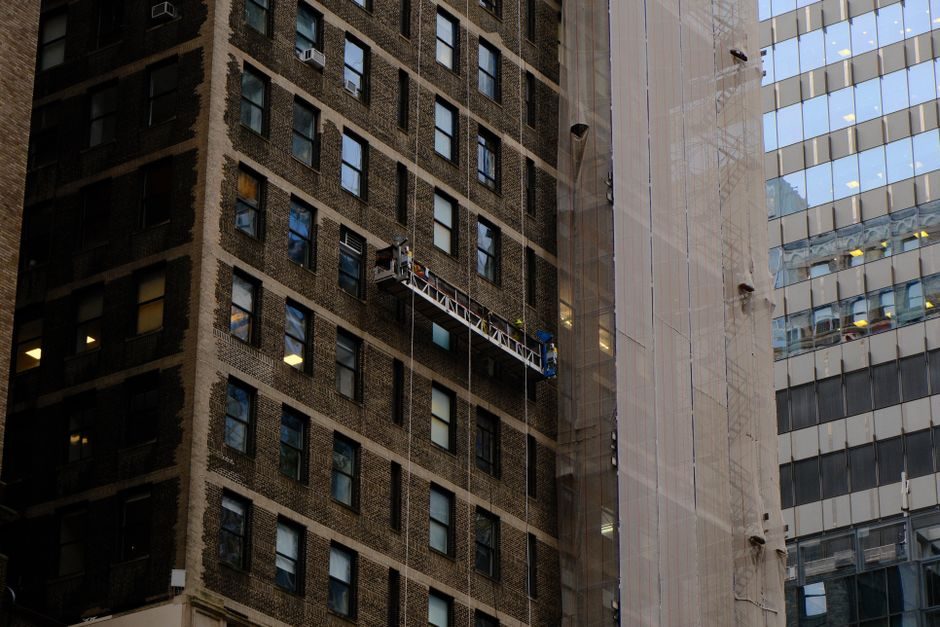
Specifying the wrong aerial work platform (AWP) costs more than a bad unit price — it costs re-rented machines, idle crews and site stand-downs. Across Chinese export listings observed on 2026-06-25, a self-propelled scissor lift entry sits at roughly USD 15,500 per piece at 1-piece MOQ, anchoring the value end of the 2026 catalog [S2].
AWP is a single umbrella covering scissor lifts, boom lifts, mast lifts, spider lifts and truck-mounted platforms — each a different tool for a different working envelope, terrain and crew size. The selection frame below uses five gates that buyers can run on any quotation, anchored against the Aerial Work Platform encyclopedia entry.
Gate 1 — Working Height and Platform Capacity vs Real Job
Working height on a Chinese export spec sheet is normally platform height plus 2 m of average reach — read the platform-height line, not the marketing number, before comparing machines [S1]. A 6 m mast lift platform, for example, is rated as an 8 m working height in most catalogs, which is a different envelope than an 8 m scissor where the deck sits flat. Buyers should write the actual platform height (m), platform capacity (kg) and deck size (m × m) on the RFQ, because the same nominal "10 m" class can mean 200 kg vs 450 kg of deck load.
Capacity drives chassis cost more than height does. Doubling deck capacity from ~230 kg to ~450 kg typically forces a wider scissor stack, a heavier chassis and a higher counterbalance, which is why entry scissor lifts cluster in the 230–320 kg band while mid-range scissor lifts sit at 450–680 kg [S2]. When the job is glazing, mechanical fit-out or two-person tool work, lock the capacity gate first; when it is inspection or single-trade overhead work, height and outreach dominate.
Gate 2 — Chassis Type: Scissor, Articulating Boom, Telescopic Boom, Mast, Spider
Chassis type sets the operating envelope before any other spec matters. Self-propelled scissor lifts give vertical lift only, with a level deck suited to slab work and flat slab-to-slab transitions; articulating booms add a knuckle joint for up-and-over access around obstacles; telescopic booms give the longest horizontal outreach in the AWP family; mast lifts are single-person vertical-only units for tight aisles; and truck-mounted platforms (aerial work truck) mount the boom on a road-going chassis for bridge, sign and street-light work. The detailed taxonomy and typical use cases are mapped in the suspended platform vs aerial work platform reference for readers comparing fixed-facade suspended access against mobile lifts. [S1]
For indoor slab work with frequent repositioning, a self-propelled electric scissor is the default; for outdoor steel or cladding, an articulating diesel boom is the default; for bridge underdeck or tunnel work, a truck-mounted platform is the default. Choosing the wrong chassis — most often buying a scissor where outreach is required, or a truck mount where the unit must enter a finished building — is the single most expensive AWP selection error.
Gate 3 — Power Source: Electric, Diesel, Hybrid, Lithium
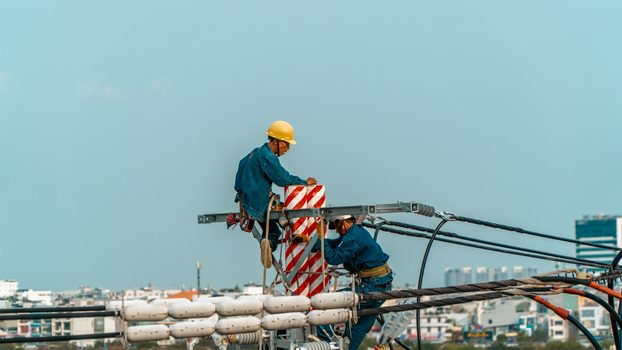
Power source is a hard site gate, not a preference. Electric DC scissor lifts run quietly enough for finished interiors and indoor slabs, with no local exhaust; diesel 4×4 booms are specified for rough terrain, outdoor sites and Grade 3+ uneven ground; lithium-ion battery packs are now common on mid-range electric scissor lifts for indoor fleets that need opportunity charging between shifts. The export catalog snapshot on 2026-06-23 lists diesel self-propelled crawler scissor lifts alongside mobile yard ramps and dock levelers, signalling that the rough-terrain diesel class is still a stocked export line for Chinese OEMs [S3].
Buyers running mixed indoor/outdoor fleets should split the spec: write "electric, lithium, indoor-rated, 8 m platform, 230 kg capacity" separately from "diesel 4×4, rough-terrain, 16 m platform, 350 kg capacity" so that quotes are comparable. A single combined RFQ typically returns a mix-and-match response with no like-for-like price.
Gate 4 — Terrain Rating, Gradeability and Stabiliser Footprint
Terrain rating decides whether the unit leaves the yard. Self-propelled scissor lifts are typically rated for slopes of 2–3° on level slab; rough-terrain 4×4 booms can climb 30–45% grades with differential locks engaged. Outrigger or stabiliser footprint matters for boom lifts: a narrower footprint costs less to ship and set up, but limits working envelope at full outreach. Buyers should write the maximum allowable ground slope (% or °) and the required working radius at full platform height on the RFQ — two numbers that eliminate half of the catalog without further discussion. [S2]
Wheel and tyre selection is part of the same gate. Non-marking solid tyres are specified for finished floors to avoid black scuff marks; foam-filled pneumatic or rough-terrain lug tyres are specified for gravel and mud. A spec line that omits the tyre type routinely returns the cheapest non-marking tyre on a unit destined for a quarry, which is a known re-spec failure.
Gate 5 — Duty Cycle, Transport Dimensions and Compliance
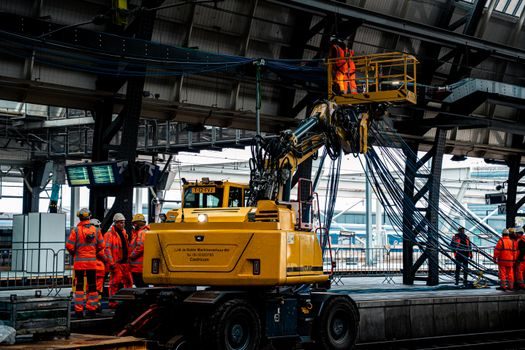
Duty cycle separates rental-grade machines from fleet-grade machines. Heavy-duty cycles (8+ hours/day, multi-shift) push buyers toward reinforced scissor arms, heavy-duty axles and higher-capacity hydraulic pumps; light-duty cycles (1–2 hours/day) accept the catalog standard. Transport dimensions — stowed length, width and height — decide whether the unit fits a standard truck or container; many 10 m electric scissor lifts fold below 2.3 m stowed height to clear low-bay loading, which is a different line item than a 14 m rough-terrain boom that may need a lowboy. [S3]
Compliance is a non-negotiable gate for European and North American sites. European buyers should confirm EN 280 series conformity (the harmonised standard for elevating work platforms) and, for petrochemical or refinery sites, ATEX rating on the power source; North American buyers should confirm ANSI A92.20 / CSA B354 series compliance. The OEM documentation pack, not the brochure, is the file to verify before shipment.
Comparison Frame: AWP Types vs Decision Criteria
The matrix below lines the main chassis types against four buyer-side criteria. The figures are qualitative ranges observed across the 2026 export catalog and the standard AWP product split described in [S1]; treat them as a sketch, not a measurement.
Self-propelled electric scissor lift: typical platform height 6–14 m, deck capacity 230–450 kg, terrain slab to light rough, best fit for indoor fit-out, warehousing and slab work. Articulating diesel boom lift: typical working height 12–26 m, outreach 6–14 m, deck capacity 200–250 kg, terrain rough / outdoor, best fit for steel, cladding and overhead pipework. Telescopic diesel boom lift: typical working height 18–38 m, outreach 10–20 m, deck capacity 200–250 kg, terrain rough, best fit for facade, sign and stadium work. Truck-mounted platform (aerial work truck): working height 14–32 m mounted on a 6×4 or 8×4 chassis, deck capacity 200–300 kg, terrain road-going between sites, best fit for bridge, tunnel and street-light maintenance.
Run this matrix against the working-at-height, outreach, terrain and transport criteria from Gates 1–5; a single chassis type will dominate once all four are scored. Where two types tie, the duty cycle and compliance gates normally break the tie.
Sourcing Levers, Price Anchors and Common Failure Modes

Price anchors on the 2026-06-23 Chinese export snapshot cluster at USD 15,500 per piece for a self-propelled scissor lift at 1-piece MOQ, with eight manufacturers in the Hubei Suizhou cluster competing on the same spec band [S2]. Diesel 4×4 boom lifts and lithium-ion electric scissor lifts sit higher in the catalog; truck-mounted platforms sit highest because the chassis is a separate build. For buyers comparing against mobile lifting equipment more broadly, the truck crane vs aerial work platform spec cut for 2026 lift buyers frame helps separate reach cranes (hook work, material lift) from AWPs (people lift, regulated access).
Common selection failures repeat across most failed AWPs: (1) buying on working height alone and missing deck capacity, (2) specifying an electric scissor for a graded outdoor site, (3) ignoring stowed dimensions and finding the unit will not clear the loading-bay door, and (4) accepting the catalog "diesel 4×4" line without checking tyre, axle and ground-clearance ratings. Each of these is detectable on the first RFQ pass if the five gates above are written into the spec line.
The next signal to track is the export price band for lithium-ion electric scissor lifts in the 8–12 m class, which is the most active cross-over segment between indoor and outdoor fleets in 2026; the Hubei Suizhou cluster at USD 15,500 per piece for diesel self-propelled units [S2] sets the floor, and any sustained drop below that line on equivalent spec is worth a second quotation.