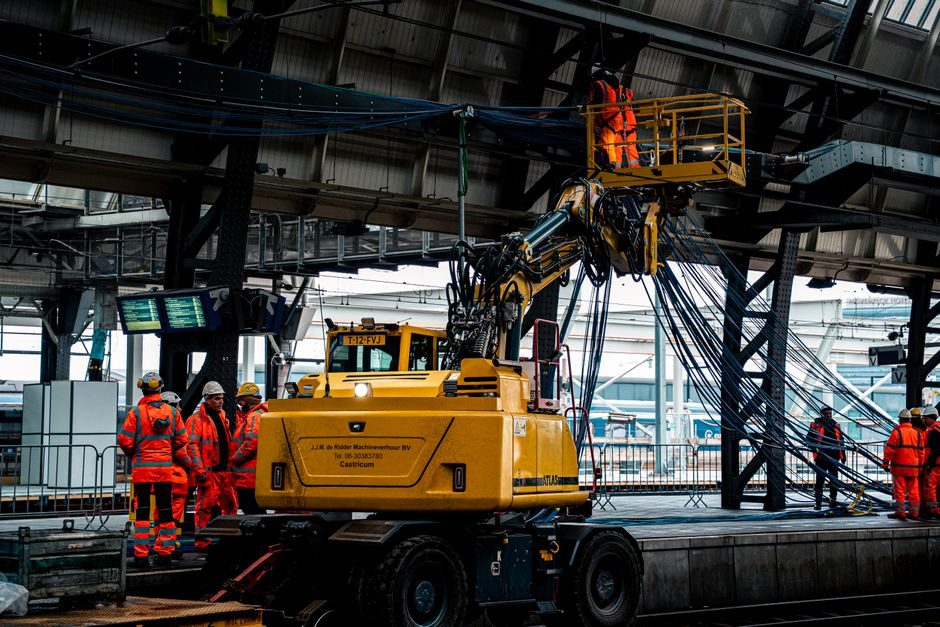
A truck crane (also called a truck-mounted crane) is engineered to lift and place suspended loads; an aerial work platform is engineered to raise personnel to a working height. The two machines share a chassis, an operator station, and a hydraulic system, but diverge completely on duty cycle, safety codes, and load-rating logic.
Chinese OEM catalogs published in 2026 list truck crane models at 25 t class (QY25D) [S2] and aerial work platforms on commercial chassis such as the EQ1101GLJ2 at 160 hp [S6]. Buyers in the same construction and rental fleet often evaluate both categories side by side, but the decision is driven by one question: is the payload cargo, or a human being?
What the two machines actually do
A truck-mounted crane uses a knuckle or telescopic boom to lift, swing, and lower cargo. The Foton truck-with-crane line covers a 1 t to 16 t lifting range across the model family [S4]. The 25 t class QY25D hydraulic truck crane is a separate, higher-capacity tier typical of road-going mobile crane sales listings [S2]. A truck crane is rated by maximum load moment (boom length × suspended weight) and is governed by crane-design safety standards covering load charts, outrigger pad pressure, and anti-two-block devices.
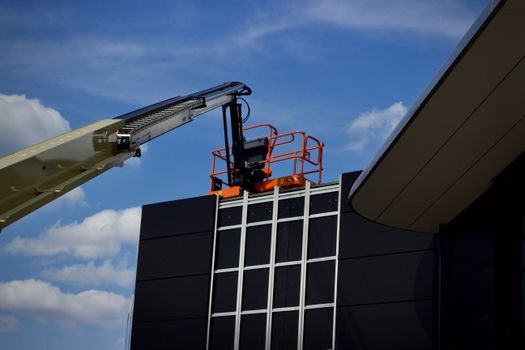
An aerial work platform, by contrast, is a people-carrying device. Truck-mounted aerial platforms (also called aerial work trucks) mount an articulating or telescopic insulating platform on a commercial chassis. Listings on Made-in-China.com in 2026 surface EN ISO 12100 (machinery safety) certified truck aerial platforms [S5], and product data sheets for the DFAC CLW5100JGKZ high-altitude operation truck show a 160 hp engine, EQ1101GLJ2 chassis, and YC-series diesel options [S6]. The platform rating is set by working height, outreach, and basket load (typically 200-300 kg), not by a cargo load chart.
Selection criteria: cargo in the air, or a person in the air
Buyers should run a four-criteria cut before opening a quotation. The same chassis (EQ1101GLJ2, 160 hp class) appears under both categories [S6], so the chassis is rarely the deciding line item.
1) Load class. A truck crane is the only legal option when the payload exceeds roughly 1 t and is not rated for human carry. Truck-mounted cranes at 1-16 t [S4] cover the majority of municipal, coal-mine, and landscaping work, while 25 t units like the QY25D [S2] cover heavier road-rescue and equipment-haul jobs. 2) Working height vs lift height. Aerial platforms are speced by working height (typically 14-45 m on truck-mounted booms) and horizontal outreach. Truck cranes are speced by hook height and radius. 3) Frequency. A truck crane tolerates frequent short lifts; an aerial platform is designed for sustained elevated occupancy, often with a duty cycle rated in platform-hours, not lift cycles. 4) Operator certification. Crane operation in most jurisdictions requires a separate license; aerial platform operation in EU/UK markets sits under EN ISO 12100 machinery-safety doctrine [S5] plus operator-training schemes (e.g. IPAF in Europe, OSHA 1926.453 in the US). The wrong license on the wrong machine is the single most common spec error at fleet intake.
Who a truck crane is for, and who it is not
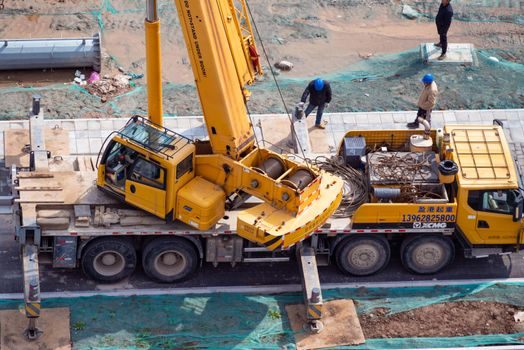
A truck crane is the right tool for municipal construction crews, coal-mine logistics, landscaping teams, and any operator moving non-detachable cargo or equipment [S4]. It is the wrong tool whenever a person must work at height for inspection, sign installation, tree surgery, or overhead-line maintenance — using a hook-and-sling "man-basket" on a crane is a code violation in most regulated markets and should never be specced as a cost shortcut.
An aerial work platform is the right tool for sign crews, utility maintenance, painting, façade work, and any task where the worker needs both hands free and a stable, guarded platform. It is the wrong tool for moving concrete blocks, planters, or steel — the basket is not a load-handling fixture, and the chassis is not designed for the dynamic loads of a swinging cargo.
Comparison: truck crane vs aerial work platform on decision criteria
The table-style cut below lines the two categories up against four buying criteria. Concrete values come from the OEM catalogs cited; qualitative entries reflect standard industry practice where the catalogs do not pin a number. [S1]
• Primary payload: cargo (1-16 t typical [S4]; 25 t class QY25D [S2]) for a truck crane; 1-3 personnel (basket 200-300 kg typical) for an aerial platform. • Governing standard family: crane-design load-chart and two-block standards for a truck crane; EN ISO 12100 machinery-safety regime for an aerial platform [S5]. • Chassis example: shared commercial chassis such as EQ1101GLJ2 at 160 hp appear in both categories [S6]. • Operator license: dedicated crane license for a truck crane; MEWP/aerial-platform training (EN ISO 12100-aligned [S5]) for an aerial platform. The right pick therefore follows directly from the payload question: cargo goes to the truck crane, crew goes to the aerial platform.
Use cases seen in 2026 OEM catalogs
Jining Baoliwei Construction Machinery lists truck cranes and aerial work platforms side by side in its 2026-06 product range [S4], reflecting how Chinese rental yards now offer both classes from a single supplier. Alibaba supplier listings group "crane aerial work platform" suppliers as a single sourcing category [S3], the same way a municipal buyer would group them in a single fleet. The Made-in-China.com 2026-06 truck-aerial-platform directory [S5] shows EN ISO 12100 certification surfaced at the listing level, which means the safety regime is now a public filter, not a private contract clause.
Real deployment patterns are stable: a 1-16 t truck crane handles landscaping, coal-mine parts, and municipal pipe-laying [S4]; a 25 t hydraulic truck crane handles road rescue, equipment recovery, and medium-sized structural lifts [S2]; an aerial work platform truck handles sign crews, street-light maintenance, and bridge inspection [S6]. When the same fleet needs both, buyers should separate the assets at the procurement stage — sharing a single chassis between cargo and crew duty cycles accelerates wear on the boom hydraulics and complicates the operator-license matrix.
Limitations and failure modes to spec against
Three failure modes recur at the spec stage. First, truck crane buyers who underspec the outrigger pad area end up with a machine that cannot deploy on soft ground; pad pressure figures belong on every RFQ, even when the catalog omits them. Second, aerial-platform buyers who spec working height without horizontal outreach end up with a machine that cannot reach over a parapet or canopy; outreach at full basket load must be on the data sheet. Third, buyers who treat the two machines as interchangeable forget that EN ISO 12100 [S5] certification on an aerial platform is not a substitute for the load-chart and anti-two-block regime that governs a truck crane. Mixing the two regimes is the most expensive spec error at commissioning.
Sourcing signals worth tracking
On the 2026 sourcing map, the active OEM cluster sits in Shandong (Jining) for both truck cranes and aerial platforms [S4], with Hubei (Wuhan) and Hunan strong on aerial-platform chassis integration [S6]. Fleet buyers running a mixed cargo-plus-crew lift profile in 2026 are quietly shifting to a one-supplier / two-asset model to consolidate spares and operator training; the catalog data above shows the supplier base is already structured for that move. A useful next check on any shortlisted truck crane is the EN 13000 crane-safety alignment, and on any shortlisted aerial platform, the EN ISO 12100 certification status as surfaced in the listing [S5].
For related reading on a closely related duty-cycle decision, see the forklift jib vs truck-mounted crane spec cut for 2026, and for a heavier assembly-bay crane comparison, the overhead bridge crane six selection gates piece. Buyers evaluating outdoor yard lifts can cross-check the six engineering gates for tower crane selection in 2026 before locking a chassis-platform combination.