Aerial work platform purchase cost in 2026 clusters into three price bands by working height: vertical mast and compact scissor units at 5-8 m working height sit in the $2,000-$5,000 entry range, mid-height scissor lifts at 9-14 m working height move into the $5,000-$20,000 band, and self-propelled boom lifts above 14 m typically exceed $30,000 per unit [S3].
The "price per meter of working height" shorthand used in procurement hides four independent cost drivers: machine class (mast, scissor, articulating boom, telescopic boom), power source (electric DC, AC, diesel), certification tier (CE, ANSI A92.20, OSHA-compliant), and total operating weight, which scales roughly linearly from 400 kg at 5.4 m to 8,000 kg at 17.95 m working height on comparable scissor platforms [S4].
Price Bands by Working Height Tier
Across publicly listed 2026 manufacturer data, vertical mast lifts covering 5-12 m platform height run $2,000-$5,000 for manual-move aluminum-alloy single-person units, with a 6.8 m working height / 227 kg capacity model weighing 980 kg and a 11.2 m / 200 kg unit weighing 2,950 kg [S4]. For comparison, mobile scissor lifts in the same 5-18 m platform height range with 230-320 kg capacity run $2,000-$5,000 for the entry segment and scale into the $10,000-$20,000 band as working height passes 12 m and the chassis mass crosses 2,500 kg [S3][S4].
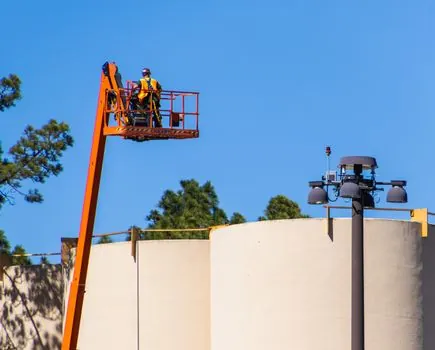
At the upper end, towable boom lifts with 10-22 m platform height and 360-degree rotation capability are priced $9,000-$20,000, sitting below self-propelled boom equivalents that exceed $30,000 once working height passes 20 m [S3]. Working-height bands published by rental operators group the same economics into three brackets: 6-8 m (compact indoor), 10-12 m (versatile general-purpose), and 20 m+ (large construction sites) [S2].
The Four Real Cost Drivers
Sticker price correlates with working height, but the slope is set by four mechanical and commercial variables. (1) Lift class: a vertical mast lift at 8 m working height delivers 160 kg capacity at 1,060 kg machine weight, while a scissor lift at the same 7.8 m working height delivers 230 kg at 1,500-2,150 kg, a 40-100% mass penalty for the larger deck [S4]. (2) Power source: diesel scissor units at 17.95 m working height carry 680 kg capacity at 8,000 kg machine weight, versus electric equivalents in the same working height class with identical capacity and identical weight, meaning power source does not change mass but does change emission-compliance cost on indoor sites [S4]. (3) Drive system: self-propelled boom lifts add roughly 50-100% to the price of an equivalent towable boom at the same working height, a premium that crosses the $30,000 threshold once working height passes 20 m [S3]. (4) Certification and delivery, which OEM pricing guides flag as separate line items rather than bundled into the headline per-meter rate [S4].
Cost per Meter: What the Math Actually Shows
Dividing list price by maximum working height produces a "dollars per meter" ratio that drops sharply with height, which is the opposite of what buyers sometimes expect. The entry vertical mast at 5 m working height for $2,000 works out to roughly $400 per meter of working height, while a 14 m scissor lift in the $15,000 band works out to roughly $1,070 per meter, and a 22 m towable boom at $20,000 works out to roughly $910 per meter [S3]. The mid-height scissor band therefore has the highest per-meter cost, driven by the capacity and chassis mass buyers demand in that segment, while the very short mast and the very tall boom both look cheaper per meter because the mast is a single-person unit and the boom uses a towable chassis to amortize cost.
Manufacturer-published working-height ranges for 2026 production models span 6-10 m, 9.1-12.1 m, 12.1-27.9 m, and "greater than 10 m" categories, with platform capacities of 136-159 kg on the most compact models and 227-453 kg machine weights on the same size class [S1]. Tracked scissor units, articulating booms, and truck-mounted platforms each carry their own working-height-to-mass scaling, with truck-mounted booms designed for multi-point outdoor work across wide areas rather than single-site vertical access [S5][S8].
What the $30,000 Threshold Buys
Self-propelled boom lifts pass the $30,000 mark once working height exceeds 24 m, where the combination of outrigger chassis, slewing mechanism, and operator controls cannot be replaced by a towable design [S3]. Below that line, towable boom lifts cover 10-22 m working height with 360-degree rotation and a large horizontal working span, suitable for wall painting, tree cutting, and lighting maintenance where the tractor can stay on the ground [S3][S8]. For pure vertical access, a 14.2 m working height scissor lift with 365 kg capacity and 5,580 kg machine weight sits in the mid-band, and a 17.95 m / 680 kg scissor crosses into the 8,000 kg machine weight class typical of higher-capacity units [S4].
Total Cost of Ownership, Not Just Sticker
Rental pricing, where published, is driven by three variables, all of which compound the per-meter math: desired working height, engine type (electric versus diesel), and project duration, with longer rentals pulling the daily rate down [S2]. For a deeper look at how platform controls affect operating cost, the ground-control versus platform-control override rules on AWPs, covered in ground-control override compliance, determine which certification tier a buyer needs before quoting. Drive-while-elevated speed limits, detailed in AWP drive-while-elevated speed limits, also feed into total operating cost by limiting how fast the unit can reposition at height on a given job site.
OSHA aerial lift safety guidelines require equipment to be selected and operated correctly to reduce fall and tip-over risks, and that selection rule is where most of the real per-meter cost lives, since a wrongly sized platform at 12 m working height either underuses its 230-320 kg capacity or pushes into a heavier class with a different price band [S5]. Buyers comparing a 6 m mast at $2,000 against a 12 m scissor at $10,000 should also weigh the 980 kg versus 2,950 kg machine weight delta, because delivery, floor loading, and trailer requirements scale with that number, not with working height alone [S4].
Selection Rules of Thumb
For indoor work at 6-8 m working height, the entry segment of aerial work platforms fits standard doorways and narrow corridors without dismantling, which is the decisive factor over raw price per meter [S2]. For 10-12 m working height, the mid-range scissor class is the volume sweet spot for HVAC, lighting, and cladding work because it balances footprint against reach [S2]. For working height above 20 m, aerial work truck mounted platforms or self-propelled booms replace static scissor lifts, and the per-meter cost ratio inverts again because the truck chassis absorbs the cost that would otherwise sit in the lift structure.
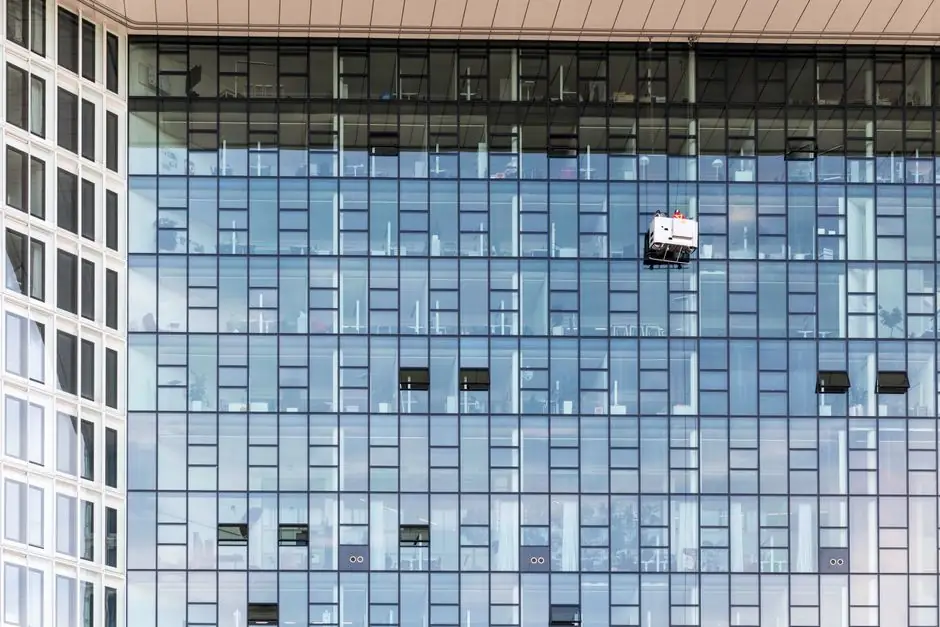
Where suspended platform designs become a cost-comparable alternative is on long-duration façade work, because the per-meter scaffolding rate competes with the daily rental rate of a 20 m boom once the project passes a few weeks. None of these trade-offs collapse into a single per-meter number, which is why OEM pricing guides publish cost drivers rather than per-meter rates [S4].
The next signal to track is the 2026 rental rate reset across European operators, which has been compressing daily rates for 6-8 m scissor units as fleet utilization normalizes, and the parallel certification update on ANSI A92.20 / CSA B354 that re-prices indoor electric units versus diesel. Both moves will tighten the gap between entry-level and mid-band pricing in 2027.