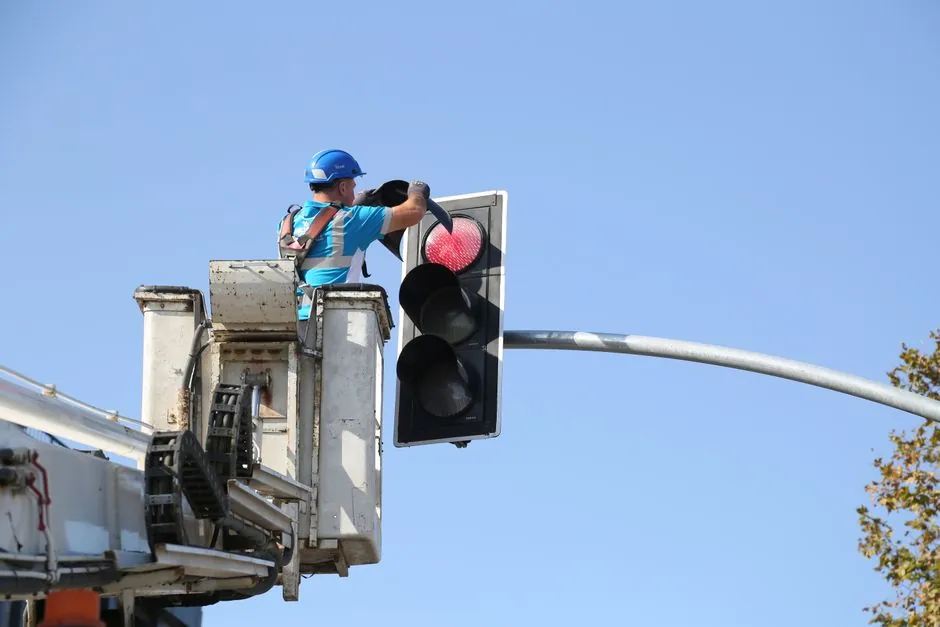
On a mobile elevating work platform (MEWP) or aerial work platform (AWP), the lower control panel is not a remote copy of the basket station, it is a separate, restricted-purpose station whose primary legal function is pre-use inspection and emergency descent [S2][S3]. The platform-level station remains the normal operating point for any work that involves a person in the basket.
The two stations are electrically interlocked through a mode selector that is commonly a keyed switch on articulating and telescopic booms, a design OSHA flagged in TIB 2002-04-11 after a worker was trapped at roughly 12 ft (about 3.7 m) when the key was removed and ground personnel could not switch the unit to lower control [S1]. The selector is the single point that decides which station has authority, and that single point is also the single point of failure during rescue.
How the Two Stations Are Wired, and Why That Matters
A typical dual-station MEWP routes boom, lift, drive, and steer functions through a mode selector that energises either the upper harness or the lower harness, never both at once. ANSI A92.20 design language (referenced in WSU FOSS Chapter 9 and WAC 296-869) requires both stations, requires the lower station to take priority for emergency retrieval, and requires operator manuals to be stored on the machine in a weatherproof compartment so the ground crew can read the exact override sequence for that model [S4].
The control responsiveness itself is the second hazard: Haulotte's field guidance notes that lower-box joystick mapping, hydraulic valve calibration, and dead-band behaviour are not identical to the platform station, so a ground operator moving a boom the same handle distance as the platform operator will see a different basket response, which is one of five failure modes Haulotte formally lists (crush, collision, communication loss, response mismatch, distance misjudgement against live electrical parts) [S3]. In practice, this means the lower station is a slower, less precise tool, fine for lowering at creep speed, risky for slewing or extending over an occupied basket.
Decision Matrix: Platform Control vs Ground Control Override
The two stations are not competing options, they are nested options with different authority. The table below lines them up against the four criteria that matter on a real site: who is authorised, what motion is allowed, what speed/precision is realistic, and which use cases are explicitly endorsed by manufacturer and OSHA guidance. [S5]
Platform control (upper station): authorised operator only, per WSU FOSS Chapter 9 and ANSI training requirements; all boom, lift, drive, and steer functions available; full proportional response matched to the operator's line of sight; use cases: normal work positioning, traverse, and any task with personnel in the basket [S4][S6]. Ground control override (lower station): authorised operator OR trained ground person following OEM manual; limited to pre-use inspection, emergency lowering, and stowing per Genie and Haulotte guidance; lower response fidelity, especially for fine boom movements; use cases: function check before shift, retrieval of an incapacitated or trapped platform occupant, parking [S2][S3][S7].
Three concrete rules fall out of that matrix. First, if anyone is in the basket, the lower station must not be used for normal positioning, only for emergency descent after the platform occupant is unable to operate. Second, the key, if the selector is keyed, must stay in the switch or be on the same person who has authority to switch modes, which is the direct remedy OSHA TIB 2002-04-11 published after the documented fatality [S1]. Third, before any ground-control movement on a snagged or trapped platform, all personnel must be removed from the basket or moved clear of the boom path, per WSU FOSS Chapter 9, because freeing a snagged platform from below can whip the basket unpredictably [S4].
Real Failure Modes and the Standards Behind Them
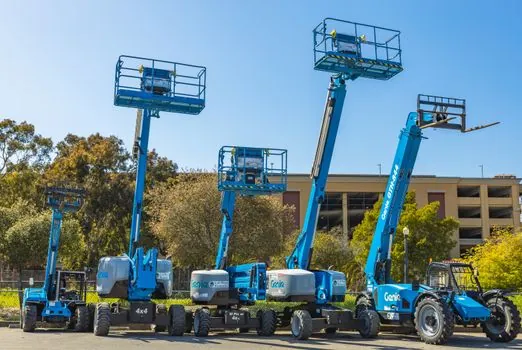
The Haulotte and IPAF risk catalogue names five ground-control failure modes worth memorising: crushing or trapping of platform occupants, collision with surroundings, communication loss over the hydraulic noise, control-response mismatch, and distance misjudgement near live electrical conductors [S3]. Each of these maps to a documented standard or guidance line. The "remove personnel before freeing a snagged platform" rule is the WSU FOSS Chapter 9 direct quote on the topic [S4].
Genie's MEWP glossary defines ground controls explicitly as a station used "in emergency situations, to override platform controls", which is the same hierarchy ANSI A92.20 builds around [S2]. Hard Hat Training's scissor-lift reference adds that the two-station split is common across vertical-rise and boom-supported AWPs alike, so the override question is not platform-specific, it is universal on dual-station equipment [S6]. Construction Equipment's operator-prep article reinforces the same sequencing: check both stations before shift, never slam a control lever, and treat the lower station as a function-test and rescue tool rather than a work tool [S7].
The earlier OSHA bulletin is the only one of the sources that names a specific accident geometry: boom at 20-25 ft (roughly 6-7.6 m), arc-flash injury, basket lowered only to about 12 ft (3.7 m) before the operator became incapacitated, ground crew locked out by the keyed mode selector with the key off the machine [S1]. That single incident is why a removable key on a mode selector is treated as a known hazard in US aerial-lift safety practice, and why the standard remediation is either a captive key, a non-keyed selector, or a documented policy that the key stays with the operator on shift.
When the Lower Box Is the Right Tool, and When It Is Not
Use ground control when: the basket is empty and the operator is running the pre-use function test from the chassis, the basket is occupied but the occupant is incapacitated and the ground person has read the OEM retrieval procedure for that exact model, or the unit is being stowed at end of shift [S2][S3][S7]. For the broader category of aerial work platform equipment, these three scenarios are the entire legitimate workload of the lower station across the surveyed guidance.
Do not use ground control when: the platform occupant is conscious and able to operate, the motion is fine positioning such as setting a platform height to within a few centimetres for a ceiling install, two people are trying to coordinate motion without a defined ground-assistant role, or the key for a keyed selector is not physically present at the machine [S1][S3][S4]. In all of those cases the correct answer is to keep authority at the platform station, which is also the station covered by the operator-level training that ANSI A92.24 and WSU FOSS Chapter 9 both require to be model-specific and documented [S4].
For dual-control boom units, an aerial work truck chassis with a bucket that shares the same lower/upper split follows the same rules: lower box is retrieval and inspection, upper box is work, and the selector is single-point-of-failure unless the key policy is enforced. On truck-mounted buckets that often means a non-keyed selector or a selector that defaults to ground on power-up, which removes the TIB 2002-04-11 failure mode by construction rather than by procedure [S1][S6].
What the Field References Agree On, and What They Leave to the Manual

Every source in the survey lands on the same hierarchy: platform control is the primary station, ground control is restricted to inspection, emergency retrieval, and stowing, and the mode selector plus its key (if any) is a life-safety component, not an anti-theft device [S1][S2][S3][S4][S7]. The differences between sources are about depth, not direction: OSHA TIB 2002-04-11 is a 3-page hazard bulletin with one named accident [S1], Genie's glossary is a one-paragraph definition [S2], Haulotte's community post is a 5-risk catalogue with an IPAF Toolbox Talk pointer [S3], and WSU FOSS Chapter 9 is a 30-line chapter on training, manuals, and ANSI conformance [S4].
What none of them replace is the OEM operator manual for the specific serial number on site, which is why WSU FOSS Chapter 9 makes the weatherproof manual compartment on the chassis a hard requirement rather than a recommendation [S4]. The override sequence, the lower-station hold-to-run behaviour, and the emergency-descent valve location all vary by model, and the only authoritative source for those details is the manual that ships with the machine. For a wider view of how MEWP drive behaviour is constrained in normal work, the related coverage of drive-while-elevated speed limits on aerial work platforms lines up with the same lower-precision theme: anything that is not normal work is governed by a slower envelope, and the lower station is no exception.
Two trackable signals to watch on this topic: any update to ANSI A92.20 or A92.24 that codifies the TIB 2002-04-11 key-presence requirement into the design standard itself, and any OEM move from keyed mode selectors to captive-key or keyless selectors on new boom production. Either would close the gap that the 2002 bulletin documented without changing the platform-versus-ground authority hierarchy that every surveyed source already agrees on [S1][S2][S3][S4].
Spec-level background on the components involved: earth ground tester.