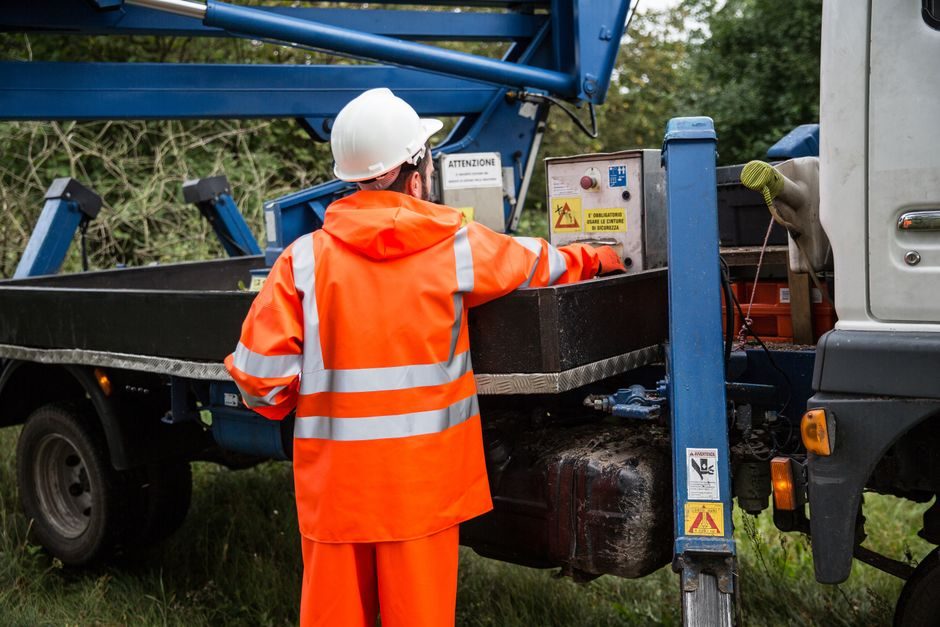
Aerial work trucks in 2026 split cleanly into three working-height bands: 12–18 m (200 kg basket, JQ5050/5060JGK series), 20–30 m (200–500 kg, HOWO 30 m / DF 145 / SC 25) and 32–36 m (Shandong Beijun telescopic electric boom lift), with new FOB prices clustering between US$ 1,200 and US$ 26,680 per unit as of June 2026 [S2][S3][S8].
Selection is driven by four spec gates — basket load, working height, boom kinematics and chassis GVW — and two compliance gates: CE marking on the assembled machine and EN ISO 12100 documentation at the supplier level [S6][S8]. Buyers who lock the height band first, then the chassis, then the boom geometry consistently report fewer field retrofits.
Working-height tier and platform capacity
The 12 m JQ5050JGK-12 carries a 200 kg (2-person) basket, and the 14/16/18 m variants JQ5050JGK-14, JQ5060JGK-16 and JQ5060JGK-18 hold the same 200 kg rating with proportional increases in outrigger span and stabiliser mass [S8]. At 20 m the capacity steps up: one Yixiang-styled 20 m hydraulic scissor platform is rated 500 kg for high-rise cleaning duty, reflecting the move from personnel-only to personnel-plus-tool loads [S2][S4].
At 25 m the Safi Group SC 25 tractor-mounted telescopic platform specifies 265 kg (584.2 lb) basket load at 25 m working height on a compact, dismantlable hydraulic truck chassis [S1]. At 30 m the HOWO hydraulic mobile aerial work platform allows customisation of colour and configuration while keeping the same personnel-lift envelope as lower tiers [S3]. The 32–36 m Shandong Beijun telescopic electric boom lift marks the top of the mainstream commercial band and is normally sold as a dedicated aerial work platform vehicle rather than a truck conversion [S2].
Boom kinematics: telescopic vs articulating vs scissor
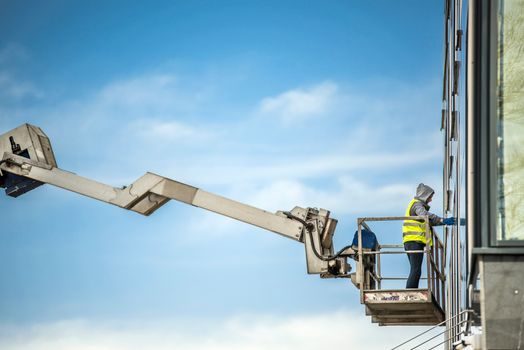
Telescopic booms (Safi SC 25, Beijun 32/36 m) give the best reach envelope per metre of stowed length and dominate the 25–36 m band [S1][S2]. Articulating booms trade straight-line reach for obstacle negotiation and are common in utility and forestry truck builds where the basket must reach over a parapet or under a bridge soffit — the XCMG/BOB-LIFT 4-ton crane-aerial platform combination sits in this niche and is priced US$ 8,999–26,680 per unit FOB [S5].
Scissor platforms (the 20 m / 500 kg high-rise cleaning model, the 4–16 m East International aluminium scissor) deliver a large, level work deck but require a flat, prepared footprint; they are the default for facade and overhead-cable work on paved sites and pair naturally with a truck chassis when the truck doubles as the transport leg between sites [S2][S9]. For internal warehouse or factory work, an aluminium scissor on a 4–16 m envelope at US$ 800–7,525 per unit is the cost floor [S9].
Chassis, engine and GVW class
Chassis choice is a hard gate. The Dongfeng DF 145 (CLW5100JGKZ) uses the EQ1101GLJ2 cab with EQB160-20 / YC4E140-20 / YC6J170-21 engines, 160 hp output, 9200×2470×3610 mm overall, 4,500/4,700 mm wheelbase and 2 t payload — a typical 12–18 m platform truck foundation [S7]. Stepping up to 30 m typically forces a heavier cab: HOWO 30 m hydraulic mobile units use a Sinotruk-class chassis with customisable upper-body configuration [S3].
Tractor-mounted platforms (Safi SC 25) are a different beast entirely: the platform is detachable, the prime mover is a standard agricultural tractor, and the operator does not need a commercial truck licence in most European jurisdictions [S1]. For fleets that already run tractor units, this configuration is the lowest-capex path to 25 m reach. For municipal or rental fleets, the truck-mounted (non-detachable) HOWO / Dongfeng pattern remains the default because it self-deploys without a secondary tractor [S3][S7].
Pricing benchmarks and MOQ reality
June 2026 FOB-China price ranges, all per-piece MOQ=1 unless noted: US$ 1,200–4,000 for a 20 m / 500 kg scissor cleaning platform; US$ 9,800–20,500 for a 25/32/36 m electric boom lift; US$ 13,000–18,000 for a HOWO 30 m hydraulic mobile aerial work platform; US$ 25,000 for a folding-arm support-leg mounting truck; US$ 8,999–26,680 for a 4-ton crane + aerial platform combination; and roughly US$ 800–7,525 for a 4–16 m aluminium scissor [S2][S3][S5][S6][S9].
For full-fleet buyers, supply ability is the second number to check: Yangzhou Yixiang publishes 100 sets/month of aerial work platform output, Dongfeng CLW publishes 20 sets/month on the DF 145 line, and Okorder-listed JQ-series suppliers publish 10 sets/month — these set realistic 12-week delivery windows for 50+ unit orders [S4][S7][S8]. Always pin a delivery term (the DF 145 line is published at 30 days ex-works with wax-coat packaging) into the PO, because aerial platforms ship in two crates and container loading mistakes are a common source of 4–6 week delays [S7].
Compliance, certification and after-sales evidence
Two certificates recur in 2026 listings: CE marking on the assembled vehicle (Beijun 32/36 m, HOWO 30 m, XCMG/BOB-LIFT crane platforms) and EN ISO 12100 at the component-supplier level (Shandong Enmax folding-arm mounting vehicles) [S2][S3][S5][S6]. Buyers in the EU should treat CE as a baseline, not a differentiator, and ask for the Declaration of Conformity referencing EN 280 for the aerial platform subsystem — listings marked "contact issuer for current status" mean the certificate image is not on the public product page and must be requested [S2][S6].
For 30+ m electric boom lifts, also confirm battery chemistry, IP rating of the basket controls and the outrigger interlock logic; the 32/36 m Beijun unit is sold as a complete electric vehicle, so chassis and platform warranties run as one contract, whereas a tractor-mounted SC 25 keeps the platform warranty separate from the tractor OEM [S1][S2]. Used-truck buyers should weight the Enmax US$ 25,000 folding-arm mounting platform as the entry point: it is CE-traceable, single-piece MOQ, and refurbishable within a 4-week lead time [S6].
Selection criteria in one table
Use four criteria to shortlist: working height band (12–18 / 20–25 / 30–36 m), basket capacity (200 / 265 / 500 kg), boom type (scissor / articulating / telescopic) and chassis (Dongfeng EQ1101GLJ / HOWO / tractor / self-propelled). A 12–18 m / 200 kg / scissor / Dongfeng matches building-maintenance and telecom crews; a 20–25 m / 265 kg / telescopic / tractor-mounted matches agricultural and forestry work where road-going mobility is secondary; a 30 m / 200–265 kg / telescopic / HOWO matches municipal and rental fleets that need highway speed and self-deployment; a 32–36 m / 200 kg / telescopic electric / dedicated chassis matches wind-turbine and large-facade specialists [S1][S2][S3][S7][S8].
The 20 m / 500 kg scissor / truck-mounted pattern is the outlier — capacity drives the chassis class, and buyers who need >300 kg at <20 m should expect the chassis to out-cost the platform itself; the cleaner specification is usually a 25 m telescopic at 265 kg, which is what the SC 25 line is engineered around [S1][S2]. For mining and heavy-haul buyers cross-shopping platforms with rigid-frame haulers, the selection logic in mining dump truck spec gates translates only loosely — the aerial work truck decision is dominated by height-and-reach, not payload-and-cycle-time.
Common failure modes and buyer pitfalls
Three pitfalls recur. First, the cheapest 20 m / 500 kg scissor units in the US$ 1,200–4,000 band are usually personnel-rated at 200 kg with the 500 kg figure applying to the deck with distributed load only; buyers who load 500 kg of glass or steel into the basket discover this on first lift [S2][S9]. Second, "30 m HOWO" listings vary widely in stabiliser geometry — outrigger spread must be on the data sheet, not implied by working height, and the JQ5060JGK-18 data shows the stabiliser mass and span scaling directly with height [S3][S8].
Third, tractor-mounted platforms (SC 25 class) require a tractor with the right PTO and hydraulic flow; the platform is dismantlable but not tractor-agnostic, and a 25 m unit on a 80 hp tractor will not meet the published cycle time [S1]. Buyers comparing used units should also note that an aerial work platform is treated as a special-purpose vehicle in most jurisdictions, so registration paperwork, not just machine condition, decides whether a US$ 25,000 used unit is a US$ 25,000 saving or a six-month compliance project [S6].
Two trackable signals for the next quarter: (1) the Beijun 32/36 m electric boom lift price band (currently US$ 9,800–20,500) tightening as more Chinese suppliers enter the segment, and (2) more CE certificates being published inline on Made-in-China listings rather than behind "contact issuer" gating, which is the leading indicator that a supplier has batch-tested rather than one-off certified [S2][S6]. Track both before placing a 50+ unit fleet order.
For component-level specifications, see aerial work truck, aerial work platform, and linear guide.