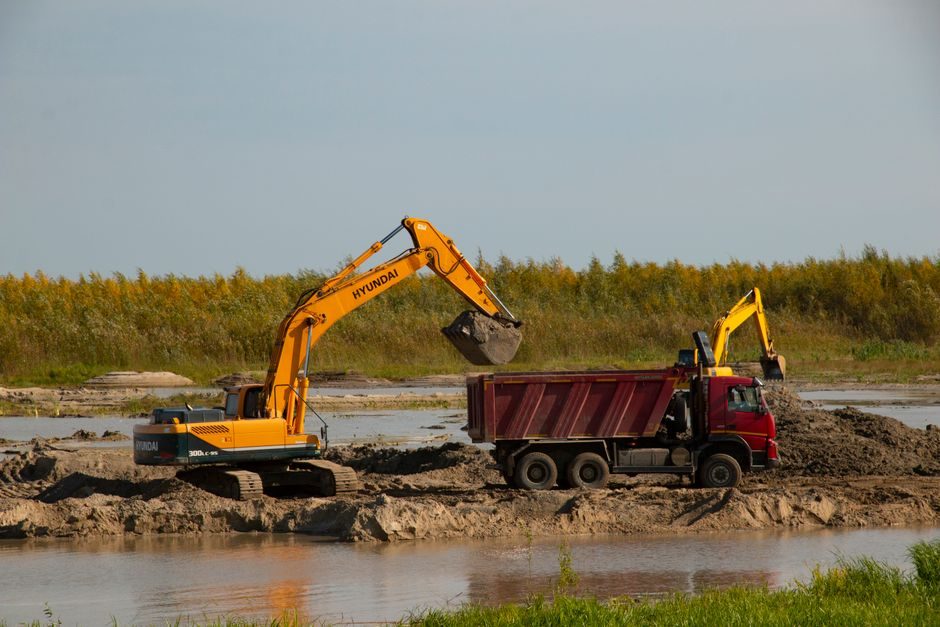
Mining dump truck selection in 2026 is a payload-and-grade calculation first, a price negotiation second: a 50-tonne-class rigid frame unit such as the HOWO 50T posts a 22,090 kg curb weight, 50,000 kg maximum permissible total mass, 8,700 mm overall length and 75 km/h maximum driving speed with 43% maximum gradability on the Okorder published spec sheet [S3]. Mismatched payload class versus site conditions is the dominant reason fleets cycle trucks inside five years instead of ten.
The market in mid-2026 is split between Chinese OEM 30-100 t mechanical and light-electrical rigid haulers built for coal, iron-ore and quarry sites, and the ultra-class 200-400 t mechanical-drive / electric-drive machines from Western majors that operate on the world's largest open pits. Procurement teams that buy on sticker price alone routinely over-spec on engine power or under-spec on frame and bed hardness, then burn through dump-truck structural warranty. The seven gates below — payload, GVW and axle load, powertrain, frame and bed, tires, braking and site geometry — lock the spec before the supplier is invited to quote. Reference definitions for the truck class are catalogued on the mining dump truck encyclopedia page, and a wider haul truck taxonomy sits on the dump truck page.
Gate 1 — Payload Class and Site Haul Profile
Payload class is the first gate, not the last. The 50-tonne HOWO-class rigid is positioned for open-pit coal and mid-scale iron-ore haul roads with one-way distances under 5 km and ramp grades below 10%, while 30-tonne units target quarry face-to-crusher loops and 90-100 tonne rigid frames target overburden stripping on iron-ore and copper operations [S3][S2]. A fleet sizing rule used by Chinese OEM buyers is to match truck payload to the largest single-bucket shovel pass: a 4 m³ shovel or 100 t excavator is generally paired with a 45-50 t rigid, and a 6-8 m³ hydraulic shovel with a 70-90 t rigid [S2].
Two payload numbers on a spec sheet need verification before sign-off: rated payload (the figure the OEM warranty is built around) and maximum permissible total mass (the legal/road limit). On the HOWO 50T, curb weight is 22,090 kg and maximum permissible total mass is 50,000 kg, leaving roughly 27.9 t of legal payload once fuel, operator, options and 5% overload tolerance are netted [S3]. Buyers that ignore this mass budget typically run trucks at 110-115% of nominal payload to hit production targets, which accelerates frame fatigue cracking and bed cracking on the second overhaul cycle.
Gate 2 — Powertrain: Diesel, Mechanical-Electric and Site Voltage
Engine model and rated power need to match both altitude and ambient temperature of the pit. Chinese OEM 50 t mining dump trucks are typically offered with WD615 series diesel engines in the 336-420 hp bracket, paired with 7-9 speed manual or fully automatic transmissions, a 5-tonne front and 10-tonne rear axle rating split, and a 6x4 drive configuration [S3][S4].
For sites above 200 km/h one-way haul or with trolley-assist infrastructure, mechanical-electric drive (AC drive alternator + wheel motors) raises the efficiency curve but adds roughly 12-18% to capital cost and requires a defined site voltage (typically 3 kV DC or 6 kV DC for trolley assist, and 690 V AC on-board for the wheel motors). Procurement teams that do not lock the on-site voltage, the sub-station location and the truck pantograph spec at the gate stage end up with stranded capital. The mechanical-spec Chinese 30-50 t class remains the dominant choice for new Chinese coal and quarry buyers in 2026 because it interfaces with no fixed infrastructure [S2].
Gate 3 — Frame, Bed and Body Hardness
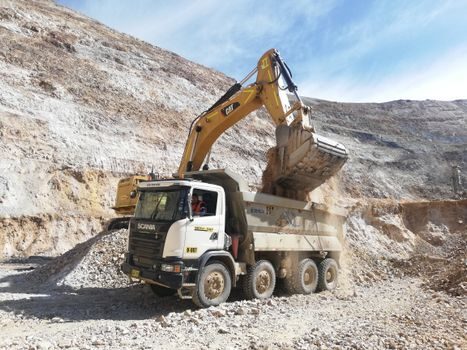
Frame is the second-most-expensive component after the engine and is the one a hard-rock fleet cannot retrofit in the field. Standard practice for 50-100 t Chinese-built mining dump trucks is a ladder-type main frame with 8 mm + 8 mm double-channel longitudinal rails, cross-member spacing of 700-900 mm, and a one-piece hot-formed bed plate at HB 400 / Q345 / NM450 grade, lined with 16-20 mm Hardox 450 or NM450 wear plate on the floor and 12-14 mm on the sides [S2][S4]. The bed volume, the tailgate height and the dump cylinder stroke need to be checked against the densest material the truck will haul — wet iron ore at 2.4 t/m³ versus coal at 0.85 t/m³ versus limestone at 1.6 t/m³ will fill the same bed at radically different gross weights.
Buyers should also require a documented body lift cycle count: 80,000-120,000 cycles is typical for a 16 mm Hardox 450 floor in iron-ore service, and dropping to 12-14 mm Hardox 400 will halve that. Heated beds, ejector bottoms and rock-box bodies are common in cold-climate and high-impact service but are not interchangeable — the ejector body adds 1.2-1.8 t and reduces effective payload. For a deeper comparison of body volume versus drum-style mixing bodies, the concrete mixer truck page is a useful reference, since both truck classes share frame-ladder and high-cycle lifting duty.
Gate 4 — Tires, Rims and Load-Speed Index
Tires are the single largest variable cost on a rigid mining truck over a 5-year ownership cycle, and a tire that is one load-index step too small for the rated GVW will fail the first re-groove. A 50 t class rigid typically runs 14.00R25 tubeless radial or 16.00R25 tubeless radial with a load index of 169-173 and a load-speed rating suited to the site cycle: short-haul high-impact runs need a higher load index and deeper tread; long-distance 35-50 km hauls need a heat-resistant compound and lower rolling resistance [S2].
Tire pressure monitoring, central inflation and run-flat capability should be specified for any site where a single flat in the pit can stop a 12-truck production line. Rim width and PCD (pitch circle diameter) must match the hub spec — Chinese OEM 50 t class commonly uses 10.00W-25 or 11.25-25 rims with 10-Stud hub patterns, and swapping to a non-OEM rim to fit a different tire brand is a documented source of hub cracking. Allocation per truck per year is roughly 1.5-2.5 tires on heavy-impact sites and 1.0-1.5 on standard iron-ore hauls [S2].
Gate 5 — Braking, Retarder and Ramp Holding
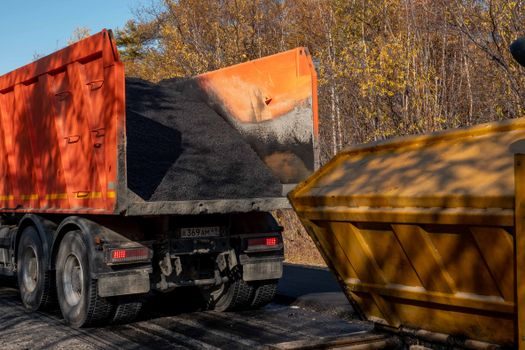
On a 43% maximum gradability machine like the HOWO 50T, the service brake, the engine retarder / exhaust brake and the spring-applied parking brake are all required to hold the rated GVW on the specified grade without thermal fade [S3]. Procurement should require a documented retarder absorption in kW and a continuous-grade test certificate: 1 km of 10% down-grade at 50 km/h at full GVW is the typical benchmark, with brake drum or disc temperatures held under 400 °C at the end of the run.
ABS/EBS, hill-start assist and a transmission-integrated hydraulic retarder are now standard on the higher-tier Chinese 50-90 t builds. For sites with sustained 8-12% down-grade loading, oil-cooled disc brakes instead of drum brakes are the safer call: oil-cooled discs have a roughly 3x higher continuous heat-rejection rate and recover faster after an emergency stop. A documented parking brake holding capacity of at least 20% grade at GVW is the minimum; any spec sheet that does not list a parking brake grade figure is incomplete.
Gate 6 — Dimensions, Turning and Pit Geometry
Published dimensions need to be checked against the pit's tightest loading and tipping geometry, not against the open road. The HOWO 50T specification lists 8,700 mm overall length, 3,000 mm width, 3,205 mm height, 3,800+1,400 mm wheelbase, 335 mm minimum ground clearance and 17 m minimum turning diameter [S3]. A 17 m turning diameter requires a haul road width of at least 22-25 m for two-way truck traffic, plus bench-cut radius of 30-35 m at loading points.
Buyers working narrow vein pits or with constrained crusher feed geometry should look at the wheelbase and the rear-axle swing clearance, not just the turning diameter: a shorter 3,600+1,400 mm wheelbase variant drops the turning diameter by 1.5-2.0 m and improves loading-spot manoeuvring at the cost of a slightly rougher empty ride [S3]. High-altitude cold-climate sites should also verify cold-start capability, battery CCA and defrost / cab-pressurisation spec at the gate stage rather than discovering limits in January.
Gate 7 — Certification, Service Network and Spare-Parts Lead Time
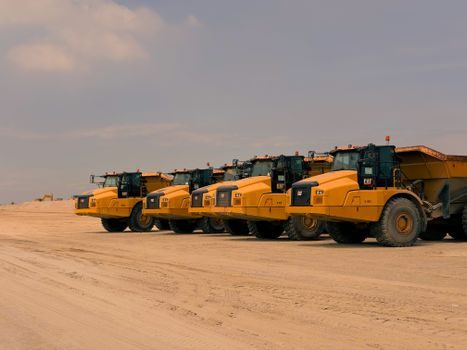
For export and for many state-owned Chinese mining operators, the spec sheet must show a documented ISO 9001 manufacturing certificate, an ISO 14001 environmental certificate, and where applicable a mining-type approval from the destination regulator. A growing number of buyers also ask for a GB / ECE cab-strength rating equivalent to ROPS / FOPS, and a published engine emission tier — China VI and Euro VI are the typical 2026 baselines for new orders, with Tier 4 Final / Stage V only required for North American and European sites [S2][S4].
Service network and spare-parts lead time dominate the lifetime cost calculation: a 50 t mining truck in remote Chinese coal service averages 1,500-2,000 engine hours per year and 6,000-8,000 hours between major overhauls, so a 14-21 day spare-parts lead time at site is the upper acceptable limit. Confirm a local bonded-warehouse for fast-moving wear parts (filters, brake pads, bed liners, electrical sensors) and a published mean-time-to-recover for OEM service engineers. Without this gate, even a correctly specified truck will sit dead on a 5% loss-of-availability cost, which is roughly the operating-margin value of one truck per year.
Selection Matrix: 30 t vs 50 t vs 90 t Rigid Class
Three options compared on four decision criteria for 2026 procurement: the 30 t quarry-class rigid, the 50 t mid-scale rigid (HOWO 50T family) and the 90-100 t heavy rigid. On payload and bed volume, the 30 t typically offers 18-20 m³ bed volume, the 50 t 24-30 m³, and the 90 t 40-50 m³ — payload and bed scale roughly linearly with GVW [S2][S3]. On site fit, the 30 t suits tight quarry loops under 3 km with 0-8% grade, the 50 t covers 3-8 km open-pit coal and iron-ore with up to 10% grade, and the 90 t targets long-haul 8-15 km routes with 6-8% sustained grade.
On capital cost per tonne of payload, the 30 t class lands highest per-tonne because the engine and frame content does not scale linearly with payload, the 50 t class sits in the median cost band, and the 90 t class drops the lowest per-tonne — a 2.4-3.0x spread between 30 t and 90 t per-tonne is normal. On service footprint, the 30 t uses standard 12.00R24 tires and a generic heavy-truck service network, the 50 t uses 14.00-16.00R25 tires and needs a mining-truck specialist, and the 90 t typically requires an OEM or mining-truck-dealer service contract with guaranteed response time [S2][S3][S4].
For a spec-driven buyer in mid-2026, the rule is: if your one-way haul is under 3 km and your site footprint is tight, the 30 t class is the rational call. Between 3-8 km and 0-10% grade, the 50 t class is the sweet spot and is what most Chinese OEM build slots serve. Above 8 km or above 8% sustained grade, the 90-100 t class — or step-up to the 200 t mechanical-electric class — is the only way to keep cost-per-tonne-hauled competitive.
For buyers working in adjacent haul-and-place equipment categories, the reach truck and aerial work truck reference pages cover the warehouse and elevated-access cousins of the rigid hauler. For spec-engineering and selection context that mirrors these seven gates, the soft starter selection criteria: six gates that decide 2026 specs article uses the same gate-by-gate format for power-control hardware, and the concrete batching plant selection: six spec gates that decide the 2026 build piece applies an analogous spec method to aggregate-feed equipment that shares many of these fleet-utilisation logic. The two most trackable signals through 2026-Q3 are: (1) Chinese OEM publication of 70-90 t class rigid frames with Stage V / China VI engine options, which would shift the cost-per-tonne band, and (2) any published update to the 50 t HOWO family dimension and weight table, since 3,000 mm width and 335 mm ground clearance are the boundary figures for tight-pit buyers.