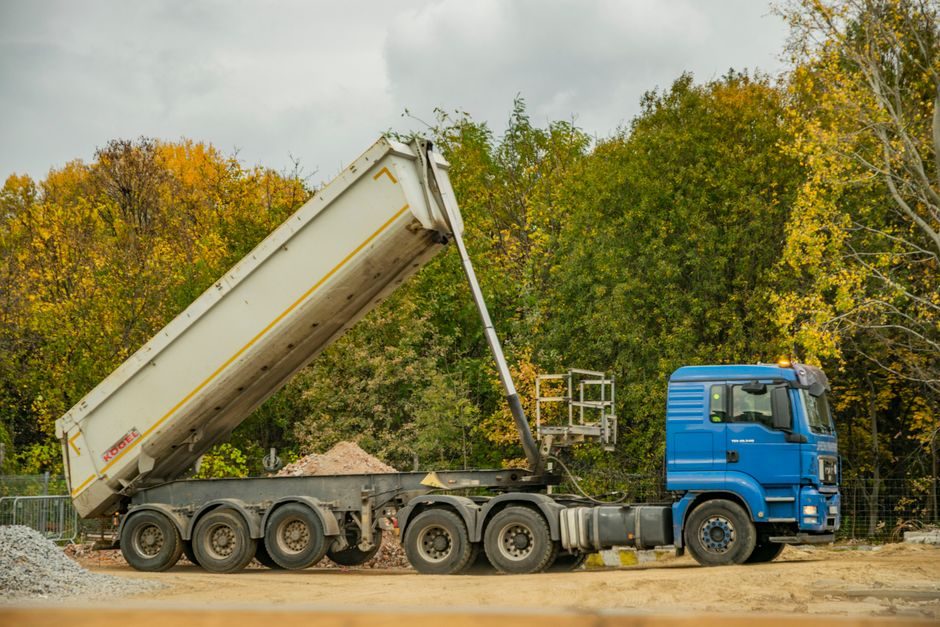
An aerial work truck is a road-legal chassis (typically Class 6–8) fitted with an insulated or non-insulated boom, a personnel bucket rated to 136 kg, and outriggers — its primary duty cycle is elevated work, not bulk haulage [S2][S4]. A mining dump truck is a non-road mobile machine, often rigid-frame with payload ratings of 30–400 tonnes, electric-drive or mechanical dump bodies, and tires in the 24.00R35 to 40.00R57 size range [S1][S5].
Specifying the wrong category is a procurement fail with downstream safety consequences: an aerial chassis is designed for low centre-of-gravity side loading, a mining truck for cyclic vertical load on a short wheelbase. The 2026 buying market shows clear segregation — DirectIndustry lists 68 mining/quarrying dump-truck SKUs across 20 OEMs [S1], while utility-aerial inventory is dominated by shorter-cycle rental fleets (Versalift-type units) sold to power-line and sign contractors [S2].
Definition and Scope Split
A mining dump truck is defined under the off-highway dump-truck class and operates exclusively on private mine haul roads; published 2026 SKUs include the ASTRA FT8060 rigid hauler with 60,000 kg payload and 313.19 kW motor power, plus Chinese 8×4 emulsion-explosive and ANFO variants from MEMU and Hubei Runli [S1][S5]. The class excludes on-road tippers such as the ISUZU KV100 dump truck listed on the same commercial pages — those are municipal/construction units with single-axle or tandem-axle payloads typically below 30 tonnes [S4].
An aerial work truck (also called bucket truck, cherry picker, or elevating work platform vehicle) is built on a commercial chassis — ISUZU KV100, GIGA, FTR, and FVR variants are common — and carries a hydraulic articulating or telescopic boom with bucket platform [S4]. The unit must meet both road-traffic rules and the elevated-work-platform standard referenced in 2026 product literature; the 2026 market treats it as a utility vehicle, not a material hauler [S2][S4].
Selection Criteria Compared Against Decision Axes
Four axes separate the categories cleanly. (1) Payload vs reach: a 60-tonne rigid mining hauler carries 60,000 kg in a single load [S1]; an aerial bucket truck carries 136–272 kg of personnel plus tools at heights of 10–30 m [S2]. (2) Operating surface: mining trucks run on engineered haul roads with grades up to 8–12%; aerial trucks run on public highways, then deploy on level pads with outrigger load charts. (3) Duty cycle: mining trucks average 20–30 load cycles per shift; aerial trucks average 1–3 deployments per shift on power-line or sign work. (4) Standards regime: mining haulers reference open-pit MSHA-style rules and OEM structural standards; aerial trucks reference platform standards plus chassis FMVSS/CMVSS for road travel.
Buyers who treat the two as substitutable get burned. The 2026 ISUZU product line on Hubei Runli's catalog explicitly lists aerial working truck and dump truck on the same page, but the two are separate SKUs on separate chassis — never co-specified [S4]. For a deeper dump-truck payload/frame/tire cut, the Mining Dump Truck 2026 Buying Guide lays out the same axes in procurement language.
Who Each Truck Is For — And Who It Is Not For
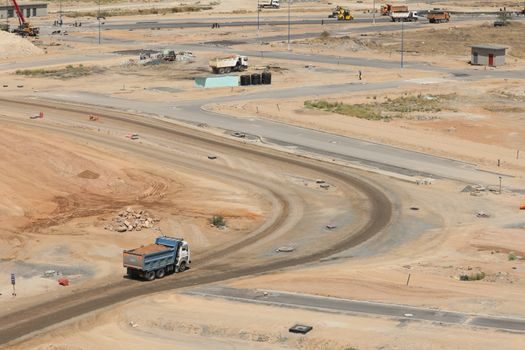
A mining dump truck is the right answer for: open-pit copper, iron, coal, or oil-sand operations running 24/7 haul cycles; quarry-to-crusher bulk movement; and large civil earthworks where 30–100 tonne payloads per cycle beat smaller articulated dump trucks (ADTs) on a cost-per-tonne basis. The 2026 DirectIndustry catalogue shows five Caterpillar Global Mining units plus two ASTRA models targeted squarely at this segment [S1]. It is the wrong answer for: municipal road construction, where road-legal tippers and ADTs dominate; tight urban sites, where the turning radius and tire width rule out 40.00R57 rubber; and any buyer who needs to drive the truck on public roads between jobs.
An aerial work truck is the right answer for: utility-line installation and maintenance (the Versalift-style fleet that Power Line Rent-E-Quip runs out of Roanoke and Richmond) [S2]; sign and lighting installation; tree-care work; and any elevated-tasked job where a scaffold would block traffic. It is the wrong answer for: moving bulk material (the chassis is not payload-rated for it); reaching above the boom's rated height — extension beyond chart voids the structural certification; and off-road deployment on unmapped terrain where outrigger pad loading cannot be verified.
Real Use Cases and 2026 Procurement Signals
Three signals from the 2026 market make the split concrete. Signal one: Chinese OEM Shenzhen Optimus Truck lists dump truck, mining dump truck, and excavator as its main product line — a pure haulage-and-dig offering with no aerial work platforms in the catalogue [S6]. Signal two: Hubei Runli's commercial page mixes ISUZU water truck, fuel tank truck, garbage truck, fire truck, and aerial working truck as parallel SKUs, all built on light/medium ISUZU commercial chassis [S4] — confirming aerial work trucks are sourced from the commercial-vehicle supply chain, not the mining-equipment chain. Signal three: DirectIndustry's 20-OEM, 68-SKU mining dump-truck index includes units from AMOG, Bell Equipment, Caterpillar, CLW Group, DAEWOO, and Deere-Hitachi, but zero aerial-bucket OEMs [S1] — the two markets simply do not overlap at the manufacturer level.
For Chinese-spec procurement, the Made-in-China and Mining-DumpTruck.com verticals confirm the bifurcation: 15-tonne MEMU MMU mobile explosive mining equipment, ANFO mixer trucks, and emulsion-explosive vehicles sit on the mining side, while Versalift-style insulated aerial units sit on the utility side [S5]. A buyer looking at one page should not infer cross-compatibility.
Limitations, Failure Modes, and Engineering Constraints
Both machines fail in characteristic ways when misapplied. Mining dump trucks in the 100+ tonne class suffer from brake-fade on long descents (dynamic retarder capacity is the spec to check, not service-brake horsepower), tire thermal runaway on continuous haul cycles, and structural fatigue at the frame rail near the rear suspension trunnion — the 2009 Journal of Hydrodynamics aerodynamic study noted that head-shape airflow and drag-reduction treatments (edge rounding, splitter planes) are an active research area for fuel economy. Aerial work trucks fail by boom deflection under side-load, outrigger pad failure on soft ground, and bucket overloading past the 136 kg two-person chart — failure modes that simply do not exist on a haul truck. [S1]
A common 2026 engineering trap is conflating a 30-tonne articulated dump truck with a 30-tonne mining rigid. ADTs are designed for soft-ground, lower-speed cycles and can move on public roads under permit; mining rigids are not road-legal without disassembly. The DirectIndustry listing spells this out by tagging the FT8060 as a "rigid dump truck" with 60,000 kg payload, not as an ADT [S1]. Buyers reading product pages must confirm the chassis class, not just the payload number.
Sourcing, Standards, and What to Demand on a 2026 RFQ
For a mining dump truck RFQ, demand: payload (tonnes), GVW, engine power (kW), body volume (m³), tire size, retarder type, frame rail steel grade, target haul-road grade, and parts-backup footprint. The 2026 supply side shows OEM concentration at Caterpillar, Bell, ASTRA, and a long Chinese tail (CLW, Hubei Runli, Shenzhen Optimus) [S1][S4][S6]. For an aerial work truck RFQ, demand: chassis GVW class, boom type (articulating vs telescopic), working height (m), platform capacity (kg), outrigger spread (m), bucket insulation class (if utility-line work), and platform-standard compliance.
A 2026 buyer should treat the two as separate procurement events, separate vendor lists, and separate certification files. A plant engineer specifying a dump truck for a quarry job has nothing to read across from an aerial spec sheet, and vice-versa; the only shared vocabulary is gross vehicle weight and tire size. Confirm platform-standard compliance on the aerial side and OEM structural-fatigue documentation on the mining side before signing a PO — both steps are non-negotiable, and neither is supplied by default in the catalogue pages [S1][S2][S4][S5].
Trackable next signals: the 2026 DirectIndustry mining-hauler index will refresh its 68-SKU count next quarter (watch for new ADT-to-rigid conversions and any new Chinese OEM entry), and the aerial-truck rental market in Virginia and the U.S. Southeast continues to consolidate around Versalift-equipped fleets (Power Line Rent-E-Quip being one of the 2026-06-29 reference points) [S1][S2].