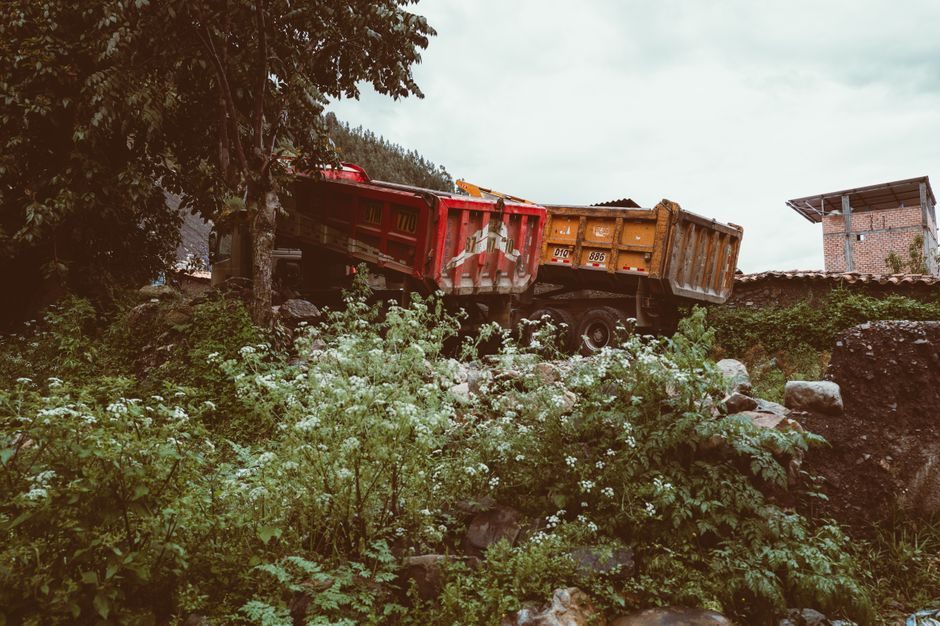
A 2026 mining dump truck purchase decision is locked in by five engineering levers — payload class, engine power and emission tier, frame and body liner, drive configuration, and supply terms — because each one rewrites the cost-per-tonne-hauled number on the bid sheet [S3][S4].
Entry 6X4/8X4 construction-grade mining dump trucks list on Made-in-China at US$9,000-13,000 per unit with 1-piece MOQ [S7], while 4X2 mini tippers sit at US$37,000-39,000 [S4], and ultra-class rigid frames from Liebherr, Caterpillar, Komatsu and XCMG clear US$1-6 million per unit before tyres and spares — meaning the same buying process covers two orders of magnitude.
Payload Class and Body Volume Are the First Filter
Mining dump trucks segment into four payload bands and the band dictates engine, frame, tyre and haul-road assumptions before the spec sheet is opened [S3][S7].
Light/construction mining dump trucks in the 25-50 t class typically pair a 6X4 or 8X4 chassis with 336-420 hp engines, a U-shaped body in Hardox-equivalent wear plate, and leaf-spring suspension; HOWO and FAW dominate this band on Made-in-China listings at US$9,000-13,000 per unit [S7]. Mid-size 50-90 t mechanical-drive rigid haulers, like the LGMG MT86H, step to roughly 500-700 hp and use a single-stage planetary rear axle with oil-bath service brakes [S2]. Large 100-200 t AC-drive rigid frames add wheel-motor electric retarding, while ultra-class 200-363 t units — Liebherr T264, Cat 798, Komatsu 980E, XCMG XDE360 — are sold as mine-site packages, not single-asset units, and lead with 2,500-2,700 kW prime power [S8]. A 30-t pit-run class machine that hauls 150,000 t/yr on a 1.6 km cycle consumes roughly 0.15-0.20 L diesel per tonne hauled, and that ratio scales inversely with payload, which is why a 360-t ultra-class unit hits 0.05-0.07 L/t on a flat 4 km cycle — the buying guide number that actually drives ROI.
Engine, Emission Tier and Drivetrain
Engine selection is the lever where Tier 4 Final / Stage V compliance is non-negotiable for North American and EU sites, while Tier 2 / China NS-IV units still ship into South America, Africa and parts of Southeast Asia [S3][S7].
Below 100 t payload, the dominant architecture is a mechanical 6X4 or 8X4 drivetrain: 9-13 L diesel, 250-450 kW, 6-12 forward gears with a torque-converter lock-up, and a single-stage planetary hub reduction [S3][S7]. Buyers should pin the exact emission tier (EPA Tier 4 Final, EU Stage V, China NS-VI) and the rated altitude derate — a 4,000 m site will pull 15-20 % off the rated kW figure and the supplier must confirm the altitude-corrected power curve, not the catalog headline. A common 2026 specification is a Tier 4 Final / Stage V 12-16 L engine at 350-450 kW for the 30-50 t band, climbing to a 60-90 L V20 at 2,000-2,700 kW for ultra-class, with Cummins QSK, MTU 2000/4000, Cat C175/C32 and Weichai WP series covering the Chinese and export volume [S3][S7].
Frame, Body Liner and Tyre Selection
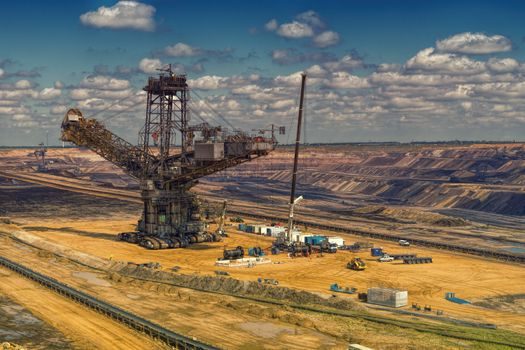
Frame design and body liner are the wear-life levers — and on a 24/7 mine cycle a 20 % liner-life gain is worth more than a 5 % engine fuel gain on a 5-year TCO model [S2][S7].
Body floor and side plates should be specified in 400-500 Brinell wear-resistant steel (Hardox 400/450 or domestic NM400/NM450 equivalent), with a 16-25 mm floor and 12-20 mm sides for 30-50 t units, scaling to 40-60 mm floor plate on ultra-class with a 1,200 mm raised body lip and a tail chute matched to the primary crusher opening. Frame rail sections are typically 320-400 mm web height in 700 MPa high-tensile steel for sub-100 t units, and welded box-section rails of 500+ mm height for ultra-class. Tyres are the single largest consumable line: 24.00R35 radial off-road tyres for the 100 t class, 33.00R51 or 40.00R57 for ultra-class, with operating pressures in the 700-850 kPa range and a tyre-life KPI of 4,000-6,000 hours under proper rotation. Buyers should request a documented body-floor thickness plan, a confirmed tyre make and ply rating, and the option-price for an EHD (extra-heavy-duty) liner package; a mining dump truck fleet that is tendered with the right liner saves one liner change per 30,000 engine hours, which on a 100 t unit is roughly US$120,000-180,000 per truck over the first major overhaul.
Drive Configuration, Hydraulics and Hoist
The hoist cylinder, body-raise angle and tipping cycle time are the operational levers that interact with loader pass count and dump-pit geometry [S3][S4].
Construction-grade 6X4 and 8X4 mining dump trucks use a single front-mounted telescopic hoist cylinder with 35-50 degree raise angle and a 20-30 second raise/lower cycle [S3][S7]. The 4X2 mini tipper variant — common in quarry and aggregate work — uses a smaller under-body cylinder sized to 6-8 t payload with 45 degree raise, and is the format most often listed at US$3,400-3,500 per unit for crawler and gasoline-engine sub-classes [S4]. For 50-100 t mechanical-drive rigid haulers, dual front-mounted cylinders with a 6,000-8,000 kN combined thrust become standard to lift a struck-capacity body in 18-22 seconds; above 100 t the trend is twin double-acting cylinders with hydraulic accumulator dump assist, which cuts cycle time to 25-30 seconds even on a 200+ t body. A hoisting system rated for 1 million cycles is the procurement target for an ultra-class truck, and the hydraulic oil reservoir must be sized for ambient operation at the site — mines above 3,500 m or below -30 C require heated reservoirs and Arctic-grade hydraulic fluid, which most Chinese export builds do not ship as standard and must be requested as a line item.
Sourcing Channels, Lead Time and Total Cost Levers
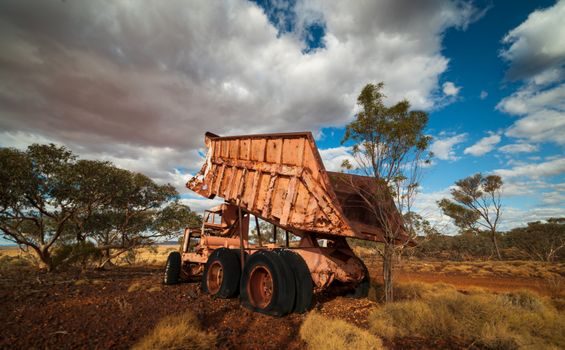
Sourcing channels in 2026 split cleanly into OEM direct (Liebherr, Cat, Komatsu, XCMG, SANY, LGMG), tier-1 Chinese export brands (HOWO/Sinotruk, FAW, Dongfeng, Shacman) and trading-company assemblies that rebrand the same chassis with different bodies [S3][S6][S7].
Made-in-China listings as of 2026-06 show entry-grade HOWO 6X4 dump trucks at US$9,000-13,000 per unit 1-MOQ from Diamond Members, with US$15,000 as a typical asking price for an 8X4 371-420 hp construction hauler in left- or right-hand-drive configuration [S7]. HOWO 6X4 mining dump truck export listings on China supplier directories sit in the US$25,000-45,000 range for a configured 25-40 t payload machine [S3], and a one-stop exporter such as Shenzhen Optimus Truck runs a 120-employee assembly operation in Yantian with a separate engineering subsidiary in Bao'an [S6]. Lead times in 2026 are 60-90 days for in-stock construction-grade units, 120-180 days for built-to-order mid-size mechanical-drive rigid haulers, and 9-14 months for ultra-class AC-drive units including commissioning. Total cost of ownership levers to lock on the RFQ are: payload-tonne product (tonnes hauled x cycle length), fuel-burn guarantee at the rated altitude, tyre-kilometre guarantee, body-liner hours-to-first-rebuild, hoist-cycle warranty, and the spares package — a 5-year/20,000-hour spares commitment typically adds 6-10 % to unit price but eliminates 80 % of unplanned downtime risk. For mid-size rigid haulers in the 50-100 t band, a 5-year TCO of US$0.08-0.12 per tonne hauled is achievable; above 100 t the number drops to US$0.04-0.07 per tonne on a flat cycle, which is the threshold at which a trolley-assist retrofit pays back inside 36 months.
Comparison: Three Truck Tiers on Five Buying Levers
The three tiers line up against five buying-guide criteria: 30-50 t construction-grade, 50-100 t mid-size rigid, and 200-360 t ultra-class — covering price, engine, frame, tyres, and use-case fit [S3][S7][S8].
Entry 30-50 t 6X4/8X4 construction mining dump trucks: price US$9,000-45,000, engine 250-310 kW (336-420 hp), frame 320-360 mm web, tyres 12.00R20-14.00R24, best fit for quarry, road construction and short-haul aggregate work. Mid-size 50-100 t mechanical-drive rigid: price US$150,000-450,000, engine 400-700 kW, frame 360-400 mm box-section, tyres 18.00R33-24.00R35, best fit for open-pit coal, copper, iron-ore mines on 2-5 km cycles. Ultra-class 200-360 t AC-drive rigid: price US$1.2-6 million, engine 1,800-2,700 kW, frame 500+ mm welded box, tyres 40.00R57 or 53/80R63, best fit for large open-pit metal mines and oil-sand operations on flat 3-8 km cycles. The 4X2 mini tipper sub-class at US$37,000-39,000 sits below all three and is a separate buying decision for narrow-vein quarry and farm-to-aggregate work [S4]. A mining mining dump truck buyer should size the truck to the loader pass count (4-6 passes for mid-size, 5-7 for ultra-class) and refuse any unit whose struck-body volume is more than 10 % under the loader's bucket-fill target.
Standards, Compliance and Documentation to Request
Documentation is the second-cheapest insurance on a 2026 mining dump truck buy — the first being the body-liner thickness plan [S3][S7].
Required documents on every RFQ response: factory-acceptance test report with measured payload, brake-stop distance and grade-hold test, engine emission certificate (EPA Tier 4 Final, EU Stage V, or China NS-IV/NS-VI as applicable), ISO 9001 / CE / CCC / EAC certificates with serial numbers, hydraulic and electrical schematic (preferably bilingual Chinese-English), and a recommended spares list with 5-year pricing [S3][S7]. For ultra-class units, buyers should also request a finite-element analysis summary of the frame rails and hoist pivot, a retarding-grid thermal-capacity curve, and a documented site-acceptance test plan including loaded grade-hold at the rated gradient. A reach truck specification may be needed for the warehouse side of the spares operation, but the mining-dump-truck spec sheet is governed by ISO 3457 (earth-moving machinery — guards and shields), ISO 5010 (earth-moving machinery — operator's controls), ISO 10265 (rubber-tyred machines — vibration), and the regional on-road homologation rules for any unit that will run on a public haul road, even for a short section.
Pre-RFQ checklist for 2026 mining dump truck tenders: lock the payload band and cycle length first, then the engine emission tier for the destination country, then the frame/liner specification, then the tyre make and ply rating, then the sourcing channel and spares commitment — and refuse any quote that does not answer all five with a measurable number, not adjectives. A truck scale on the haul-road exit is the cheapest way to verify the supplier's stated payload against actual loaded weight on the first 30 days of operation.
For related coverage, see Multi-Gas Detector 2026 Price & Cost Guide: Sensor Stack, Brand Tier and Cert Levers.