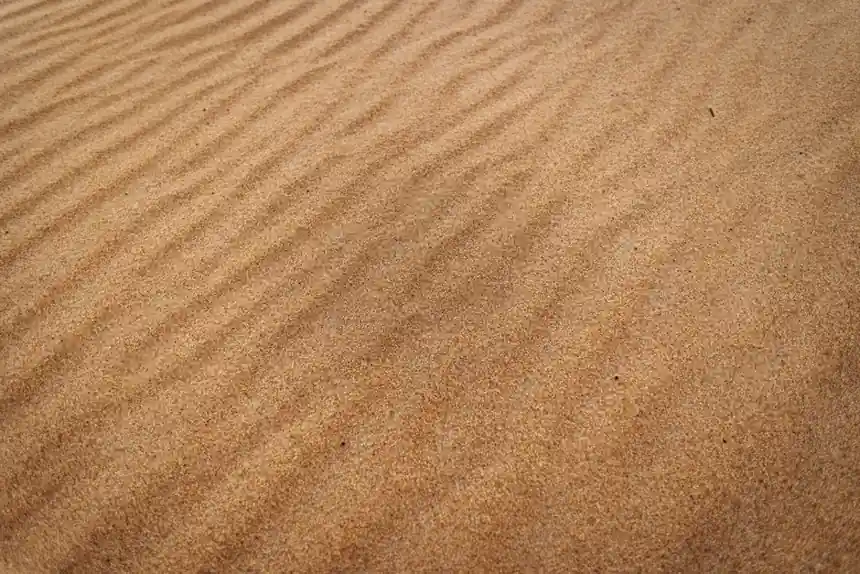
Molding sand AFS grain fineness number (GFN) is the single most leveraged variable a foundry can adjust to move a casting's surface roughness, and a working band of GFN 80-120 covers most cosmetic-grade iron and aluminum work.
The AFS GFN is a calculated average sieve size: the higher the number, the finer the sand, the smaller the inter-granular voids at the mold face, and the smoother the as-cast skin. Foundries that need finish closer to investment casting push beyond GFN 120; high-pressure molding lines that depend on gas permeability often sit at GFN 50-70 and accept a rougher face.
What the AFS GFN actually measures
AFS GFN is proportional to the number of grains per unit mass, so a small numeric increase corresponds to a real jump in surface area per gram of sand [S1]. The standard calculation gives an estimate of the average sieve size of a sand sample, and that distribution is what drives the area of contact between molten metal and the mold wall [S2].
Sand distribution governs how much bond and water the system holds, and a mis-sized distribution shows up first as a surface defect rather than as a mechanical-property miss. University of Northern Iowa work on aluminum castings showed that GFN significantly changes AFS permeability up to roughly GFN 80, after which the trend flattens, so chasing GFN past that point buys very little permeability headroom and a lot of packing density [S4].
Selection band: coarse vs. fine by application
For cosmetic surfaces, using AFS grain fineness numbers above 60 makes mold surfaces smoother, which is directly reflected in the finish of the casting, and published guidance points at the GFN 80-120 range as the practical band for visible iron and steel castings [S6].
Independent work on A356-T6 aluminum cast parts confirmed the same direction: the higher the GFN, the finer the sand, and the smoother the surface of the cast part, with finer distributions cutting measured Ra on flat coupons [S5]. For non-cosmetic structural castings, GFN 40-60 is still common because coarser grains vent gas faster and resist burn-on; the trade-off is rougher skin and more finishing time downstream.
Comparison: GFN bands against decision criteria
The right GFN is a four-way trade, and the table below lines the three practical bands against the criteria that actually drive the call on a molding line. [S2]
GFN 40-60 (coarse): best permeability and gas venting, lowest packing density, roughest as-cast surface (typical Ra above 12.5 micrometers on iron), lowest binder demand, suited to heavy section ferrous castings where internal soundness matters more than skin. GFN 80-120 (fine-medium): the working band for most cosmetic iron, steel, and aluminum work, balances surface finish with permeability, suits horizontal and vertical molding with refractory coating, holds dimensional tolerance well. GFN 130+ (very fine): pushes finish toward investment-casting territory, sharply raises binder and water demand, reduces permeability so venting becomes the limiting factor, used on thin-wall aluminum and small cosmetic iron where the shell molding machine route is also competing.
Two boundaries worth flagging: GFN above roughly 80 stops buying meaningful permeability improvement, and the area-per-gram curve flattens near 175 sq. cm/gm, so doubling GFN beyond that point is a binder cost with little finish return [S4].
Standards, tests, and what to log on the floor
AFS Mold and Core Test Handbook methods are the reference set: AFS 2220-00-S for compactability, AFS 2218-00-S for moisture by forced hot air, plus weekly screen analysis and AFS or 25 micron clay content, all of which feed back into GFN control [S2]. For shops that want to control GFN directly, weekly screen analysis is the minimum cadence, with LOI and 25 micron clay tests alongside it [S3].
Surface roughness should be reported as both Ra and Rq on a flat reference coupon at 5 to 30 degree draw angles, the same protocol used in binder-jetted sand mold studies, so a GFN change can be linked to a finish number rather than a subjective rating [S5]. For plants evaluating the automatic molding line route against conventional jolt-squeeze, GFN and finish data need to be captured on the same coupon geometry to keep the comparison honest.
Limits, failure modes, and where GFN is the wrong lever

GFN alone cannot fix a finish problem caused by refractory coating selection, ramming energy, or metal temperature, and the UNI study explicitly separated sand fineness, material type, and refractory coating as independent variables [S4]. Spherical and round grains smooth the surface faster than angular or sub-angular aggregates at the same GFN, so a switch from silica to ceramic at unchanged GFN can move finish by more than another 20 GFN points of silica [S4].
Coarse sand below GFN 50 is the wrong choice for cosmetic surfaces even if it is the cheapest, because permeability and finish move in opposite directions and the surface roughness tester reading on the casting will reflect that. The shop-level signal to watch is a GFN drift of more than 5 points week over week without a sieve or bond change, which usually points at classifier wear or incoming-sand variability before it shows up as scrap.
Cross-link: tooling and adjacent spec decisions
When GFN is being raised to chase finish, the sand casting mold draft, coating weight, and pattern finish need to be re-checked in the same change ticket, because a finer sand face exposes pattern tooling defects that a coarse mix previously hid. For shops that also size die-cast tooling, the GFN logic mirrors draft-and-finish thinking used in standardized mold base vs interchangeable cavity inserts work, where surface outcome is a coupled decision rather than a single knob. [S5]
Trackable signals for the next quarter: incoming silica sieve distribution drift at the classifier, weekly GFN average versus the 80-120 cosmetic band, and Ra measured on a fixed 10 degree draw-angle coupon after any bond or coating change.
