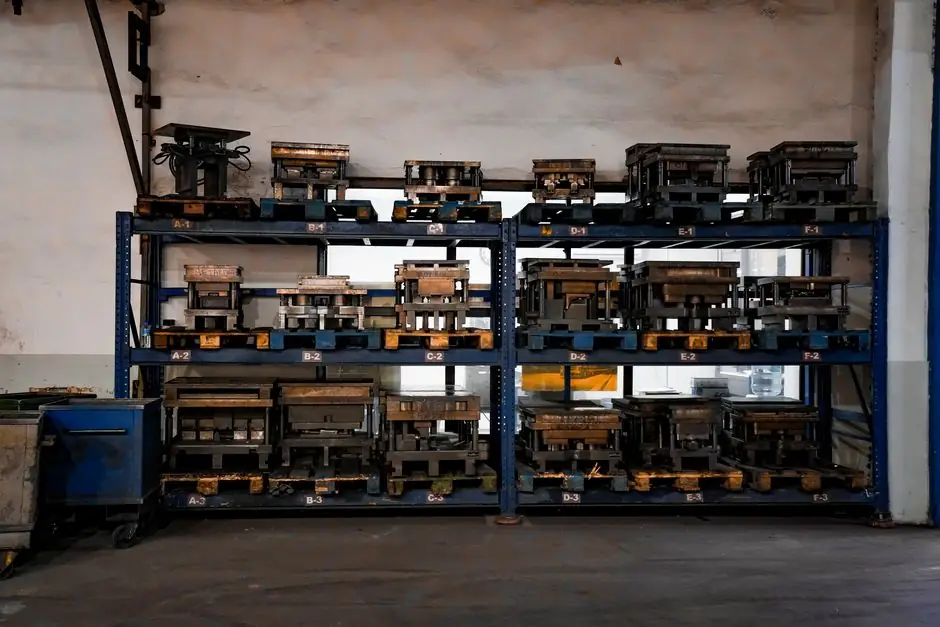
For high-cycle plastic injection molds targeting 500,000+ shots, hardness is split deliberately: the mold base and holder blocks run 27-34 HRC for machinability, while cavities and cores run 35-52 HRC depending on resin abrasiveness, with H13 pushed to 50-60 HRC after through-hardening for filled or high-temperature polymers [S1][S2][S3].
The P20 family (AISI P20, 1.2311, 1.2738 P20+Ni) remains the default at 28-35 HRC supplied pre-hardened, and 718H / NAK80 occupy the 35-42 HRC band for higher precision; H13, S136, and ASP60 cover 48-70 HRC for wear- and heat-critical cavities [S4]. Holders are almost never specified at working-cavity hardness because through-section hardness uniformity is poor above 35 HRC in large 4140-class blocks.
Hardness bands by mold component, not by "the steel"
Industry practice separates three hardness zones inside one tool: holder/base (27-33 HRC), core-and-cavity (28-52 HRC pre-hardened, up to 60 HRC after heat treatment), and inserts for high-wear features (48-70 HRC). Finkl's HolderBloc (4140+S, DIN 1.2331) is supplied at 27-33 HRC specifically for mold bases with extensive machining, and is not recommended for highly polished surfaces because sulfide inclusions can be revealed as fine directional scratches during diamond paste polishing [S3].
The same vendor's COREBLOC (P20 modified, 1.2312) targets holders and core blocks from 14" up to 30" thick, while Mold Die (P20+Ni, 1.2738) ships at 285-321 BHN (30-34 HRC) and Hi-Hard MD at 321-352 BHN for higher wear resistance with deep hardening [S3]. Pre-hardened 718H is commonly delivered at 35-39 HRC for stable machining before any post-treatment [S4][S6].
Resin-driven selection: which HRC band for which polymer
Resin abrasiveness and processing temperature drive the cavity hardness jump, not abstract preference. For common plastics (PP, ABS) on appliance housings and toys, P20 at 28-35 HRC delivers 100,000-300,000 cycles at 8,000-12,000 yuan/ton; stepping up to 718H at 35-39 HRC extends life to 300,000-500,000 cycles and cuts polishing time by roughly 30% for automotive interior precision parts [S4].
For high-temperature engineering plastics (PEEK, LCP) at engine-component or battery-casing temperatures, H13 or DIN 1.2344 (50-60 HRC after treatment) is specified for 500-650°C thermal-crack resistance and 500,000-1,000,000 cycle life, with 2344 favored where rapid mold cycles demand higher thermal conductivity [S1][S4]. Glass-fiber reinforced resins (e.g. PA+GF30) push the spec to ASP60 at 68-70 HRC, exceeding 1,000,000 cycle life for IC packaging and high-end components [S4]. PVC and medical parts route to S136 (48-52 HRC, ≥13% Cr) at 20,000-70,000 yuan/ton to resist cavity corrosion from acidic resin byproducts [S4].
Pre-hardened vs through-hardened: when to skip the heat treat
Pre-hardened P20, 718H, and NAK80 ship ready to machine at 28-42 HRC, eliminating the distortion risk of a post-machining quench and supporting ±0.01 mm cavity tolerance on intricate geometries [S5]. NAK80 in particular is supplied pre-hardened for direct machining and, after nitriding, reaches roughly 1,000,000 cycle life for transparent and high-gloss parts [S4].
Where cavity hardness must exceed 42 HRC, the steel is supplied soft, machined, then heat-treated. 718H solution-treated at 880-900°C and aged at 680°C drops to 25-30 HRC for machining before final aging to working hardness, a route chosen to control distortion on large tools [S6]. H13 in the as-delivered annealed state machines at roughly 45% of 160 Brinell B1112 reference, then through-hardens to 50-60 HRC and holds that hardness through repeated thermal cycling between hot plastic and coolant channels [S1].
Chemistry behind the HRC: what the alloy actually does
Modern plastic mold steels sit in a 0.25-0.50% C window, enough carbon to form hard carbides after heat treatment while keeping enough toughness for thin ribs and sharp corners [S5]. Chromium at 8.0-18.0% does double duty: it forms wear-resistant carbides and provides the passive oxide layer that lets S136, HPM38, and MAR-X survive PVC and medical-grade sterilization chemistries [S4][S5].
Molybdenum at 0.3-3.0% is the element that lets a 500 mm+ block through-harden uniformly, the property that pushes buyers away from 4140 toward COREBLOC and 1.2738 for large holders [S3][S5]. Vanadium at 0.01-0.50% pins grain size via fine VC carbides, suppressing the coarse chromium-carbide networks that would otherwise polish out as pits. Precipitation-hardening grades (NAK80 class) add 0.5-2.0% Al and 0.5-3.0% Cu to enable a low-temperature age to 40-45 HRC, the lowest-distortion route to working hardness [S5].
Failure modes and over-spec penalties
Specifying H13 for a holder block is a classic over-spec: the extra hardness destroys machinability (P20 machines at 65-75% of B1112 reference, H13 at roughly 45%), and the deep-hardening benefit is wasted on a non-wearing structural component [S1]. Conversely, running P20 at 30 HRC against 35% glass-filled PEEK at 720°F is an under-spec: the cavity will gall within tens of thousands of shots because the abrasive filler cuts the soft matrix faster than the carbides can resist [S1].
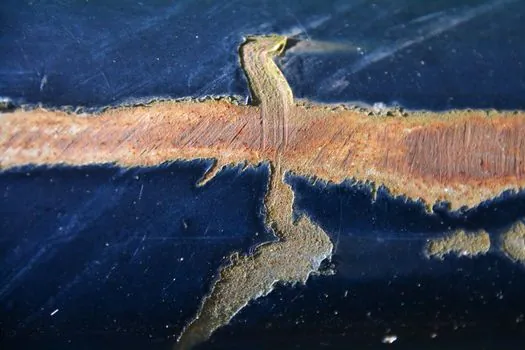
Edge build-up and white layer from EDM must be polished out before any P20 cavity sees production, otherwise the re-hardened skin spalls and marks the part [S4]. For PVC molding, plain P20 and NAK80 require chrome plating or a corrosion-resistant upgrade to S136, since chloride released during PVC processing attacks the low-chromium matrix within a few thousand cycles [S4]. More on the carbon-vs-alloy trade-off behind these choices is covered in this grade-selection rule set for carbon and alloy steels.
Standards, sourcing, and test methods
Hardness is conventionally reported in HRC for heat-treated mold steel (up to 62 HRC) and in BHN / HBW for pre-hardened blocks; the 285-321 BHN / 30-34 HRC equivalence is a direct conversion, not a separate property, and is the format Finkl uses for Mold Die and Hi-Hard MD [S2][S3]. Cross-reference standards (AISI P20, DIN 1.2311, DIN 1.2738, DIN 1.2344) are the cleanest way to compare supplier datasheets, because heat-treated condition is implied by the designation [S3][S4].
For cast-mold applications, the same base-hardness logic carries over but the steel is poured rather than wrought; sand casting mold tooling in cast iron mold form is sized differently, and hardness verification on a mold base relies on a calibrated hardness tester on a prepared cross-section, not on a surface reading. Related read on the alloy families behind these grades: alloy steel reference.
Trackable signals to watch next: (1) whether 1.2738HH / Hi-Hard MD at 321-352 BHN continues to displace standard 1.2738 in mid-cycle automotive tooling, since the data already shows improved polishability and through-hardening at the same basic cost tier [S3]; (2) any move by ASP60-class PM grades into glass-filled EV battery housings as cycle counts climb past the 1,000,000 mark [S4].