
Tapered roller bearings remain the default radial-and-axial load carrier on tractors, combines, balers, and tillage implements, where combined loads reach 15-30% of the dynamic load rating C in normal field duty and peaks can spike higher during plow strikes or PTO engagement [S1].
For inch-series agricultural hardware, conformance to ANSI/ABMA 19.2:2013 is the baseline for boundary dimensions, chamfers, tolerances, and the Type TS (single-row) designation system used across most implement hubs, gearbox shafts, and final drives [S2]. Metric series for OEM platforms follow ISO 355; cross-series substitution should be avoided because contact angle and effective load center differ.
Load profile, speed, and contamination on the farm
Agricultural bearings run hot, dirty, wet, and shock-loaded: mud, crop residue, fertilizer dust, and high-pressure washdowns are constant, so the sealing system typically decides field life more than the steel itself. Typical hub applications on a 150-300 hp tractor operate at shaft speeds of 0.5-3 m/s (roughly 50-300 rpm at the wheel/planter shaft) with combined radial-thrust loads from implement draft, while gearbox input shafts can run 1500-3000 rpm under continuous load [S1].
Sealing classes commonly specified for ag use include RS (rubber seal both sides), 2RS variants, and the heavy-duty cassette or multi-lip labyrinth seals used in OEM hub units; lip seals typically limit continuous operating temperature to roughly 120 degrees C, while metallic shields push the ceiling to about 200 degrees C. Pitch, dust, and water ingress drive an estimated 60-70% of premature agricultural bearing failures, which is why many ag hubs now ship with integrated seal-and-collar cartridges rather than serviceable cone/cup pairs.
For bearings operating near or below 1 m/s, grease life rather than fatigue life tends to limit service interval; relubricatable designs with a 26-30% fill of lithium-complex or polyurea grease, with NLGI 2 most common, are still the norm on tillage and planter shafts [S1].
Type, series, and contact angle decisions
The TS design shown in ANSI/ABMA 19.2:2013 carries a nominal contact angle near 10-16 degrees for the standard family, which trades a small amount of axial capacity for a strong radial capacity and a predictable effective load center used in shaft deflection checks [S2].
Type TDO (double outer, two cones one cup) and TDI (double inner) are used where axial load is dominant, for example in final-drive pinions and large gearbox countershafts, where thrust can reach or exceed the radial component. Spherical rollers or cylindrical rollers generally outperform tapered rollers where misalignment exceeds 0.001 rad, so ag hubs with stamped-steel housings usually need a careful fit stack-up rather than a roller change.
Crossed-roller guides and four-point contact variants occasionally appear in steering columns and some implement-lift linkages, but for the typical ag tractor or combine the tapered roller bearing family is still the right starting point. Use a deep-groove ball or roller bearing only when the load is purely radial or misalignment is severe; the geometry will not return the same thrust capacity.
Material, heat treatment, and surface
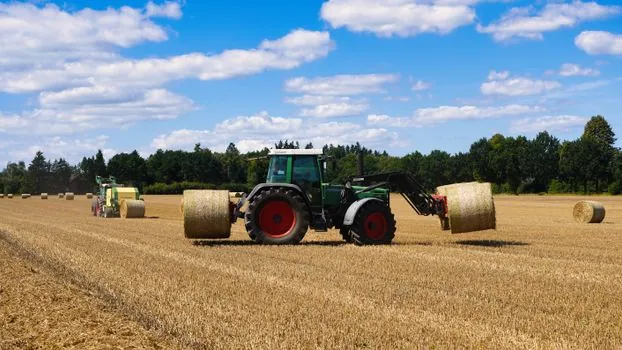
Standard ag-market cones and cups are through-hardened chromium steel (AISI 52100 equivalent) to about 58-62 HRC, case-hardened low-alloy variants (carburizing steels such as AISI 8620) reach 58-60 HRC at 1.5-2.0 mm case depth, which improves shock tolerance on tillage and baling shafts [S1]. Through-hardened grades give better wear under clean conditions; case-carburized grades survive impact and edge loading better in dirty, shock-loaded duty.
For implements that see fertilizer or manure exposure, stainless or zinc-nickel coated variants extend life but cut fatigue life by 5-15% relative to standard through-hardened material, so they should be limited to splash zones and low-load pivots, not main hubs. Surface finish on bearing seats should meet Ra 0.8 micrometers or better for heavy-duty fits per ANSI/ABMA 19.2:2013 fitting-practice tables [S2].
Sizing, dynamic load rating, and L10 life
Use C/P ratio, not bore diameter alone, to size. For ag hubs, a C/P ratio of 6-8 in steady field duty, 4-5 in shock-heavy work, is a common starting band [S1]. Below 4, L10 life drops into the 1000-3000 hour range; above 10 you are usually over-spec and paying weight and friction penalties.
L10 life in hours = (C/P)^p x 10^6 / (60 x n), with p = 10/3 for ball bearings and 10/9 for roller bearings. For a typical ag wheel hub at 200 rpm with C/P = 6, the calculated L10 lands around 30,000-40,000 hours, which is far above the 5,000-10,000 hour service interval targets OEMs actually design for, so the safety margin comes from contamination and lubrication, not from steel capacity.
Compared side by side, the four common ag-relevant bearing families line up as follows on key decision criteria: (1) single-row tapered roller (TS) wins on combined radial+thrust load capacity and shaft stiffness, but is sensitive to misalignment above 0.0005 rad; (2) double-row tapered (TDO/TDI) doubles thrust capacity and resists shaft deflection better, at roughly 1.5-2x the cost and envelope; (3) cylindrical roller gives higher radial capacity and tolerates some axial movement of the shaft, but no thrust capacity; (4) deep-groove ball is cheapest and runs fastest, but radial and thrust capacity both fall 40-60% short of an equivalent-bore TS unit. The same conclusion is reinforced in our 2026 mining read, where shock and contamination force the same material and sealing trade-offs for tapered roller bearing selection.
Sealing, lubrication, and contamination control

For outdoor ag use, the seal is the bearing. Specify seals by ingress rating (ISO 60529 IP code where applicable, or vendor mud-pulp test data) rather than by lip count. A well-designed multi-lip seal with a dust lip and grease lip will outlast a single-lip seal by 2-4x in field dust, and integrated hub cartridges with factory-set grease typically deliver 5-8 years of service before re-pack [S1].
For relubricatable service, lithium-complex or polyurea greases with NLGI 2 viscosity, EP additives, and ASTM D4950 GC-LB rating are the workhorses; high-temperature synthetic greases (PAO or ester) are reserved for high-speed gearboxes above 120 degrees C sump temperature. Relubrication interval on tillage shafts under heavy dust is typically 50-100 hours, not the 250-500 hours suggested in clean-industry manuals.
If your platform must run road rollers, packer wheels, or soil-engaging tools in the same fleet, use the same sealing philosophy and grease spec across the whole implement to simplify service, but verify static load ratings because packer wheels see predominantly radial load and a different C/P target than a planter gauge wheel.
Standards, fitting practice, and what to write on the drawing
For inch-series ag applications, call out ANSI/ABMA 19.2:2013 boundary dimensions and tolerance class (ABEC-1 / Class 4 is standard for ag, ABEC-3 / Class 2 reserved for precision gearboxes) on the print [S2]. Heavy-duty fitting practice (interference on the rotating ring, slight clearance on the stationary ring) is the default for ag shafts and hubs, per the Heavy Duty Fitting Practice tables in the standard.
Specify by full designation: for example, a TS part becomes "LM29749/LM29710" (cone/cup) or a vendor 4-digit "2788/20" assembly, not just by bore. Include the matched pair, the seal code (RS, 2RS, RZ), the clearance class (C0, C2, C3, C4 as applicable to tapered designs), and the grease spec (NLGI grade, base oil type, ASTM D4950 rating).
Common pitfalls to avoid: (1) mixing metric and inch parts on the same shaft, even when the bore is close, because contact angle and load center shift; (2) specifying case-carburized parts where through-hardened is the OEM-supplied equivalent, which changes the diametral clearance and preload stack; (3) relying on C3 clearance to "fix" thermal expansion in a cold field environment, when in fact most ag duty runs below 80 degrees C and standard C0 is correct.
Sourcing, replacement, and field reality
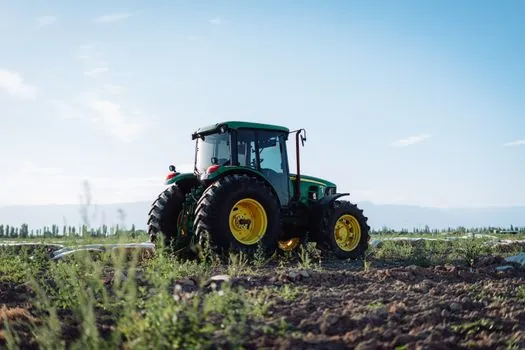
For ag, the practical shortlist is dominated by four- to six-tier OEMs (Timken lineage from 1895 [S3], SKF, FAG/Schaeffler, NSK, NTN, JTEKT/Koyo) plus a long tail of regional aftermarket brands. For OE specification work, stick to the brands that publish full ANSI/ABMA 19.2:2013 boundary-dimension tables, ABEC tolerance certificates, and material traceability (heat lot, steel grade) [S2][S3].
Aftermarket parts that meet the same ABMA 19.2 designation can be substituted in non-safety applications, but verify the seal type, grease fill, and clearance code; the cheapest matching part often ships dry or with a low-temperature grease, which is the most common reason a "identical" replacement fails in one season. For packaging-line crossover, where contamination is food-grade rather than abrasive dirt, the spec map looks very different, and the relevant rules are detailed in our 2026 packaging-line bearing selection read.
The three highest-value verifications on every ag bearing drawing are: ABMA 19.2 designation and tolerance class, sealing class and operating-temperature limit, and the matched grease specification (NLGI, base oil, EP, ASTM D4950 rating).