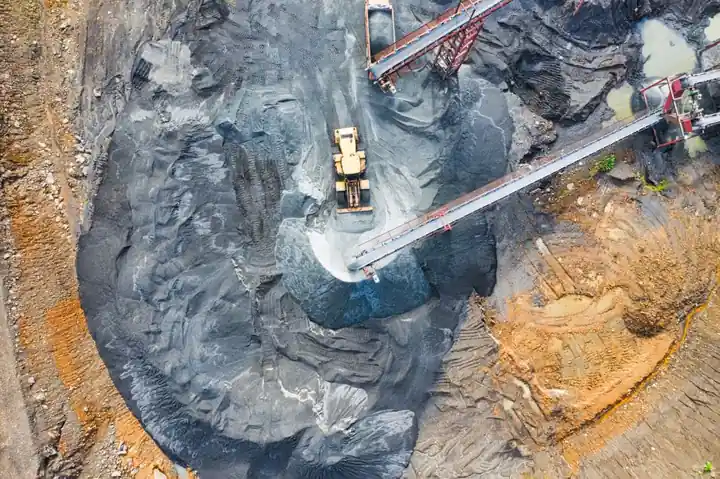
For mining duty, tapered roller bearing selection is driven first by radial load (Cr), then by impact factor (1.2-1.8 over static), then by sealing class, with the four-row TDO/TDI configuration preferred where combined radial-thrust loading from gearboxes and pinion stands exceeds single-row capacity [S1][S3].
Single-row bearings handle roughly 10-30% of the combined load that matched four-row assemblies do, and TDO/TQI double-row units such as 48685/48620D reach Cr=390 kN, Cor=1030 kN at the dimension pairs common in mining gearboxes [S3]. Selection is governed by ABEC/ISO tolerance class, bore diameter, and a conformity ratio of about 0.01-0.03 between roller and raceway, not by brand.
Load and Geometry: the Numbers that Drive Selection
Tapered roller bearings support combined radial and axial load through line contact on the inner ring, outer ring, and the tapered roller set, with load lines passing through a single theoretical apex on the bearing axis [S1]. The line-contact geometry gives 1.5-2x higher radial capacity than a same-bore roller bearing of point-contact type, at the cost of speed; typical limiting speeds for TRB in mining service run 1,500-3,000 rpm depending on lubrication regime.
Key bore-diameter classes for mining: 100-300 mm covers most conveyor pulleys, gearbox input shafts, and wheel hubs; 300-600 mm covers large pinion stands on mining dump truck wheel ends and SAG mill gearboxes; above 600 mm enters mill-trunnion territory. The HS730 excavator bearing 225x285x30mm and the 22232 W33 spherical bearing 160x290x80 mm sit squarely in mid-range mining service, the latter as a self-aligning alternative where TRB is over-specified for misalignment tolerance [S2][S3].
Configuration Matrix: Single, Double, Four-Row for Mining
Four-row TDO/TDI (Type 2) is the default for rolling-mill back-up rolls and large pinion stands where both faces take thrust; double-row TD is the workhorse for wheel-hub and planetary gear-carrier duty; single-row TS remains the standard for general road roller drum shafts and conveyor idlers where moderate combined load is acceptable [S1].
RNB's catalog illustrates the spread: EE126097/126150 Class 2 in single-row at large bore, 48685/48620D in double-row TDO (Cr=390 kN, Cor=1030 kN), and M270749D/M270710 at 447.675x635x223.838 mm in double-row TDO for heavy-mill duty [S3]. Mining specifying engineers should default to double-row or four-row when combined C/P ratio (axial-to-radial) is above 0.4, and confirm the cup/cone separable design (TS) only when disassembly for maintenance is a hard requirement, since paired back-to-back mounting is field-sensitive.
Materials, Sealing, and Lubrication: Where Mining Fights the Bearing
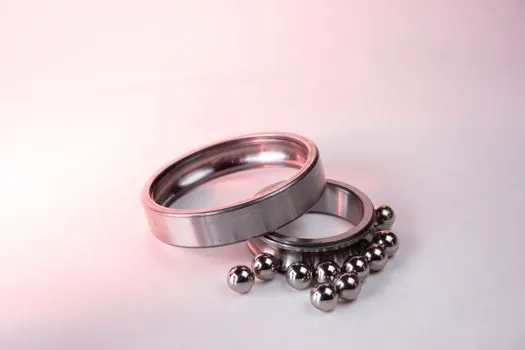
Through-hardening chromium steel (AISI 52100) and case-carburizing variants (AISI 8620) are the baseline material pair; mining typically demands case-carburized for impact resistance, with surface hardness around 58-62 HRC and a tough core of 30-45 HRC. RNB markets high rolling-contact fatigue strength, high hardness, and high wear resistance as the three dominant performance claims for their TRB line, which is consistent with case-carburized construction under ISO 9001:2008 quality systems [S3].
Contamination is the primary failure mode in open-pit and underground service. A mining-grade TRB specification should name a sealing class (LLU, LLB, or RSA-equivalent), grease retention interval, and an exclusion zone for solid contaminants, with relubrication intervals commonly shortened to 200-500 hours versus the 1,000-2,000 hours baseline of clean industrial duty. The R22-11 size at 22x56x17 mm and the R46-1MTF show the automotive TRB form factor (small bore, light series) is unsuitable as a direct mining substitute; the 41.5x62x19 mm R41Z-20 differential bearing sits at the very low end of mining applicability and should only be used on light support equipment [S2].
Standards, Tolerance, and Spec Discipline
ABEC 0 (ISO Normal) tolerance is acceptable for most mining conveyor and gearbox positions; ABEC 3 (ISO 6) is the common floor for precision planetary and pinion-shaft positions; ABEC 5+ is reserved for high-speed trunnion and gearbox high-speed pinion positions where balance class is specified. Mounting dimensions follow the ISO 355 metric series for tapered roller bearings, with bore increments on the 0.5-1.0 mm grid for small bores and the 5-10 mm grid for industrial sizes above 100 mm [S1].
OEM choice versus generic OEM/ODM sourcing continues to dominate 2026 mining procurement decisions, with the make-or-buy line falling on after-market supply chain depth rather than on load-rating accuracy; the related OEM vs ODM for mining equipment 2026 procurement plan and the AC motor lifespan bearing-failure-mode reference together cover the upstream VFD and motor-driven failure chains that converge on the bearing seat.
Selection Criteria vs Bearing Type: a Quick Comparison

Single-row TS handles the lowest combined load, supports the widest speed range, and is the easiest to mount; it is the right pick for general conveyor idlers and light gearboxes, and the wrong pick for pinion stands or wheel hubs. Double-row TDO doubles the load capacity and handles moderate thrust in both directions, the default for wheel hubs, planetary carriers, and moderate pinion stands. Four-row TQO/TQI quadruples single-row capacity and is the only correct choice for mill back-up rolls and large haul-truck wheel ends, at the cost of needing matched assembly and tighter mounting precision [S1][S3].
The decisive trade-off is conformity ratio and surface finish: tapered roller bearings run line contact with 0.01-0.03 conformity versus the 0.5-0.7 conformity of roller bearing ball equivalents, so TRB wins on load, loses on speed and on misalignment tolerance (a few minutes of arc versus the 0.5-2 degrees typical of spherical and self-aligning types).
Stock and Lead-Time Signals Worth Tracking
Distributor stock snapshots from August 2026 show the HS730 excavator bearing (225x285x30 mm) holding 168 sets, R22-11 / R22-11UQU42 (22x56x17 mm) at 265 sets each, A-ET-CR-0492STPXI (21.99x50x18.3 mm) at 625 sets, R46-1MTF at 175 sets, and the R38-9 / R41Z-20 differential pair (38x62x19 mm and 41.5x62x19 mm) at 295 sets each [S2]. This mid-year inventory picture is a useful lead-time baseline; mining planners should treat any single-source size below 200 sets as a stocking risk and qualify at least one alternate supplier per critical bore-diameter class before the next shutdown window.
Verifiable next node: cross-reference the 48685/48620D double-row TDO spec against current mining dump truck wheel-end requirements and confirm the M270749D/M270710 four-row variant at 447.675x635x223.838 mm against your largest mill back-up roll schedule for the 2026-2027 turnaround.