Air-cargo AGV selection is now a 5-axis decision: rated payload (typically 1.0–6.0 t for ULD dollies, LD3 containers, and main-deck pallets), lift mast height (1.5–4.5 m for high-rack ULD staging), navigation modality (QR-code, magnetic tape, laser SLAM, or natural-feature), zone classification (ATEX/IECEx zone 1 or 21 near fuelling and battery bays), and fleet-management protocol.
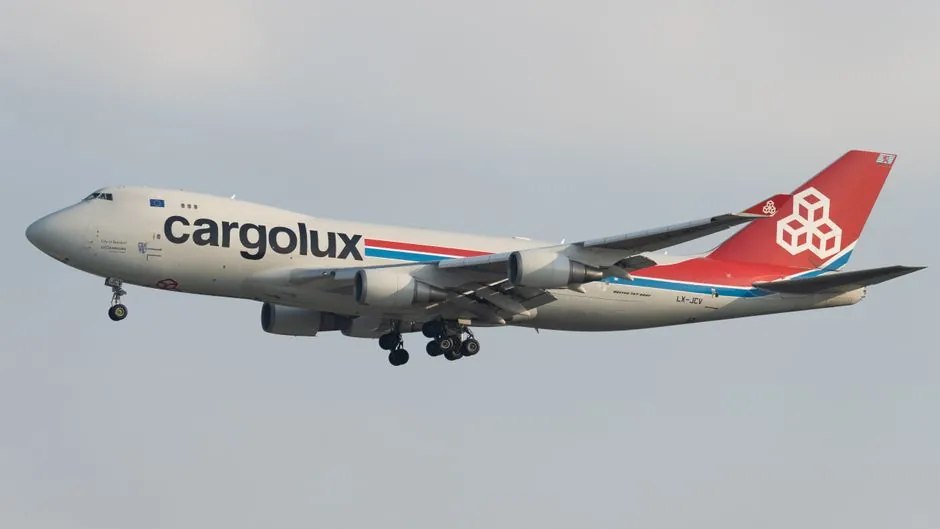
The driver is throughput, not novelty. Lufthansa Cargo connects 350+ stations in roughly 100 countries through 5 European hubs, with a fleet of Boeing 777F long-haul freighters and Airbus A321F medium-haul freighters carrying more than 30 ULD types [S1]. Amazon Air Cargo backs its service level with 100+ aircraft and 250+ daily flights across North America, EMEA, LATAM, and Asia, plus a money-back guarantee of up to $10,000 per flight for late deliveries [S2]. At those volumes, manual dolly handling cannot hold the SLA window, and AGV robot fleets are being scoped against the same 24/7 cadence that the airlines advertise.
Payload classes that match ULD and pallet mix
Air-cargo terminals see three dominant ULD weights: LD3 containers at roughly 1.5 t loaded, LD7 / LD9 main-deck pallets at 4.0–4.5 t, and M-1 (16 ft) or AKE mainstream containers around 1.0–1.2 t [S1]. Most spec sheets therefore cluster into three AGV payload bands: 1.0–1.5 t for LD3 / AKE last-mile, 2.0–3.0 t for general pallet builds, and 4.0–6.0 t for main-deck forklift AGVs handling LD7 and full pallet positions. For lighter transfer flows, an air pick-class conveyance may be parallel-considered, though that family is a pneumatic tool, not a cargo mover, and belongs in MRO workshops rather than ramp halls.
Counterweight geometry matters as much as tonnage. Main-deck 777F freighters require pallet heights up to 2.4 m (96 in) and AKE door clearances near 1.6 m, so any AGV rated for those loads must also support a free-fork lift of at least 3.0 m with a 500 kg residual capacity at full elevation, otherwise operators face load-stability faults on cornering.
Navigation modality versus terminal environment
Four navigation families compete for air-cargo ramp duty. QR-code / fiducial AGVs (markers on the floor every 1.0–2.0 m) are the cheapest and most deterministic for fixed terminal layouts, but require repainting whenever gate positions change, a 30–60 minute line-down per marker re-lay. Magnetic-tape AGVs are similarly priced but read a routed track and suit retrofits in older warehouses where floor cuts are acceptable. Laser-SLAM AGVs (LIDAR with reflective beacons or natural-feature maps) carry a 20–40% price premium but allow dynamic re-routing when gate assignments shift, which Lufthansa Cargo and Korean Air both describe as a normal daily event at their hubs [S1][S5]. Natural-feature vision systems are the newest entrant, suited to greenfield terminals and proven in mixed lighting if the camera stack is paired with IMU fusion.
Spec the navigation stack alongside the WMS / cargo-handling system interface. Lufthansa Cargo's eBooking and eAWB services (e-AWB, FWB, FHL flows) push assignment data into the ramp in real time, so the AGV fleet manager should consume AWB-level events rather than polled job lists, otherwise vehicle dwell at the build-up position climbs past 90 s and erodes the on-time guarantee [S1]. For comparison context on heavier lifting duties outside the cargo hall, Truck crane selection for road construction: 1-160 t size map shows the same payload-banding logic applied to site cranes, a useful pattern when AGVs and yard cranes share the tarmac.
ATEX and IECEx zone classification on the ramp
Air-cargo AGVs routinely pass within 5–10 m of refuelling bowsers, so any battery bay, charging station, or AGV that enters the fuelling apron should be rated to ATEX 2014/34/EU equipment group II, category 2 (zone 1 for gas, zone 21 for dust) as a baseline, with category 3 acceptable only on the cold-side of the apron. Lithium-traction batteries complicate the picture: cells must be UN 38.3 tested, and the charger enclosure itself often drives the zone re-classification. Lead-acid traction packs remain common for high-cycle air-cargo AGVs because the charging off-gassing envelope is well understood and the thermal-runaway threshold sits above 60 °C.
Dangerous-goods handling tightens the requirement further. Amazon Air Cargo explicitly accepts biological substances, GMOs, lithium batteries (in and with equipment), and dry ice at select locations, all of which sit in IATA DGR classes that forbid unrated electrical equipment in the staging cell [S2]. Specify the AGV with sealed IP54 minimum enclosures, intrinsically safe (IS) signal levels on the truck bus, and spark-arrested motor contactors; the OEM should furnish the full ATEX/IECEx certificate set, not a generic industrial rating.
Who AGV is for, and who it isn't
AGV is for: (1) hub cargo centres with more than 50 daily wide-body movements, where an SLA of 30 min or tighter is contractually binding; (2) operators running a closed ULD pool with predictable container types; (3) sites where labour cost per moved ton exceeds the financed AGV cost per hour, which happens above 10–15 t/h sustained throughput. It is not for: (1) low-volume feeder terminals under 20 t/day, where a single tug and 2 operators beat the ROI; (2) mixed-fleet open yards where ad-hoc container types dominate, since re-tagging markers inflates OPEX; (3) sites lacking a WMS or AWB-level event stream, because without it the AGV cannot self-dispatch. [S2]
This same go/no-go framing is used in Roller Bearing Selection for Cement Plants: 2026 Spec Map: set the duty envelope first, then pick the family, not the other way around. The same logic applies to air impact wrench procurement in the maintenance shop, where torque class and vibration data drive the decision, not brand familiarity.
Comparison of the four navigation options on air-cargo criteria
Lining the four navigation families against the four most-cited air-cargo criteria gives a usable selection table. (2) Re-routing flexibility: QR and magnetic tape are rigid (re-paint or re-lay needed), laser SLAM is dynamic within a mapped zone, natural-feature is fully dynamic. (3) Maintenance burden: QR requires marker re-print every 6–18 months and clean floors, magnetic tape is durable but cuts the slab, laser SLAM needs only lens cleaning and beacon integrity, natural-feature needs lighting-stable conditions. (4) Suitability for cold-chain / DG cells: magnetic tape and laser SLAM both perform in low-light and dry-ice fog, QR is fragile to frost on the markers, natural-feature vision struggles in sub-zero condensation. For a 24/7 hub with mixed cargo, laser SLAM currently reads as the most balanced default. [S3]
Failure modes and the one signal worth tracking
The three failure modes that bite AGV fleets in air-cargo are: (1) marker loss on QR systems after jet-blast sweeping, which can drop fleet availability by 15–25% in a single shift; (2) battery-swap queueing when chargers are undersized, where dwell time exceeds 12 min and forces 1.3x fleet sizing; (3) WMS event latency above 30 s, which starves dispatch and pushes AGV utilisation below 60% of nameplate. Track one signal weekly: ULD moves per AGV-hour, with a target above 8 moves/h for the 2.0–3.0 t class, and above 4 moves/h for the 4.0–6.0 t main-deck class, which gives an early read on whether the navigation stack is keeping pace with airline SLAs. [S2]
Next node: the AGV robot family overview for the full taxonomy of vehicle types, and the AMR robot page for fleets that need dynamic rerouting beyond a mapped zone. Monitor Amazon Air Cargo's published fleet growth beyond the 100-aircraft line and Lufthansa Cargo's 777F / A321F replacement cadence, both of which set the throughput floor any new AGV deployment must clear [S1][S2].
