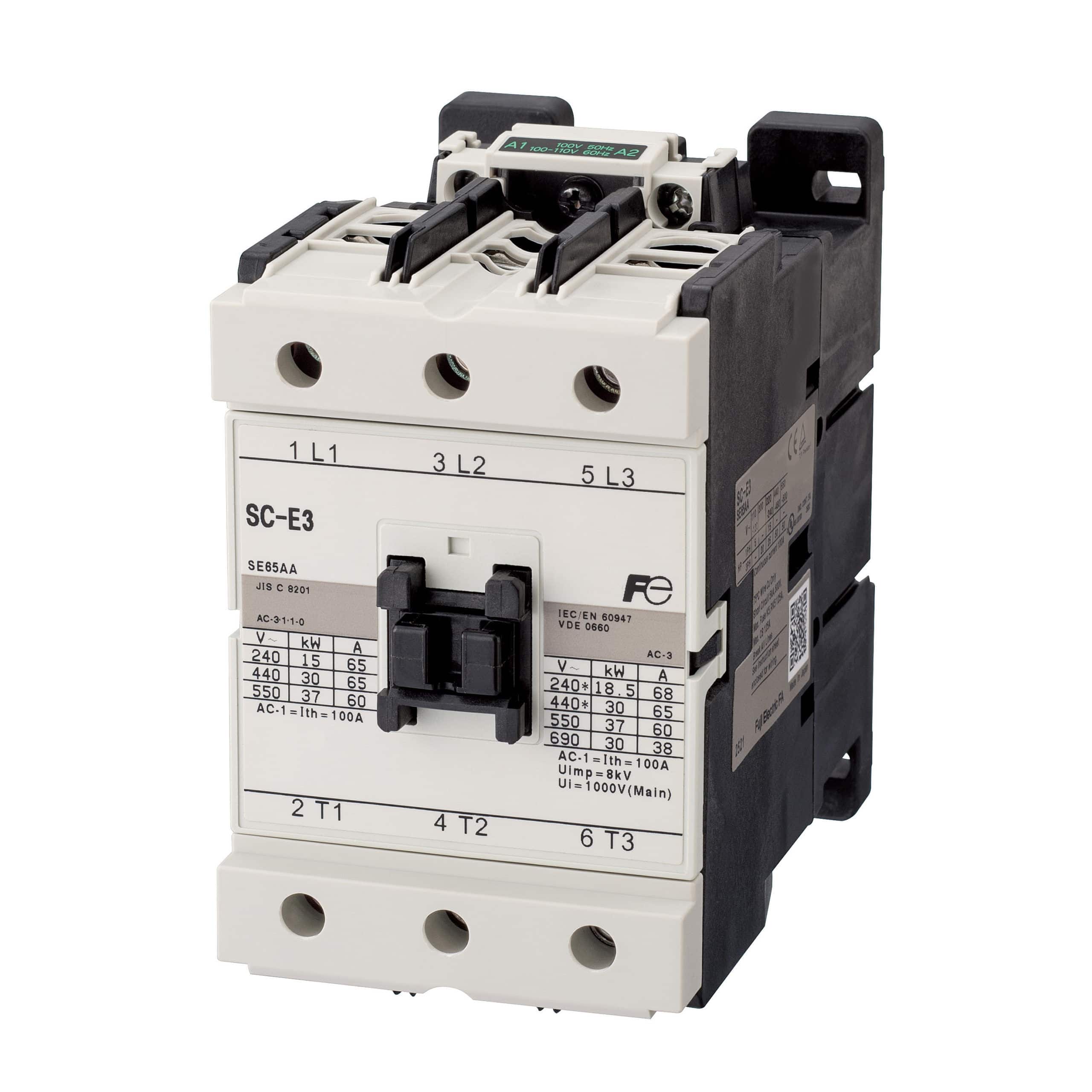
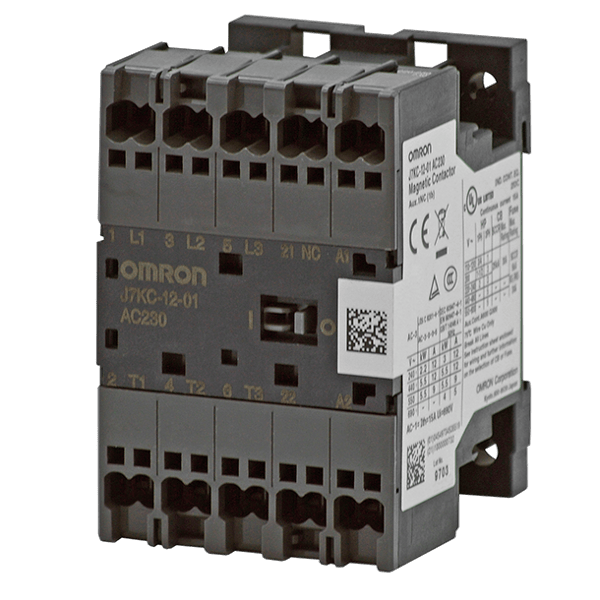
A contactor is an electromagnetically operated switch built to make and break power circuits under load, most often the supply to a three-phase motor. Unlike a control relay, it carries currents from a few amperes to thousands of amperes and integrates arc-quenching features so it can interrupt motor inrush and stall current without the contacts welding. In factory documents the contactor is the heart of a motor starter, working with a thermal overload relay for running protection and an upstream fuse or circuit breaker for short-circuit protection.
Selection turns on one idea that beginners miss: a contactor is not rated by a single ampere number but by a utilization category that describes the duty it will switch. The same frame can be rated 32 A for resistive heating, 18 A for plain motor starting, and 6 A for frequent reversing. This guide decodes those categories against IEC 60947-4-1, NEMA ICS 2, UL 60947-4-1, and IEC 60470, so you can match a device to a load with confidence.
This guide is written for industrial purchasing engineers and panel designers. Across 6 chapters it covers what a contactor is and how it switches, the families from low-voltage air-break to medium-voltage vacuum, AC and DC coil technology, NEMA versus IEC sizing and contact materials, the spec-sheet parameters that decide selection, and a step-by-step decision sequence, closing with 7 selection FAQs and verified maker comparisons. All ratings reference the public standards IEC 60947-4-1, NEMA ICS 2, UL 60947-4-1, IEC 60947-5-1, and IEC 60470.
Chapter 1 / 06
What is a Contactor
A contactor is an electrically controlled switch that opens and closes a power circuit by means of an electromagnet rather than a human hand. Energizing a control coil pulls a movable armature toward a fixed core, and the armature drags a set of bridging power contacts closed against their springs. Remove the coil voltage and the springs throw the contacts open again. Because the coil can be driven by a small control signal from a pushbutton, a PLC output, a timer, or a thermostat, one low-power command can switch a large AC motor, heater bank, or capacitor stack from a safe distance. This separation of a low-power control circuit from a high-power load circuit is the defining function of the device.
Mechanically a low-voltage contactor has five functional groups: the electromagnet (coil, fixed core, and movable armature), the return springs, the main power contacts (usually three poles for a three-phase load, sometimes four), the arc-quenching system, and a block of auxiliary contacts for control logic and signaling. The main contacts carry and switch the load. The auxiliary contacts, rated only for control-circuit currents, are used for hold-in seal circuits, interlocking, and status feedback to a PLC. Auxiliary contacts come as normally open (NO) and normally closed (NC) types, and a mechanically linked or mirror-contact NC auxiliary per IEC 60947-5-1 Annex L or IEC 60947-4-1 Annex F is required where a safety circuit must confirm the main contacts have actually opened.
The reason a contactor is not simply a large industrial relay is the arc. When contacts carrying a motor current part, the current does not stop instantly; it sustains an arc across the opening gap that can reach thousands of degrees and will erode or weld the contacts if not extinguished quickly. Low-voltage contactors fight the arc with insulated arc chutes that split and stretch the arc plus magnetic blowout that deflects it into cooling plates, while medium-voltage contactors open the contacts inside a sealed vacuum interrupter where the arc snuffs out at the first natural current zero. The quality and physics of the arc-quenching system, more than the contact metal alone, set the electrical endurance of the device.
The contactor sits inside a larger control assembly. A contactor plus a thermal overload relay sized to the motor full-load current forms a motor starter; add a short-circuit protective device (fuse or motor-protection circuit breaker) and you have a complete branch-circuit motor controller. Standards split the responsibilities cleanly: the contactor makes and breaks normal and overload current, the overload relay trips the coil on a sustained running overload, and the upstream fuse or breaker clears a genuine short circuit. Short-circuit coordination between the contactor and that upstream device is classified by IEC 60947-4-1 as Type 1 (the contactor may be damaged but stays safe) or Type 2 (no damage beyond light contact welding that can be separated, and the contactor remains serviceable). Where a load demands controlled acceleration or speed adjustment rather than plain across-the-line switching, a contactor is paired with or replaced by a soft starter or a variable frequency drive, which limit inrush and torque electronically.
Contactors are everywhere current must be switched repeatedly and remotely: motor control centers in factories, HVAC compressor and fan circuits, lighting and heating panels, pump and conveyor lines, lift and crane drives, capacitor banks for power-factor correction, and the high-voltage main of battery electric vehicles. The global market runs on a handful of standardized families and a few dominant makers, but the underlying selection discipline is identical at every scale: identify the load, choose the utilization category, then read the ampere figure that belongs to that category.
Chapter 2 / 06
Contactor Types and Families
Contactors split first by voltage class and arc-interruption medium, then by the load they are optimized for. The dividing line between low voltage and medium voltage sits at 1,000 V AC. Below it, air-break electromagnetic contactors with arc chutes dominate; above it, vacuum interruption takes over because air cannot reliably quench an arc at distribution voltages in a compact device. The table below maps the main families to their voltage class, interruption method, and typical service.
Family
Voltage Class
Interruption Method
Typical Service
LV air-break contactor
Up to 1,000 V AC
Air, arc chute + magnetic blowout
Motors, heaters, lighting, general loads
Modular (installation) contactor
Up to 440 V AC
Air, compact arc chamber
Building lighting, heating, DIN-rail panels
Capacitor-switching contactor
Up to 690 V AC
Air, with damping pre-charge resistors
Power-factor correction banks (AC-6b)
DC contactor
12 V to 1,500 V DC
Magnetic blowout, sealed/gas-filled
EV traction, battery, solar, traction supply
MV vacuum contactor
1 to 12 kV (7.2 / 12 kV)
Vacuum interrupter
MV motors, transformers, capacitor banks
Low-voltage air-break contactors are the default industrial device. Three power poles switch a three-phase load; a coil drives the armature; ceramic or thermoset arc chutes with steel splitter plates quench the arc. They are built and rated to IEC 60947-4-1 and UL 60947-4-1 (which superseded the older UL 508 for new electromechanical-contactor certifications) and range from roughly 9 A to over 1,000 A AC-3. This family covers the overwhelming majority of motor-starter, heater, and general switching duty in panels worldwide.
Modular or installation contactors are slim DIN-rail devices, often 1 to 4 pole, optimized for building services: corridor and car-park lighting, electric heating, and small pump control. They trade the heavy arc chute of an industrial contactor for compactness and quiet operation, are usually rated by AC-1 (resistive) and AC-7a/AC-7b (household and similar), and frequently offer a silent permanent-magnet or hand-auto override for installers.
Capacitor-switching contactors are a specialized air-break variant for power-factor correction in reactive power compensation systems. Energizing a capacitor bank produces a violent inrush that can reach 30 or more times the rated current, which would weld an ordinary contactor; these units add early-make auxiliary contacts with damping resistors that pre-charge the capacitors through a current limit before the main poles close. They are rated to utilization category AC-6b for capacitor-bank switching.
DC contactors serve a fundamentally harder interruption problem: a DC arc has no natural current zero, so it must be physically stretched and deflected by permanent-magnet blowout fields until it self-extinguishes, and polarity often matters at the terminals. Modern sealed, gas-filled (hydrogen-rich) DC contactors switch hundreds of amperes at 12 to 1,500 V DC and are the main battery-disconnect and pre-charge components in electric vehicles, energy-storage systems, solar inverters, and DC traction. Schaltbau, TE/Gigavac, and the EV-line products of the major makers are typical sources.
Medium-voltage vacuum contactors open their contacts inside a sealed ceramic vacuum interrupter. With no gas to ionize, the arc collapses at the first current zero and contact erosion is minimal, giving roughly 1 million mechanical operations and very high switching frequency. Built to IEC 60470, common ratings are 7.2 kV and 12 kV at 400 to 630 A, and they almost always pair with current-limiting MV fuses for short-circuit protection. They are the standard choice for medium-voltage motor starting, transformer feeders, and capacitor-bank switching in mining, petrochemical, and large pumping or compressor plants.
Chapter 3 / 06
Coil Technology and Operation
The coil is the brain of the contactor, and the single largest source of nuisance faults in the field. Coils divide into AC-operated, DC-operated, and the now-common electronically controlled wide-band coil. Each behaves differently at pull-in, while holding, and at drop-out, and those behaviors decide power burden, audible noise, dip ride-through, and how many control-wire variants a panel shop must stock. The table below compares the three coil types on the parameters that matter at selection.
Coil Type
Inrush vs. Hold
Operate / Release Band
Behavior and Use
AC coil
Inrush ~6 to 10x hold
85 to 110% rated; drop-out 60 to 70%
Needs shading ring; higher VA; common, low cost
DC coil
No inrush, constant
85 to 110% rated; slow decay
Quiet, cool, longer dip ride-through
Electronic wide-band coil
Managed, low burden
Wide, e.g. 24 to 60 V / 100 to 250 V
One coil covers AC/DC range; fewer variants
AC coils exploit a useful self-regulating effect. With the armature open the magnetic air gap is large, the coil impedance is low, and a large inrush current of roughly 6 to 10 times the holding value flows, generating a strong pull to close the contacts fast. As the armature seals, the air gap closes, impedance rises, and the current automatically drops to a low sealed value that will not overheat the coil. Because AC flux passes through zero twice per cycle, the pull force pulsates and would buzz the armature, so AC contactors carry a shading (shorting) ring set into the pole face that creates a lagging flux to bridge the zero crossings and hold the armature firm. AC coils are designed to operate over about 85 to 110 percent of rated voltage and to drop out cleanly at roughly 60 to 70 percent.
DC coils see only their ohmic resistance, so the current is constant and there is no inrush surge; the coil runs cooler and silent, and no shading ring is needed. The stored magnetic energy decays slowly when supply is removed, so a DC-held contactor rides through a brief voltage dip longer than an AC one before dropping out, which can be an advantage or a hazard depending on the application. The cost is that larger DC coils need an economizer or a pull-in/hold two-stage drive to limit steady heat, since they lack the AC coil's automatic current taper. DC coils are mandatory where the only control supply is a battery or DC bus.
Electronically controlled wide-band coils, marketed by several makers as universal or smart coils, put a small power-electronic interface in front of the magnet. They accept a wide range of AC or DC control voltage on the same part (for example 24 to 60 V or 100 to 250 V), regulate a clean pull-in surge and a low DC-style hold, cut power burden dramatically, and reduce the number of coil variants a panel builder must inventory. ABB built its AF range around this idea with a single coil covering 100 to 250 V AC/DC, and most premium IEC ranges now offer an electronic-coil tier.
Two coil ratings recur on every datasheet and are worth fixing in mind. Pickup (operate) voltage is the value at or below which all contacts are guaranteed to complete their travel as a de-energized coil's voltage is raised. Drop-out (release) voltage is the value at or above which all contacts are guaranteed to return to their de-energized state as an energized coil's voltage falls. The gap between them defines immunity to chatter on a sagging supply: too small a margin and a brown-out makes the armature hum and the contacts bounce, which is a classic root cause of contact welding. Pick-up and seal current, and therefore the coil VA burden, also fall as the contactor moves from open to sealed, which is why the inrush VA on a large AC contactor can be many times its holding VA and must be checked against the control transformer rating.
Chapter 4 / 06
Sizing Standards and Contact Materials
Two sizing philosophies coexist in the market, and confusing them is a frequent procurement error. NEMA sizing (under NEMA ICS 2) assigns a contactor to a fixed frame size, 00 through 9, each with a generous safety margin, so the same frame serves a band of loads with comfortable headroom. IEC sizing (under IEC 60947-4-1) rates a contactor closely to a specific application through its utilization category and rated power, producing a smaller, lighter, lower-cost device that demands accurate selection. North American panels lean NEMA for robustness and field interchangeability; European and OEM panels lean IEC for density and cost. The NEMA frame table below gives the continuous current and three-phase motor horsepower the standard assigns at 460/480 V.
NEMA Size
Continuous Current (A)
Max Motor HP at 460/480 V (3-ph)
Size 00
9
2
Size 0
18
5
Size 1
27
10
Size 2
45
25
Size 3
90
50
Size 4
135
100
Size 5
270
200
Size 6
540
400
Size 7
810
600
Size 8
1,215
900
The IEC approach replaces the frame number with the utilization category and the rated operational current at a given voltage. The same physical contactor will carry three different ampere ratings depending on the load it switches, because the making and breaking duty differs by category. AC-1 (resistive) is the easiest duty and yields the highest ampere figure; AC-3 (motor starting, makes at high inrush but breaks at run current) yields a lower one; AC-4 (plugging, inching, reversing, makes and breaks at high inrush) yields the lowest, often around one third of the AC-3 value for the same frame. Selecting an AC-3-rated unit for a load that actually inches or reverses is a leading cause of premature contact failure.
Contact material is the other half of endurance. Silver tin oxide (AgSnO2) is the modern default for motor and power switching: it resists arc erosion and, critically, resists welding under high making currents, and it has displaced the older silver cadmium oxide (AgCdO) on both performance and environmental grounds (cadmium is restricted under RoHS). Silver nickel (AgNi) suits lighter, higher-frequency switching with low contact resistance. Fine-grain silver or silver-graphite appears in special duties. The contact metal sets resistance, temperature rise, and weld resistance, but it cannot rescue an undersized device: endurance is the product of correct utilization-category selection, the arc-quench design, and the contact alloy together.
Two endurance numbers appear on every serious datasheet. Mechanical life is the number of no-load operations the mechanism survives, commonly 10 to 30 million operations for a quality low-voltage contactor, limited by spring fatigue and pivot wear. Electrical life is the number of load-switching operations the contacts survive before erosion ends their service, commonly 1 to 2 million at AC-3 rated load and sharply fewer at AC-4 or above rated current. Manufacturers publish electrical-endurance curves of operations versus breaking current for each category; reading the curve at your actual breaking current and operations-per-hour, rather than trusting a single headline number, is the difference between a device that lasts a plant's life and one that needs annual replacement.
Short-circuit coordination ties the contactor to its upstream protection. IEC 60947-4-1 defines Type 1 coordination, where a fault may damage the contactor and overload relay but the device stays safe and the fault is contained, and Type 2 coordination, where after a fault the contactor suffers no damage beyond light, separable contact welding and remains serviceable. Type 2 demands matching the contactor to a specified fuse or motor-protection breaker; manufacturers publish coordination tables listing the exact upstream device, its rating, and the resulting type for each contactor. Specifying Type 2 with the wrong fuse silently voids the rating.
Chapter 5 / 06
Key Specification Parameters
A contactor datasheet can list 20 or more lines, but a focused set drives selection. The parameters below are the ones that decide whether a device fits a load and survives its service life. Read them in the order given, because several depend on the one before.
Utilization category and rated operational current (Ie): the master pair. Ie is always quoted against a category and a rated operational voltage (Ue), for example 18 A AC-3 at 400 V. Do not compare two contactors on a bare ampere number; compare them at the same category and voltage. A contactor with a high AC-1 figure may have a modest AC-3 figure and a small AC-4 figure on the same frame.
Rated operational voltage (Ue) and rated insulation voltage (Ui): Ue is the working system voltage the contactor is rated to switch (commonly up to 690 or 1,000 V AC for LV devices); Ui is the higher voltage its insulation is designed and tested to withstand, with rated impulse withstand voltage (Uimp, typically 6 or 8 kV) covering switching and lightning transients. Ue must match your system; Ui and Uimp govern clearance and creepage for safety.
Number and arrangement of poles: three-pole for a standard three-phase load, four-pole where a switched neutral or a fourth power path is needed. Confirm the count of built-in auxiliary contacts and the maximum that can be added by snap-on blocks, and whether a mechanically linked (mirror) NC auxiliary is available for safety feedback per IEC 60947-5-1 Annex L.
Coil specification: control voltage and whether AC, DC, or electronic wide-band; operate and release voltage band (commonly 85 to 110 percent operate, 60 to 70 percent drop-out for AC); inrush and holding VA or W; and the time to close and to open. Match the inrush VA against the control transformer; match the coil voltage to the control supply exactly.
Endurance: mechanical life in operations (10 to 30 million typical for quality LV contactors) and electrical life in operations at the relevant category, ideally read from the published endurance curve at your breaking current. Confirm the maximum operating frequency in operations per hour, which for AC-4 duty is far lower than for AC-3.
Short-circuit data: rated conditional short-circuit current (Iq) with the specified protective device, and the Type 1 or Type 2 coordination classification with that device. A contactor is only as safe as the fuse or breaker it is coordinated with; quote the upstream device alongside.
Connections, mounting, and ratings of the package: terminal type and conductor range (screw, spring, or ring-lug technology), DIN-rail or panel mounting, frame width for panel density, ambient temperature derating (ratings are typically given at 40 to 60 degrees C and must be derated above), and enclosure or component ingress rating. Add certifications: UL 60947-4-1 / CSA for North America, CE and the relevant IEC marks for Europe, plus CCC for China and marine or rail approvals where the project demands them.
One subtlety repays attention: the difference between thermal current (Ith), the maximum continuous current the contacts can carry without switching, and the operational current Ie tied to a switching category. A contactor may carry 40 A continuously (Ith) yet be rated only 18 A AC-3, because carrying current and breaking inrush current are different stresses. Sizing on Ith alone, ignoring the switching category, is a classic and expensive selection mistake.
Chapter 6 / 06
Selection Decision Factors
To turn the preceding chapters into a specific part number, follow the sequence below. Most selection failures come not from one wrong number but from deciding the ampere rating before the load duty is understood. These steps double as a fixed RFQ template.
Define the load and duty: motor, heater, lighting, or capacitor bank, and how it is switched: plain across-the-line start, or frequent inching, plugging, and reversing. This fixes the utilization category (AC-1, AC-3, AC-4, AC-6b, or a DC category) before any ampere figure is read.
Set voltage and current: the system rated operational voltage (Ue) and the motor full-load current or load current. Pick a contactor whose Ie at that category and voltage equals or exceeds the load; for AC-4 duty read the AC-4 column, not AC-3.
Choose poles and auxiliaries: three or four power poles, plus the count of NO and NC auxiliary contacts for the seal-in, interlock, and feedback logic, including a mirror NC contact if a safety circuit must confirm contact opening.
Specify the coil: control voltage and AC, DC, or electronic wide-band type, with the operate and release band suited to your supply stability, and the inrush VA checked against the control transformer.
Coordinate short-circuit protection: choose the upstream fuse or motor-protection circuit breaker and confirm Type 1 or Type 2 coordination from the manufacturer's table, with the rated conditional short-circuit current (Iq) at or above the prospective fault current.
Check endurance against duty: read the electrical-life curve at your breaking current and operations per hour, not just a headline number, and confirm the mechanical life and maximum operating frequency cover the application's switching rate.
Set environment and package: ambient temperature derating above 40 to 60 degrees C, altitude, vibration, ingress rating, terminal and conductor type, DIN-rail or panel mount, and frame width for panel density.
Confirm certifications and ecosystem: UL 60947-4-1 / CSA, CE/IEC, CCC, and any marine or rail approval; plus accessory availability (overload relays, auxiliary blocks, mechanical interlocks for reversing, and coil surge suppressors that match the frame).
A last dimension that purchasing often overlooks is manufacturer serviceability and ecosystem fit: whether the maker offers a coordinated family of overload relays, auxiliary blocks, reversing interlocks, and coil-suppression modules that snap onto the same frame, and whether spare parts and replacements remain available across a panel's 10 to 20 year service life. The dominant low-voltage families are Schneider Electric TeSys (TeSys D for general motor duty roughly 9 to 150 A, TeSys F and Giga for larger frames, with patented EverLink terminals), Siemens SIRIUS (the 3RT2 range covering motors to about 95 A and 3RT.3 four-pole devices to 525 A), ABB AF (built around a single electronically controlled coil spanning 100 to 250 V AC/DC to cut coil variants), and Eaton XT and DILM (the Cutler-Hammer and Moeller IEC lines, alongside Eaton's NEMA Freedom range for North America). For medium voltage, vacuum contactors from Eaton, ABB, Siemens, and specialist makers cover 7.2 and 12 kV motor and capacitor duty. Choosing within one coherent ecosystem, rather than mixing frames, is what keeps a control panel maintainable for its full life.
FAQ
What is the difference between a contactor and a relay?
Both are electromagnetically operated switches, but a contactor is built to make and break load currents from a few amperes up to thousands of amperes, while a control relay typically switches small signal-level loads below 10 A. Contactors add arc-quenching features (arc chutes, blowout coils, magnetic deflection, or a vacuum interrupter) so they can interrupt the inrush and stall current of a motor without contact welding. Contactors are normally three-pole or four-pole power devices with separate auxiliary contacts, are rated by IEC 60947-4-1 utilization category, and almost always fail safe to the open position. Relays are usually single-pole or double-pole, rated by IEC 61810, and are chosen for logic switching rather than power switching.
What do AC-1, AC-3 and AC-4 utilization categories mean?
Utilization categories under IEC 60947-4-1 define the making and breaking duty a contactor is tested for. AC-1 covers non-inductive or slightly inductive loads with power factor at or above 0.95, such as resistive heaters and incandescent lighting, where making and breaking both occur at roughly rated current. AC-3 covers squirrel-cage motor starting: the contactor makes at about 6 times rated operational current (the motor inrush) but breaks at only 1 times rated current while the motor runs, which is the most common motor-control rating. AC-4 covers plugging, inching, and reversing, where the contactor must both make and break at around 6 times rated current repeatedly, the harshest duty, so the same frame is derated to a much lower ampere figure.
Should I choose an AC coil or a DC coil?
An AC coil draws a high inrush of roughly 6 to 10 times its holding current at pull-in because the air gap is open and impedance is low, then settles to a low sealed current; it needs a shading ring to suppress chatter at the AC zero crossings, and it drops out fast (typically at 60 to 70 percent of rated voltage) when supply is lost. A DC coil draws a constant current, runs cooler and quieter, has no inrush surge, and holds in longer on a voltage dip, which is why DC and electronically controlled wide-band coils (for example 24 to 60 V or 100 to 250 V universal coils) are preferred for control panels fed by a PLC or PSU. Many modern contactors use a DC-operated electronic coil even on AC supplies to cut power burden and stocking variants.
What is the difference between NEMA and IEC contactor sizing?
NEMA sizing (NEMA ICS 2) assigns a fixed frame size (00, 0, 1, 2 up to 9) with a generous safety margin, so a NEMA Size 1 is rated 27 A continuous and 10 hp at 480 V regardless of the exact load, which makes it physically larger, more expensive, and forgiving of derating. IEC sizing (IEC 60947-4-1) rates a contactor to the specific application by utilization category and rated power so the device is matched closely to the motor, giving a smaller, lighter, lower-cost unit but with less inherent margin. North American panels often specify NEMA for robustness and field interchangeability; European and OEM panels favor IEC for density and cost. A correctly sized IEC AC-3 contactor and a NEMA frame can switch the same motor, but the IEC unit demands accurate selection.
What causes contactor contact welding and how is it prevented?
Welding happens when the contacts carry an arc or high current long enough to melt and fuse the silver-alloy tips. The common causes are undersizing the contactor for the actual making current (for example using an AC-3 unit on AC-4 plugging duty), excessive operating frequency beyond the rated operations per hour, contact bounce from a marginal or chattering coil supply, and switching a short circuit that exceeds the rated conditional short-circuit current. Prevention means correct utilization-category selection, a stable coil voltage within 85 to 110 percent of rated, proper Type 2 short-circuit coordination so the upstream device clears faults before the contactor parts, and respecting the electrical life curve. Silver tin oxide (AgSnO2) contact material resists welding far better than silver cadmium oxide.
What is the difference between mechanical life and electrical life?
Mechanical life is the number of no-load switching operations the moving parts (armature, springs, pivots) survive before wear, commonly 10 to 30 million operations for a quality low-voltage contactor. Electrical life is the number of operations the contacts survive while making and breaking the rated load current, where each break draws an arc that erodes the contact tips, typically 1 to 2 million operations at AC-3 rated load and far fewer at AC-4. Electrical life falls sharply as the switched current and utilization category severity rise, so manufacturers publish electrical-endurance curves of operations versus breaking current per category. A contactor reaches the end of life when contact erosion raises resistance and temperature, not when the mechanism wears out.
When do I need a vacuum contactor instead of an air-break contactor?
Air-break contactors with arc chutes are standard up to roughly 1,000 V AC and cover most low-voltage motor and heater duty. When the system is medium voltage (typically 1 kV to 12 kV, with common ratings of 7.2 kV and 12 kV and currents to 400 to 630 A) or the duty demands very high switching frequency with long maintenance-free life, a vacuum contactor is used: the contacts open inside a sealed vacuum interrupter where the arc extinguishes at the first current zero with minimal contact erosion. Per IEC 60470, vacuum contactors deliver around 1 million mechanical operations and switch motors, transformers, and capacitor banks frequently, usually combined with current-limiting fuses for short-circuit protection. They are the norm for MV motor starting in mining, petrochemical, and large pump or compressor plants.
Contactor Manufacturers
Source-backed product routes. Open a company dossier for procurement scope and cited evidence.