
AGV robot selection in food and beverage plants is dominated by three hardware gates: IP65 or higher enclosure rating, food-grade contact surfaces (typically 304/316 stainless, NSF/ANSI 169 or EHEDG Doc. 2 compliant), and a navigation stack that survives wet, reflective floors [S1][S2].
Plants running dairy, beverage, bakery, and cooked-meat lines typically pair tugger AGVs (1500-3000 kg drawbar pull) with underride carts for case transport, or unit-load AGVs (1000-1500 kg deck load) for pallet moves between warehouse and production [S1]. Across all classes, the AGV must coexist with a hygienic envelope: sealed cable glands, sloped top decks (≥15° drainage angle) so washdown water runs off, and no internal cavities that trap product residue [S2].
Matching AGV Class to Line Type and Throughput
Food and beverage plants split cleanly into three AGV duty profiles, each with a different sweet spot for payload, speed, and footprint [S1].
Unit-load AGVs with 1000-1500 kg deck capacity and lift-mast or roller-top decks handle pallet moves from warehouse dock to production entry, typically at 1.0-1.5 m/s. Tugger AGVs pulling two to four wheeled carts at 1500-3000 kg gross train weight cover case and tray moves between processing and packaging at 1.2-2.0 m/s. Mobile manipulators (an AGV robot base married to a 6-axis arm) target end-of-line palletising, with a typical 10-20 cycles per minute and a 5-10 kg pick payload. For sub-zero meat, seafood, or cold dairy docks (0-4 °C chill, -25 °C frozen), chassis electronics, batteries, and grease must be derated or replaced with low-temperature variants; standard LiFePO4 packs lose roughly 20-30% of usable capacity at -20 °C unless an active battery heater is fitted [S1].
Hygienic Envelope: IP, Materials, and Cleanability
The single hardest selection gate in food and beverage AGV deployment is the hygienic envelope, not the navigation stack [S2].
Washdown environments demand at least IP65 on the chassis (dust-tight, resistant to low-pressure water jets from any direction), with the battery compartment and service connectors rated to IP67 if the AGV is cleaned in place. Top-deck material should be 304 stainless for dry packaged-goods zones and 316 stainless for high-salt, dairy-CIP, or seafood zones, with all welds ground to Ra ≤0.8 µm to prevent biofilm harborage. The EHEDG zone concept (commonly split into dry, splash, and washdown zones) maps directly to AGV top-deck and wheel-deck requirements, and a properly sealed AGV can move across all three zones without a re-cleaning step [S2]. Cables routed through sealed glands, laser scanners recessed behind flush-mounted windows, and field-replaceable wheels (no internal gear oil reservoirs) are the most common failures found in the first six months of operation when the spec is loose on these points.
Navigation Choice Under Wet, Reflective Floors

Food and beverage floors are wet, often slick with fat or sugar film, and frequently polished concrete or resin-coated to meet hygiene rules, which is a hostile environment for magnetic-tape and inductive-loop guidance [S1].
Laser-SLAM navigation (safety-rated 2D LiDAR, typical 30 m range, 270° field of view) is the dominant spec for new greenfield plants, because it needs no floor cuts and survives the wet-and-reflective conditions that confuse vision-only stacks. QR- or 2D-code fiducials on the floor remain common for high-rack forklift AGVs, where 10 mm position repeatability is needed at the rack bay; the trade-off is floor maintenance and slip risk on wet lines. Magnetic-tape guidance is the lowest first-cost option but is brittle under scrubbers and CIP runoff, and is typically restricted to dry, low-traffic, single-purpose loops. For mixed-traffic lines with pedestrian zones, add a top-mounted 3D obstacle-detection scanner so the AGV slows or stops when a worker enters a 1.5-2.0 m envelope, which also keeps the AGV inside ISO 3691-4 safety-case language for driverless industrial trucks.
Power, Charging, and Battery Safety in Washdown Zones
Battery selection is the second most-failed gate in food and beverage AGV tenders, mainly because standard Li-ion and lead-acid packs were not designed for wet cleaning [S1].
LiFePO4 (LFP) chemistry is now the near-default for new food-grade AGVs because of its thermal stability (thermal-runaway onset typically above 250 °C versus 150 °C for NMC) and its tolerance of the daily partial-state-of-charge cycling that shift work demands. Opportunity charging at 30-80 kW DC, with the charger contacts rated to IP65 and the contactor interlocked to the AGV's safety PLC, keeps a 24/7 beverage line in service without battery swaps. For 2 °C and colder zones, the battery box must include a silicone-pad heater drawing 200-400 W from the charger between shifts, and the cells should be specced for -20 °C discharge at 0.5C minimum. Charging bays must sit outside splash and washdown zones, otherwise the floor around the bay becomes a contamination and slip hazard and breaches the EHEDG zone model that the rest of the line is designed to [S2].
Integration with Palletising, Packaging, and Traceability
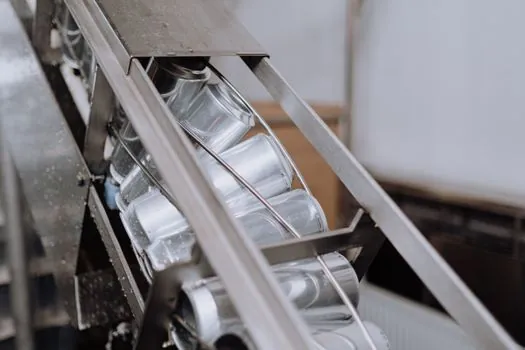
An AGV in a food plant is rarely useful on its own; the business case is the integration of transport with upstream packaging and downstream palletising [S1].
For end-of-line palletising, an AMR robot base fitted with a 6-axis arm and a vacuum or clamp end-effector replaces a fixed palletiser and frees the floor for product changeovers; cycle time is 8-15 picks per minute for 5-10 kg cases, with placement accuracy of ±5 mm enough for most slip-sheet and tier-sheet patterns. Traceability hooks ride on the AGV's WMS/MES link (typically OPC UA over MQTT or REST): the AGV reads a 1D/2D barcode on the pallet or tote at pickup, pairs it with the route and the destination conveyor or staging lane, and writes the timestamp to the lot record. This same data path is what ties the AGV into the supplier-side chain for food processing equipment supply chain 2026: spec anchors and shock buffers, where spec locks on motors, drives, and bearings are written into the AGV BOM at order time.
Common Failure Modes and Sourcing Cautions
The most common food-and-beverage AGV failures in the first 18 months are wheel-motor seal leaks, scanner-window fogging, and battery-heater short cycling in cold rooms [S1][S2].
Wheel-motor seal leaks trace back to IP65 specified on the AGV body but only IP54 on the wheel hub, which is the first point of CIP splash exposure; spec both to IP67. Scanner-window fogging comes from temperature swing between cold-store and washdown; either specify heated optical windows or accept a 5-10 minute warm-up delay after door opening. Battery-heater short cycling happens when the heater thermostat is undersized for the cell mass; overspec the heater by 50% and add insulation to the battery box. For sourcing, insist on the AGV supplier providing a hygienic-design file (surface-finish table, seal schedule, lubrication list) and on the lubricants being food-grade H1 registered, a rule that also governs the adjacent Food-Grade Ball Bearing Selection: Material, Lubricant, and Seal Gates on the same conveyor and AGV wheels. Two verifiable next nodes: confirm the AGV's safety PLC is ISO 3691-4 certified, not just a generic CE declaration, and verify the navigation vendor has a wet-floor reference site running for at least 12 months.
The underlying component specifications are covered under lighting equipment and electric lamps.