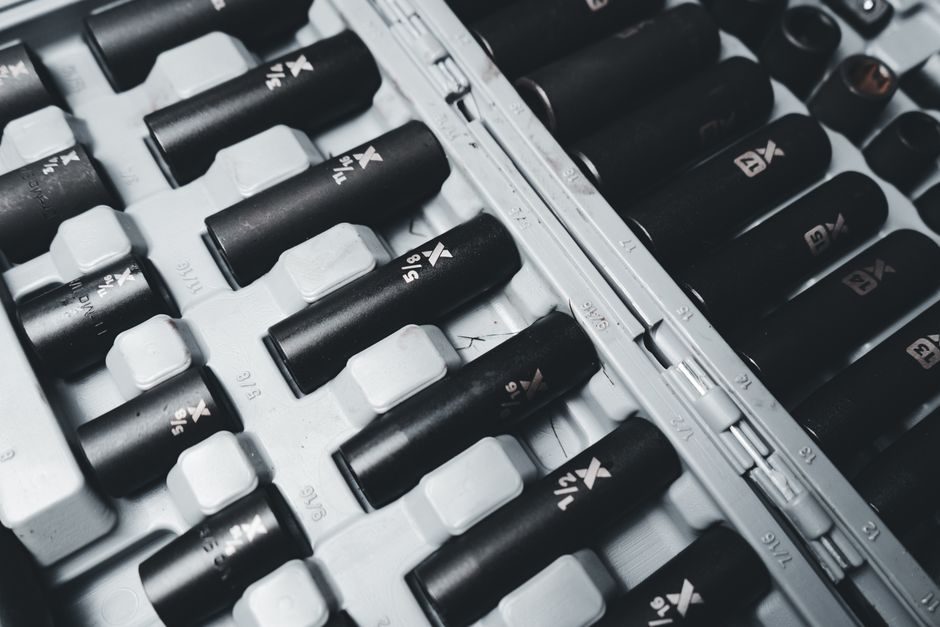
A pneumatic air impact wrench is the right tool when the job repeats the same high-torque rundown hundreds of times a shift and shop-air is already on the wall. The 2026 Taiwan-sourced product slate, anchored by suppliers on CENS and Made-in-China.com, segments cleanly by square drive: 1/4" and 3/8" for assembly and small-engine work, 1/2" for automotive and light-truck service, 3/4" for heavy-vehicle and agricultural wheel nuts, and 1" for mining, rail and off-road tire work [S2][S8][S10].
Selection in 2026 comes down to four correlated numbers — square drive, max torque (ft-lb or N-m), free speed (RPM) and average air consumption at 25% duty (SCFM) — plus a clutch mechanism decision (rocking-dog / pin / twin / hammer). The data set below is enough to build a side-by-side short list before the first phone call to a vendor.
Drive-Size Buckets and the Torque They Actually Deliver
A 3/4" pro wrench from a Taiwan maker is rated 550 ft-lb (TI-5060) and 600 ft-lb (TI-5061) maximum torque, both built around a rocking-dog / pin clutch [S2]. One step up, an export-spec 3/4" twin-clutch model posts 1000 ft-lb (1356 N-m) max torque at 4500 RPM free speed, 11.2 SCFM average air consumption at 25% duty, 90 psi / 6.3 kg/cm² working pressure, 3/8" NPT air inlet, 200 mm length, 3.9 kg bare weight [S9]. The 1" drive category is dominated by two-piece export packs shipping 22.8 / 24.8 kg per carton at 1.64 cu-ft, and four-piece 3/4" packs at 20.4 / 22.6 kg per 1.15 cu-ft [S8][S10].
For 1/2" drive, the Made-in-China catalog on 2026-04-15 shows a "1300 ft-lb" pneumatic unit at 7500 RPM free speed sitting in the US$ 99-399 wholesale band with a 20-piece MOQ, while a brushless cordless competitor from the same listing climbs to US$ 1500-6000 per piece [S5]. The cordless number matters only as a reference ceiling: it tells a buyer that a 1/2" air tool at one-tenth that price is the rational shop-floor pick when the airline is already plumbed.
Clutch Type, Free Speed and Why Both Numbers Are Coupled
Clutch mechanism dictates the feel and the duty cycle a wrench will tolerate. Rocking-dog / pin clutches (TI-5060, TI-5061) are the workhorses below ~700 ft-lb and survive impact-shop abuse; twin-clutch designs push the rating past 1000 ft-lb while keeping the handle shorter and the balance better for vertical work on wheels [S2][S9]. Hammer clutches dominate the 1" class because the inertial mass is what breaks the fastener loose, not the motor.
Free speed tracks clutch selection: the 3/4" twin-clutch sample runs 4500 RPM [S9], the 1/2" pneumatic catalog unit runs 7500 RPM [S5], and 1" heavy-duty wrenches typically settle in the 4000-5500 RPM band. Higher free speed does not mean higher delivered torque — delivered torque is set by the hammer or clutch pack and the air-stall pressure. A buyer chasing "fast" by RPM alone is buying a tool that strips fasteners; a buyer chasing "max torque" without checking free speed is buying a tool that will not actually spin a wheel off in the field. Pair the two: 4500 RPM + 1000 ft-lb for 3/4" truck work, 7500 RPM + 1300 ft-lb for 1/2" production assembly [S5][S9].
Air Supply Budget: SCFM, Inlet Size and Hose Diameter
Average air consumption at 25% duty cycle is the single most underspecified number in casual buying. The 3/4" twin-clutch reference is 11.2 SCFM at 90 psi (6.3 kg/cm²) through a 3/8" NPT inlet [S9]. A 1/2" shop tool at 7500 RPM will pull 4-6 SCFM; a 1" mining wrench commonly pulls 14-25 SCFM depending on free speed and stall. The compressed-air supply chain — compressor CFM at 90 psi, 1/2" or 3/4" main, 3/8" or 1/2" drops, quick-coupler bore — must deliver this or the tool runs below stall pressure and the rated torque number is fiction.
Translated to hardware: a shop planning ten 1" impact wrenches running 30% duty needs a compressor in the 60-80 SCFM class, not the 20 SCFM pancake unit that comes with a starter kit. Quick-couplers under 1/4" NPT bore will throttle a 3/4" wrench even if the hose and compressor are correct; the 3/8" NPT inlet on the reference model is the floor for that class [S9]. When in doubt, walk the airline, not the catalog.
Spec Comparison: 1/2" Pneumatic vs 3/4" Pneumatic vs 1" Pneumatic
Three decision criteria separate the buckets cleanly. Max torque: ~1300 ft-lb for 1/2", ~550-1000 ft-lb for 3/4", and roughly 1500-2500 ft-lb for 1" [S2][S5][S9]. Free speed: 7500 RPM (1/2") > 4500 RPM (3/4" twin-clutch) ≈ 4000-5500 RPM (1") [S5][S9]. Average air at 25% duty: ~4-6 SCFM (1/2"), 11.2 SCFM (3/4" twin-clutch), 14-25 SCFM (1") [S9]. A buyer who needs fastener-removal authority on truck or off-road wheel nuts should sit in 3/4" twin-clutch; production-line assembly of small fasteners belongs in 1/2"; mining, rail and large-construction tire work belongs in 1".
Weight and ergonomics tell a second story. The 3/4" twin-clutch sample is 3.9 kg at 200 mm length [S9], a 1" export pack is 22.8-24.8 kg per pair of tools in a 1.64 cu-ft carton [S10], and the typical shop 1/2" sits around 2-3 kg. Heavier does not equal stronger beyond the clutch rating; it usually means a larger hammer or a twin-motor housing. Specify by clutch type and rated torque, then accept the weight that comes with it.
Use-Case Mapping: Who the Wrench Is For, and Who Should Walk Away

Air impact wrenches are for shops that already pay for compressed air, run the tool through a full shift, and need repeatable torque on the same fastener class. Automotive repair bays, tire shops, heavy-truck depots, agricultural equipment dealers, mining tire crews, and production assembly lines are the core buyers. Mobile mechanics who do not have a tow-behind compressor and field service crews working off a small gas-powered piston compressor should look at cordless brushless impact wrenches instead — the air-supply chain will not keep up with the rated SCFM. [S1]
Home-shop buyers who pull a wheel nut off twice a year are over-spec'd by anything 3/4" and over-budget by anything 1/2" pneumatic. For that workload, a cordless 1/2" brushless in the US$ 99-399 wholesale range visible on the 2026 catalog is the right answer [S5]. Reach for air only when the duty cycle is measured in shifts, not weekends.
Common Failure Modes and What the Spec Sheet Hides
Three failure modes dominate warranty returns. Stall under load from undersized airline: the wrench runs fine free, then dies on a seized lug, and the operator blames the motor — the cause is pressure drop across the hose and coupler, not the tool. Worn hammer pins or cracked dog ears on rocking-dog clutches after 12-18 months of daily impact-shop use, accelerated by dry airlines; an FRL (filter-regulator-lubricator) on the drop is non-optional for a 1" class tool. Exhaust freeze in cold weather when the handle-exhaust design [S9] vents into the operator's palm; the engineering fix is a down-handle exhaust or a hose kit, both worth specifying before the first winter.
Two spec-sheet traps are worth flagging. "Max torque" is a stall or break-away number, not a working-tightening number — for controlled tightening to a target, spec a torque wrench and a torque wrench tester downstream of the impact. "Free speed" is no-load; under load a pneumatic impact typically runs 60-70% of free speed, which is why a 4500 RPM rating still feels deliberate on a 3/4" wheel job [S9].
Sourcing Signals and 2026 Market Reality
Taiwan remains the dominant origin for mid-to-high end air impact wrenches: the TI-5060 / TI-5061 spec sheet and packing data (2 pcs / 4 pcs per export carton, dimensional weight in kg and cu-ft) on CENS are representative of how a serious Taichung supplier quotes an OEM or distributor buyer [S2][S8][S10]. Mainland-China suppliers, surfaced through Made-in-China.com and Alibaba product groups, span the full range from sub-US$50 private-label 1/2" units to US$1500-6000 industrial hydraulic-class offerings; verify by checking MOQ, audit status, and whether the spec sheet publishes SCFM at 25% duty rather than the marketing number "max airflow" [S5][S6].
Two signals to track over the next procurement cycle: continued migration of 1/2" pro tools from brushed pneumatic to brushless cordless at the consumer end of the catalog, and parallel demand for higher-SCFM 3/4" and 1" pneumatic units from the heavy-vehicle and mining-tire segments, which the 2026 export carton data still shows growing in piece count [S5][S8][S10]. For a structured spec pass, pair this guide with a planetary reducer selection sheet when the impact wrench is part of a fixtured torque station, and review the air pick page if the same shop also runs chipping hammers on the same airline.