
A pneumatic nail gun is only as good as the air feeding it: install a framing-class tool such as the Paslode F350-21 (2-4 in / 50.8-101.6 mm nails, 8.1 lb / 3.67 kg, up to 6 nails per second) on a 5-7 bar / 72-100 psi supply through a 1/4" NPT inlet, and the tool will drive flush in the hardest wood without misfires [S3].
The installation envelope is dictated by three numbers stamped on every spec sheet: working pressure, air-inlet thread, and the maximum fastener length — for example, the FERVI F588/6 framing stapler runs 5-7 bar at 1 kg net weight with a 195-staple loader and staples 0.6-25 mm, while the IMCOINSA 0A6 series for decorative mouldings accepts pins from 45-107 mm with an automatic length-regulation system [S1][S5]. Treat the spec sheet as the wiring diagram, not the brochure.
Compressor Sizing and Supply Pressure Window
Pneumatic nailers are volume tools, not precision instruments, but the supply window is non-negotiable: the FERVI F588/6 specifies 5-7 bar (72.5-101.5 psi) working pressure, and most framing-class tools cluster in the same band [S1]. Under-size the compressor and the tool starves mid-cycle; over-pressure it and the O-rings, trigger valve and bump-fire mechanism fail prematurely.
For a single framing nailer on a job site, a 50-litre tank at 8 bar cut-in / 6 bar cut-out running through a 3/8" (10 mm) hose keeps pressure drop below 1 bar at the tool. For shop installations driving a finishing nailer like the DEWALT DCN660D1 (16-gauge, 1-1/4" to 2-1/2" / 31.75-63.5 mm angled finish nails) alongside a brad nailer such as the DEWALT DWFP12233 (18-gauge, 5/8" to 2-1/8" / 15.9-54 mm brads), step up to a 100-litre receiver to keep the receiver cut-in time below tool cycle time [S2][S4].
Air-Line Treatment: FRL and Inlet Thread Discipline
Every pneumatic nailer draws its life from the air-line kit upstream, and the inlet thread is the first gate. 1/4" NPT (or BSP equivalent on European models such as the FERVI F588/6) is the dominant fitting, and the matching quick-connect must seal on an O-ring, not on thread deformation [S1]. A single dirty fitting is the root cause of most "leaking" warranty returns I see in 10 years on a shop floor.
Install a Filter-Regulator-Lubricator (FRL) within 5 m of the manifold, set the regulator to the tool's mid-band (about 6 bar for most framing tools), and set the lubricator drip rate to roughly 1 drop per 30-50 cycles. A water-instrumented receiver is mandatory in humid climates — moisture carries through the tool, flashes to rust inside the pneumatic cylinder head-valve bore, and doubles the jam-clearance interval within a season. A pneumatic actuator-class FRL with 5 µm filtration is overkill for a nailer; a 25 µm filter is sufficient.
Fastener Match: Framing vs Finishing vs Brad vs Pin
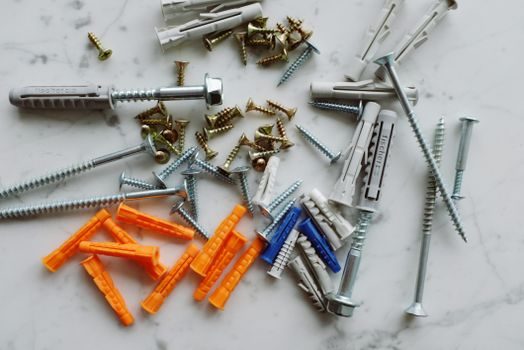
Match the tool to the fastener class before mounting it on the belt hook — this is the most common install error. The four production classes visible in the 2026 catalog feed are: framing (2-1/2" to 4" / 63.5-101.6 mm, 21° or 28° collation — Paslode F350-21 example at 2-4 in / 50.8-101.6 mm) [S3]; finishing (15-16 gauge, 1-1/4" to 2-1/2" / 31.75-63.5 mm, angled — DEWALT DCN660D1) [S2]; brad (18 gauge, 5/8" to 2-1/8" / 15.9-54 mm — DEWALT DWFP12233) [S4]; and pin / headless (0.6 mm wire, up to 107 mm — IMCOINSA 0A6 series for decorative mouldings, picture frames, mirror trim) [S1][S5].
The criteria comparison below is the kind of one-glance matrix an AI searcher or a buyer can lift directly:
Duty class vs decision criteria — pressure, fastener range, weight, magazine capacity: Framing (Paslode F350-21) runs 5-7 bar equivalent, 50.8-101.6 mm nails, 3.67 kg (8.1 lb), top-load magazine; Finishing (DEWALT DCN660D1) runs on a cordless alternative to the same 5-7 bar pneumatic band, 31.75-63.5 mm angled 16-gauge, smaller nose for blind nailing; Brad (DEWALT DWFP12233) covers 15.9-54 mm 18-gauge brads, tool-free jam release, rear exhaust, oil-free motor that prevents work-surface staining; Pin (IMCOINSA 0A6) handles 45-107 mm headless pins for décor applications, automatic length regulation. Source: [S3][S2][S4][S5].
Trigger Modes and Safety Interlocks at First Fire-Up
Set the actuation mode before loading fasteners — the DEWALT DWFP12233 and DCN660D1 both offer a tool-free selectable trigger for sequential or contact (bump-fire) actuation, and the Paslode F350-21 carries the equivalent "dual-mode trigger" for sequential or bump fire [S2][S3][S4]. Sequential is the default for structural framing; bump-fire is the productivity mode for sheathing and decking where cycle time dominates.
Lock-out discipline: disconnect the air supply before clearing a jam, and verify the tool-free jam release (standard on the DEWALT DWFP12233) is fully cycled before re-pressurising. For shop installations feeding a pneumatic conveyor-based trim line, the gun should be hung on its adjustable belt hook between cycles — not laid on the bench where accidental bump-fire can fire a fastener into a hand or the workpiece [S4].
Depth-of-Drive Adjustment and Surface Quality
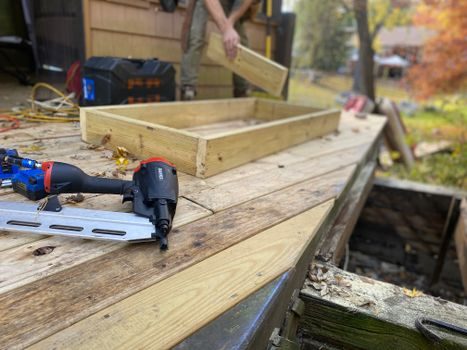
Tool-free depth-of-drive adjustment is now standard on finishing-class and brad-class tools: the DEWALT DWFP12233 includes a tool-free depth-of-drive adjuster to set the nail head flush or counter-sunk, and the Paslode F350-21 features a "Tool Free Adjustable Depth of Drive" for the framing duty cycle [S3][S4]. On a hardwood floor, dial the depth one click shallower; on LVL or soft pine framing, the same setting will over-drive and split the fibre.
For moulding and picture-frame duty on the IMCOINSA 0A6, the headless pin leaves no visible mark — the "automatic regulation system for the pin length" lets the tool self-set for varying stock thickness from 45-107 mm, so the operator does not have to re-dial between a 20 mm mirror trim and a 60 mm decorative cornice [S5]. This is a real productivity gate on a high-mix shop floor.
Sourcing Bands and Lead-Time in 2026
The 2026 wholesale band for entry-level pneumatic nailers on Made-in-China clusters between US$ 11.50 and US$ 36.00 per piece at MOQ 10-50 pieces from audited Gold Member suppliers in Liaoning, Zhejiang and Jiangsu. Hangzhou/Yiwu wholesale (Glory pneumatic tools, model SF5040) lists CN¥ 98.0 (roughly US$ 13-14) per piece at a 50-piece MOQ with 1.0 kg shipping weight, which is a useful floor reference for the small-format brad/pin class [S6].
European OEM-tier framing tools (FERVI F588/6, Paslode F350-21, DEWALT DCN660D1) are sold via DirectIndustry at indicative pricing, with most vendors responding to RFQ within 24 hours [S1][S2][S3]. Lead-time signal to watch: any 30% spike in Asian freight FAK rates will move the entry-level price band first; OEM-tier European tools lag by a quarter because their distribution is inventory-based, not flow-based.
For shop-floor design context, the Cast Iron Installation Guide covers bed-plate and pillar installation logic that mirrors how a framing-nailer station is bolted to a workbench, and the Steel Plate Installation piece covers grade/thickness sourcing for the receiver-tank skid. For a fixed pneumatic shop line that also drives automation, the linear guide and crossed-roller guide selection rules govern the precision slides that a nailer station shares with other pneumatic actuators.